

Intro: Newness Means Nothing
What if novelty is overrated? What if those who spend their careers trying to create the next great television show are wasting their time?
At the risk of being reductive, this sentiment is essentially half-true. At least, that’s what the data suggests.
Since the beginning of 2024, cable and broadcast TV series have accounted for more than 45% of all slots on Nielsen’s weekly Top 10 streaming chart, even though most of these shows no longer produce new episodes.
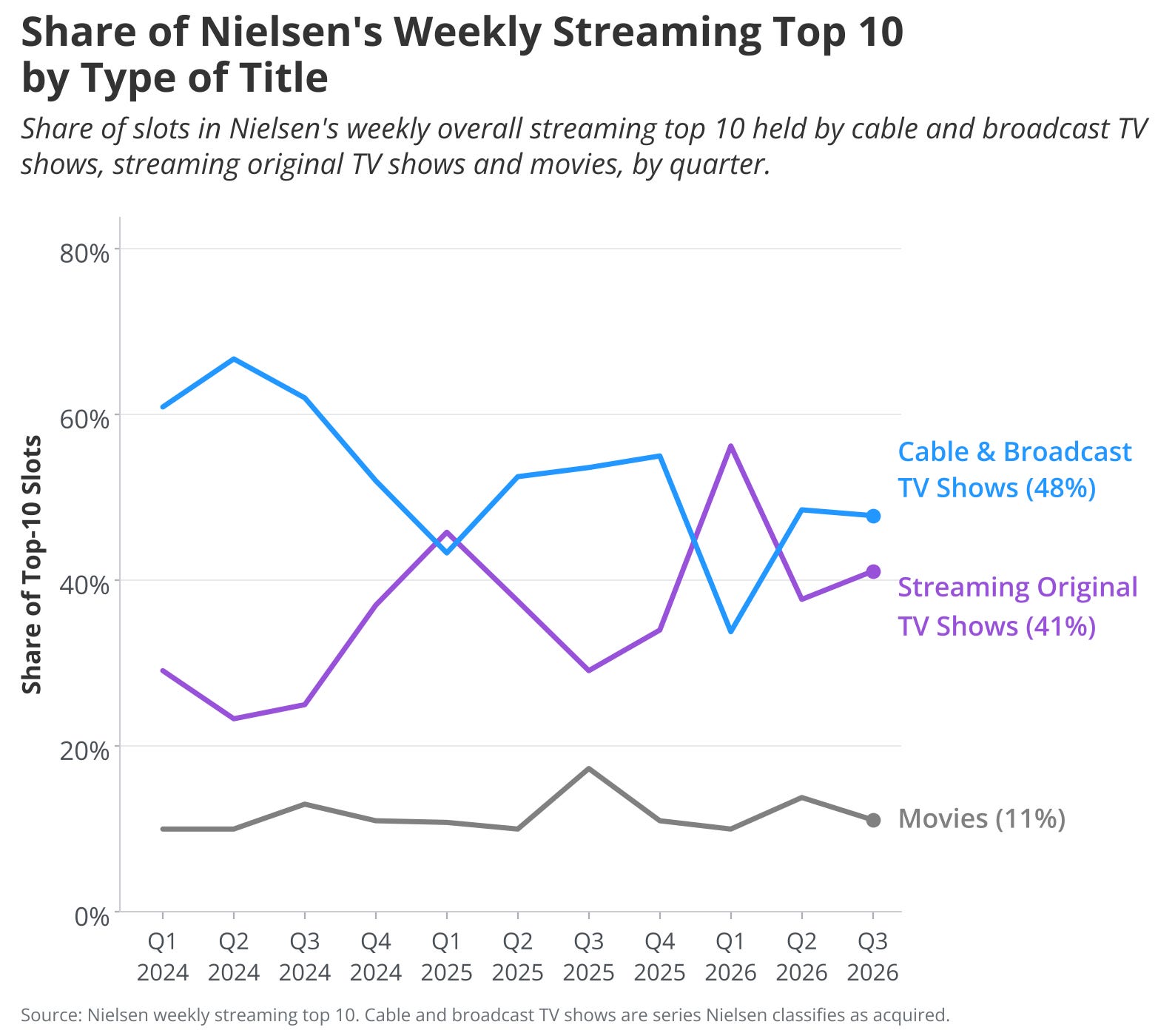
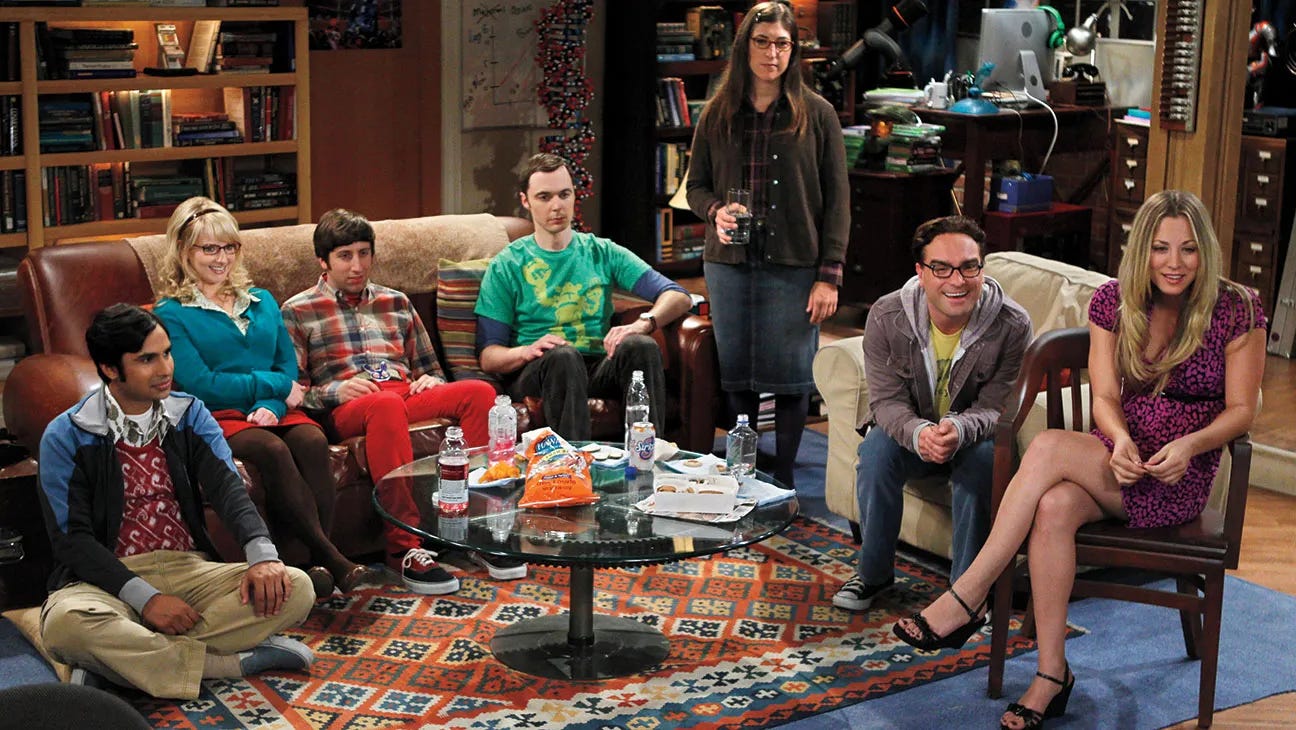
This cohort of nostalgic cable favorites includes The Office, Monk, Suits, and, our focus for today, The Big Bang Theory.
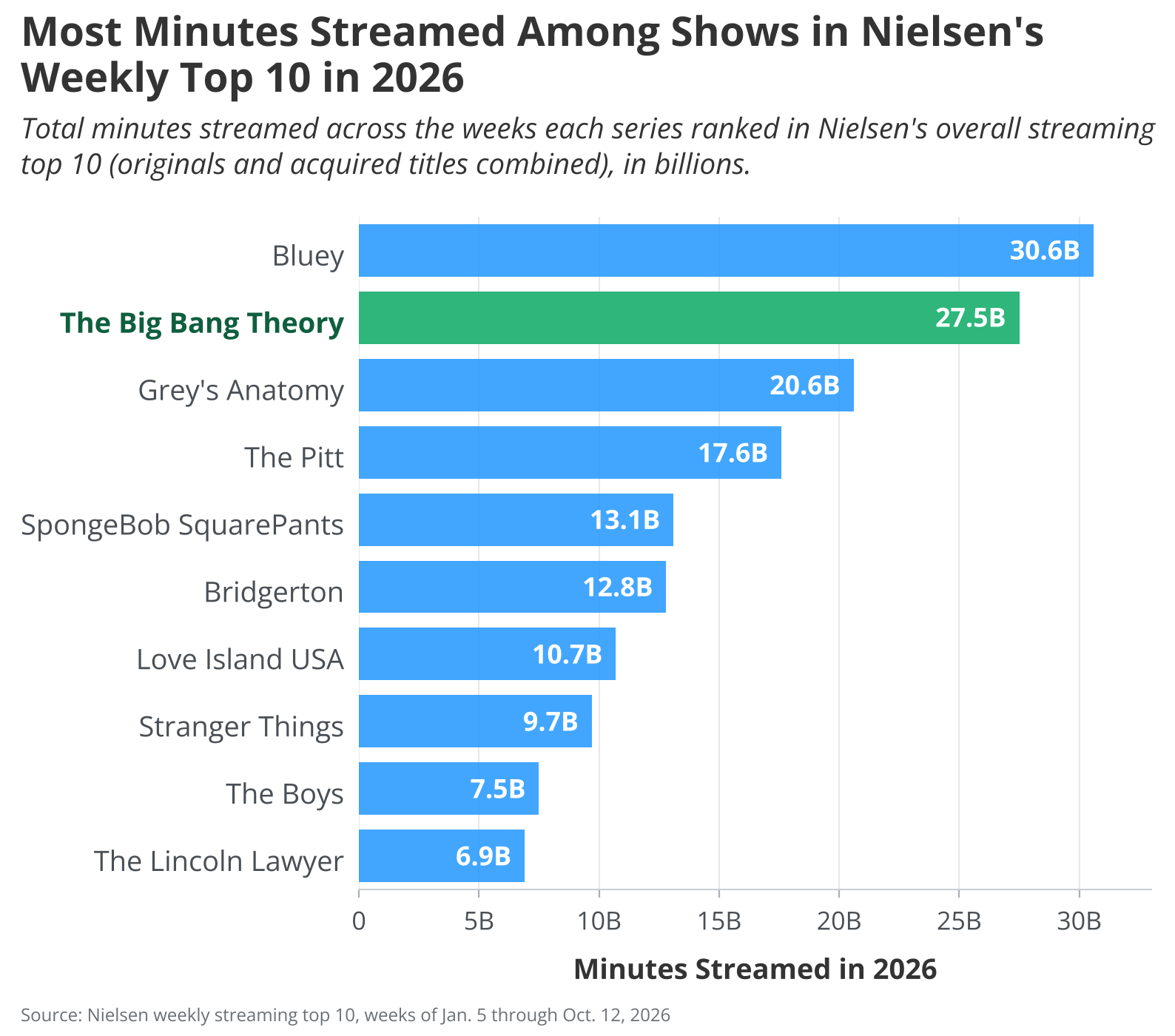
Despite airing its final episode in 2019, the beloved nerd-centric sitcom is currently the biggest show on streaming (among adults), surpassing the 2026 viewership of Stranger Things, The Pitt, The Bear, and just about every other buzzy program you can think of.
The ascendant popularity of a 20-year-old sitcom begs an inevitable question: Why this particular show? How have Sheldon and his pals remained relevant for so long, and is their recent success emblematic of broader viewership trends?
So today, we’ll explore The Big Bang Theory’s remarkable afterlife, the streaming revival of sitcoms, and the show’s very specific place in television history.
How The Big Bang Theory Became Streaming’s Biggest Show (Seven Years After Its Finale)
In 2026, the biggest show on streaming is a 10-minute children’s cartoon about a dog named Bluey and his extremely responsible dog parents—a phenomenon I covered back in April. Kids love this show, often watching dozens of episodes in one sitting, with this rabid engagement accounting for 29% of all Disney+ viewership.
In the world of adults, 2026’s biggest show is The Big Bang Theory, which is readily available on HBO Max. The sitcom’s 12-season catalog has accumulated more year-to-date viewing time than blockbuster programs like The Pitt, Bridgerton, Love Island, and Stranger Things—by a significant margin.
The Big Bang Theory’s streaming popularity is nothing new, as the sitcom has been a mainstay of Nielsen’s Top 10 rankings for the better part of three years. Yet, over the past nine months, the show’s viewership has surged to an all-time high, an impressive feat for a sitcom that aired its final episode more than seven years ago.
At first glance, this resurgence appears to be driven by the show’s increasingly elaborate fictional universe, which has spawned three spin-offs to date, most recently Stuart Fails to Save the Universe, which may explain the recent uptick in viewership.
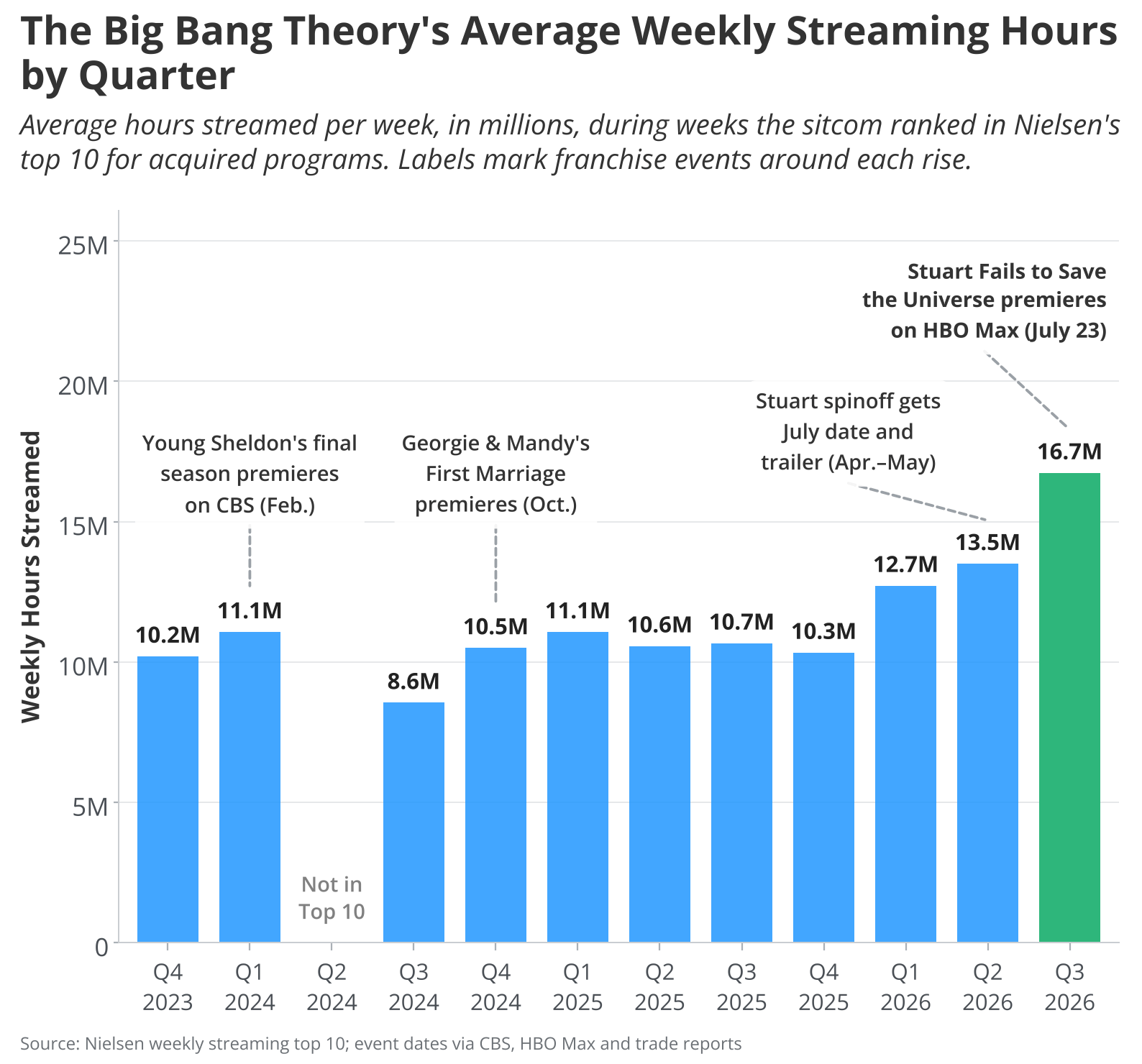
I haven’t watched any of these spin-offs, but I have been subjected to countless Young Sheldon advertisements while watching football, so there’s that.
At this point, The Big Bang Theory is arguably television’s most valuable franchise, surpassing the likes of Star Wars, Love Island, and Love Is Blind.
The enduring popularity of Sheldon and his acquaintances is particularly notable given the sitcom format’s waning relevance.
Once television’s most popular programming format, sitcoms are now bordering on extinction, having fallen from 13% of new releases to just 1.7%.
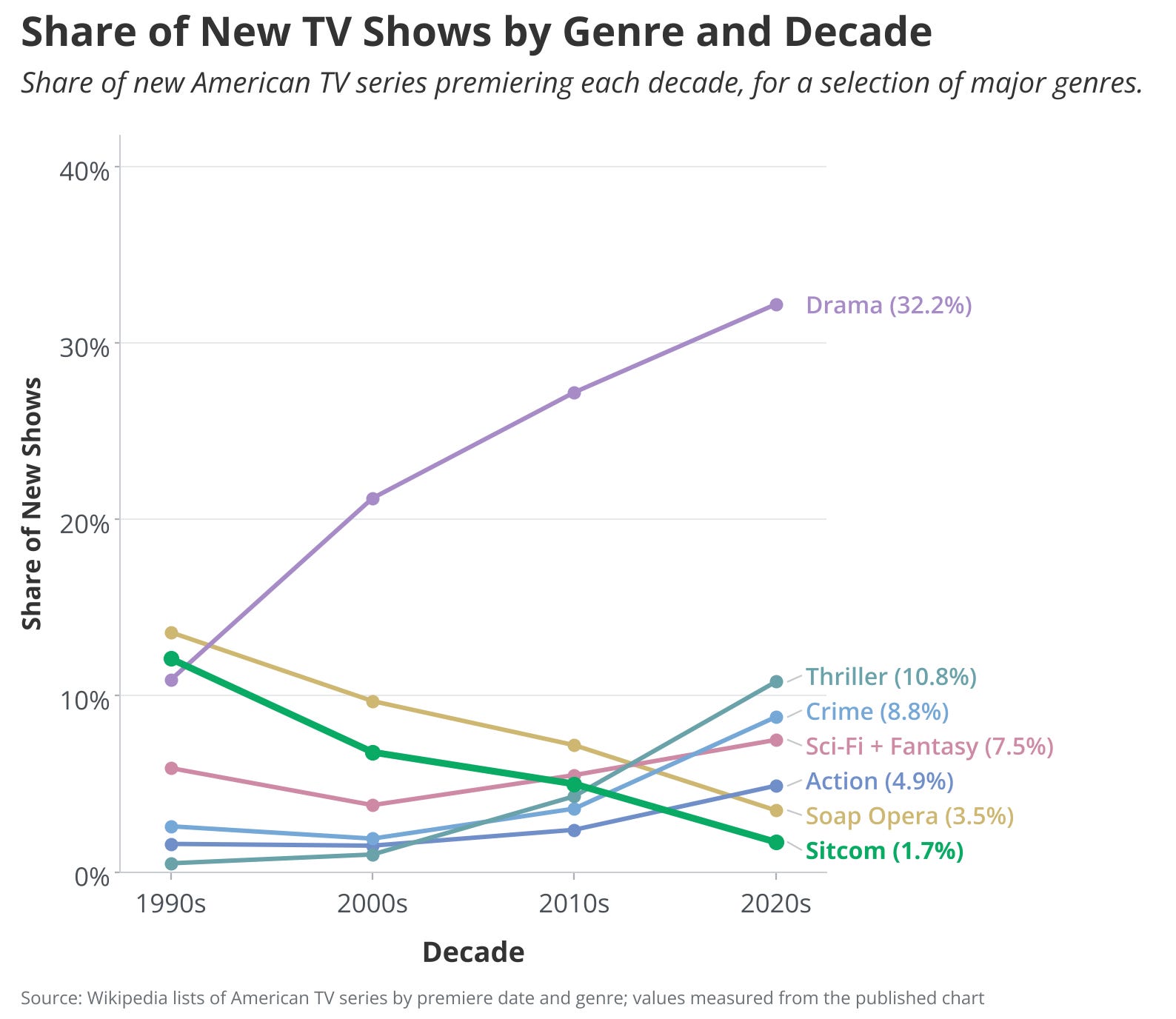
Only a nominal share of new shows are sitcoms, but that doesn’t mean the format has lost its audience. In fact, sitcoms occupy a bizarre middle ground in the TV landscape—out of fashion when it comes to new programming, yet consumed voraciously on streaming services. Look at the most-watched shows of the past three years, and you’ll find The Office, Friends, and Family Guy alongside The Big Bang Theory. Audiences can’t get enough of a format that Hollywood has largely left behind.
A 2023 YouGov survey found that comedy is the most popular genre for both watching and rewatching—a rather confusing finding, given that fewer and fewer TV shows are comedies.
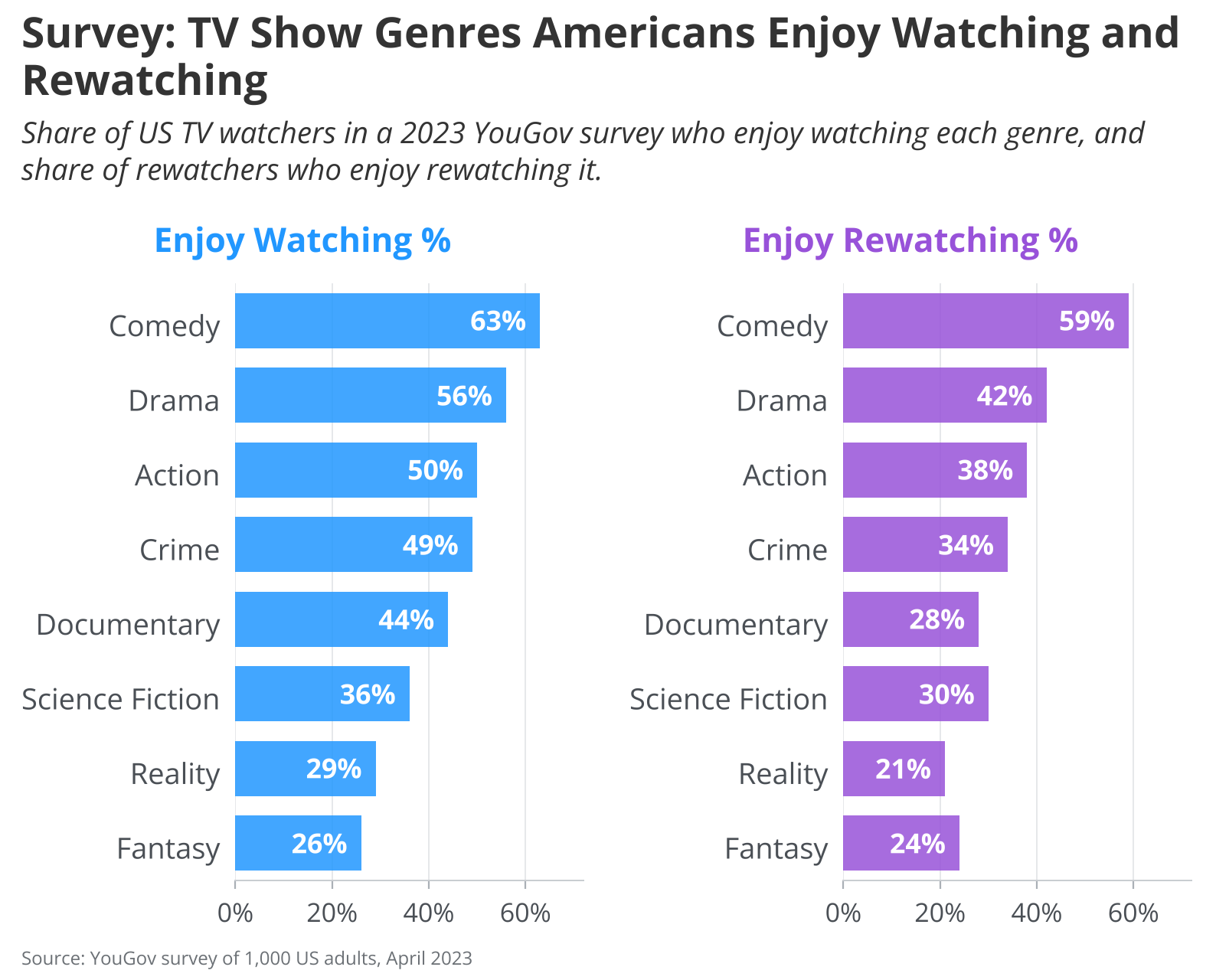
My biggest takeaway from this graphic is comedy’s sheer rewatchability, which outpaces every other genre by a sizable margin and helps explain why decades-old shows like The Office and The Big Bang Theory have enjoyed such a thriving afterlife on streaming.
These programs are prime examples of a streaming-era phenomenon I’ll call “comfort viewing,” in which audiences gravitate toward familiar, lighthearted television to manage stress and regulate emotions. After a long day of work and/or being on the internet, sometimes you just want to hang out with Michael Scott and Sheldon Cooper.
Indeed, YouGov survey data suggests that “comedy” and “comfort” are the two primary reasons viewers return to shows they’ve already watched.
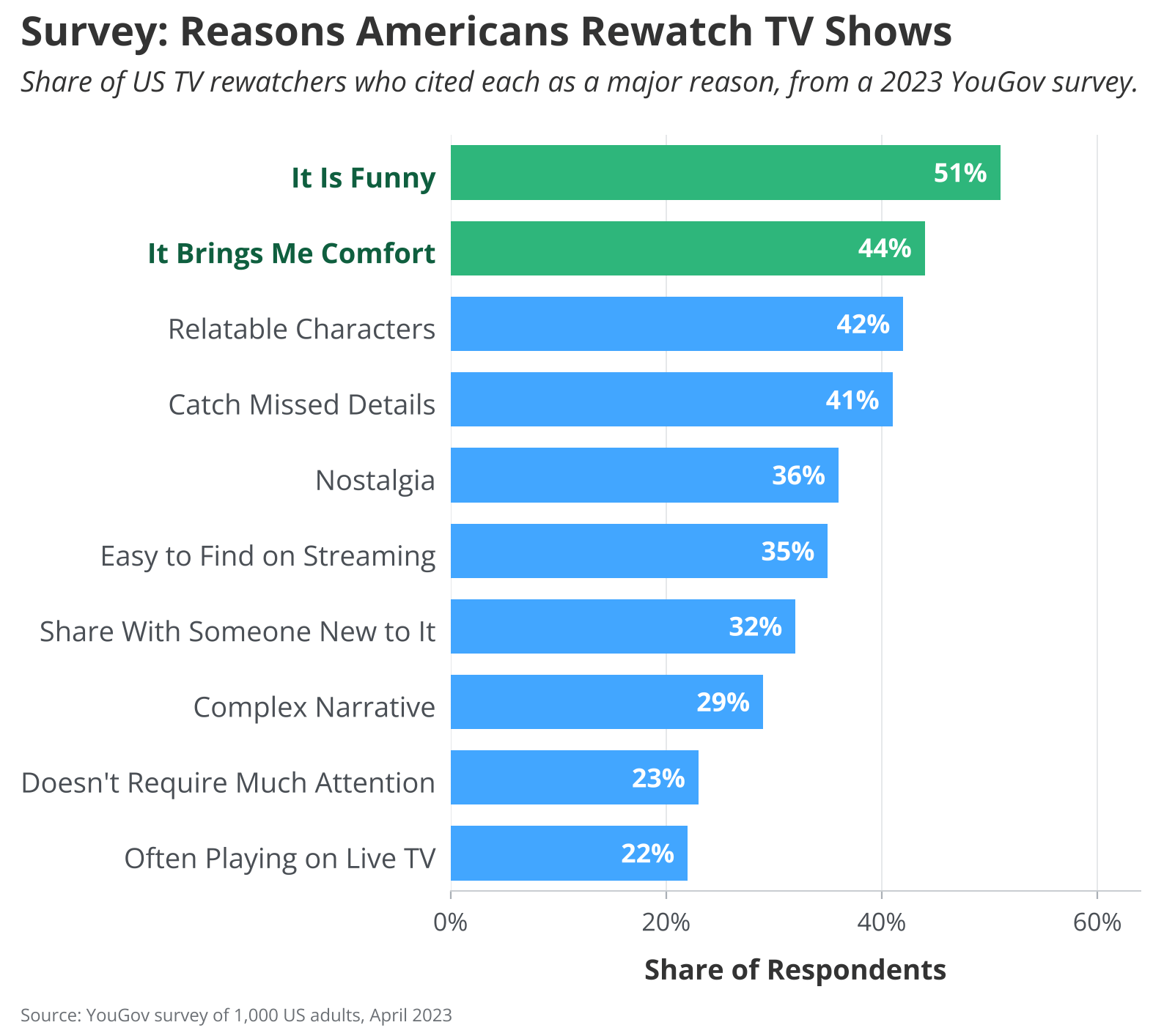
The sitcom is perhaps the platonic manifestation of these impulses. The format is nostalgic. The situations are always low-stakes, and, for the most part, they’re funny.
Which brings us back to The Big Bang Theory and Young Sheldon. The traditional multi-camera sitcom has faded alongside linear television. As viewers abandon traditional TV, series finales are attracting smaller and smaller audiences, to the point where some struggle to surpass 2 million viewers.
Among this dwindling crop of sitcoms, The Big Bang Theory was perhaps the last gasp of a television format that audiences once gathered to watch live.
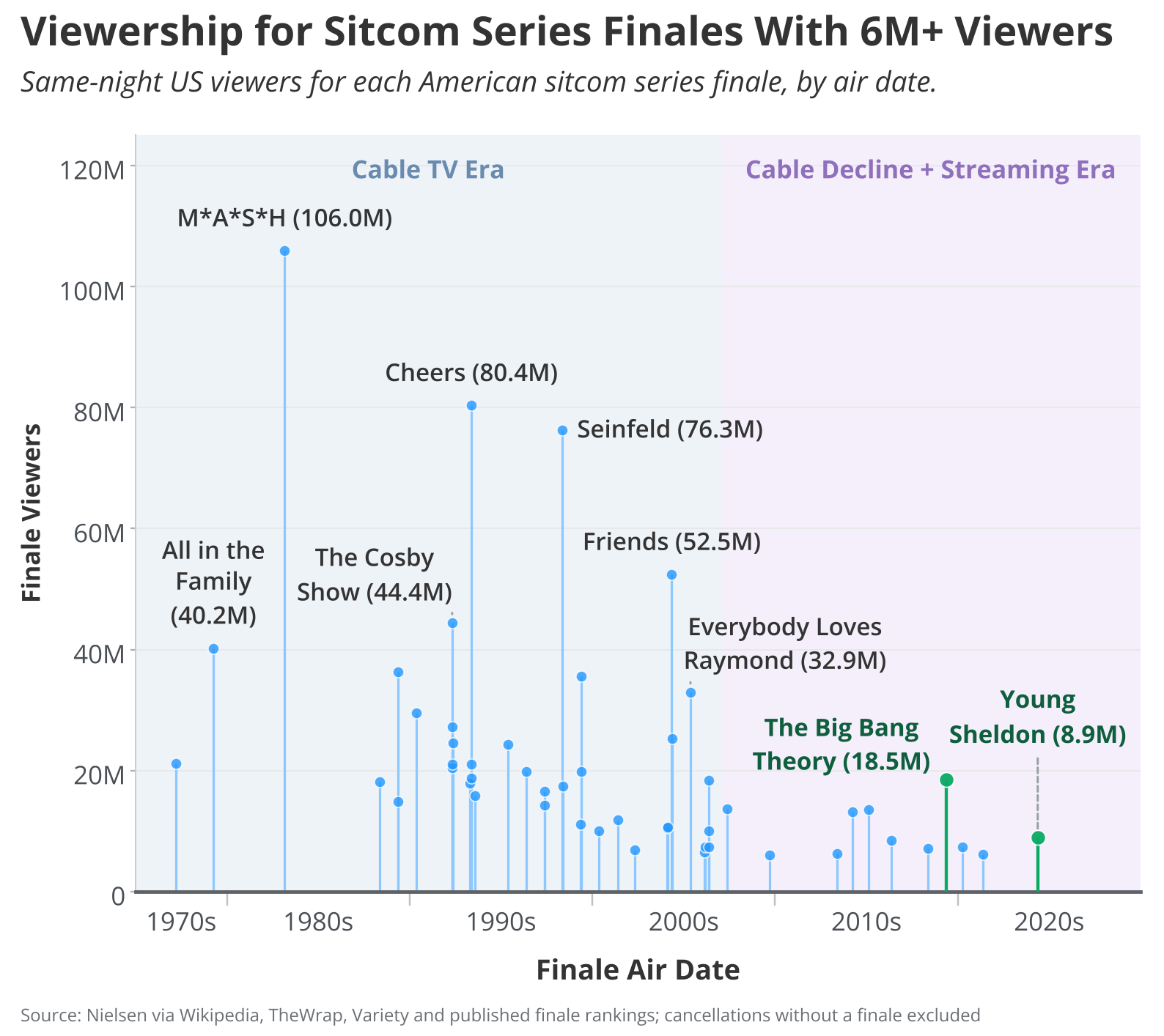
What I’m about to write will undoubtedly cause some to wince, given how snobbish people can be about The Big Bang Theory, but the show stands as perhaps the last great sitcom: the closing chapter of a format that once dominated television.
Situational comedy remains in high demand, yet there is a remarkable shortage of new shows being produced to satisfy said demand. This makes The Big Bang Theory—one of the last major hits of its kind—an obvious choice for streaming audiences.
I’m not sure people actively want new sitcoms. Yet, paradoxically, they seem to really want old ones.
Enjoying the article thus far and want more data-centric pop culture content?
Final Thoughts: Cultural Liminal Spaces
Liminal spaces have gone mainstream in 2026. For those unfamiliar with the concept, a liminal space is a place that feels suspended between eras or realities—familiar yet strangely alien. This could take the form of an abandoned building that retains the aesthetic of a bygone decade (like a mall), or a digital environment with a distinctly twee aesthetic (like a Y2K-era web page). The concept is rather malleable. Perhaps the most famous example is Backrooms: an imagined labyrinth of nondescript, empty rooms that offer an unsettling approximation of our reality.
Given this concept’s flexibility, I would like to add my own spin on the genre, which I’ll call a cultural liminal space. A cultural liminal space offers an opportunity to engage with art far removed from one’s personal taste or day-to-day preferences. This could be watching a movie with your family over Christmas, consuming content at 2 am with your friends after a night out, or, my personal favorite, watching linear television in a hotel room.
In the case of hotel rooms, it’s hard to set up a streaming service, so my wife and I default to what’s on cable TV. This usually leaves us choosing among a handful of shows: Diners, Drive-Ins and Dives; a rerun of Friends; or, of course, The Big Bang Theory. I have never actively sought out this show; it simply gets served to me when I deign to watch cable TV.
What I’ve just presented is a lot of mental gymnastics to excuse myself from culpability when I say, “I like The Big Bang Theory.” There is a 0% chance that I would actively seek out this program on streaming, but when I am in a hotel room after a long day of travel, this is pretty much the only content I want to watch. Part of the reason I’ve made this so complicated is that I’m a snob, so I created a brand-new concept to excuse my viewership of this show—which is a super snobby thing to do.
Yet there are legions of non-snobs around the world who love watching The Big Bang Theory without having to enter their own personal Backrooms. I’ll admit this sitcom is silly, sophomoric, and simple-minded at times. But it’s also funny, and it’s comforting. It’s the type of show I’ve essentially been taught not to like, let alone expect new versions of. And yet, when it’s made available—whether in a hotel room or among HBO Max’s vast catalog—people watch it in droves.
This confusing set of incentives makes me think that the future of television will increasingly be mired in its past. People may claim to love buzzy prestige premieres, but deep down, what they really want is to rewatch decades-old sitcoms and hang out with Sheldon Cooper.
Enjoyed the analysis? Support Stat Significant and unlock the data behind the insights.
Become a paying subscriber to get bonus graphics, interactive dashboards, downloadable datasets, and to support independent journalism.
Paying subscribers get:
Bonus Data Stories: Full access to the Monday Roundup, a weekly bonus edition with extra culture data stories, curated datasets, and recommended reads.
The Public Dataset Directory (Updated Weekly): A curated directory of public datasets from around the web.
Interactive Data Hubs: Interactive dashboards across Streaming TV, Movies, Music, Search Trends, Wikipedia, and more.
*Note: For best results, open this link in a web browser while logged in to your Substack account.
Want to promote your data tool or media publication to Stat Significant’s 26,200 readers? Email daniel@statsignificant.com
Need help with a data problem? Book a free data consultation
Connect with me on LinkedIn if you want to chat about a data project.
Like movies? Follow me on Letterboxd
Just for what it's worth, Bluey is a girl.
The Big Bang Theory was a great show and I enjoyed watching it because especially for nerds, it showed that being smart and being unabashed about passions and “geek” things was cool and yes, you would still attract girls. It was not just funny, but also empowering.
Another reason why people are streaming older sitcoms is common sense that the big studios have forgotten for many years. They have forgotten that many people regardless of background, sometimes just want to be entertained after a long day. We don’t always need to be lectured to or be given morality lessons by Hollywood; we just want to relax, tune out from the world, and laugh.
Classic sitcoms like The Big Bang Theory, Cheers, Frasier, Seinfeld, Married With Children, and others do that very well; putting them on streaming platforms is a smart move, but I still recommend buying them on DVD just in case they stop streaming or they push disclaimers about “offensive content.”
Own the content if you like it that much.