


Intro: Adam Sandler, Small-Screen Star
In 1999, Adam Sandler was the biggest movie star in America, if such a title exists. His irreverent humor and goofy voices propelled low-budget comedies like The Waterboy and Big Daddy to $375M and $465M in global box office (adjusted for inflation), despite Roger Ebert’s thorough disdain for both films—and the disapproval of nearly every other major critic.
From there, Adam Sandler was box office gold, with a run of hits that includes 50 First Dates, The Longest Yard, Click, I Now Pronounce You Chuck and Larry, Bedtime Stories, Grown Ups, and Just Go with It. Each movie cleared $100M, and each movie was savaged by critics.
And then his box office dominance began to falter. Following the back-to-back disappointments of That’s My Boy and Blended, Sandler gradually retreated from theatrical exhibition, eventually signing a lucrative deal with Netflix through his production company, Happy Madison.
Since then, Adam Sandler has mainly been a streaming movie star, barring a handful of exceptions—most notably all-time ulcer-inducer Uncut Gems. Over the past 5 years, Sandler has starred in a handful of films that feel borderline nonexistent despite being watched by tens of millions of people: Spaceman, Hubie Halloween, and You Are So Not Invited to My Bat Mitzvah. All real, all number one on Netflix, and all subsequently memory-holed.
Sandler may be the foremost example of a streaming movie star: an A-list actor whose career has become increasingly oriented around the small screen. And while streaming films have existed for less than fifteen years, they have already produced a recognizable cohort of performers, led by a hodgepodge of one-time box-office draws and ascendant television actors.
So today, we’ll explore the rise of the streaming movie star, identify the performers who have embraced this newfangled format, and examine the forces that drove these actors away from theaters in the first place.
The Rise of the Streaming Movie Star
When you consider the streaming movie’s roots—such as the afterschool television special, the made-for-TV movie, or the Hallmark Christmas film—what Netflix and its competitors have built is actually quite remarkable. Hallmark, a greeting-card-company-turned-cable-network, cultivated a stable of D-list celebrities whose theatrical careers had long faded (or never really existed), while streamers have replicated this same model but on a grander scale, with A-list actors whose box-office appeal has only recently begun to wane.
As such, the actors with the most prolific streaming careers are box-office stalwarts from the 1990s and 2000s who are only a few years removed from their commercial peak, including Mark Wahlberg, Adam Sandler, Ben Affleck, and Eddie Murphy.
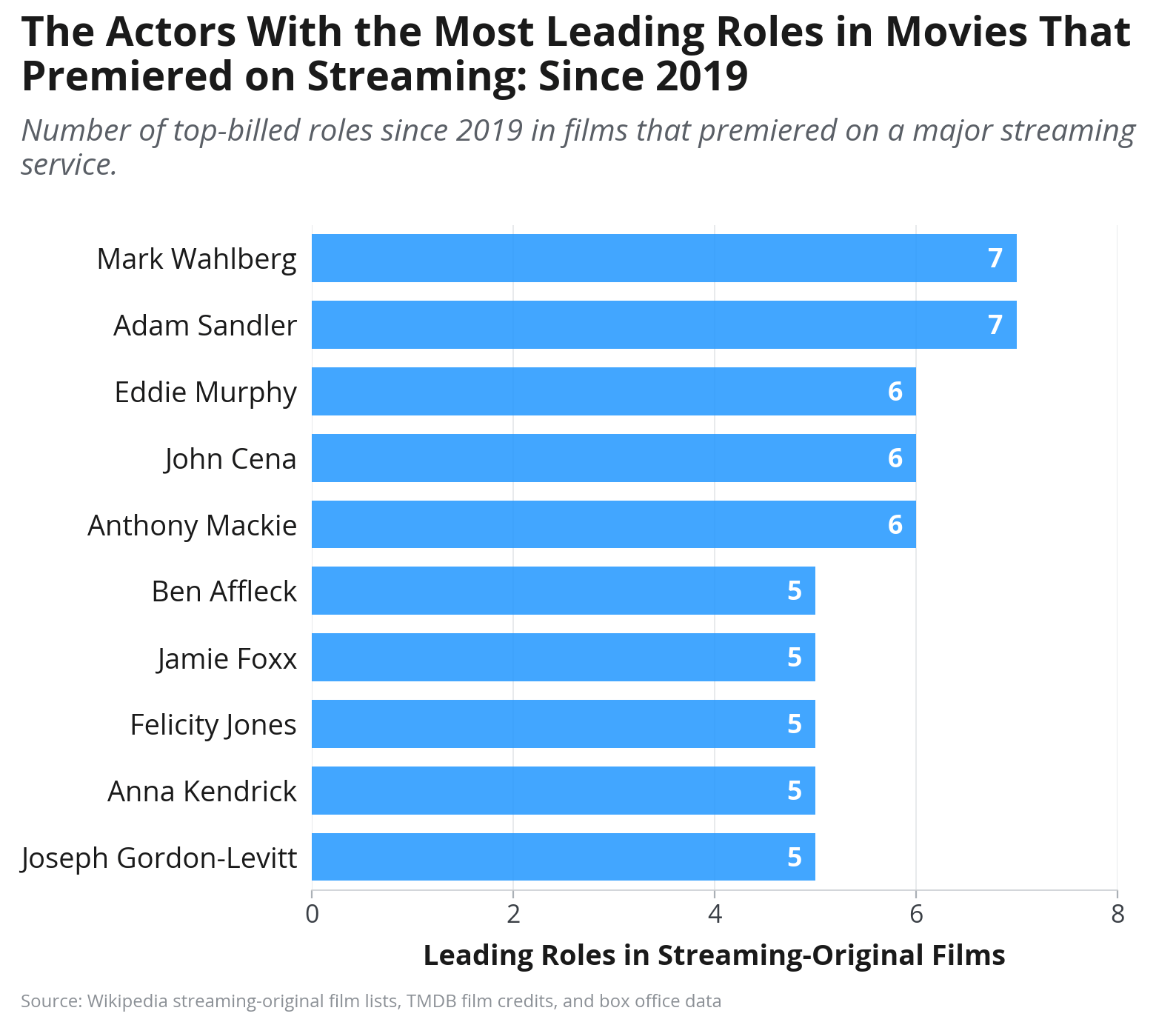
At the same time, making a lot of movies for Prime Video or Netflix does not necessarily make someone a “streaming movie star.” An actor like Adam Sandler or John Cena may simply be prolific, with some of their projects landing on streaming platforms.
So, according to this fledgling classification (that we are defining in real time), what puts the “streaming” in streaming movie star?
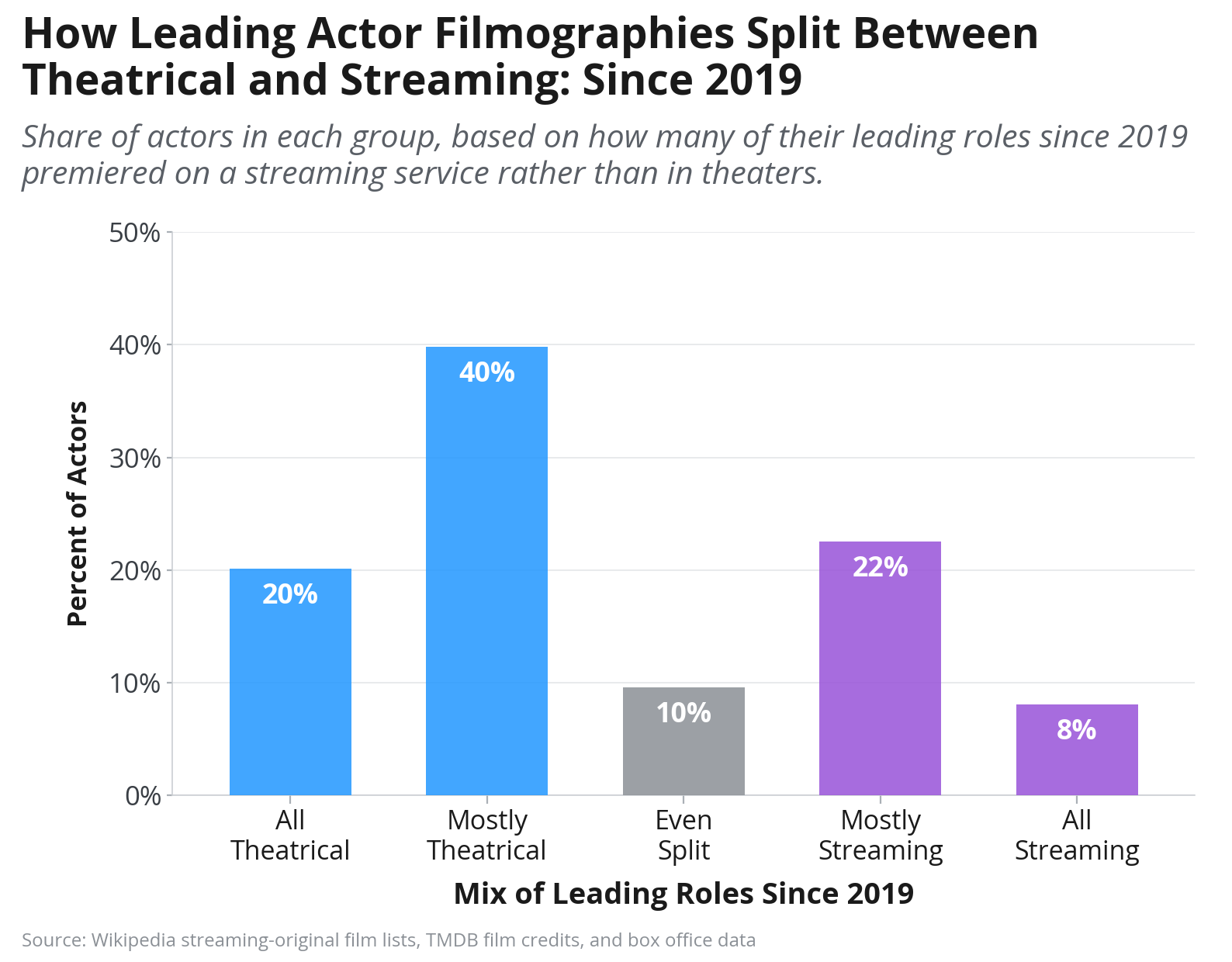
My argument is that this distinction comes down to a balance between theatrical and straight-to-streaming releases. Since 2019, only 8% of A-list actors with multiple leading roles have appeared exclusively in streaming movies, while another 22% have worked across both formats but tilt more heavily toward streaming. Taken together, both groups could reasonably be classified as streaming-movie performers.
To see this distribution in action, we can construct a Venn diagram separating streaming-only performers from theatrical mainstays based on their post-2018 movie output. On the theatrical side, we find Margot Robbie alongside a handful of action stars like Gerard Butler and Keanu Reeves. On the streaming end of the graphic, we get an odd mixture of one-time box-office draws, along with somebody named Sofia Carson (who we’ll return to in a second).
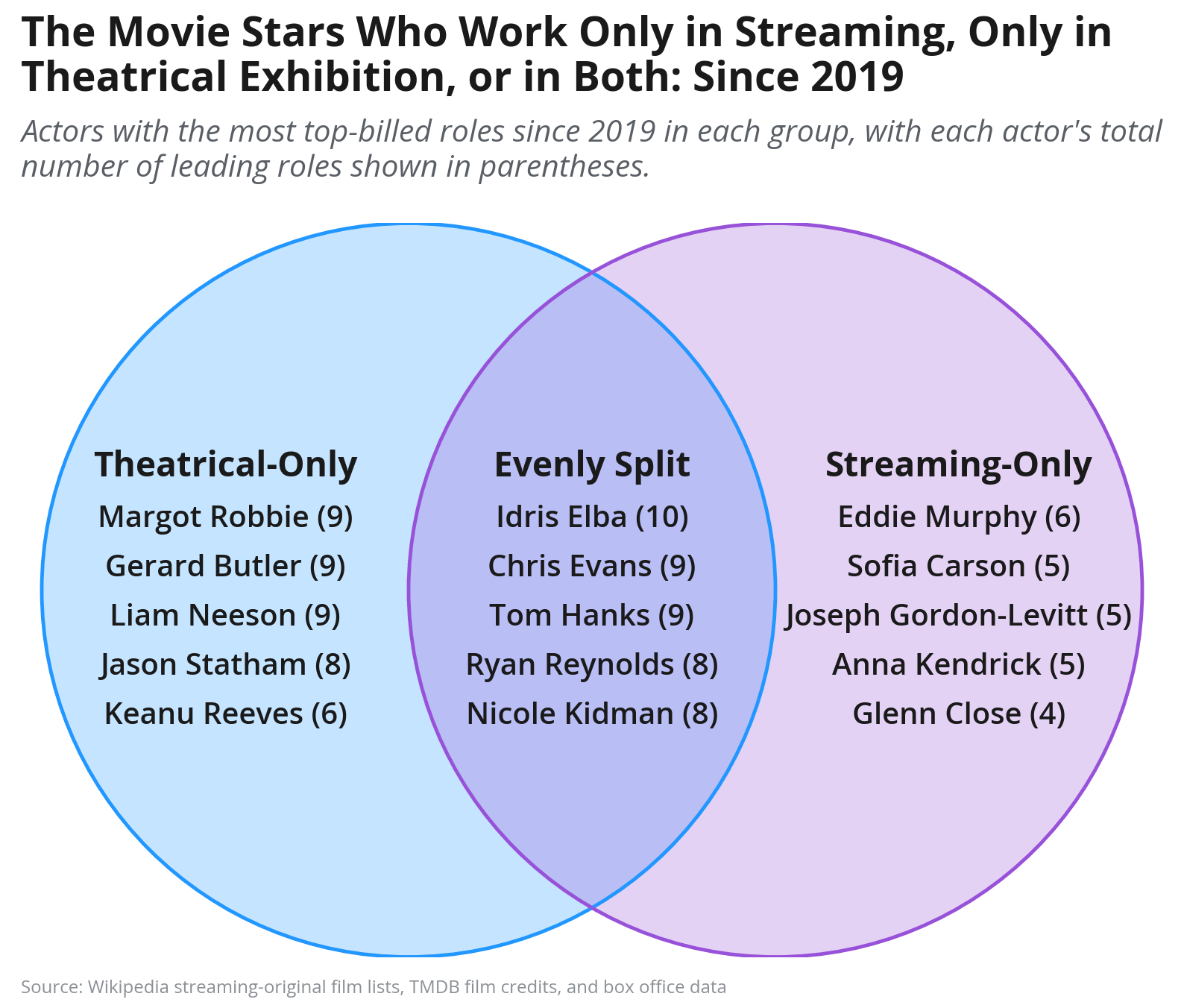
For the most part, the actors who lean toward streaming are well-known performers with careers that predate cord-cutting, with the exception of Sofia Carson, who belongs to an emergent class of actors made famous by Netflix who exclusively star in films that go straight to Netflix. Other performers who fit this amorphous category include Millie Bobby Brown (aka Eleven from Stranger Things), Joey King, and Zoey Deutch.
These are performers whose fame was either cultivated almost entirely through streaming or whose careers veered into the streaming ecosystem at an early stage. However, cases like Millie Bobby Brown and Sofia Carson are the exception, since the prototypical Netflix movie star is usually much further along in their career, having already established their box-office bona fides in the 1980s, 1990s, or 2000s.
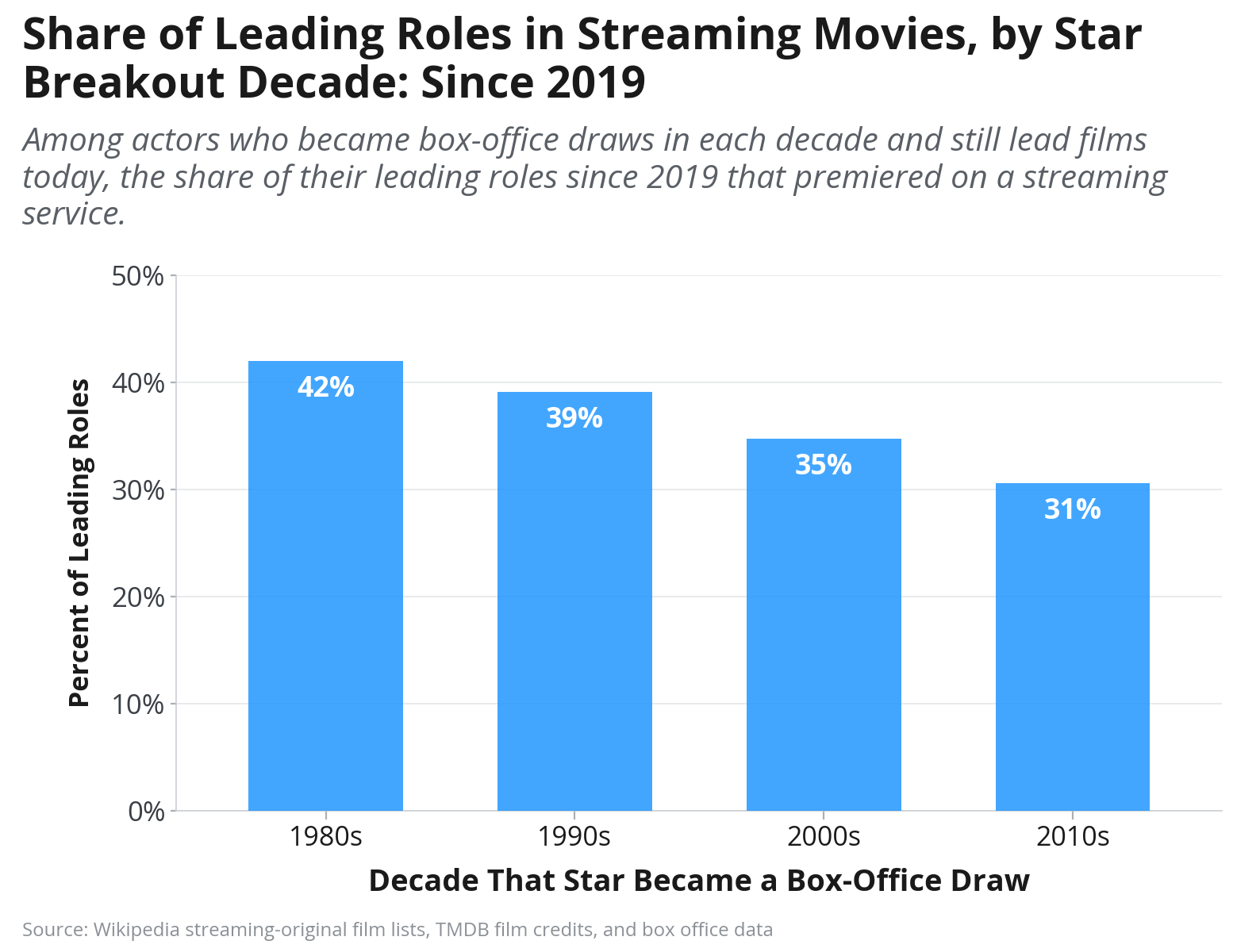
This trend rests on a straightforward contract between platform and actor: a streamer leverages a performer’s considerable (yet fading) commercial capital; in return, the actor gets money, visibility, and a steady supply of work. It’s a fair trade. And yet the discourse surrounding straight-to-streaming movies often treats the participation of well-known actors as a kind of moral failure. This logic usually goes something like this: If these actors are so rich and famous, why can’t they simply choose better projects? Why settle for a format that is slowly eroding the very institution that made them famous in the first place—the theatrically released movie?
That may be true for some actors, particularly those sitting in the middle of our Venn diagram. But many performers have far less agency than we assume. The deeper I got into this analysis, the more I came to see the Netflix-performer relationship in reverse: actors don’t choose streaming so much as streaming chooses them.
Consider the share of streaming-only movies split out by genre: leading parts in comedy and romance skew toward Netflix, while action and horror movies are more likely to be released theatrically.
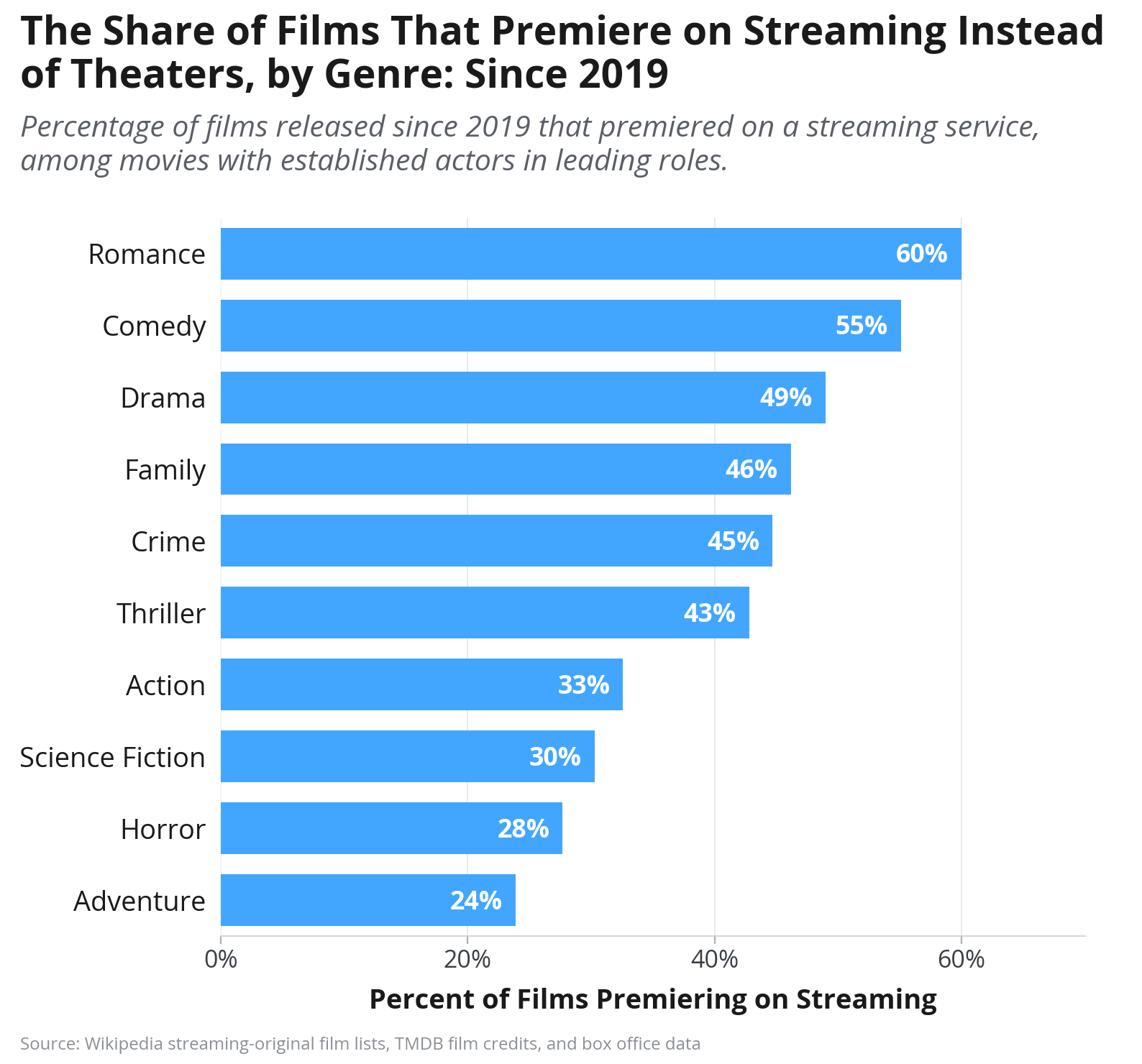
This helps explain why action stars like Keanu Reeves and Jason Statham remain firmly on the theatrical-only side of our Venn diagram, while comedic actors like Eddie Murphy and Adam Sandler have been absorbed into the broader Netflix ecosystem.
If you’re a comedy star from the 1980s or 1990s—or an emerging actor frequently cast in rom-coms, like Sofia Carson or Zoey Deutch—then streaming movies constitute the lion’s share of roles you’re offered.
Let’s say you fall into one of these buckets and you’re headed for a career of small-screen stardom on Netflix, Prime Video, or Hulu. Is that really such a bad thing? Does choosing a streaming-only movie over a glitzy theatrical release consign you to cultural irrelevance?
There is indeed a notoriety tax associated with a streaming release (versus a premiere in theaters), but it’s smaller than you might expect. When we examine how long a lead actor’s Wikipedia page trends amongst the site’s daily top 100 entries following a movie release, we find a meaningful—but hardly enormous—gap between theatrical and streaming films.
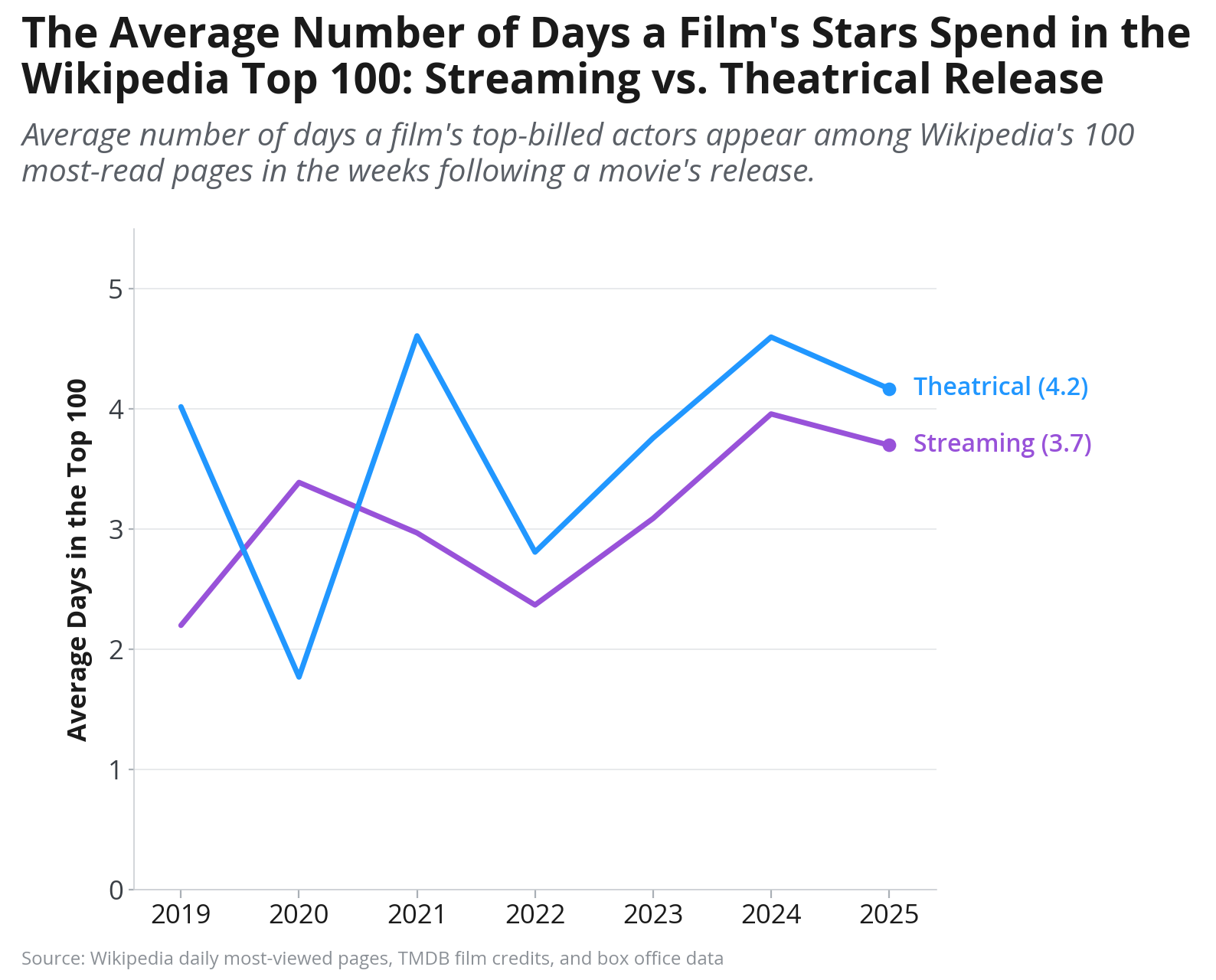
With the exception of 2020, when nearly every movie was a streaming movie, straight-to-streaming releases see a fairly consistent 12% drop in search interest—a penalty that feels surprisingly modest given the format’s subpar cultural reputation.
And if the goal is simply to remain visible, keep making movies, and continue collecting paychecks, then starring in a Prime Video production doesn’t seem like such a drastic compromise.
Enjoying the article thus far and want more data-centric pop culture content?
Final Thoughts: The Evolution of the B-Movie
While Netflix, Prime Video, and Tubi TV are relatively recent additions to the entertainment landscape, there is nothing particularly new about the straight-to-streaming movies that inhabit these platforms. This format is simply the latest evolution of a film category that has existed for decades.
In the beginning, there was the B-movie: schlocky genre fare produced for cheap that attempted to turn a nominal budget into a modest profit. These projects coveted performers who were slightly past their prime—recognizable names that came at a discount. From there, the B-movie has taken several forms: the made-for-TV film, the Hallmark original, the direct-to-video or DVD release, and eventually the low-budget titles that populated Redbox kiosks and cable-on-demand menus. For much of the 2010s, this was simply where Nicolas Cage dwelled—a strange liminal space between movie stardom and cultural obscurity.
Then along came Netflix, and for a while it seemed like the streamer would thoroughly blur the line between made-for-TV movies and theatrical releases. Films like Roma, Marriage Story, and The Irishman showed the promise of the streaming medium, particularly the ability to support ambitious, idiosyncratic projects that might struggle in a franchise-dependent studio system. But over time, the straight-to-streaming movie began to resemble its forebears—the Redbox fare where you’d see Jean-Claude Van Damme on the cover and think “oh, that’s what he’s been up to!”
The further I got into my research—and the more I came to understand streaming-movie stardom as a product of circumstance—the more one question nagged at me: Given the historical precedent for this kind of entertainment, why do straight-to-streaming movies have such a poor cultural reputation? If a popular comedic actor from the 1990s has few viable options outside of Netflix, why do we hold that against them?
My best guess is that animus is a form of misdirected cultural scapegoating. Up until the late 2010s, B-movies posed little threat to theatrical exhibition. Nobody decided to skip a night at the movies because of a direct-to-DVD Nicolas Cage thriller. The same cannot be said for a Netflix Original. These films are lower quality and erode the appeal of theatrical exhibition, and so we vent our frustration at the most visible faces of this operation—actors like Eddie Murphy and Adam Sandler who keep starring in these things.
We blame these performers for helping streamers chip away at movie theaters. Yet the causal nature of this relationship runs in the opposite direction. The reality is something closer to a devil’s bargain, one where streaming robs an actor of the ability to make movies for theaters and then offers itself as one of the few plausible alternatives. The end result is a slate of films that only seem to exist in theory (and on the Nielsen charts), where listing them reads like a game of two truths and a lie: Candy Cane Lane, The Do-Over, The Family Plan, The Pickup, Me Time, The Union, and The Family Plan 2. All starring a beloved Hollywood actor, all real—and yet also somehow not.
Enjoyed the analysis? Support Stat Significant and unlock the data behind the insights.
Become a paying subscriber to get bonus graphics, interactive dashboards, downloadable datasets, and to support independent journalism.
Paying subscribers get:
Bonus Data Stories: Full access to the Monday Roundup, a weekly bonus edition with extra culture data stories, curated datasets, and recommended reads.
The Public Dataset Directory (Updated Weekly): A curated directory of public datasets from around the web.
Interactive Data Hubs: Interactive dashboards across Streaming TV, Movies, Music, Search Trends, Wikipedia, and more.
*Note: For best results, open this link in a web browser while logged in to your Substack account.
Want to promote your data tool or media publication to Stat Significant’s 26,200 readers? Email daniel@statsignificant.com
Need help with a data problem? Book a free data consultation
Connect with me on LinkedIn if you want to chat about a data project.
Like movies? Follow me on Letterboxd
Great work as always!
Great analysis here 👍