

In Case You Missed It:
I recently launched the Monday Roundup, a twice-monthly bonus edition featuring quick-hit culture data stories, curated datasets, and recommended reads. You can read the latest edition here, with full access available to paying subscribers.
Intro: A “Booming” Campaign for the Ages
In the 1920s, American pop music ran through Tin Pan Alley, a Manhattan district where songwriters, performers, and promoters gathered to turn simple melodies into mass-market commodities. It was one of the earliest examples of entertainment-industry agglomeration, a precursor to music factories like the Brill Building and Motown.
Tin Pan Alley eventually reached its cultural apex with the runaway success of 1923’s “Yes! We Have No Bananas.” For the uninitiated, the song is exactly as banana-centric as advertised, and is so overwhelmingly repetitive that it sparked brawls between those playing it endlessly and its unwilling listeners.
Yet this virality was hardly organic. Tin Pan Alley manufactured popularity by funneling sheet music to “song pluggers,” who performed new tunes in stores, theaters, and restaurants, and by staging “booming” campaigns, in which musicians were planted in public crowds to play a song again and again so it might seem like a preexisting craze.
I came across the exploits of Tin Pan Alley while researching a recent article and was surprised to learn that the music industry has been engineering catchiness long before drum machines, auto-tune, Taylor Swift, or TikTok algorithms. In many ways, these early promoters were the first practitioners of a hybrid science: part sonic optimization, part behavioral manipulation, and ever more refined with each passing generation.
So today, we’ll dig into the scientific underpinnings of song catchiness, examining the compositional tricks that make tracks memorable and the environmental conditions that make a tune inescapable.
Today’s newsletter is sponsored by Quantum of Sollazzo
Want a Weekly Guide to All Things Data?

Quantum of Sollazzo is a weekly data newsletter followed by 4,000+ data professionals with the best links to data journalism, data visualization, tools, tutorials, data thinking, and AI. Every Tuesday in your inbox.
👉 Subscribe to Quantum of Sollazzo
What Makes a Song Catchy: The Musical Hallmarks
There is no single formula for catchiness, so much as a collection of musical tendencies that, when combined with the right artist and cultural moment, can make something indelible.
Two recent studies have tried to quantify these sonic hallmarks, mining auditory data from thousands of hit and non-hit songs to identify the musical features most closely associated with memorability.
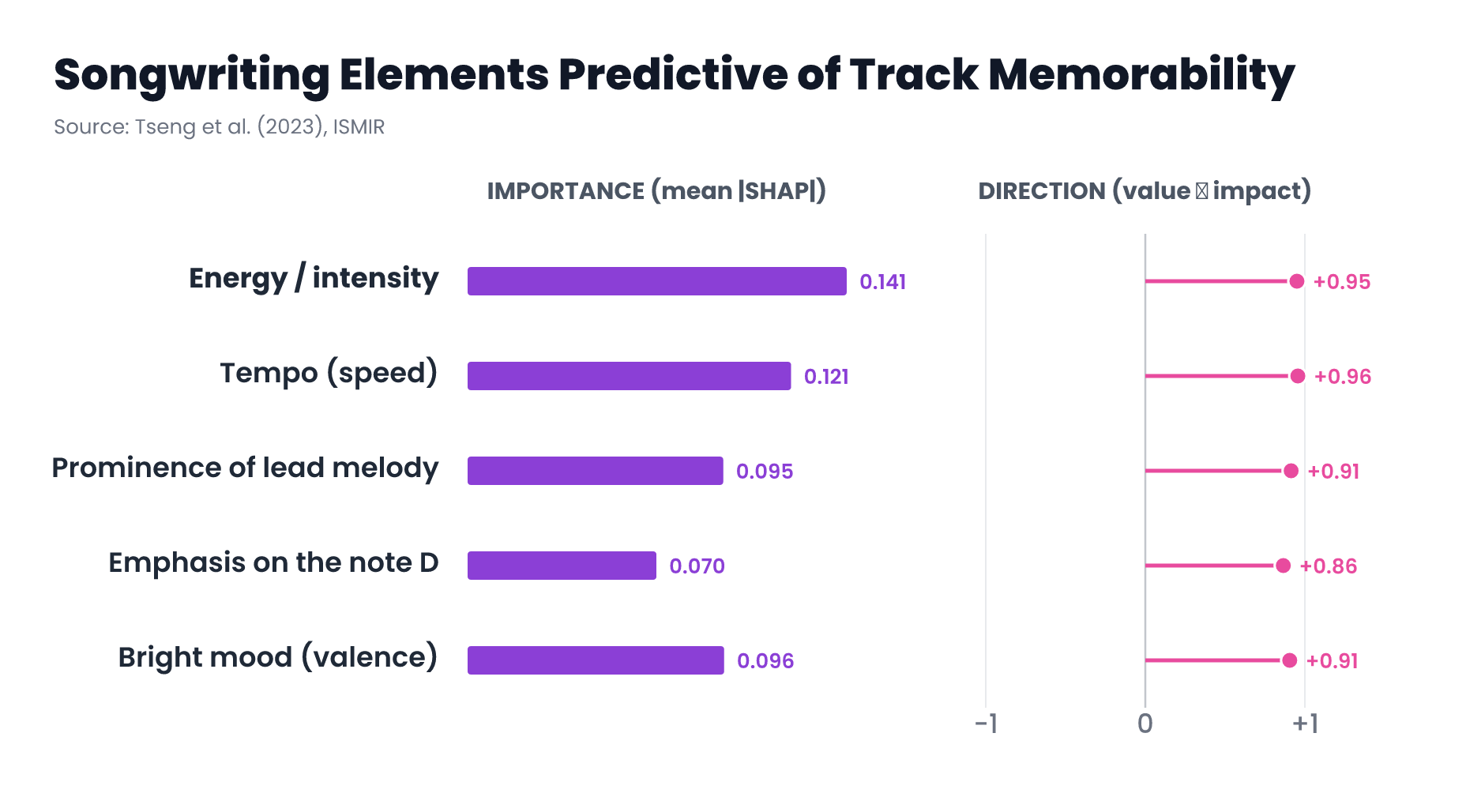
The first study, conducted by researchers at National Yang Ming Chiao Tung University in Taiwan, identified five sonic traits meaningfully associated with memorability: higher energy, faster tempo, a prominent lead melody, greater emphasis on D notes, and a more positive mood. If you’re completely devoid of musical talent (like me!), then here are some example songs that satisfy nearly all of these requirements: “Call Me Maybe,” “Love Story,” “Uptown Funk,” “I Gotta Feeling,” “Dancing Queen,” and “Shake It Off.”
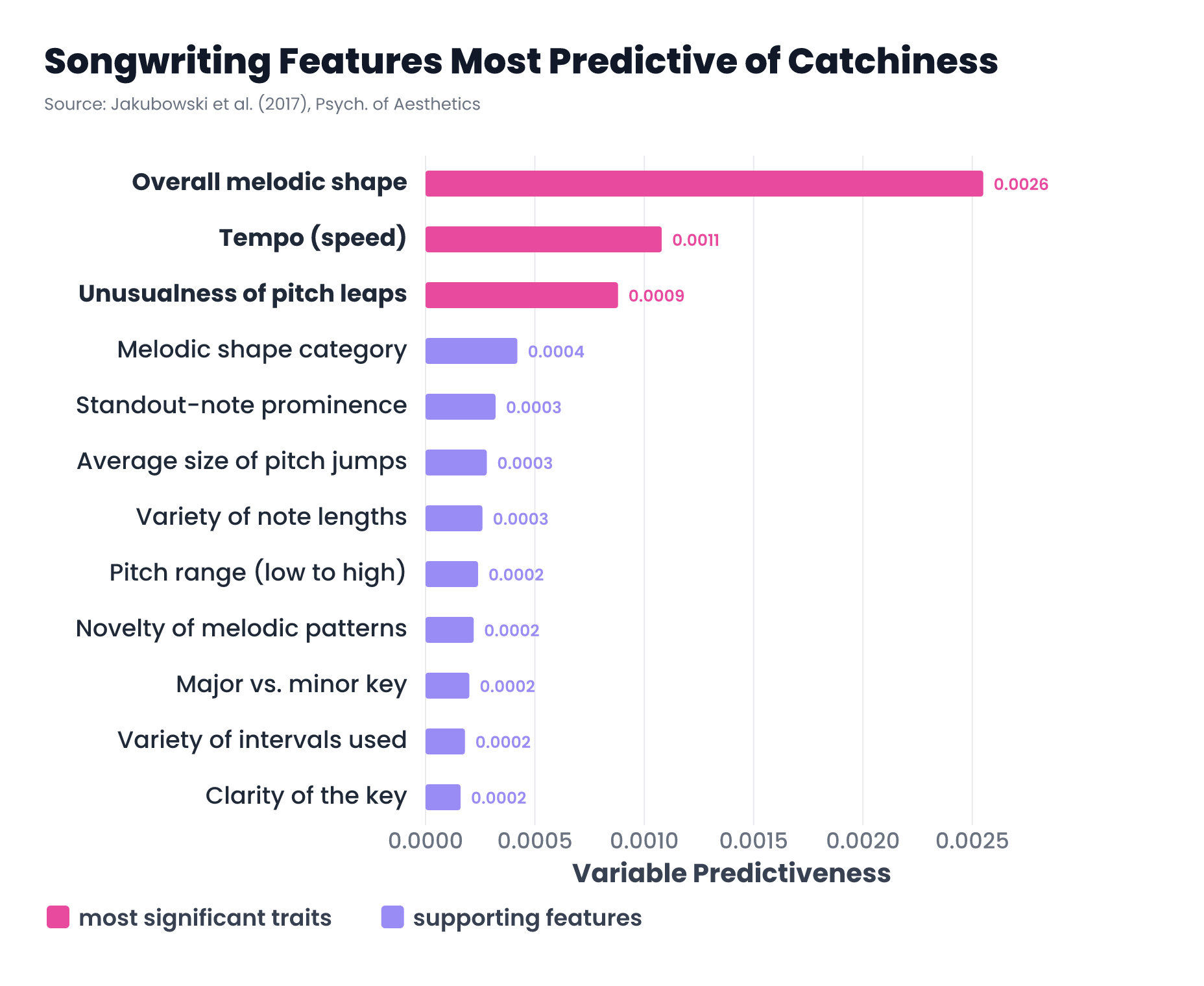
A similar study from researchers at Goldsmiths, University of London, also found tempo to be a key factor, alongside a track’s melodic shape and the unexpectedness of its pitch leaps. Earworms typically rely on a traditional rise-and-fall structure, giving them a recognizable melodic arc, while unusually large jumps between notes add just enough surprise to make the song feel both familiar and distinctive all at once.
The textbook example of this rise-and-fall-plus-surprise pattern is Adele’s “Hello,” a melodramatic dirge that lulls you into complacency before vaulting to level 11 in a moment of sonic exaltation. For a few seconds, the song gives you something startling, then quickly settles back into the familiar, returning the listener to their musical comfort zone.
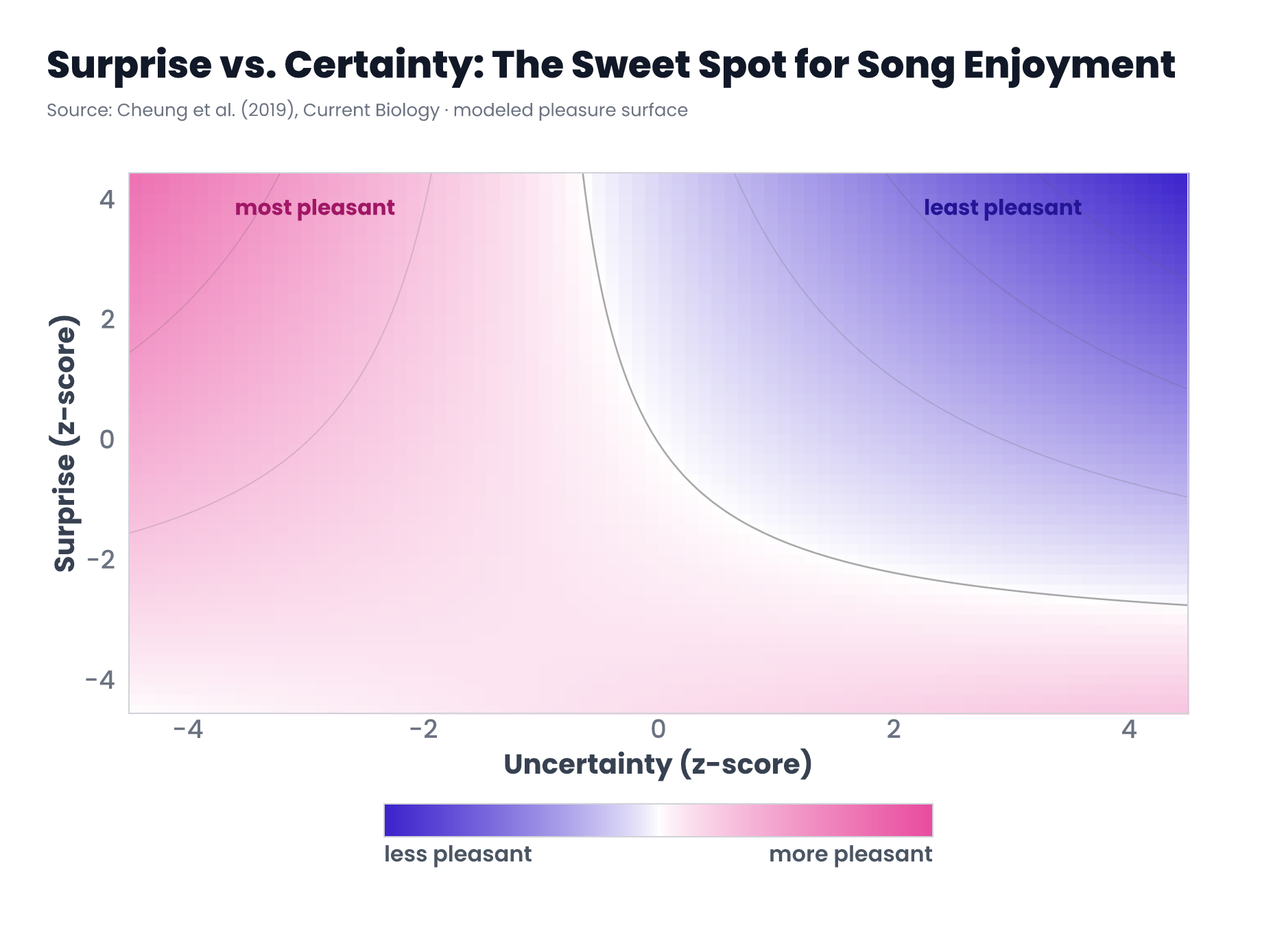
This never-ending tug-of-war between familiarity and novelty is a common thread in nearly all research on song memorability. One study from the Max Planck Institute for Human Cognitive and Brain Sciences asked participants to rate musical excerpts across three dimensions—certainty, surprise, and pleasure—and found that tracks resonated most when listeners had a sense of where songs were headed (high certainty), only to be rewarded with a brief moment of novelty (high surprise). In other words, people want the same thing—but a little different.
And few devices capture this mix of familiarity and surprise better than the compound vocal hook, which stacks recognizable musical ingredients to make something unexpectedly fresh. I had not encountered the term before writing this essay, so for the similarly uninitiated, a compound hook is exactly what it sounds like: a hook made of hooks. The textbook example is Pharrell’s “Happy,” where the title phrase, call-and-response structure, backing vocals, rhythmic vocal delivery, chorus lift, and handclaps all converge into a near-perfect moment of musical memorability.
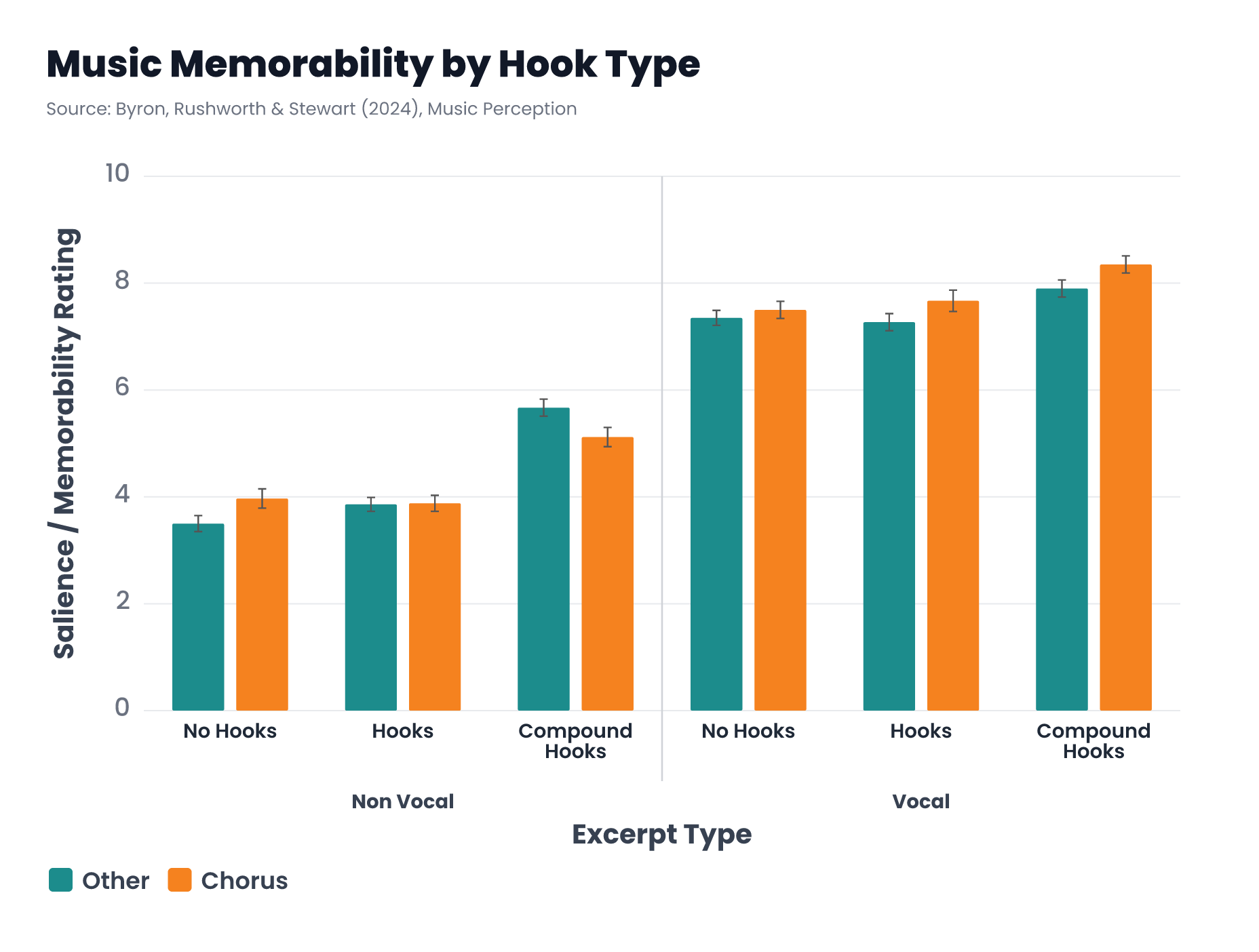
One study from the University of Wollongong in Australia tested the memorability of different hook strategies, comparing vocal hooks, instrumental hooks, compound hooks, and songs with no hook. The results were not particularly surprising: compound vocal hooks earned the highest scores, suggesting that the stickiest songs do not rely on a single ear-catching trick, but layer several of them at once. And because these hooks are vocal, we can sing them, hum them, and quietly rehearse them to ourselves, keeping them lodged in memory and allowing them to spread from person to person with viral efficiency.
So let’s say you are Pharrell, and you’ve created a track as unforgettable as “Happy.” Do you simply set it free and see what happens? Of course not.
Song composition alone does not make a track inescapable. That requires promotion, repetition, and distribution: the machinery that turns an infectious track into a cultural plague. A “song of the summer” does not arrive fully formed. It is engineered at every stage, from the songwriting itself to the shameless promotional strategies perfected by record labels.
What Makes a Song Catchy: The Environmental Factors
Within the broader architecture of music-making, there are several small optimizations that can increase a track’s chances of becoming inescapable. Many of these tactics are tailor-made for short-form video and playlist culture, yet their underlying logic dates back to the 1920s and Tin Pan Alley. The song promotion of that era was often brazen and ethically dubious, but it understood something fundamental about hit-making: sometimes the best way to lodge a song in popular imagination is brute-force exposure.
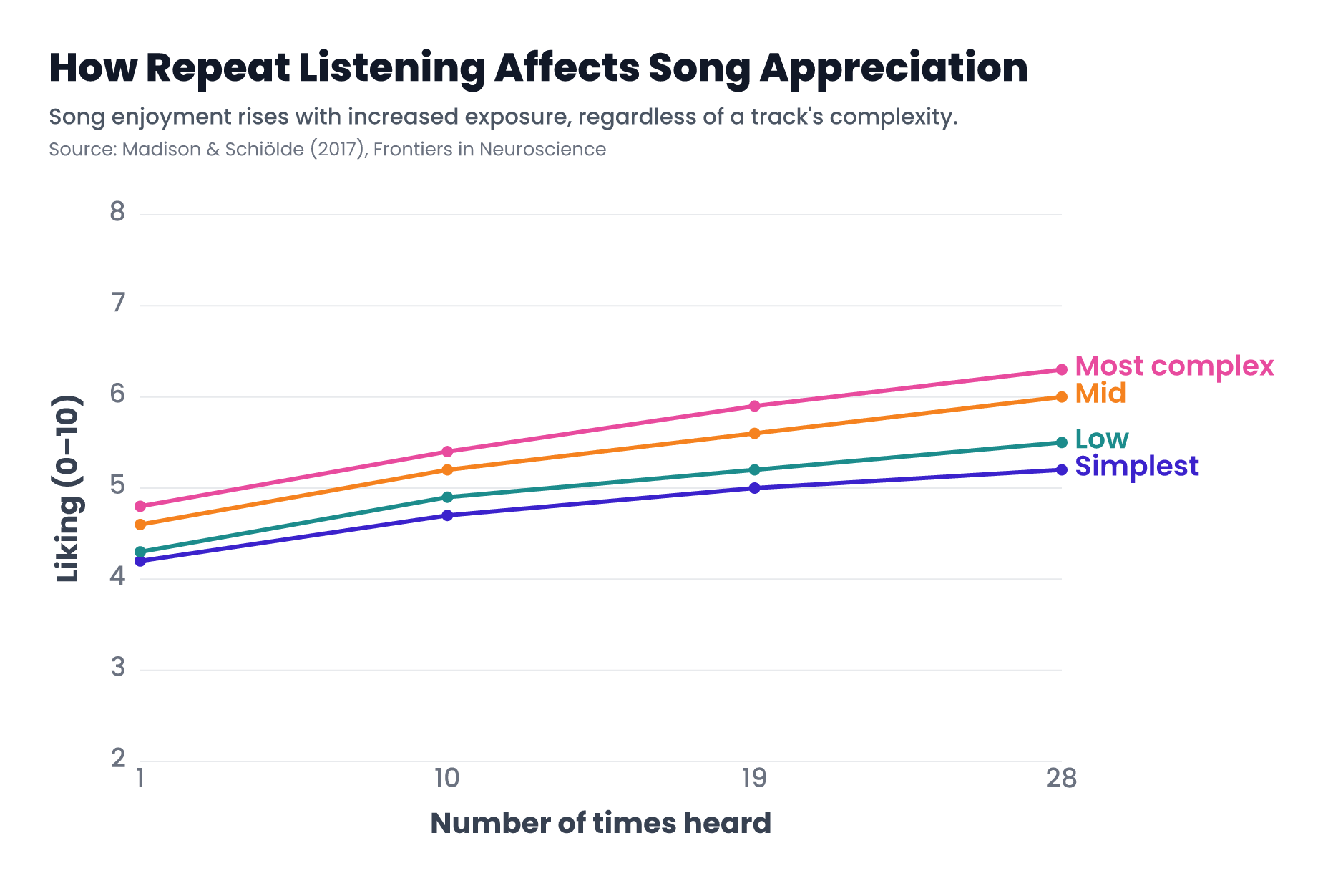
An experiment from researchers at Umeå University in Sweden found that song enjoyment increased with repeated exposure, regardless of a track’s complexity. A song could be as densely layered as Led Zeppelin’s “Stairway to Heaven” or as basic as Nickelback’s “Photograph”; either way, most listeners like it more on the twentieth listen than on the first.
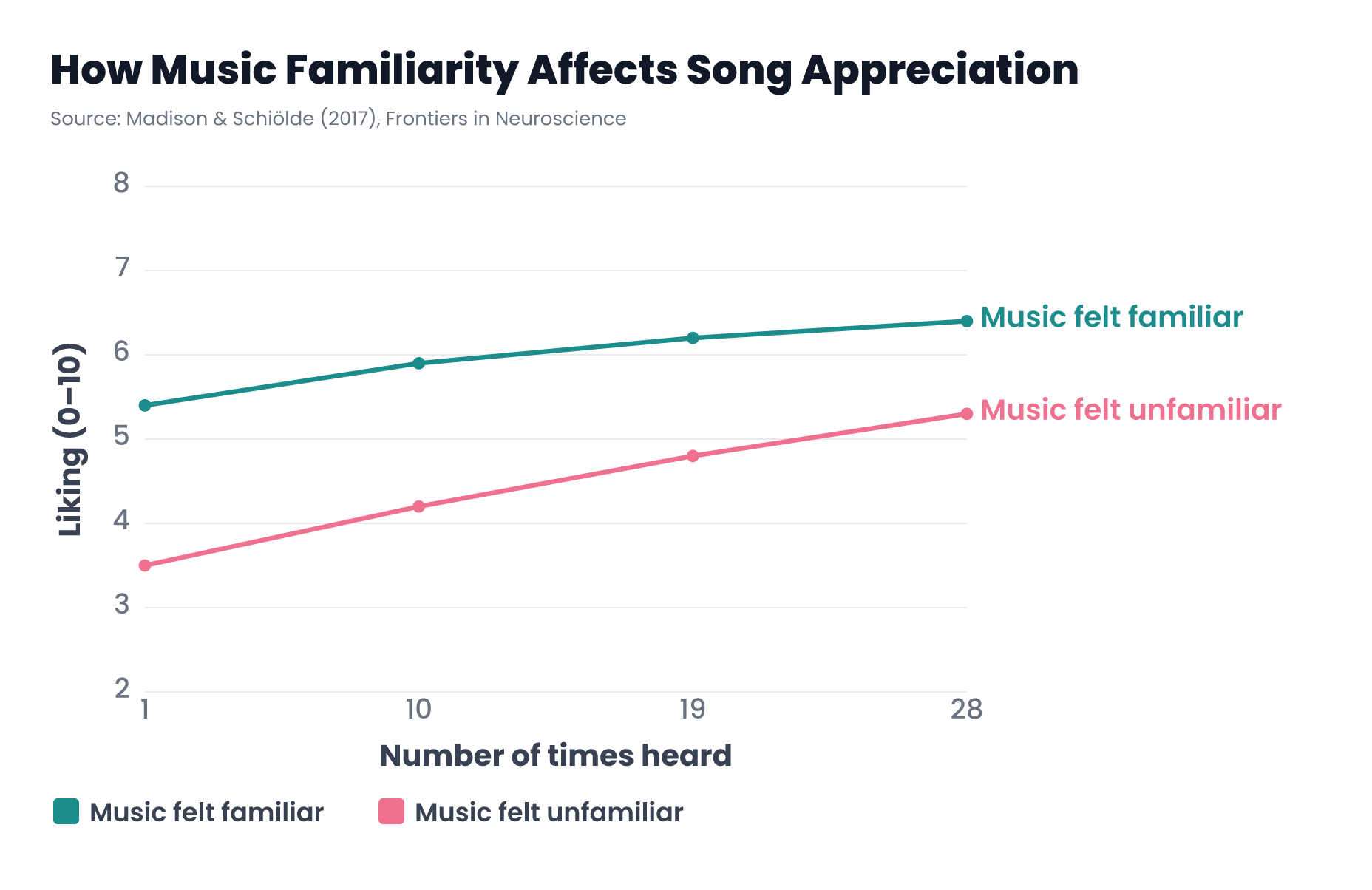
Much of this stems from our primordial attraction to the familiar. The same Umeå University study asked participants to rate songs for likability, then grouped the results by how familiar each listener was with the track’s style. The pattern was depressingly straightforward: the more recognizable a song was, because listeners either knew the band or had heard similar artists, the more they tended to enjoy it. And with each listen, that preference only grew stronger.
You can think of musical taste as an ever-expanding lineage. People rarely make radical leaps between genres or styles. Instead, their preferences tend to evolve incrementally, moving from classic rock to a neighboring genre like pop punk through a chain of similar artists that make for a logical transition.
So if you loved a '90s band like Creed, with its particular brand of alternative-rock melodrama and mid-tempo earnestness, then Nickelback’s arrival in the early 2000s probably felt like a logical next step. The former helped lay the groundwork for the latter, smoothing the path from one generation of radio rock to the next.
That is, until you, an impressionable teen, learned that Nickelback was not a band to be embraced, but apparently “the worst band of all time.” As someone who has spent far too much of his professional life thinking about Nickelback, both the band and the meme, I often wonder how many potential fans were snuffed out by the group’s subpar reputation. Which brings us to the final ingredient of song pervasiveness: social influence.
Our taste in music is heavily shaped by the people around us. If a close friend loves a song, we may seek it out; if they hate it, that judgment can poison the well before we ever press play.
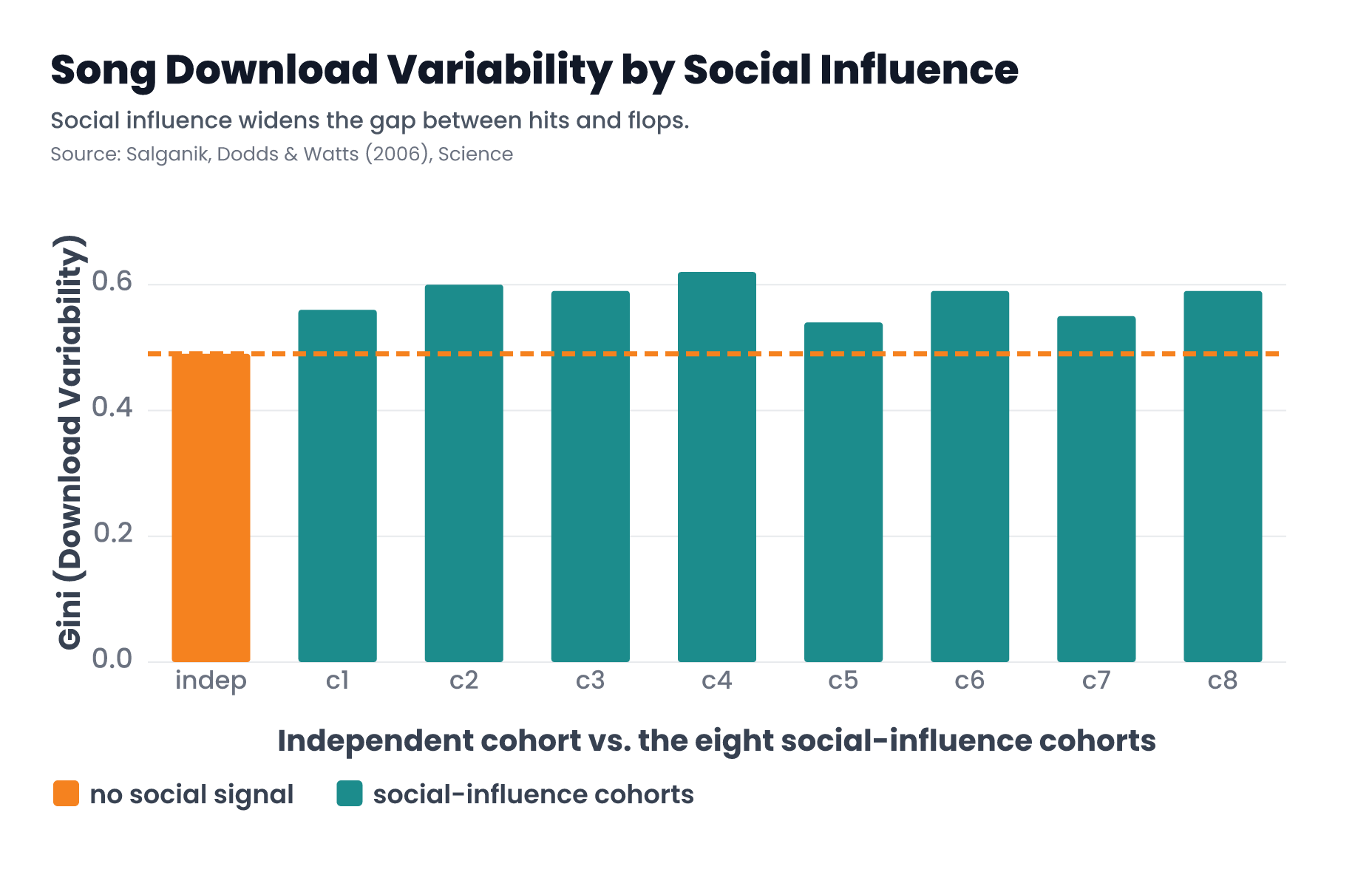
Researchers at Princeton tested this dynamic by giving participants a set of unfamiliar songs and varying the social context in which they appeared. Some participants received only the songs themselves, with no indication of what anyone else thought. Others were placed in environments where they could see which tracks their peers had liked and downloaded. The results were all too predictable: when listeners were exposed to social signals, download patterns became far more volatile. Songs were more likely to become runaway hits or total nonentities, suggesting that popularity can be shaped, and sometimes manufactured, by the visible preferences of others.
We are surrounded by these sorting mechanisms in everyday life: Billboard charts, TikTok view counts, Spotify rankings. These systems make success self-compounding, allowing a Taylor Swift album to saturate popular playlists, attract even more attention, and remain ubiquitous long after its initial release.
Stat Significant is a Reader-Supported Publication
If you find this work valuable, consider becoming a paying subscriber.
You’ll get full access to the Monday Roundup, a twice-monthly bonus edition of quick-hit culture data stories, curated datasets, and recommended reads, plus the Public Dataset Directory and interactive dashboards for Streaming TV, Movies, Music, Search Trends, Wikipedia, and more.
Final Thoughts: The Pop Star Illusion
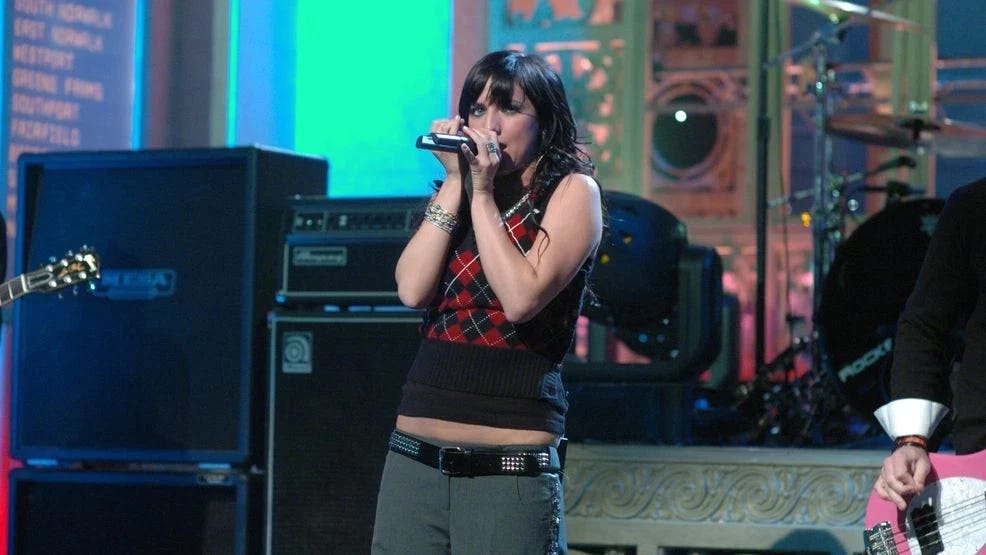
In the early 2000s, Jessica Simpson was an inescapable cultural force. Today, I imagine few members of Gen Z know much about the singer-turned-reality-TV-star or the zeitgeist’s fixation on her inability to decode a tuna can label (if you don’t get the reference, a one-second Google search will suffice).
Simpson’s cultural ubiquity was so complete that when her younger sister Ashlee launched a music career of her own, it felt like a natural extension of the Simpson Industrial Complex.
By 2004, Ashlee Simpson was riding high on the success of “Pieces of Me,” a fizzy pop-rock hit that peaked at No. 5 on the Billboard Hot 100, earning her an invitation to perform on Saturday Night Live—a show that would ultimately undo her short-lived career.
During her second performance of the night, the wrong pre-recorded vocal track started playing. Faced with the impossible task of lip-syncing the words of an entirely different song, Simpson froze, performed a strange little jig, and walked off the stage.
Ashlee Simpson’s catastrophic non-performance dominated the national conversation for what felt like four years, prompting a series of uneasy questions that no one had bothered to ask in the first place. Why had we simply accepted that Jessica Simpson’s sister was also a pop star? Was this person a music industry plant incapable of singing? If Ashlee Simpson played a limited role in the creation of her music and could not perform that music live, then what was the point of her art?
Had you asked those questions before the Saturday Night Live debacle, I’m not sure the answers would have been any different. What changed was that the illusion of Ashlee Simpson’s pop stardom had been broken. In one painfully awkward ten-second stretch, the machinery became visible: “Pieces of Me” was not the pure expression of a singular artist, but a song engineered for catchiness by co-writers and producers, then attached to a performer who could plausibly sell it as her own.
With every passing year, the music industry becomes more mechanized. From Tin Pan Alley to the Brill Building to Motown to modern hitmakers like Max Martin and Jack Antonoff, record labels have perfected the art of producing optimally catchy songs and then blasting them into ubiquity through brute-force exposure. The role of the pop star, then, is to complete the illusion: to make the track feel like an extension of their persona, even if they had little role in its creation.
Music production is an alchemical science: a many-variable equation calibrated around tempo, pitch, texture, familiarity, and repetition. When it works, you get a song like “Pieces of Me” or “Yes! We Have No Bananas”—a track so efficiently constructed, so faithful to pop’s oldest formulas, and so relentlessly pervasive that it burrows into your brain. When it doesn’t, you get every other Ashlee Simpson song, along with all the tracks you’ve never had to erase from memory because they never made it there in the first place.
Enjoyed the analysis? Support Stat Significant and unlock the data behind the insights.
Become a paying subscriber to get bonus graphics, interactive dashboards, downloadable datasets, and to support independent journalism.
Paying subscribers get:
Bonus Data Stories: Full access to the Monday Roundup, a twice-monthly bonus edition with quick-hit culture data stories, curated datasets, and recommended reads.
The Public Dataset Directory (Updated Weekly): A curated directory of public datasets from around the web.
Interactive Data Hubs: Interactive dashboards across Streaming TV, Movies, Music, Search Trends, Wikipedia, and more.
*Note: For best results, open this link in a web browser while logged in to your Substack account.
Want to promote your data tool or media publication to Stat Significant’s 26,200 readers? Email daniel@statsignificant.com
Need help with a data problem? Book a free data consultation
Connect with me on LinkedIn if you want to chat about a data project.
Like movies? Follow me on Letterboxd