

Intro: A Synthetic Campfire Vibe
I’ve gotten pretty lazy with my music discovery as of late. Instead of taking the time to find new artists or explore newfangled playlists, I’ve simply defaulted to Spotify’s AI DJ, who goes by the name DJ X. I’ve written about my conflicted relationship with DJ X in the past, particularly how using this feature feels like an admission of cultural stagnation.
To humanize this bot, Spotify has made DJ X behave like a real-life radio disc jockey, chiming in every couple of songs to introduce the next batch of music. The result is an uncanny valley of synthetic table-setting:
“Up next, we’ve got some songs that capture a campfire vibe—some tracks that make you feel like you’re staring up at the stars.”
“We’re going to play some songs that you were listening to back in 2018. Modest Mouse up first.”
“Next, we’re going to play some songs that make you feel like you’re sitting around a campfire. Let’s begin with Mumford & Sons.”
You’ll notice that 66% of these anecdotes involve a large language model referencing campfires, which makes little sense given this model has never existed outside cyberspace, let alone roasted s’mores. For whatever reason, DJ X is obsessed with cultivating a “campfire vibe,” which means playing an endless rotation of 2010s stomp-clap indie folk, mostly The Lumineers and Mumford & Sons.
In 2012, I was really into stomp-clap music, as was the rest of the world, allowing “Ho Hey” to escape containment and become one of the year’s biggest hits. In hindsight, however, I’ve soured on stomp-clap indie folk, a subgenre whose reputation has aged rather poorly (in my estimation).
If you go dumpster diving through the Billboard charts of yesteryear, you’ll find plenty of outdated music trends, from stomp-clap and nu-metal to disco and ska. Which got me thinking: what are the most disdained subgenres in music history, and can we come up with an authoritative ranking of these fads?
So today, we’ll explore music’s most polarizing trends over the past 80 years, quantify their cyclical rise and fall, and examine the unfortunate condition of being young and liking popular culture.
The Worst Trends in Music History
To qualify for this analysis, a subgenre has to have been popular (meaning its canonical artists graced the Billboard 200 album chart for a number of weeks) and retroactively disliked by people who rate stuff online.
To do this, I compiled an exhaustive list of musical subgenres, each with at least 20 albums that reached the Billboard 200, then cross-referenced those albums’ composite scores on Best Ever Albums (which grades albums based on lists compiled by the site’s users and professional critics).
When we sort by average rating (out of 100), our list of disdained musical trends is topped by 90s teen pop, post-grunge, and auto-tune club pop. If a subgenre’s composite score fell below average, I classified it as “retroactively disliked” and highlighted it in red.
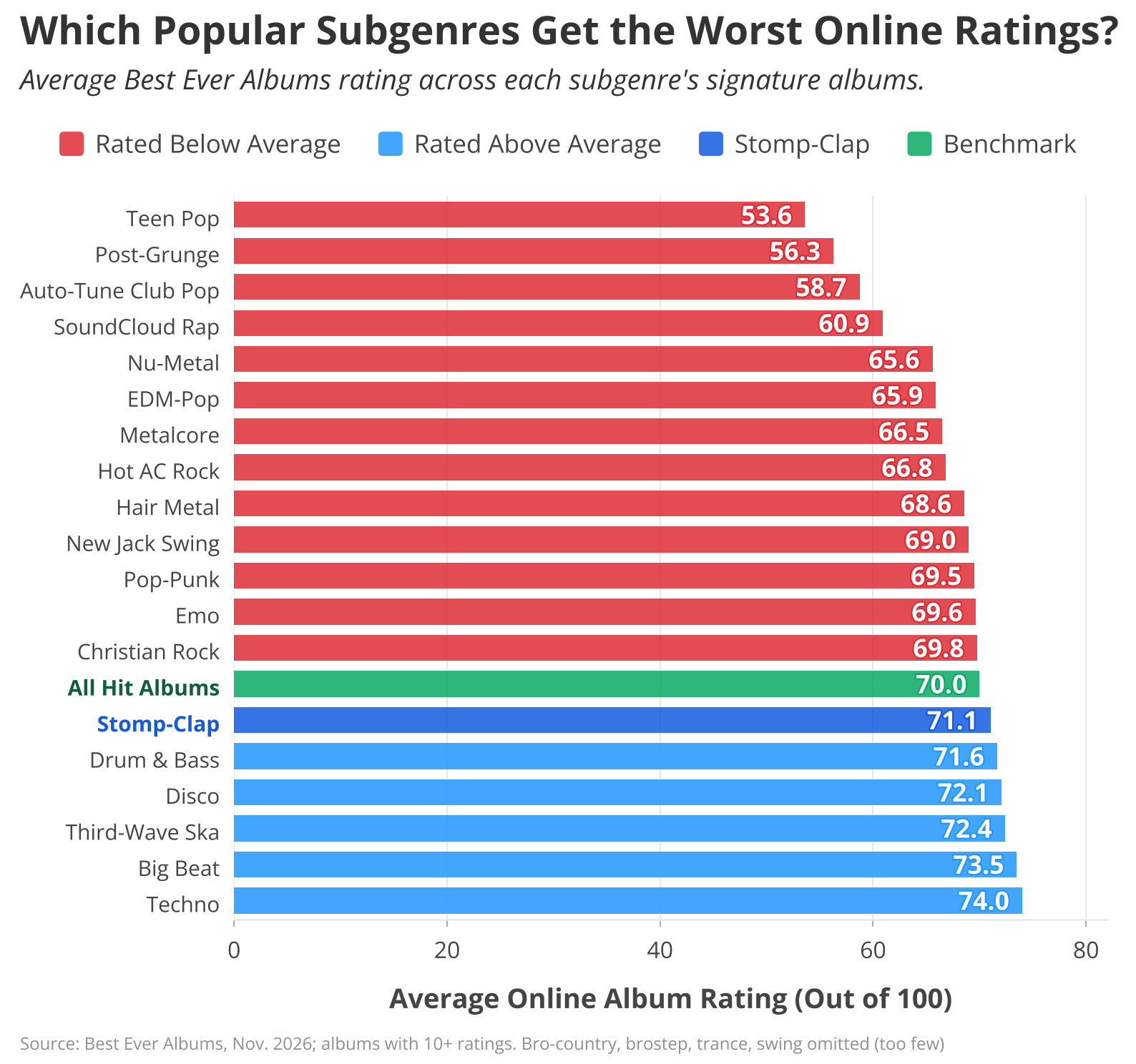
Looking at the results of my query, I had two immediate reactions:
Stomp-clap, a style I assumed was universally bemoaned, receives decent online ratings, presumably from people who enjoy a good “campfire vibe.”
To many, this roster of subgenres might read like the output of a random word generator—but I assure you, they all exist.
So for those scanning this assemblage of musical buzzwords and wondering, “What is third-wave ska, and what happened to the first two waves?” I’ve put together a graphic showing our most maligned subgenres alongside their biggest artists (as determined by cumulative weeks on the Billboard 200).
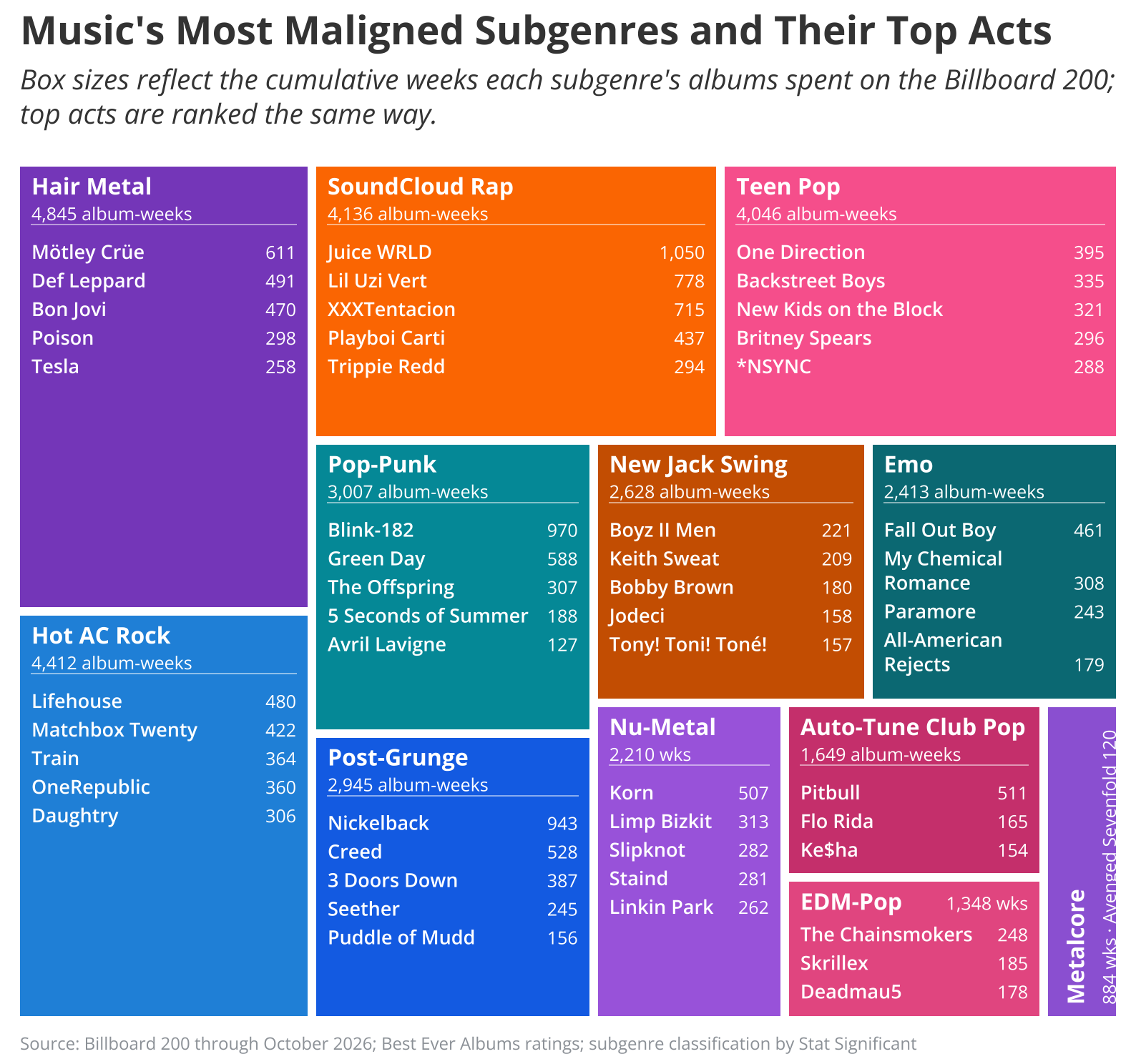
Given the diversity of artists on this list, a few entries are bound to cut deep. For example, thirteen-year-old me would be sad to learn that emo and pop punk have fallen out of favor—and likely would have listened to some emo music to cope. You’ve probably also spotted a few whose poor reputations you agree with, like the post-grunge butt-rock of Nickelback and Creed.
What these musical fads have in common is that they can all be discussed in the past tense. Each enjoyed a period of mainstream success, typically lasting somewhere between six and ten years, before fading into relative obscurity.
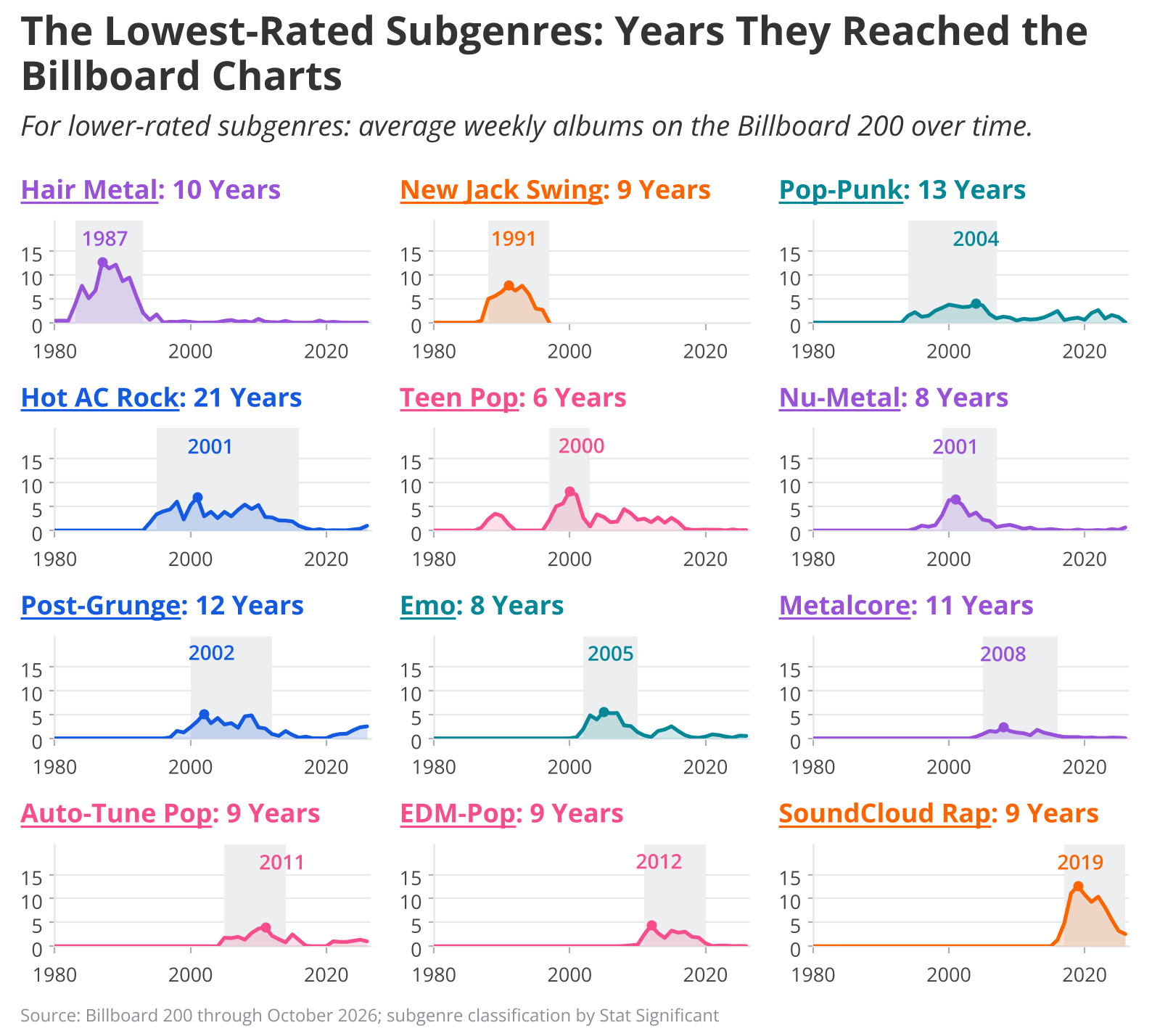
And thus we arrive at the universal pain of being young and impressionable. As I’ve explored in previous analyses, our musical tastes are heavily shaped between the ages of 12 and 22—a phenomenon reflected in a 2021 YouGov survey in which every generation insists (without a hint of irony) that music peaked during their youth.
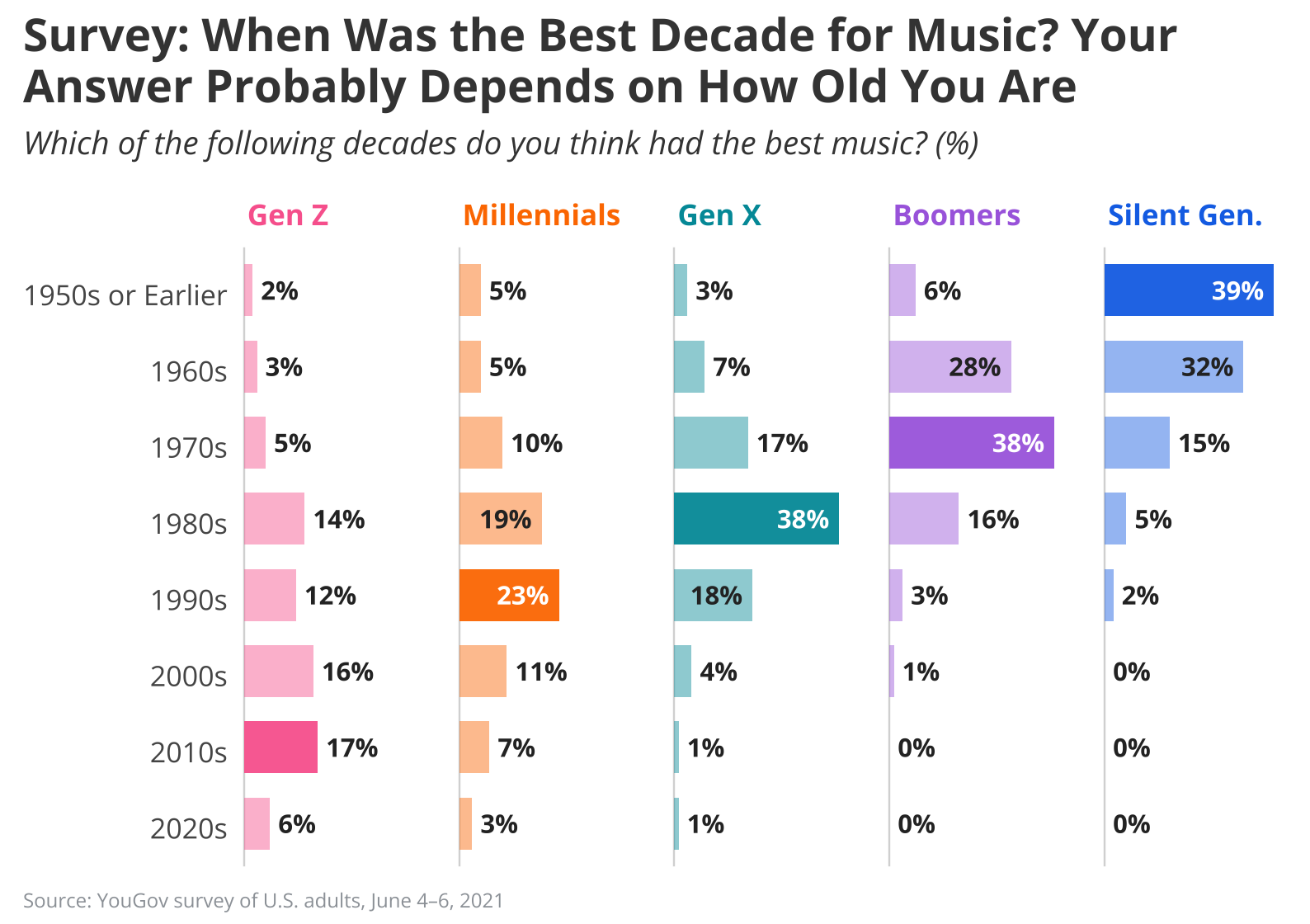
Taken together, you could map the commercial rise and fall of these subgenres onto your own adolescence to better understand why you might have a soft spot for an unpopular style of music.
For example, I was 13 when Green Day released American Idiot, which means I had no choice but to love this album wholeheartedly. To me, this was when music peaked. To someone who wasn’t 13, it might have seemed like an irritating trend.
This logic applies to any era of music—no one is safe from the naïveté of adolescence. If you were 18 in 1986, you probably thought Mötley Crüe was awesome; if you were 42 in 1986, you probably thought Mötley Crüe stinks.
The rapid cyclicality of these trends is what makes popular music so personal and so divisive across generations. A style might enjoy less than a decade of popularity, but if that time coincides with your teenage years, its influence can linger long after everyone else has moved on.
Enjoying the article thus far and want more data-centric pop culture content?
Final Thoughts: The End of History
Looking back, there was something intoxicating about being young and earnestly loving pop culture, blissfully unaware that most movies, TV shows, and songs come with an expiration date. For example, when I was 11, I saw the movie Daredevil, starring Ben Affleck and Jennifer Garner, and genuinely believed it was the greatest piece of art ever created.
At that age, I was captivated by just about every aspect of this film:
This was the first superhero movie I had ever watched. I’ve since seen 100 superhero movies and understand that Daredevil doesn’t even crack the top 90.
I also suspect that 11-year-old me fancied Jennifer Garner, although I didn’t really understand what that meant.
The soundtrack was filled with nu-metal bangers and emo songs, including two back-to-back scenes featuring Evanescence tracks (“My Immortal” and “Bring Me to Life”).
For three years, this movie was a big part of my personality. I bought it on DVD, watched it repeatedly, and when I finally got an iPod, those two Evanescence songs were among the first I downloaded.
In the years since, my taste in film and music has improved (it could really only get better), and what once felt sacred now strikes me as a mediocre cultural relic. I’ve come to understand that playing two Evanescence songs in back-to-back scenes constitutes artistic negligence. Numerous actors have since played Daredevil, and Ben Affleck has even gone on to play Batman. But at the time, this movie and its music felt like the most important thing in the world.
What I’ve just described is a phenomenon psychologists call the end-of-history illusion: we’re pretty good at recognizing how much we’ve changed, but remarkably bad at anticipating how much we’ll change in the future. We assume that the things we care about today will remain important, even though our past selves offer plenty of evidence to the contrary.
I suspect most people have their own version of Daredevil (likely several). Eventually, we grow up and realize that so much of what we once loved was just a collection of fleeting fads.
As the years pass, we grow increasingly distant from the version of ourselves who once loved these short-lived, often questionable cultural trends. Until one day, an AI DJ plays your favorite stomp-clap song from way back when, and you find yourself saying, “Oh wow, the Lumineers! This is exactly the campfire vibe I was looking for.”
And just like that, DJ X will be vindicated.
Enjoyed the analysis? Support Stat Significant and unlock the data behind the insights.
Become a paying subscriber to get bonus graphics, interactive dashboards, downloadable datasets, and to support independent journalism.
Paying subscribers get:
Bonus Data Stories: Full access to the Monday Roundup, a weekly bonus edition with extra culture data stories, curated datasets, and recommended reads.
The Public Dataset Directory (Updated Weekly): A curated directory of public datasets from around the web.
Interactive Data Hubs: Interactive dashboards across Streaming TV, Movies, Music, Search Trends, Wikipedia, and more.
*Note: For best results, open this link in a web browser while logged in to your Substack account.
Want to promote your data tool or media publication to Stat Significant’s 26,200 readers? Email daniel@statsignificant.com
Need help with a data problem? Book a free data consultation
Connect with me on LinkedIn if you want to chat about a data project.
Like movies? Follow me on Letterboxd
But I kinda love pop music….🎶 😬
Really enjoyed your observations and data!