

Intro: From Styrofoam to Stranger Things
In the beginning, there were four channels. Each offered a few dozen programming options, with only modest turnover from year to year. You watched what you were given and did not complain about production quality. Sure, Doctor Who had wobbly sets, Star Trek featured Styrofoam boulders scattered across obvious soundstages, and Mighty Morphin Power Rangers spliced American actors into recycled footage from an entirely different Japanese show, but none of that mattered. The alternative was sitting alone with your thoughts or—God forbid—reading a book.
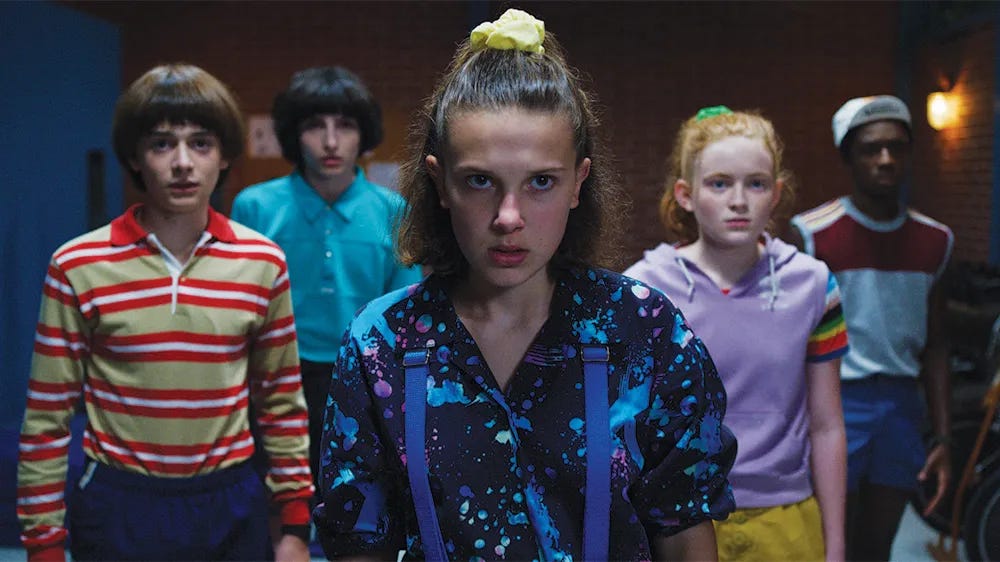
Then television became something more. First came The Sopranos, The Wire, Breaking Bad, and the early prestige TV darlings. Then Netflix arrived with streaming-era hits like House of Cards and Stranger Things. Soon, every major media company was launching a platform of its own, flooding the market with splashy original series in an effort to win the streaming wars. Each year crowned a new “most expensive show ever made.” Wobbly sets and Styrofoam boulders were no longer acceptable.
Which brings us to the year 2026 AD, a period of great retrenchment for television. There is now a vague understanding that TV’s glossy prestige era is over. Or is it? Television is certainly more polished than it was 30 years ago. The harder question is whether streamers have abandoned the wanton spending of the late 2010s.
So today, we’ll examine the rise of TV production budgets, identify the streamers that let their spending spiral out of control, and answer one of life’s great mysteries: Does having more money actually make something better?
Is TV’s Big-Budget Era Over?
For this analysis, I assembled a catalog of the most expensive TV seasons of all time, as measured by per-episode production cost. When we chart these high-priced seasons by premiere year, three distinct eras emerge: the before times (pre-2013), the early prestige era (2013–2018), and the streaming wars (2019–2024).
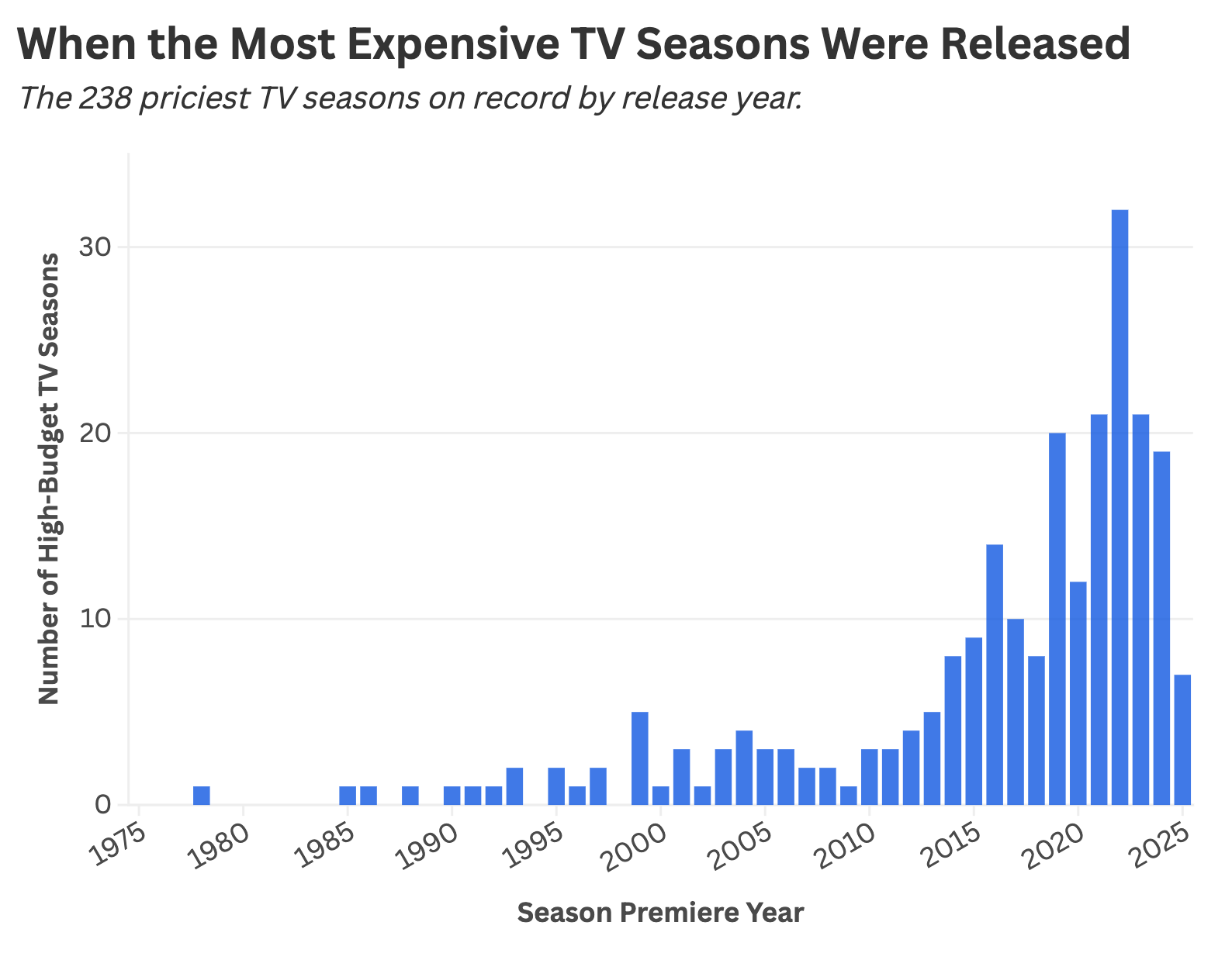
The latter two periods of prestige programming follow a similar arc: a sharp rise in spending, followed by a notable retreat—the likely product of imitation and correction. Which brings us to 2025 and 2026. The number of high-priced TV seasons fell sharply in 2025, and 2026 has yet to produce a show expensive enough to make the list.
When Stranger Things reached its series finale last year, industry coverage framed the moment as the end of an era: a period in which streaming services spent lavishly to create shows with the scale and production value of Hollywood blockbusters. At the time, I found the framing contrived—an attempt to turn an arbitrary milestone into semi-readable clickbait. In hindsight, this was, indeed, the end of an era.
From the premiere of Stranger Things in 2016 to its finale in 2025, television viewers ate well. The 100 most expensive seasons in TV history are a testament to just how spoiled we were: most of the streaming services behind these shows did not exist before 2018, yet they spent extraordinary sums to keep us entertained—all for $5.99 a month. We paid less and got more. What a time to be alive, and parked in front of a television.
And no platform produced more high-budget TV series than Netflix, the company that precipitated this content explosion. Across our catalog of high-priced television seasons, Netflix and Disney+ account for the largest number of expensive shows.
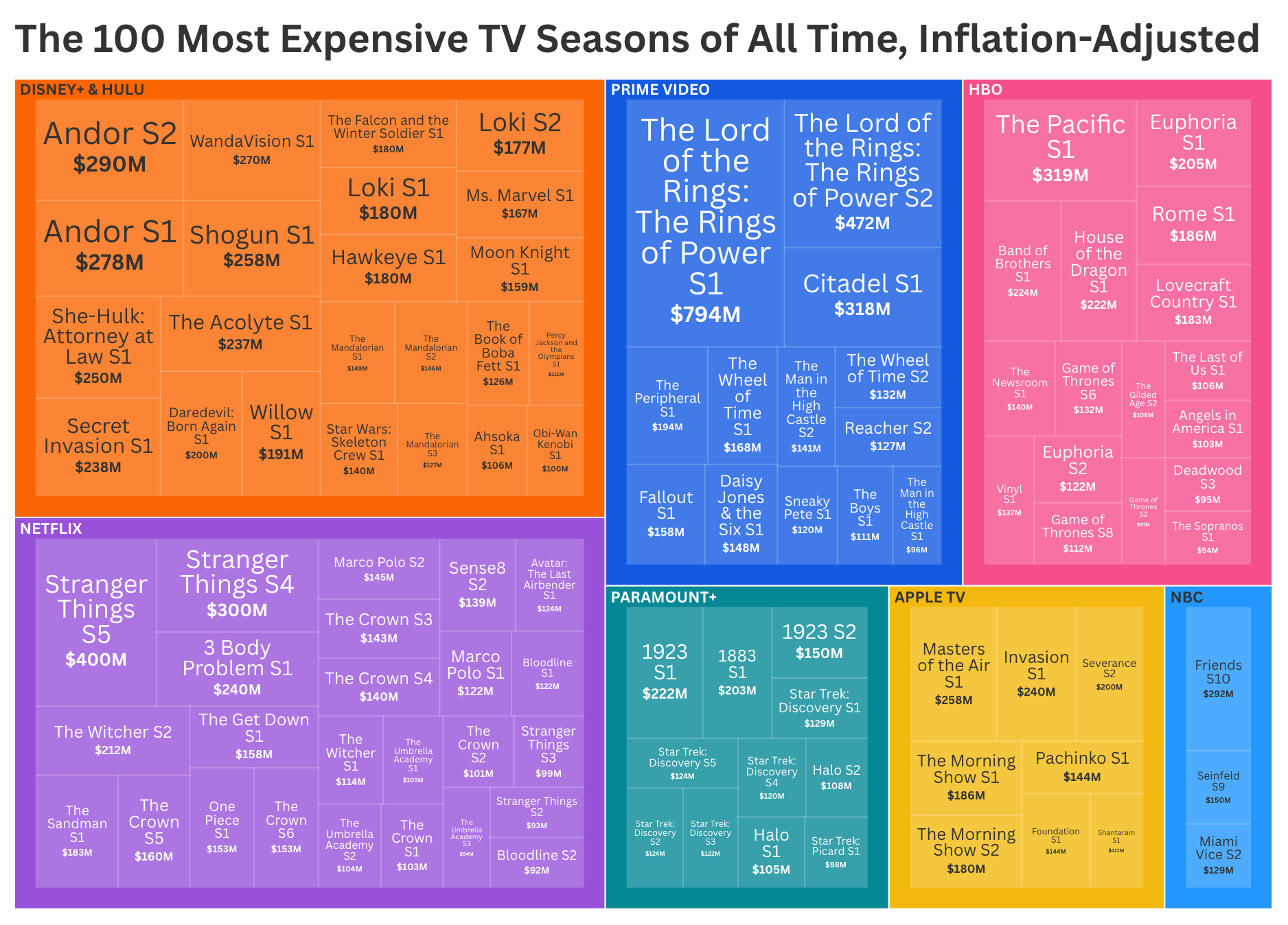
One could look at this graphic and conclude that Netflix simply spent its way to market leadership: pour enough money into glossy prestige series, and viewers will follow. But that is only part of the story. Quality—or at least production value—may matter less than abundance.
Netflix did not merely bring highbrow HBO-style programming to streaming; it embraced all forms of content: dating shows, docuseries, game shows, true crime, and, most recently, podcasts. In the end, Netflix succeeded by replicating what television had always been: a grab bag of curiosities, this time a bit shinier and available on demand.
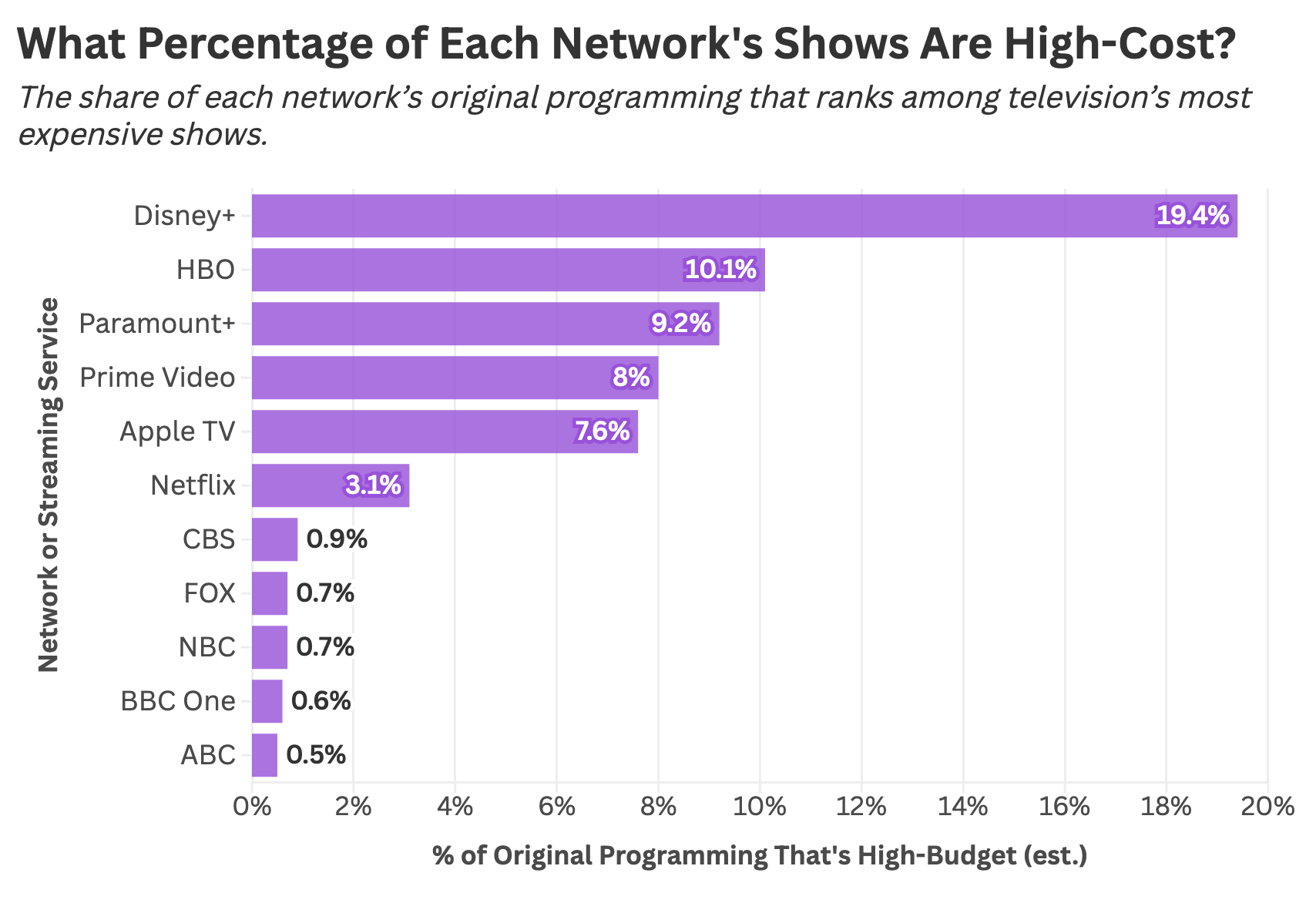
In fact, Netflix’s high-cost programming accounts for a relatively small share of its original content. For every wildly expensive season of Stranger Things, there are, metaphorically speaking, 33 cheaply produced seasons of Love Is Blind. Meanwhile, other streamers faced a late-mover tax: entering an increasingly crowded market, they had to spend massive sums to capture attention. As a result, their early libraries leaned heavily on big-budget series that doubled as customer-acquisition vehicles. For later entrants like Disney+ and Paramount+, that often meant producing fewer shows at higher cost.
These companies spent and spent. But did all that money pay off? It depends on how you define success. Across our dataset of 238 high-priced television seasons, bigger budgets did not translate into greater acclaim: in fact, the more expensive a season was, the lower its online rating tended to be.
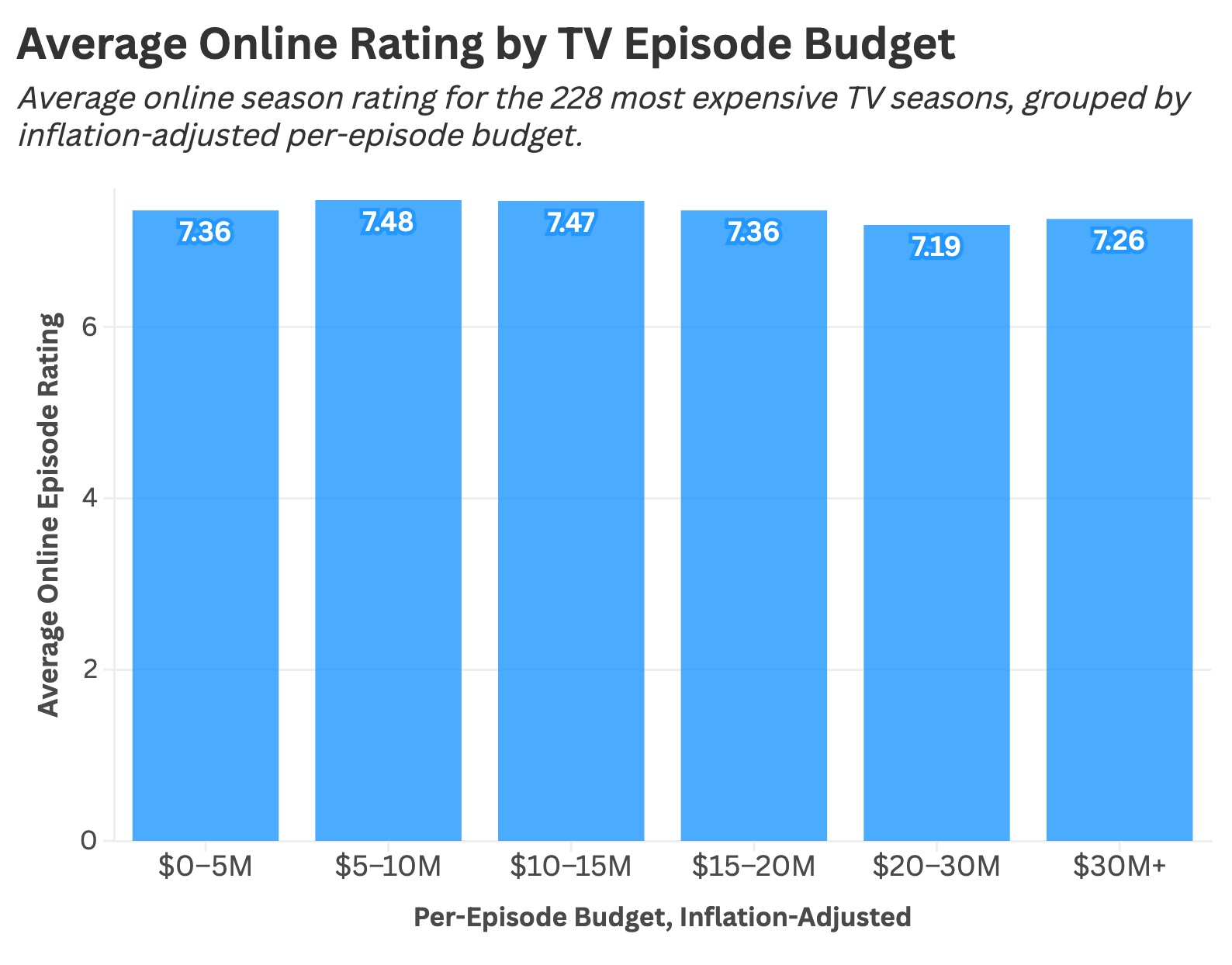
You could stop reading here, armed with a satisfying sound bite: spending more money on television makes it worse. Hollywood executives are idiots. Put you in charge, and you would build a captivating content library for pennies on the dollar.
But the reality is more complicated. The relationship between spending and acclaim is muddied by audience expectation. The most expensive television seasons of all time tend to fall into one of three categories:
Adaptations of preexisting intellectual property: Franchise series set within vaunted fictional universes like The Lord of the Rings, Star Wars, or Marvel must satisfy enormous built-in fan bases.
Finales and legacy sequels: Long-running shows and sequel series carry unusually high expectations, such as the final season of Stranger Things or HBO’s The Pacific, a spiritual successor to Band of Brothers.
A little-seen Amazon series called Citadel: the first season of this show cost $53 million per episode for no discernible reason beyond financial mismanagement.
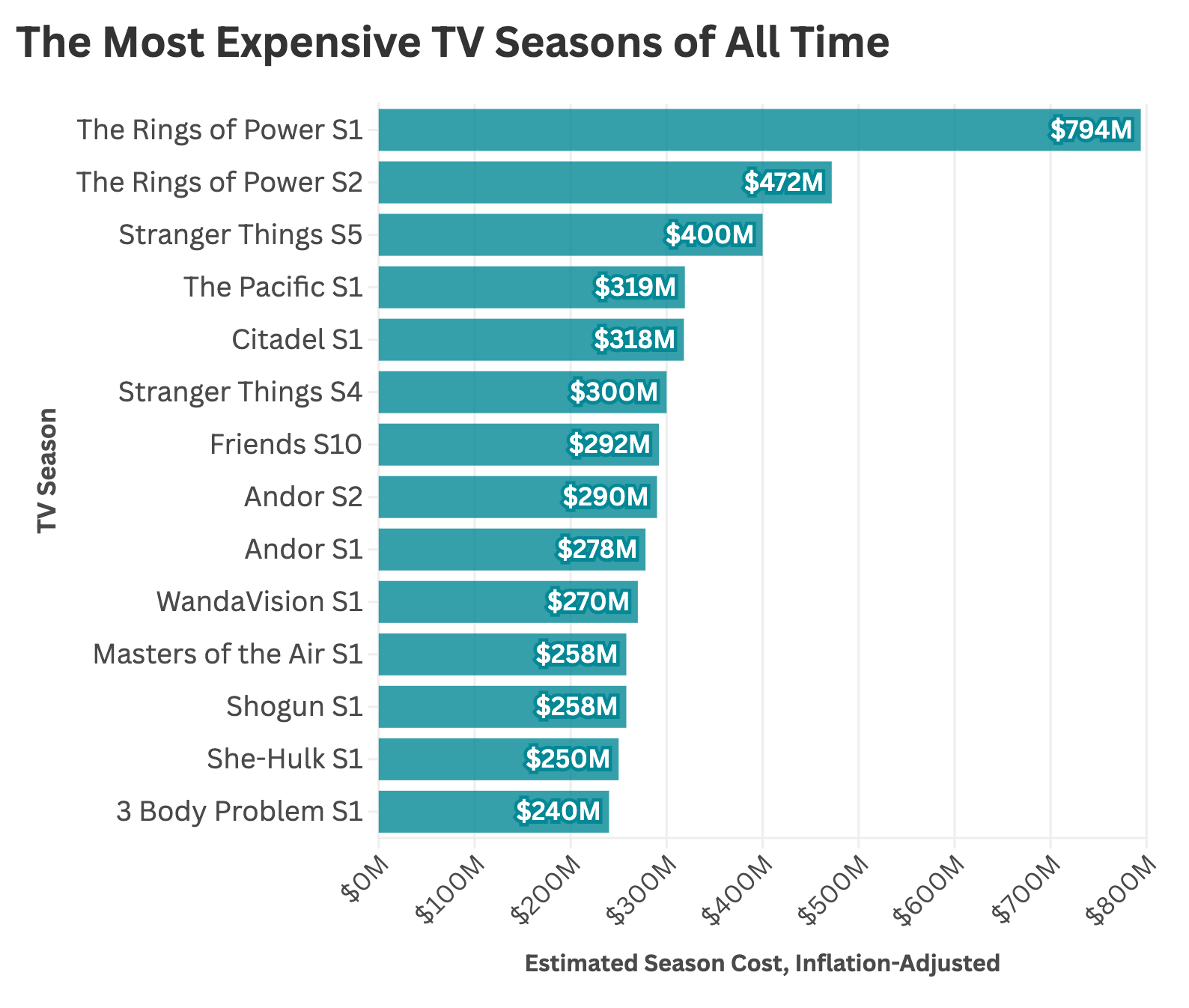
In many cases, lavish spending is an attempt to meet outsized expectations. But a massive budget can only buy so much goodwill. Even at a reported $60 million per episode, The Rings of Power left many fans disappointed.
Of course, acclaim is only one measure of success. A show like Hacks can win 30 Emmys while drawing an audience comparable to a preseason football game. The more important question is whether all that spending translates into meaningful viewership.
On that front, the results are more favorable. The expensive shows on our list are 10 times more likely to appear in Nielsen’s weekly Top 10 ranking than a modestly budgeted program that did not make our dataset. Once there, these pricey programs remain on the charts longer and accumulate more viewing hours. While extravagant budgets may not produce critical acclaim, they do buy an audience.
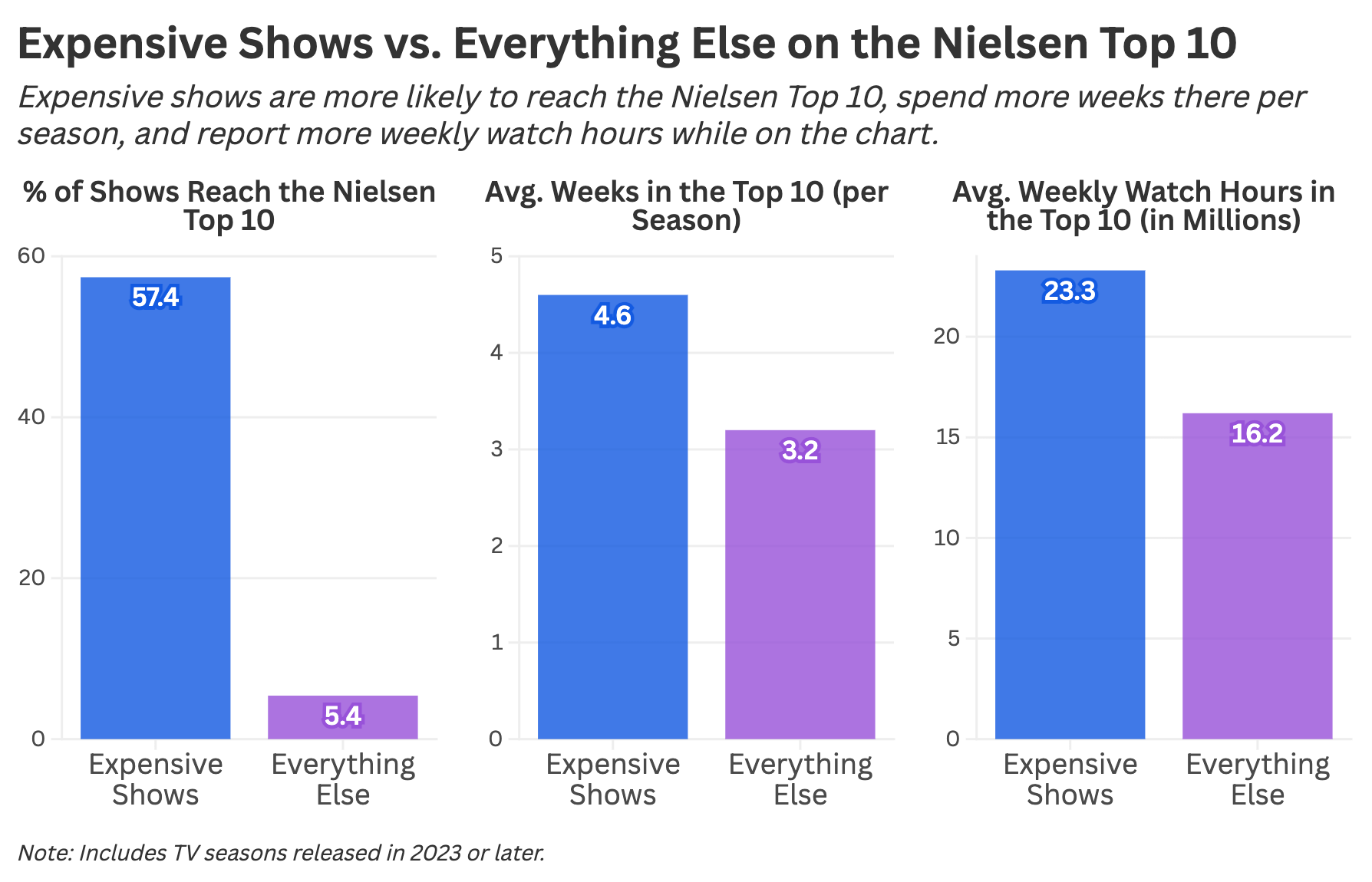
The harder—and likely unanswerable—question is whether that incremental viewership was worth the cost. My best guess is that, for a time, it was. If you wanted to compete with Netflix, you had to spend aggressively to get people’s attention. But as the streaming market has matured and subscriber growth has slowed, that approach is no longer justified—as evidenced by the spending slowdown in 2025 and 2026. There is no longer a sound business case for Masters of the Air’s $250 million price tag, or for spending $300 million on a season of Citadel—a show that apparently exists.
Stat Significant is a Reader-Supported Publication
If you find this work valuable, consider becoming a paying subscriber.
You’ll get an ad-free reading experience, access to the Public Dataset Directory, the Stat Significant Data Catalog of downloadable datasets, and interactive dashboards for Streaming TV, Movies, Music, Search Trends, Wikipedia, and more.
Final Thoughts: A Glorious Arrangement

“Get Big Fast” emerged as one of the defining mantras of the dot-com era, most famously embraced by Amazon, where Jeff Bezos reportedly had the phrase printed on employee T-shirts. The strategy was simple: spend aggressively, acquire customers as quickly as possible, and seize control of a market before competitors could catch up. And while the dot-com boom ended in a small-scale financial crisis, a handful of spectacular startup successes turned “Get Big Fast” into a template for a generation of founders—and, eventually, for any new market that appeared ripe for disruption.
Yet for every startup that got-big-fast, hundreds more burned precious capital chasing bigness. Take Homejoy, an on-demand cleaning startup that raised $40 million and grew by offering first-time cleanings for $19.99, far below its usual $85 price tag. The company treated those discounts as customer acquisition spending, betting users would return at full price. They did not: only 15% to 20% booked again within a month, and fewer than 10% were still active after six months. Even after data showed the discounts were attracting unprofitable customers, Homejoy continued subsidizing growth to please its investors—until the company shut down in 2015, less than five years after launching.
Homejoy is simply one entry in a long line of businesses that chased scale without sustainability, joining a crowded startup graveyard that includes Pets.com, MoviePass, Quibi, FTX, Webvan, WeWork, Juicero, Munchery, Bird, and many more.
In the 2010s, this became the operating model for television, a market that had long subsisted on low-cost programming and the reliable economics of the cable bundle. The strategy was simple: spend massive sums on big-name TV shows, acquire customers, and maybe—just maybe—they will stick around.
For viewers, it was a glorious arrangement. We got wildly expensive programming at a subsidized price—and sometimes for free. If the streaming boom had merely produced a wave of above-average shows for very little money, that would be a charming story. But the consequences were considerable, irreparably changing the entertainment industry.
Since the streaming bubble began to burst in 2022, Hollywood has been littered with casualties of an untenable business model: the writers’ union went on strike, the actors followed, Paramount sold to Skydance, and the newly enlarged Paramount Skydance moved to swallow Warner Brothers. When the dust settles, there will be fewer studios, fewer jobs, and fewer shows. In exchange, viewers will have gotten ten years of unsustainably awesome television.
In the beginning, we got The Sopranos and Breaking Bad. In the end, Netflix got-big-fast while the rest of the industry saw mass consolidation. And for one brief, absurd moment in between, we got a $300M show called Citadel that tens of people watched.
Enjoyed the analysis? Support Stat Significant and unlock the data behind the insights.
Become a paying subscriber for interactive dashboards, ad-free reading, downloadable datasets, and to support independent journalism.
Paying subscribers get:
The Public Dataset Directory (Updated Weekly): A curated directory of public datasets from around the web.
Ad-Free Reading: No ads, made possible by new Substack personalization tools.
The Stat Significant Data Catalog: Downloadable datasets assembled, cleaned, and updated weekly by Stat Significant.
Interactive Data Hubs: Interactive dashboards across Streaming TV, Movies, Music, Search Trends, Wikipedia, and more.
*Note: For best results, open this link in a web browser while logged in to your Substack account.
Want to promote your data tool or media publication to Stat Significant’s 26,100 readers? Email daniel@statsignificant.com
Need help with a data problem? Book a free data consultation
Connect with me on LinkedIn if you want to chat about a data project.
Like movies? Follow me on Letterboxd
Last week I watched season 2 of Citadel and it appeared to be just as expensive as season 1. My wife and I must be 2 of the tens. And it ended on what looked to set the stage for season 3.
Good analysis! Always enjoy your work. One note: there were three networks in the beginning, not four. ABC, NBC, CBS. Fox didn’t come along until the early 1990s and by that time cable already had original programming.