

Intro: #StayInLA
The past decade has not been kind to Los Angeles’ entertainment industry. The combined shock of the 2023 labor strikes and the 2025 wildfires intensified fears that film and television production is migrating overseas, threatening a fragile ecosystem of below-the-line workers based in Hollywood.
In the days after the wildfires, filmmaker Sarah Smith and writer Alexandra Pechman organized a WhatsApp group of showrunners and industry workers, drafted a petition, and launched the grassroots #StayInLA campaign. What began as an emergency effort to help Los Angeles rebuild grew into a broader political movement, drawing more than 20,000 petition signatures, endorsements from prominent actors and filmmakers, and even the fleeting attention of Donald Trump—an actor himself, best known for his performance in Home Alone 2: Lost in New York.
Having worked in the entertainment industry and lived in Los Angeles, I have long wanted to investigate this often-vague anxiety: to understand exactly where these productions are migrating and quantify the extent of Hollywood’s flight from, well, Hollywood itself.
So today, we’ll examine Hollywood’s great production migration, explore how these logistical shifts have reshaped the filmmaking process, and investigate whether outsourcing production has any measurable impact on the quality of the movies themselves.
How Hollywood Stopped Making Movies in Hollywood
The American film industry began concentrating in Los Angeles in the 1910s, drawn to the city’s year-round sunshine, varied landscapes, inexpensive land, and distance from Thomas Edison’s patent enforcement on the East Coast. By the 1920s, Hollywood had become the global center of filmmaking, with studios, skilled workers, and supporting businesses clustered together in a self-renewing ecosystem.
For decades, most American films were produced on Los Angeles backlots, where studios provided filmmakers access to turnkey sets and skilled crews. This mechanized approach kept costs low and enabled directors to crank out four to six movies a year. During this era, Hollywood operated much like Henry Ford’s Model T assembly line; studios were maniacally focused on speed and frugality.
LA’s stranglehold over movie production would ultimately be tested by two filmmaking trends:
The rise of the blockbuster: In the 1970s, box-office smashes like The Godfather and Jaws demonstrated the commercial potential of event cinema. By the 1980s, corporatized studios like Paramount-Gulf-Western were actively manufacturing blockbusters, pouring ever-growing budgets into spectacle-driven stories. Films like Predator, First Blood, and Raiders of the Lost Ark were shot on location in jungles, deserts, and other far-flung settings, as exotic locales amplified their sense of scale.
The rise of IP and tax credits: The 2000s and 2010s brought a surge in big-budget filmmaking built around familiar IP. Marvel’s vaunted Cinematic Universe and other franchises required considerable financial investment, leading studios to offset costs by relocating production to incentive-rich cities such as Vancouver and Atlanta.
The result of these production strategies was a slow-building migration out of Los Angeles and California altogether.
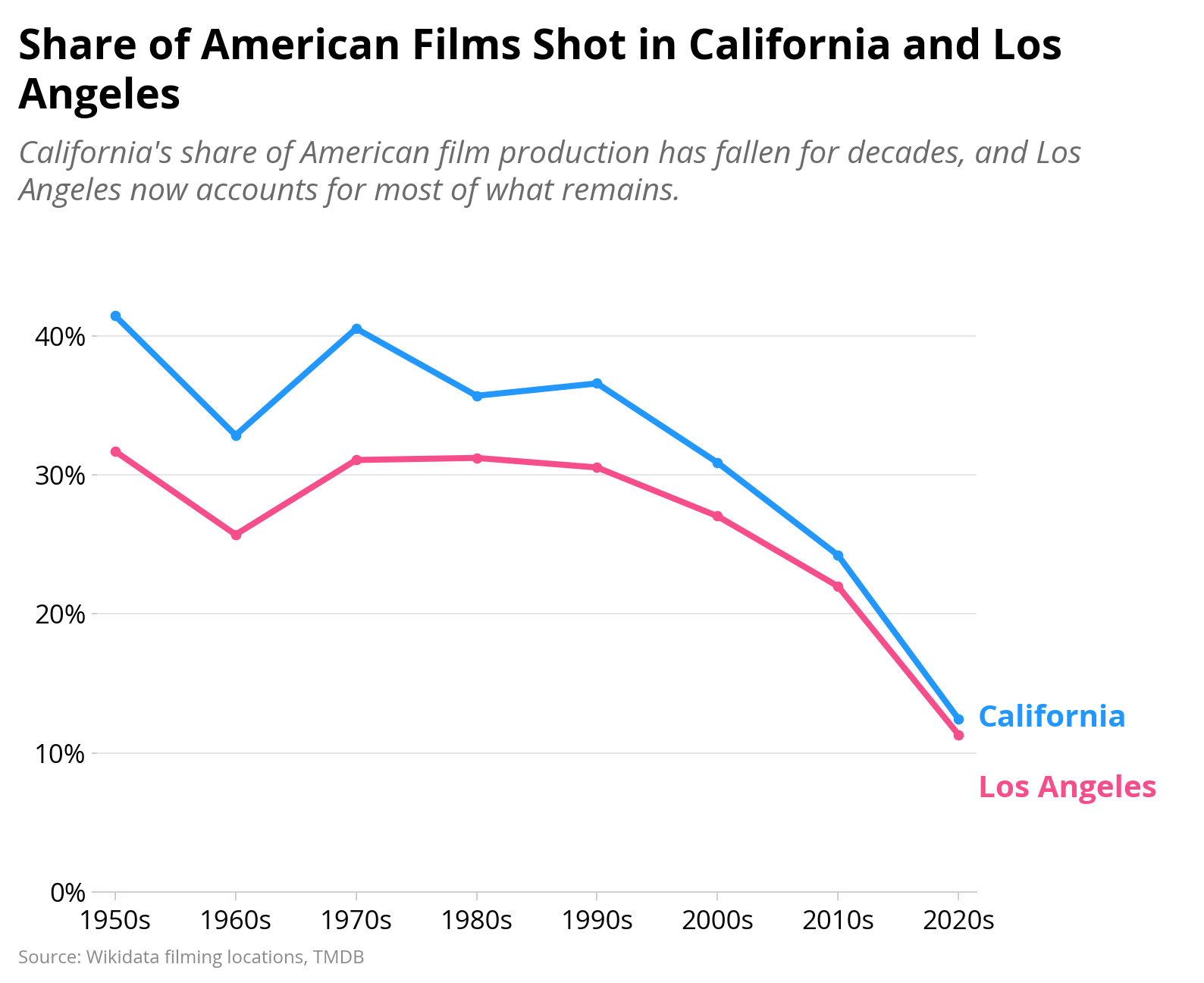
So where did all the movies go? Hollywood’s production exodus has benefited a small group of filmmaking hubs offering some combination of established infrastructure and financial incentives. London, for example, boasts world-class facilities such as Pinewood Studios, while cities like Atlanta and Vancouver provide generous tax credits and rebates that reimburse studios for their local spending.
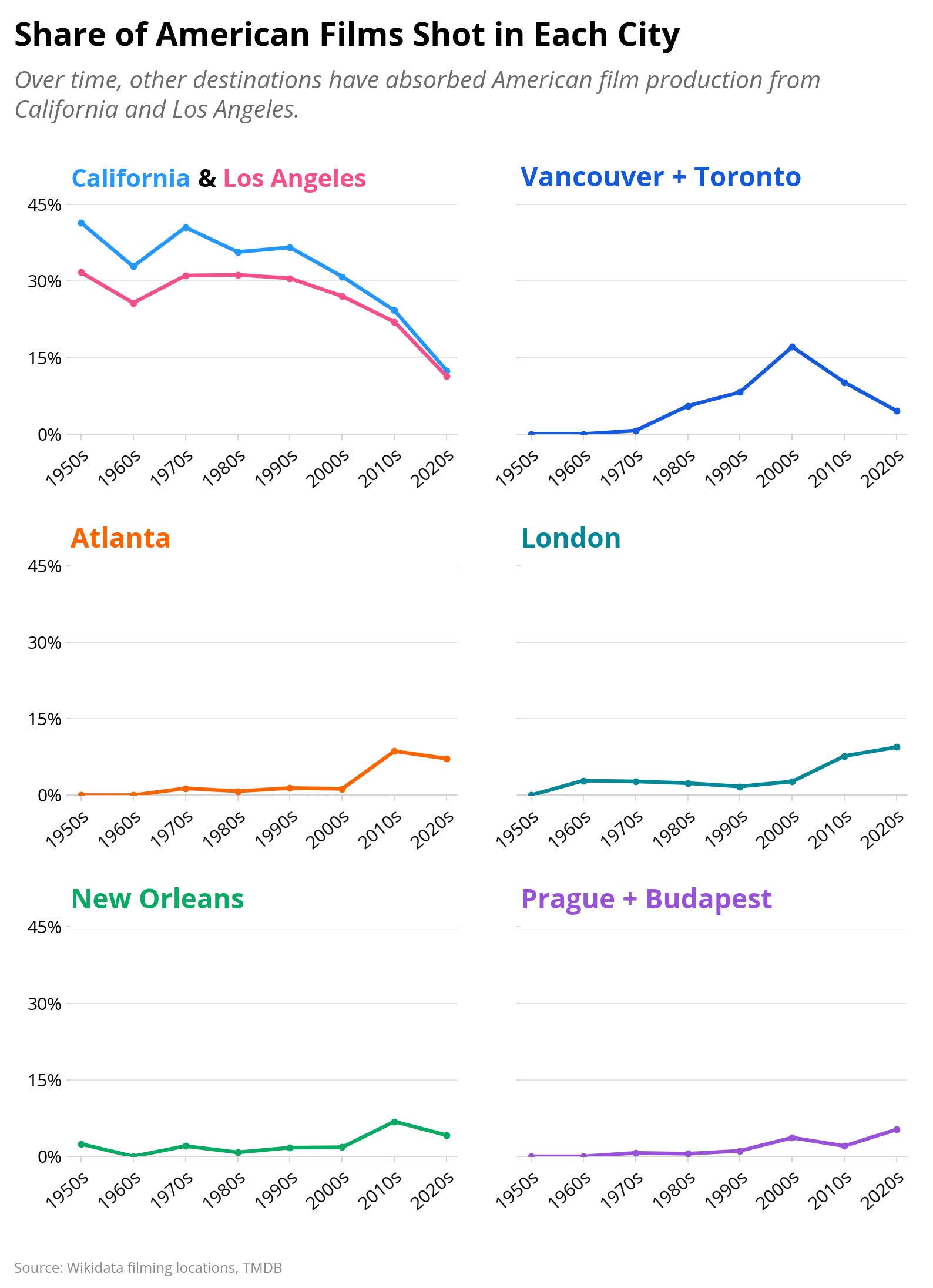
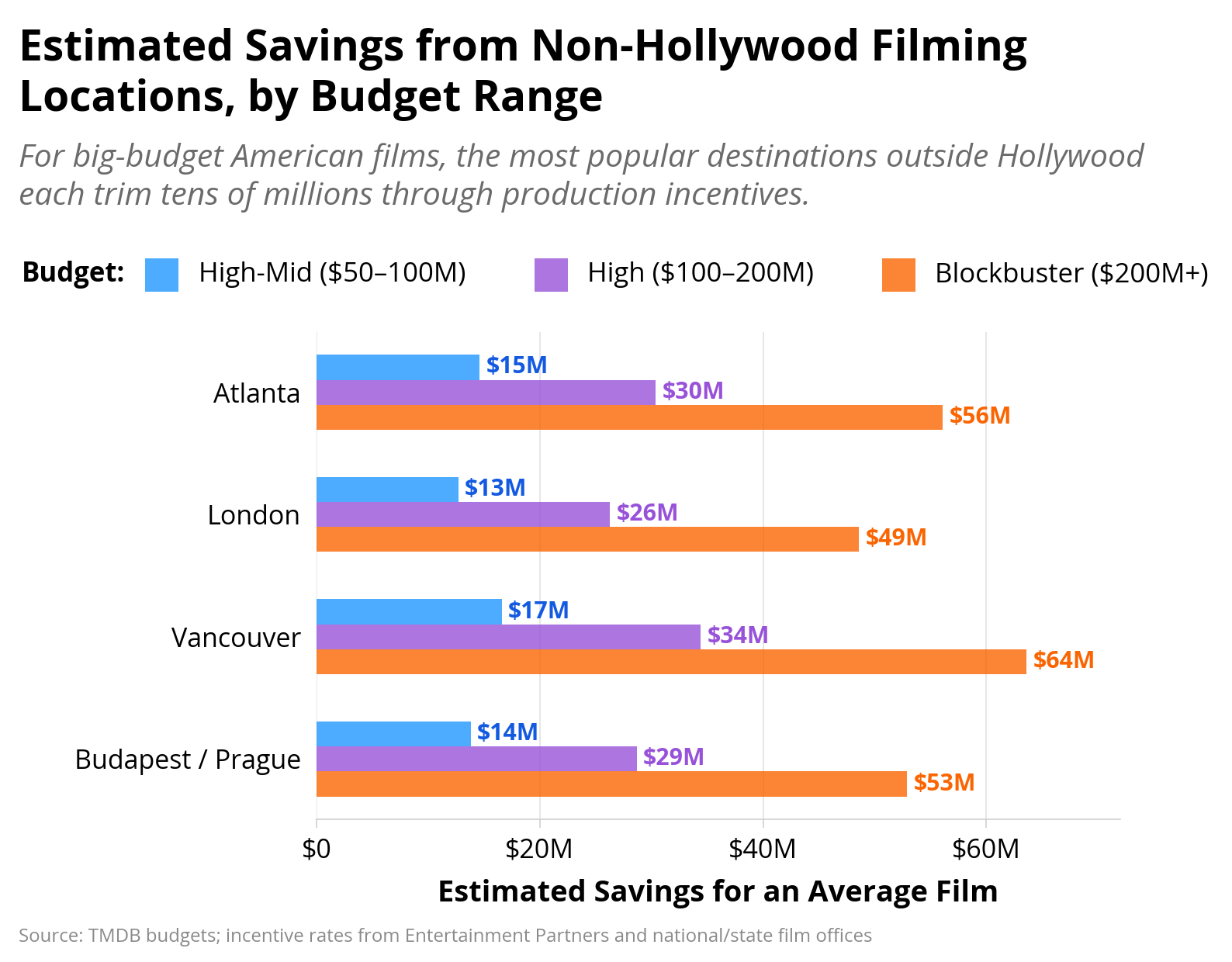
The savings these destinations offer are substantial, making them an obvious choice for a superhero movie whose story could unfold almost anywhere—be it a generic cityscape or somewhere in outer space. For a major blockbuster, tax incentives equate to tens of millions of dollars, freeing up money for name-brand actors, elaborate set pieces, and unremarkable CGI effects.
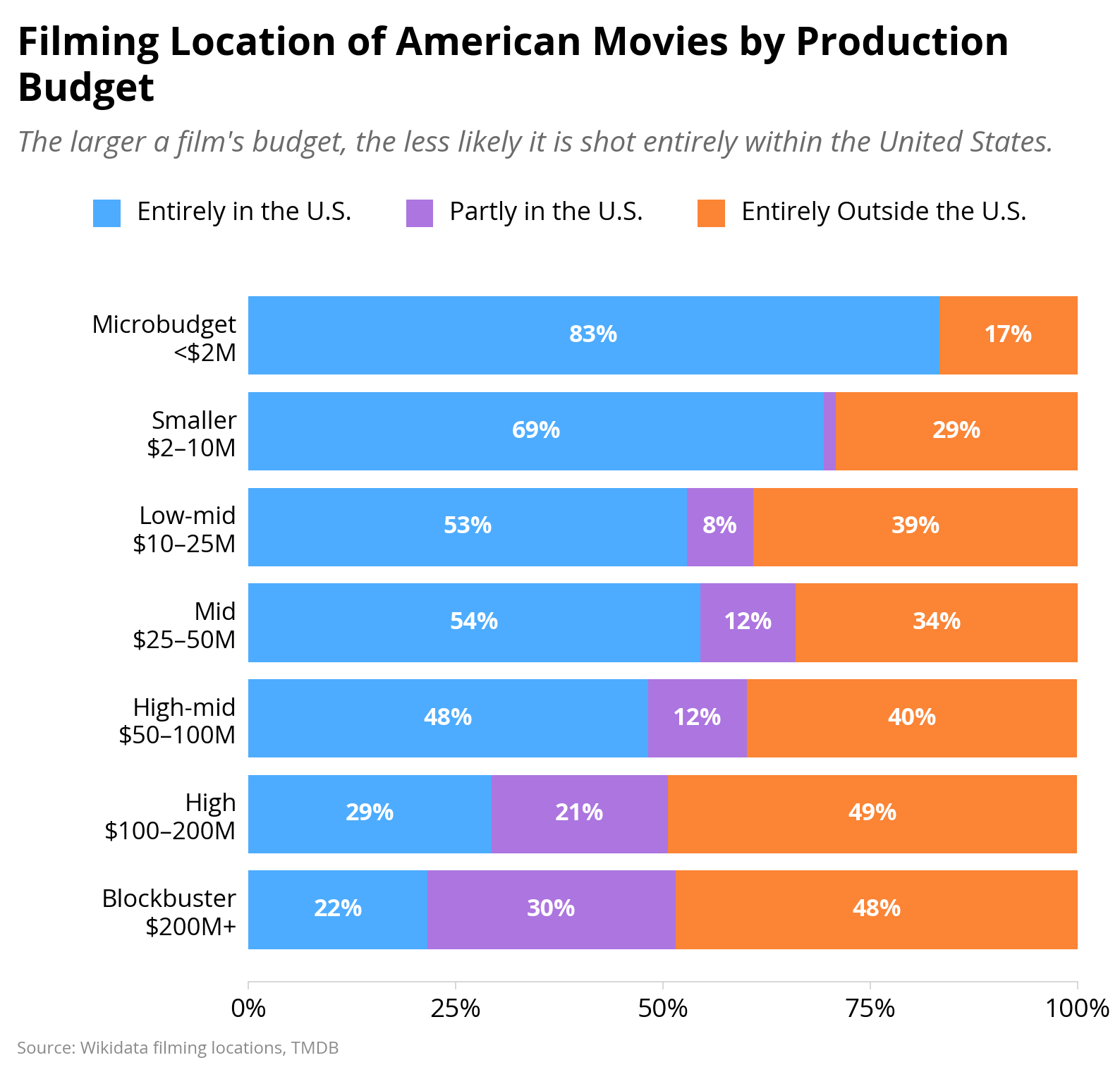
As such, the larger a film’s production budget, the more likely it is to be filmed entirely outside the United States.
In some cases, this globe-trotting appears directly on screen, like when Mission: Impossible stages an elaborate car chase through Rome. In other cases, location choice is driven entirely by financial considerations.
The latter trend has created a widening gap between where stories are set and where they are filmed, as productions increasingly follow tax incentives and lower costs rather than narrative necessity.
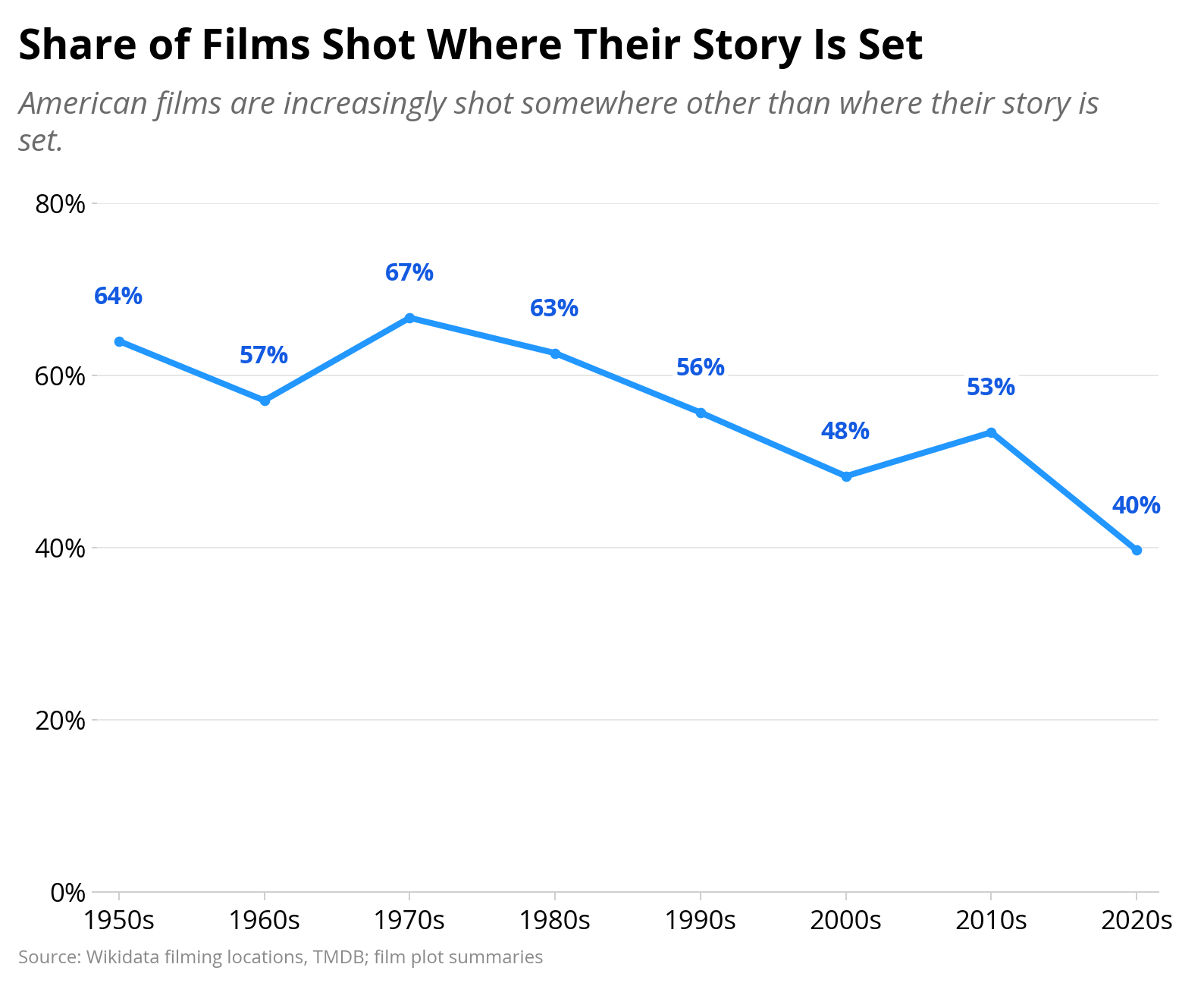
Look closely, and you’ll spot Toronto’s skyline standing in for New York, or Prague’s streets masquerading as nearly every other European city. With each passing year, filming locations have become untethered from the places depicted on screen.
This disconnect has become a persistent grievance among film critics, particularly when it comes to streaming movies shot far from their narrative setting. Nearly every week, the hosts of my favorite movie podcast complain about some disposable Netflix rom-com ostensibly set in New York but unmistakably filmed in New Orleans. After hearing this criticism ad nauseam, I began to wonder whether shooting on location actually has a discernible impact on a film’s quality—at least in the eyes of viewers.
As a cinema purist, I believe movies should be filmed where they are set, even when that setting is outer space. Most audiences, however, either cannot tell the difference or simply do not care.
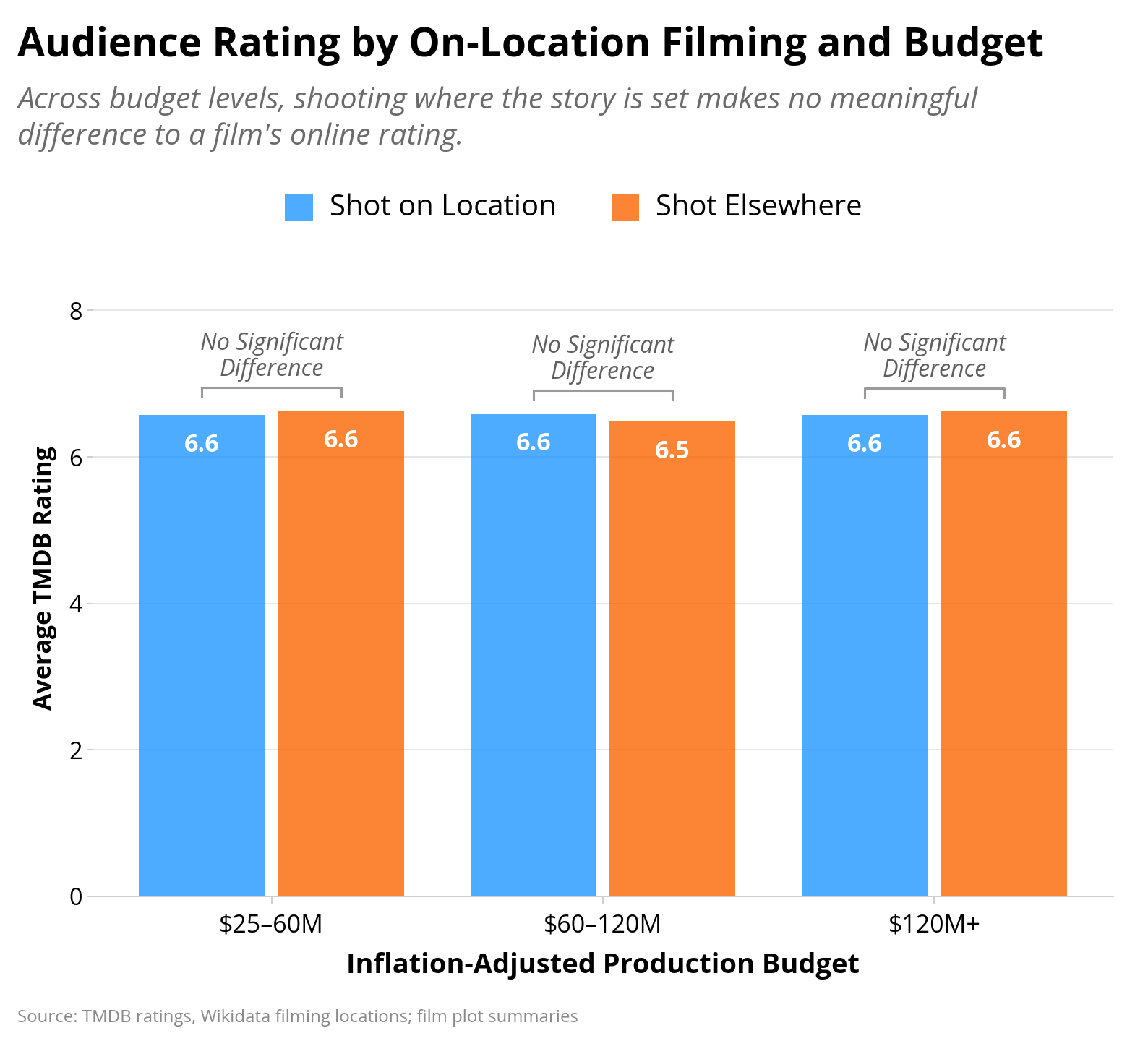
Perhaps I have gone to great lengths to prove something studio executives already know: the average viewer is not scrutinizing every frame for telltale glimpses of the Toronto skyline. More likely, they are glancing at Instagram while the film’s protagonists laboriously explain the plot for the narrative comprehension of multitasking viewership—at which point the authenticity of the location becomes irrelevant.
Enjoying the article thus far and want more data-centric pop culture content?
Final Thoughts: Cost Disease

My junior year of college, I scored an internship at Conan O’Brien’s late-night talk show. So, like Miley Cyrus circa 2009, I hopped off the plane at LAX with a dream and an unpaid internship.
Within a week, I’d discovered three things:
Entertainment internships are often glorified daycare for the children of industry executives: I could be classified as many things, but “nepo baby” is not one of them—which made me an exception among my intern class.
There was no work to do: The show had far more interns than meaningful tasks. I never even earned the privilege of fetching coffee.
The Warner Bros. backlot was eerily empty: I had grown up on movies like The Player and Singin’ in the Rain, where Hollywood appeared as a bustling factory of overlapping productions squeezed onto compact studio lots. Instead, I found emptiness.
This combination of things led to a bizarre summer where me and a posse of underutilized unpaid interns wandered a near-vacant Warner Bros. studio as if it were the Backrooms. This meant hanging out in the Central Perk set from Friends or cart-racing other interns from The Ellen DeGeneres Show on the street where they filmed Gilmore Girls.
My lasting impression was that Hollywood had become a collection of offices where white-collar workers decided how the sausage got made, while remarkably little sausage was actually being made there.
It was also during this summer that I learned of the hazards of cost disease.
Cost disease is an economic phenomenon in which labor-intensive industries with limited productivity gains—healthcare, education, live theater, filmmaking—become steadily more expensive over time. The quintessential example of this is Broadway, where the cost of living in New York City increases, leading wages to rise, but there remains a fixed set of theaters for Broadway shows to be staged, thereby limiting revenue growth. The end result is economic unsustainability, as these productions either curtail spending by employing fewer people or pass higher costs along to consumers through ticket pricing, often both.
My summer in LA was cost disease in miniature. I was paid exactly $0 to relocate to Los Angeles, where I then paid thousands of dollars to live in America’s third most expensive city. And this was the very bottom rung of entertainment’s corporate ladder.
Higher up the corporate hierarchy, cost disease takes different forms. For entry-level assistants, it means accepting low wages and paying high rent for the possibility—however remote—of eventually joining the executive class. For camera crews and VFX artists, it means becoming part of a traveling circus that chases tax incentives to Atlanta, Prague, and Vancouver. For studio executives, it means making do with smaller crews, outsourcing production overseas, and, eventually, using AI to replace some human labor.
If this has all drifted into bummertown, it’s because many of Hollywood’s problems can be traced back to a single economic theory of everything: the rent is too damn high. From there, everything else starts to unravel.
The end result is a peculiar version of Hollywood: a place increasingly devoid of physical production, populated instead by executives, AI art, and unpaid interns drag-racing golf carts through empty studio streets.
Enjoyed the analysis? Support Stat Significant and unlock the data behind the insights.
Become a paying subscriber to get bonus graphics, interactive dashboards, downloadable datasets, and to support independent journalism.
Paying subscribers get:
Bonus Data Stories: Full access to the Monday Roundup, a bonus edition with extra culture data stories, curated datasets, and recommended reads.
The Public Dataset Directory (Updated Weekly): A curated directory of public datasets from around the web.
Interactive Data Hubs: Interactive dashboards across Streaming TV, Movies, Music, Search Trends, Wikipedia, and more.
*Note: For best results, open this link in a web browser while logged in to your Substack account.
Want to promote your data tool or media publication to Stat Significant’s 26,200 readers? Email daniel@statsignificant.com
Need help with a data problem? Book a free data consultation
Connect with me on LinkedIn if you want to chat about a data project.
Like movies? Follow me on Letterboxd
It’s always so fascinating to learn how incentives completely unrelated to creative choices shape culture. I wonder how many iconic artistic decisions from classic movies (or even songs, fashion, etc) are actually just economic choices in a trench coat
Interesting piece.
Your closing discussion of Baumol’s cost disease caught my attention because it points toward an argument I have been making for nearly three years now -> the economic endpoint of generative AI in the arts, and especially in music, is the obsolescence of the body.
You do not make that claim, although you mention studios eventually using AI to replace “some human labor.” The word “some” is doing quite a bit of work there, lol.
Baumol’s classic string quartet example exposes exactly what is happening, as a quartet cannot become more productive without changing the nature of the activity itself. Making music is necessarily constrained (hence the “disease” labeling). Four people must inhabit the duration of the music together, and, of course, they bring their collective individual decades of study to get to that point. Generative AI exists to solve this cost “disease” by removing those bodies and collective histories and producing hyper-scalable simulations of the resulting sound, whose economic objective is to capture the anxious, directionless attention of a mass population seeking attention and witness.
My concerns, research, and writing on this topic do not lie in the employment segment of this. I argue music’s meaning arises from our encounter with an embodied act unfolding in time. Generated music preserves the audible signs of such an act while severing them from the act itself. As I wrote in a recent essay, AI-generated music is smoke without the originating fire. I am not trying to be cute; the semiotic and epistemological stakes are civilizational here.
I also learned when I got my grad degree in Public Administration with a focus on economics that there are solutions to this that do not portray a string quartet as “diseased,” but they would require changing the structural relationship of value. I was surprised in my studies that almost every single modern ailment we move through today, such as the unsustainable cost of housing and the idea that an unpaid internship is morally fine, has already been solved, and it is just that we choose to live this way rather than choose to live in another way.