

Welcome back to the Monday Roundup!
The Monday Roundup is a bonus edition featuring data-driven culture stories, curated datasets, and recommended reading. Given the strong response to this format, I’ll be publishing it weekly for the foreseeable future.
Your regular Wednesday essay stays free for everyone—this is strictly additive.
Today’s edition has six new data stories. Free readers get the first two; paid subscribers get the full thing, plus datasets and recommended reading. Enjoy!
In Today’s Roundup:
Original Data Stories: YouTube’s surprising gaming dominance, the IMAX boom, why hit tracks have a small army of songwriters, whether Disney’s live-action remake machine is losing steam, what Love Island reveals about reality TV’s low hit rate, and how Count Binface became Britain’s viral political star.
Recommended Reads: Notable data journalism and pop culture reads from around the web.
Unique Datasets: Ten publicly available datasets, covering everything from television episode plots to Pitchfork album reviews to eight decades of New York Times articles.
Trend 1: YouTube Is for Gamers
I recently built a Google Trends equivalent for YouTube to quantify the terms that most frequently appear in the site’s top videos. My initial guess was that this list would feature newly released trailers, music videos, and sports highlights. In essence, I was expecting data reflective of my YouTube homepage. But, as is always the case, my predictions never align with the zeitgeist.
In fact, when I reviewed my initial output, I barely recognized 50% of the top terms. And thus I found a new way to feel old. That’s because I am not, nor have I ever been, a gamer, and the most frequently used terms on YouTube revolve around gaming.
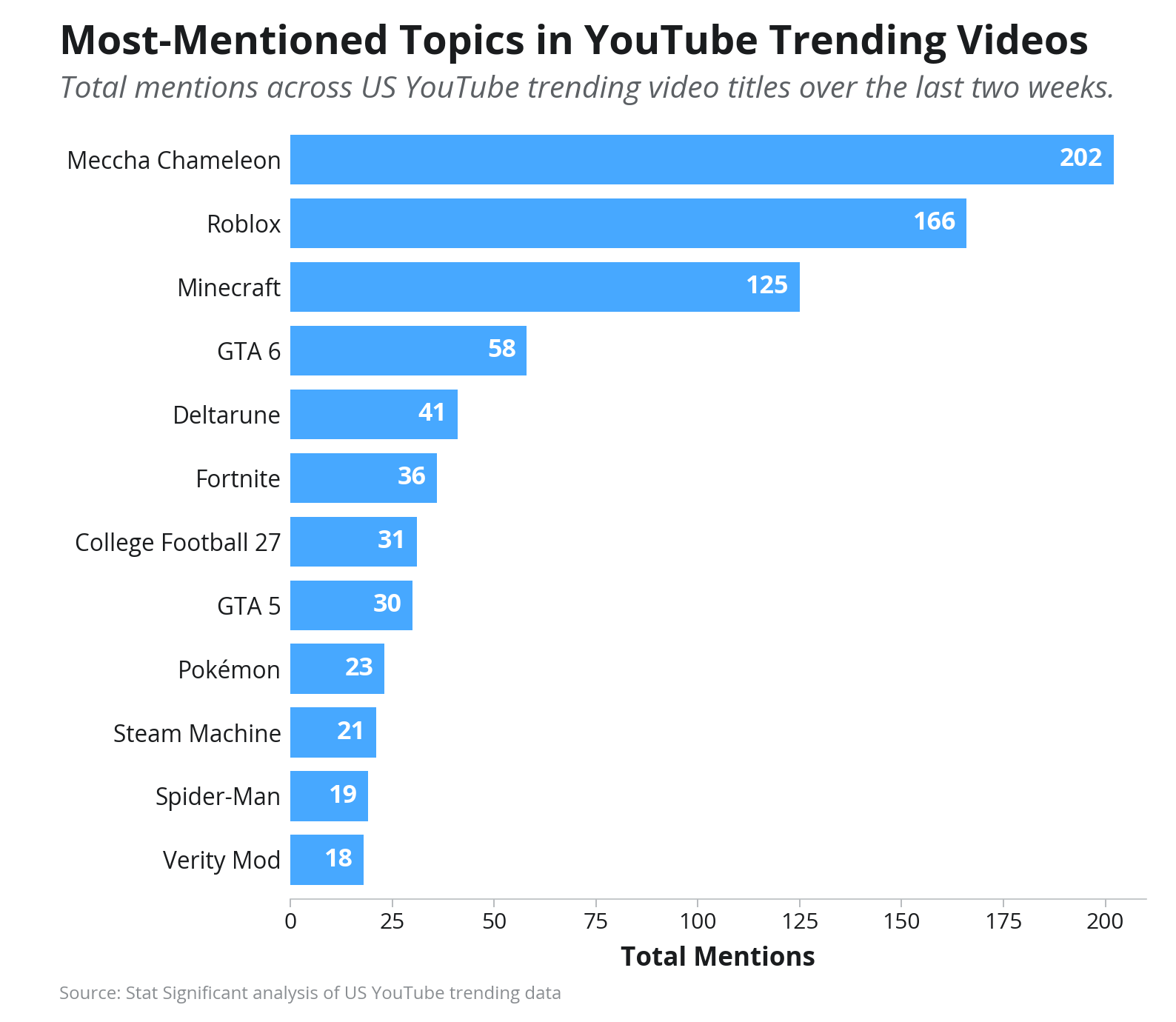
At first, I assumed this to be a mistake. But when I looked at the site’s top trending videos over the last few months, gaming content comprised anywhere between 55% and 70% of all entries.
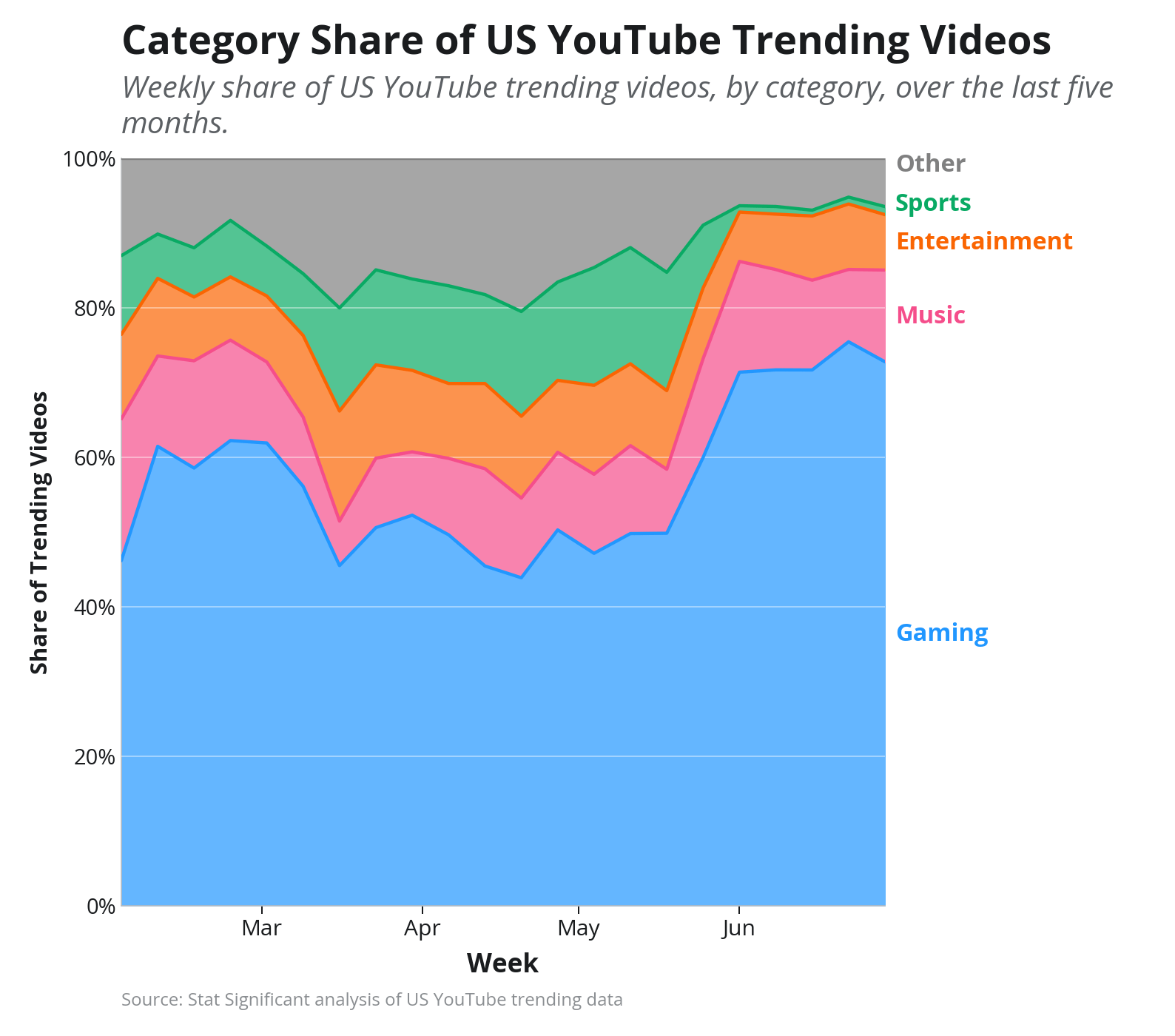
In short, the most popular content on YouTube involves another person playing video games or hearing their hot take about a video game.
In fact, YouTube is the top destination for gaming discovery by orders of magnitude, above dedicated gaming platforms like Twitch or Discord.
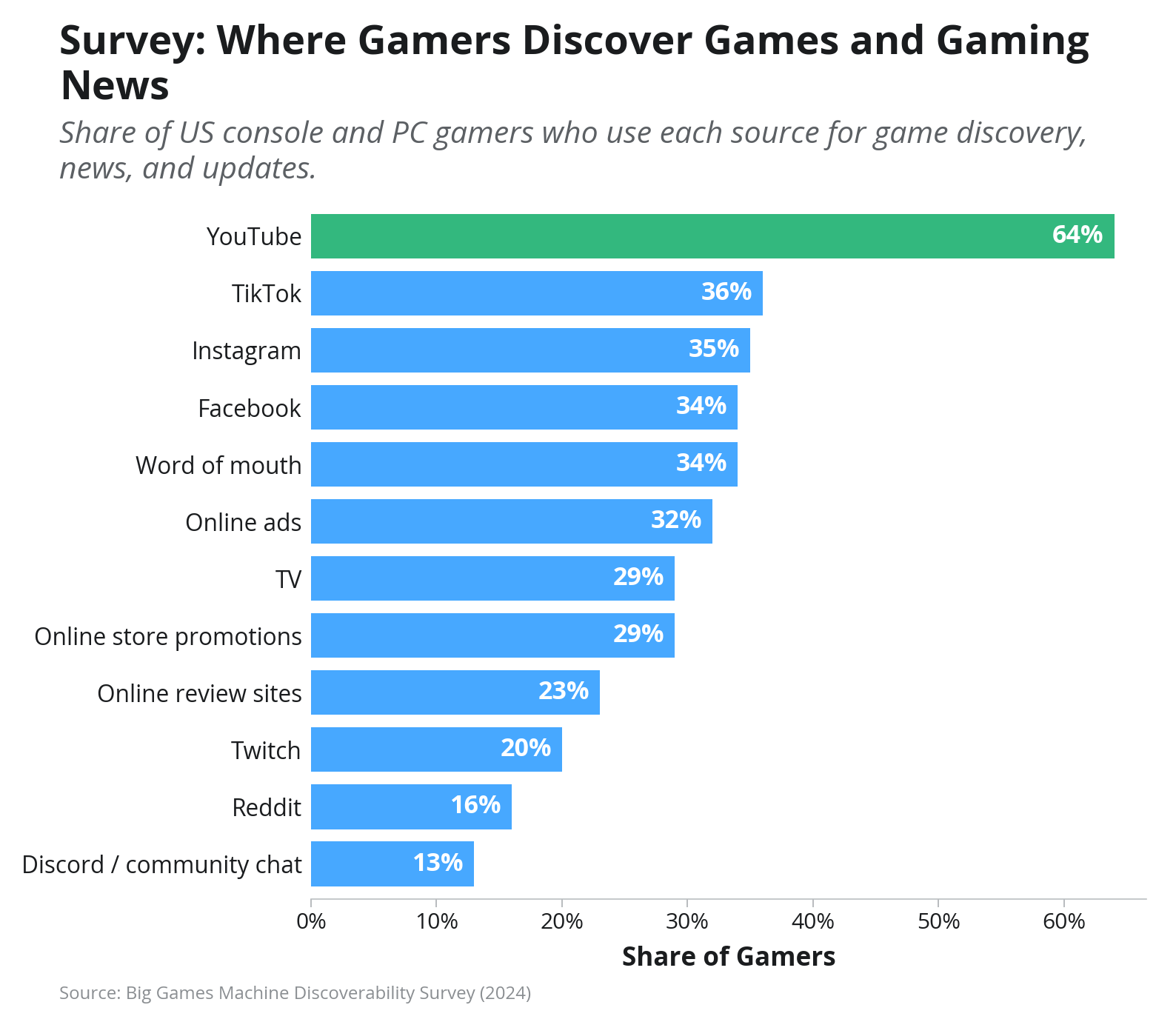
To many, this fact is painfully obvious. To me, this was the find of the century.
The takeaway—and I pretty much believe this is always the takeaway when it comes to YouTube—is that the platform can be anything for everyone.
YouTube is the top place to go for gaming content, just as it’s the foremost destination for movie trailers, sports highlights, music videos, podcasts, late-night talk show clips, and videos of celebrities eating chicken wings.
Trend 2: IMAX Is the Present and Future of Moviegoing
Running a movie theater is brutal. You are essentially a middleman with little control over the product you sell. Your job is to create an experience compelling enough to lure people away from their living rooms—all while containing costs, relying on relatively low-wage labor, and competing with every other conceivable form of entertainment. Given those constraints, how can theaters sustainably grow when they do not control the movies themselves?
One of the few levers exhibitors do control is the viewing experience: the size of the screen, the quality of the sound, and the spectacle of the presentation. Over the past decade, theater chains have increasingly invested in premium formats such as IMAX, Dolby Cinema, and 4DX, offering audiences something they cannot replicate at home. And if premium formats had their own Super Bowl, World Cup, or Paris Fashion Week, it might look something like the recent release of Christopher Nolan’s The Odyssey.
Since the pandemic, premium formats have become an increasingly important selling point for moviegoing. They are now on track to account for roughly 17% of U.S. ticket sales this year, up from 10% in 2019.
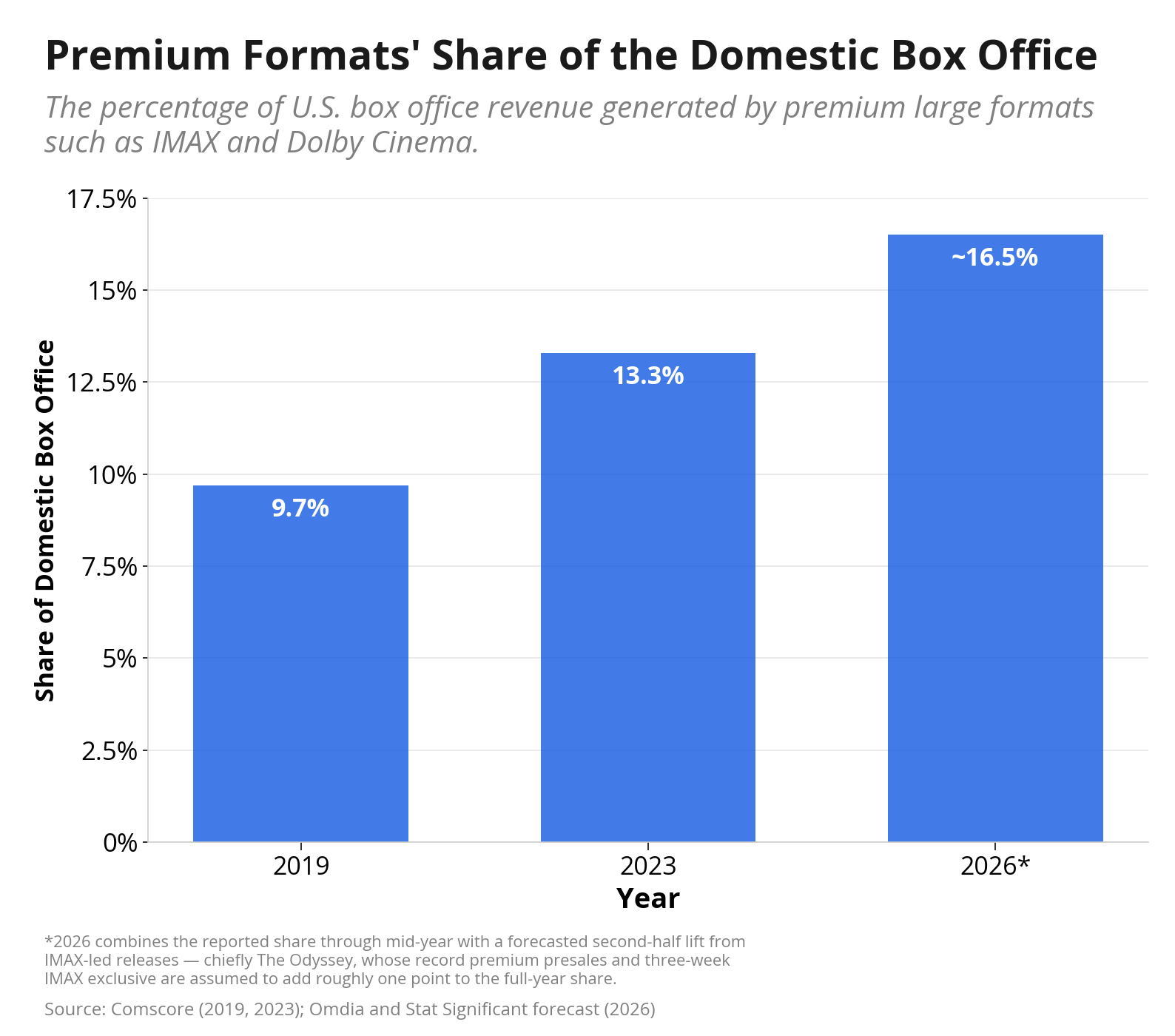
These formats also command significantly higher ticket prices, allowing exhibitors to grow revenue even as overall attendance declines.
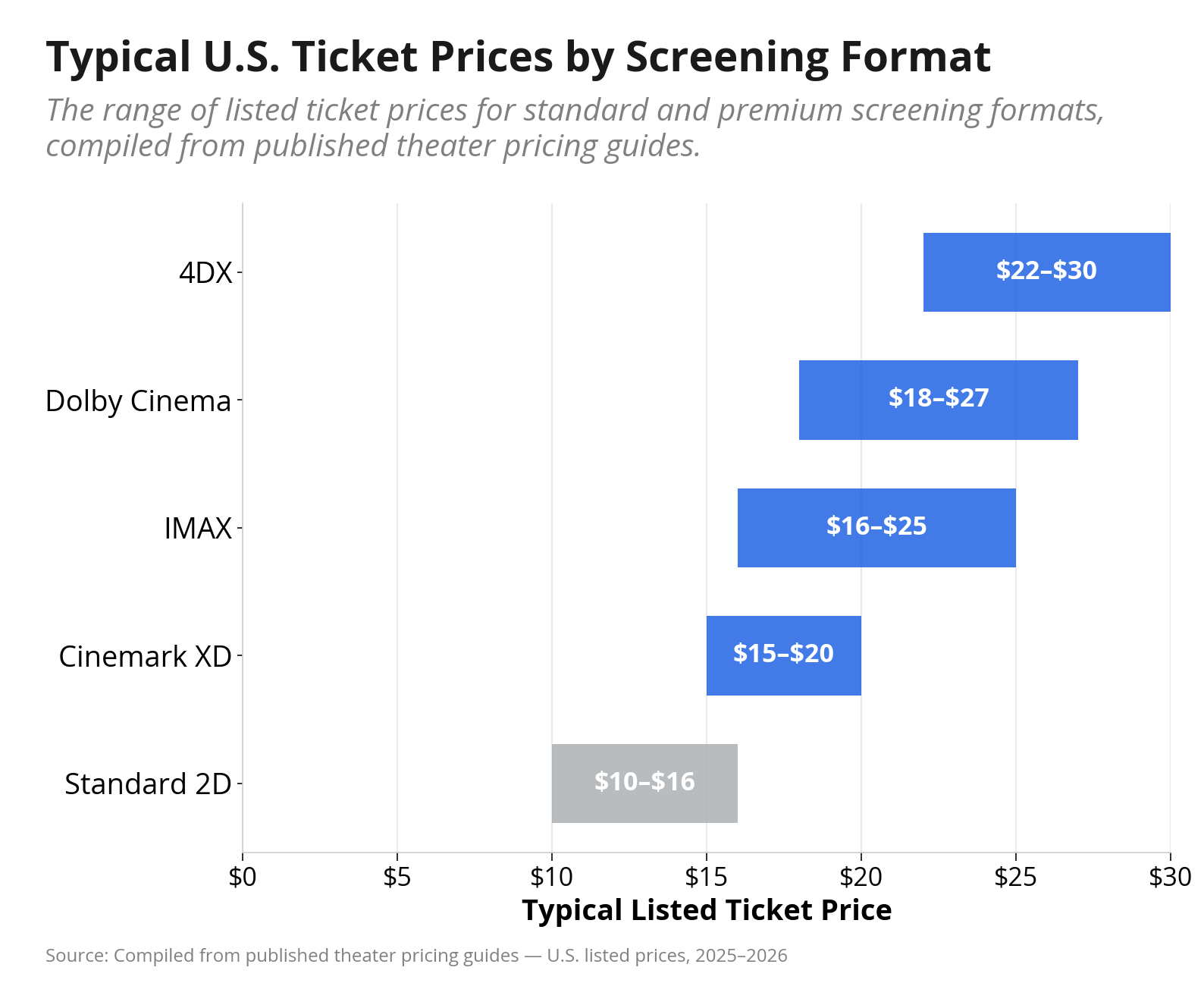
The greatest obstacle to this strategy is scarcity. There are only so many IMAX screens, and building one requires substantial upfront investment—an especially difficult proposition for debt-laden theater chains and independent exhibitors operating on thin margins.
Still, this appears to be the direction moviegoing is headed. Do not be surprised if, 50 years from now, every theater is effectively an IMAX theater, forcing exhibitors to invent an entirely new premium tier to promote. They’ll call it Double IMAX, Triple IMAX, or Double-Triple IMAX 360+.
Trend 3: How Many Writers Does It Take to Make a Hit Song?
The 1970s saw the rise of the singer-songwriter, a genre headlined by the likes of James Taylor, Carole King, and Cat Stevens. If you wanted a nice lullaby to sing to your child, these were your go-to artists.
The process behind these hit songs was decidedly straightforward: artists wrote and performed their own tracks, and the end result was a unique product of that individual author-performer.
Today, very few, if any, songs have a single songwriter.