

Intro: The St. Elsewhere Snow Globe
Before there was The Pitt or ER, there was St. Elsewhere. Premiering in 1982, St. Elsewhere was one of the first modern medical dramas, chronicling the eccentric chaos of St. Eligius, a struggling Boston teaching hospital. In its time, the show was critically beloved, though its legacy is inseparable from one of television’s most divisive finales.
In the final minutes of the final episode, the show abruptly cuts to an alternate reality in which a lead character (Dr. Donald Westphall) appears not as a doctor but as a construction worker. His son Tommy Westphall, who is autistic, sits nearby staring at a snow globe. Inside the snow globe is a tiny replica of the very same St. Eligius Hospital, implying that the entire show existed in the boy’s imagination. Yikes!
Longtime fans were apoplectic: the preceding 136 episodes had been rendered meaningless—a thing TV viewers generally dislike. Despite overwhelming backlash, St. Elsewhere’s finale has endured within popular imagination. And nowhere is the show’s twisted legacy more apparent than in the Tommy Westphall Universe.
The Tommy Westphall Universe is a pre-Internet fan theory that imagines most television shows taking place inside the mind of St. Elsewhere’s Tommy Westphall. The Westphall Universe’s logic goes like this: because characters from St. Elsewhere appeared in crossover episodes for Homicide, and Homicide connects to the Law & Order universe, both shows can be attributed to Tommy. If you allow this web to keep expanding, then programs like Cheers, M*A*S*H, and Chicago Hope all exist within the mind of a child. Ultimately, St. Elsewhere’s finale was so baffling and widely disliked that fans built a satirical TV reality to make sense of their disappointment.
Four decades later, television has changed dramatically, reshaped by streaming and a clearer understanding of what makes for a satisfying conclusion. But has this institutional knowledge led to better endings? Have showrunners learned from the mistakes of St. Elsewhere, Game of Thrones, and other finale fiascos?
So today, we’ll investigate whether omniscient showrunner Tommy Westphall has gotten any better at sticking the landing, how finale quality has changed in recent decades, and whether finality is simply a structural weakness of television itself.
Do Most TV Shows Stick the Landing?
To assess the quality of television endings, we’ll compare each show’s IMDb finale rating with its average rating across earlier, non-final seasons.
For House of Cards, this calculation would go something like this:
Average episode rating across first five seasons: 8.44
Episode rating for the series finale: 2.6
Finale’s difference from the show baseline: –69.2%
From there, we’ll sort each series into one of three buckets:
Exceeds Expectations: The finale scores at least 10% higher than the show’s typical episode rating.
Meets Expectations: The finale scores within 10% of the show’s typical episode rating, in either direction.
Disaster: The finale scores at least 10% lower than the show’s typical episode rating.
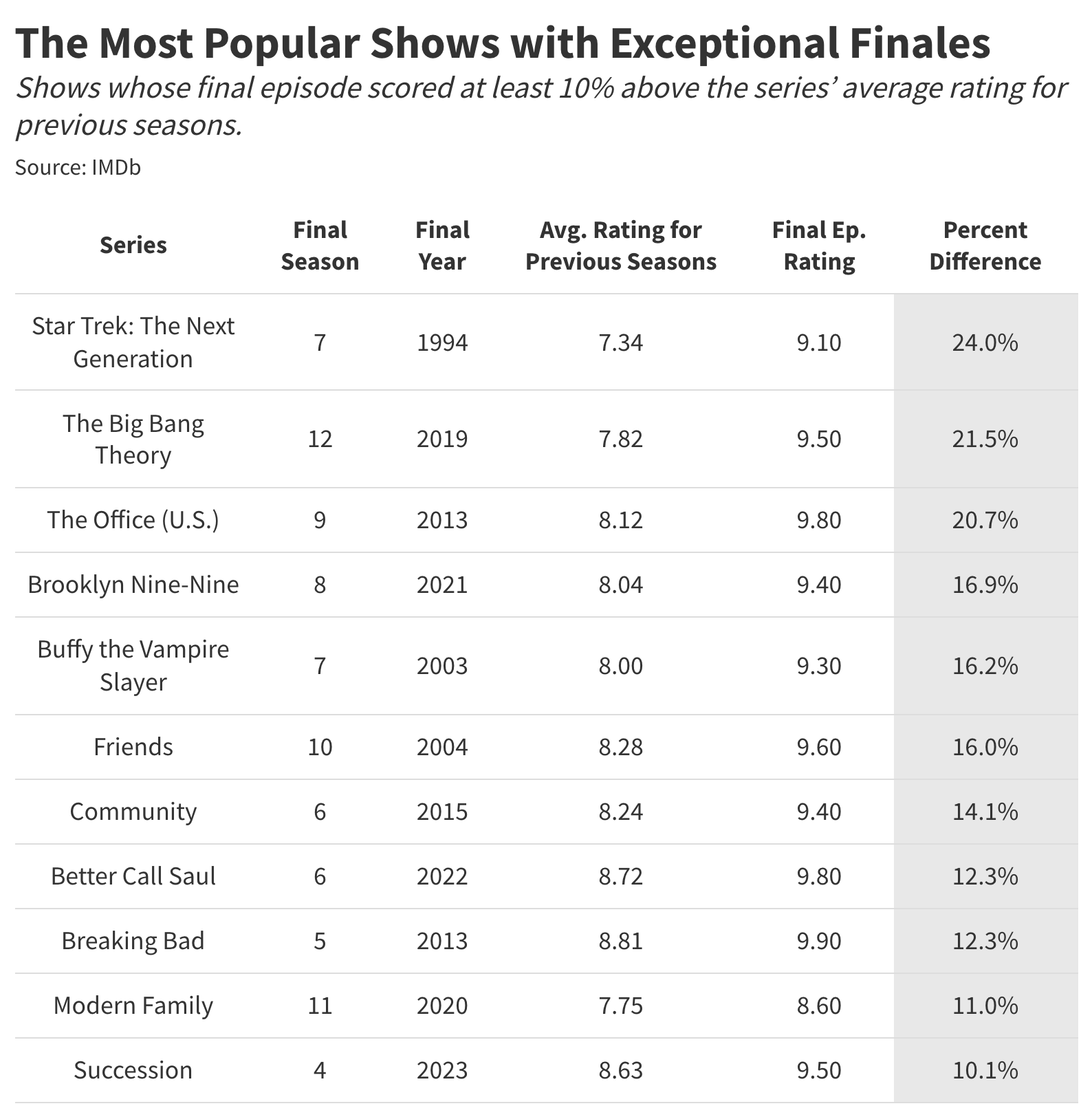
To see this approach in action, consider the most popular “Exceeds Expectations” finales in recent memory, a list headlined by The Big Bang Theory, The Office, and Breaking Bad. Each of these shows ended on a high note, deepening viewer appreciation for the series as a whole.
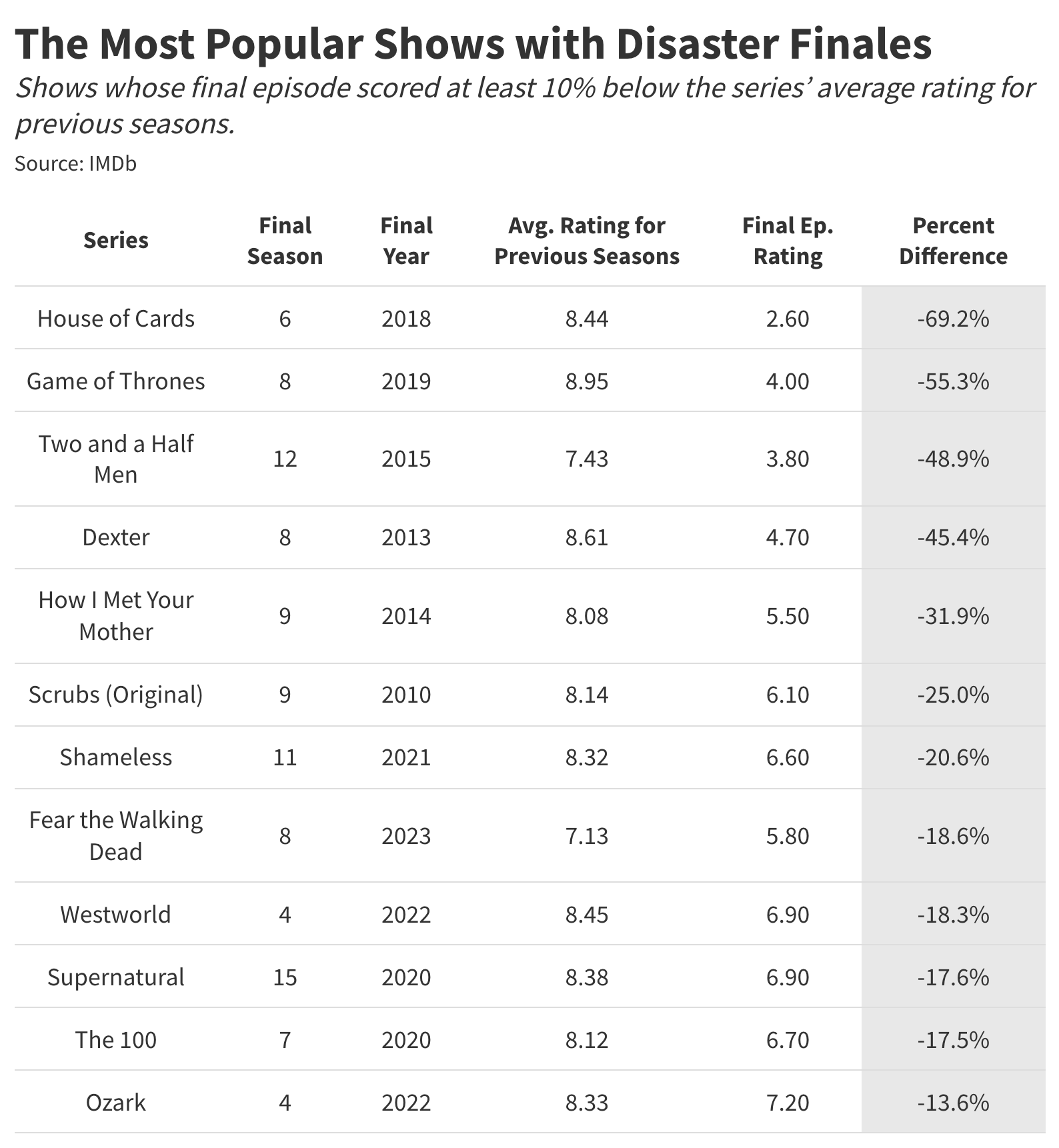
And then there are the disaster endings: finales so deflating they make you question whether you should ever trust a TV show again. Somehow, I’ve been a fan of almost every series on this list, and can verify that these finales ruined my day, and sometimes my week. Game of Thrones, How I Met Your Mother, Dexter—I wish I had missed these endings because of a root canal or multi-day DMV appointment, or both. In fact, a root canal performed at the DMV could not surpass the ill will I have toward the finale of How I Met Your Mother.
Using our finale-quality metric, we can evaluate every series with a meaningful digital footprint to answer two key questions:
Do most shows end on a high note?
Have showrunners gotten better at sticking the landing?
The answers to these age-old conundrums are 1) “kind of” and 2) “yes.”
Across television history, 68% of finales meet expectations, 10% qualify as disasters, and 22% exceed viewer expectations. Better yet, finales appear to have improved over the past half-century, as disaster endings have become less common and exceptional conclusions have grown more frequent.
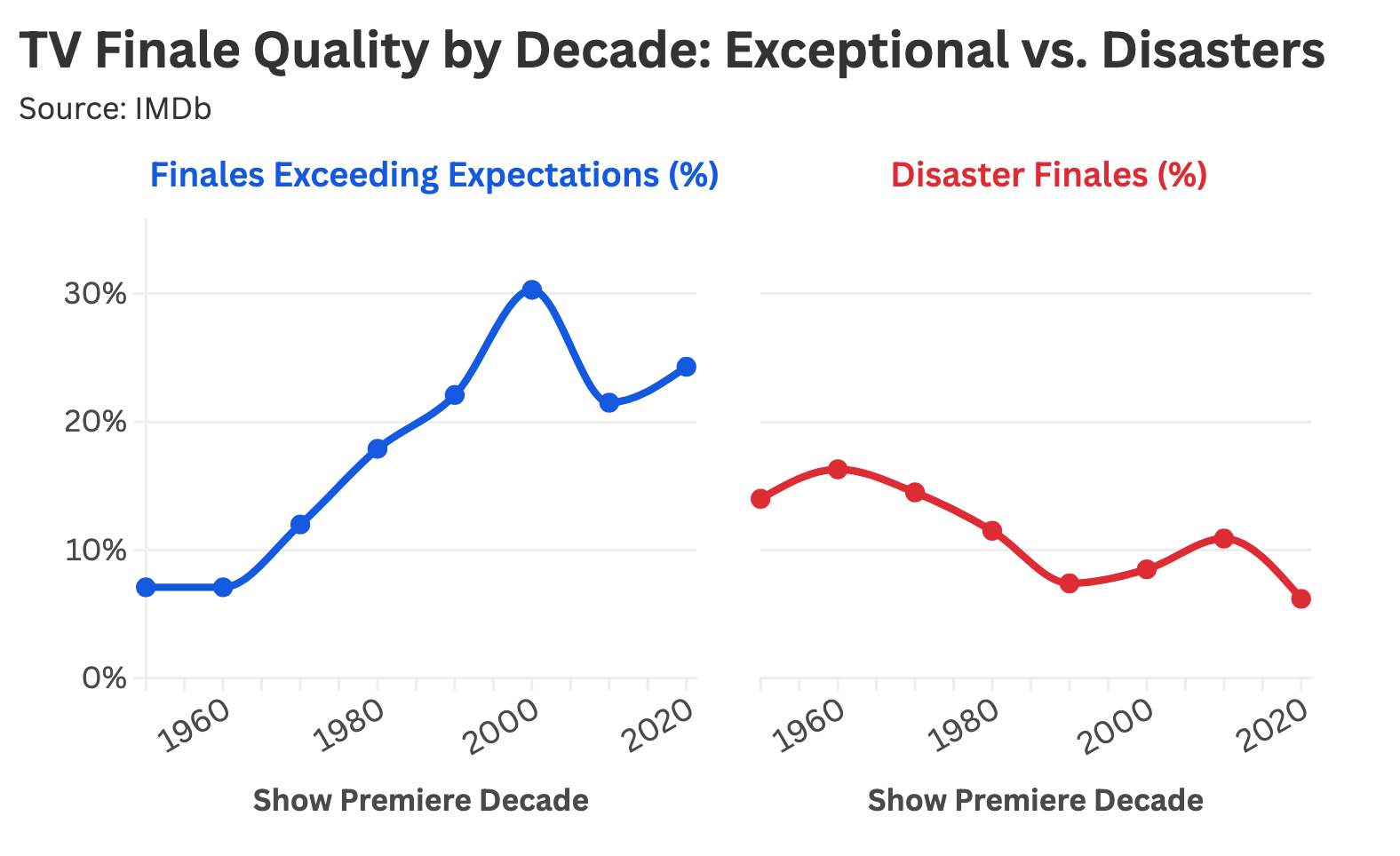
Television appears to have made meaningful progress in the art of endings, which raises a simple question: why?
The answer centers on program longevity, or rather, lack thereof.
How satisfying or enraging a finale feels depends heavily on when a show calls it quits. And paradoxically, the longer a show runs, the more likely its ending is to land at one of two extremes: exceeding expectations or imploding under the weight of them.
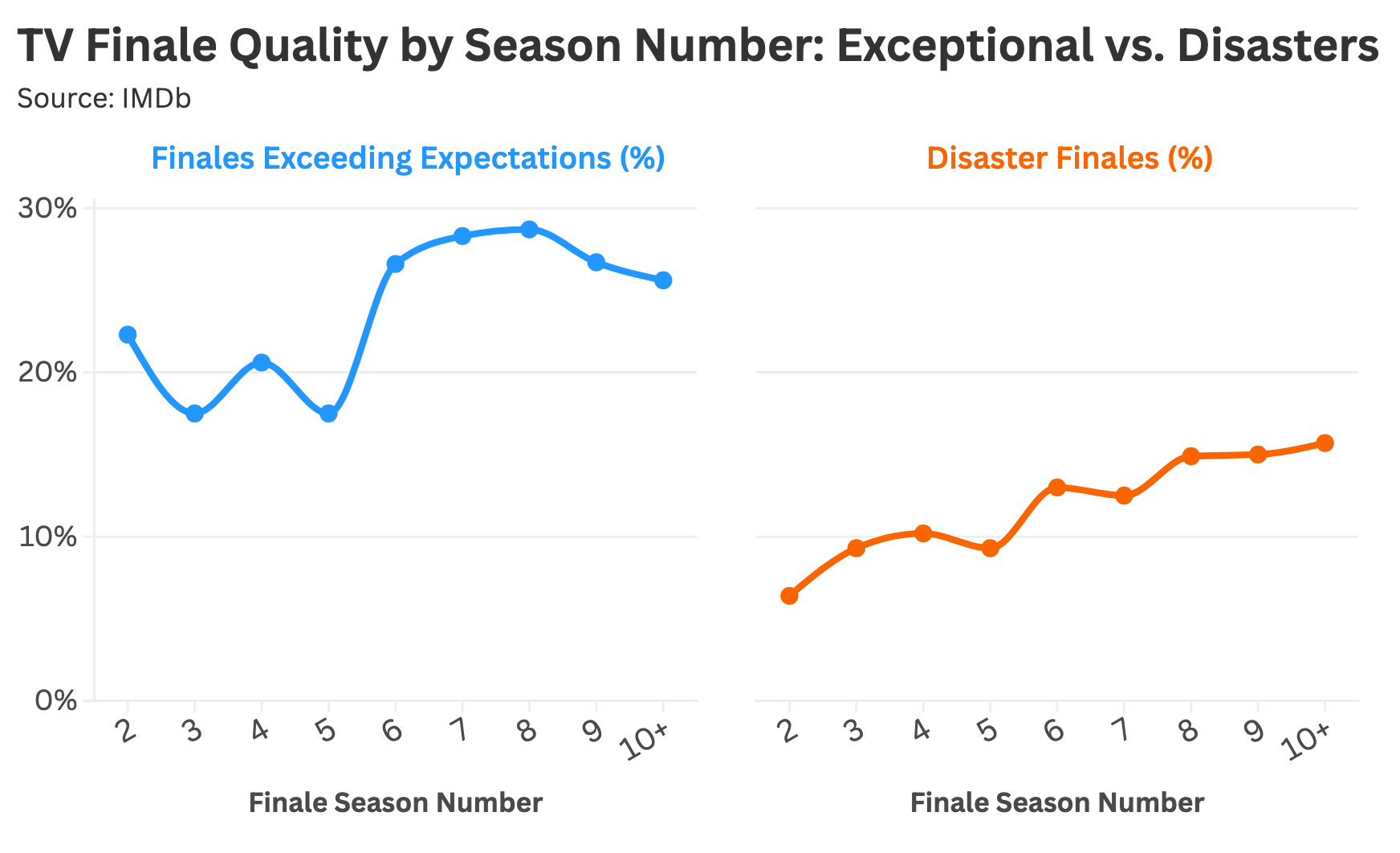
The greater fan investment—across years, sometimes decades—the stronger their reaction.
Before the streaming era, this narrative volatility was further compounded by the punishing pace of network television. Long-running hits from the 1980s and 1990s were mined for every last ounce of content: Cheers ran 11 seasons, ER ran 15, and M*A*S*H ran 11, each producing 22 episodes a year.
Week to week, episode quality could vary wildly. And nothing captured this uneven output better than “sweeps week.” In brief, “sweeps” were four Nielsen rating periods, traditionally held in November, February, May, and July, during which selected households recorded their viewing habits for Nielsen to tally. These results were then used to determine advertising rates.
As a result, showrunners were incentivized to create spectacle. They brought in buzzy guest stars, engineered cliffhangers, staged weddings and deaths, and produced novelty episodes that broke from a show’s normal rhythm.
What I always found strange about “sweeps week” was the implication that TV shows could simply choose to try harder. For a few weeks each year, every series became more dramatic, more expensive, and more desperate for attention, while the other 18 episodes received 75% of max effort.
Today, no such concept exists: shows run fewer seasons and feature fewer installments per season. Every episode matters.
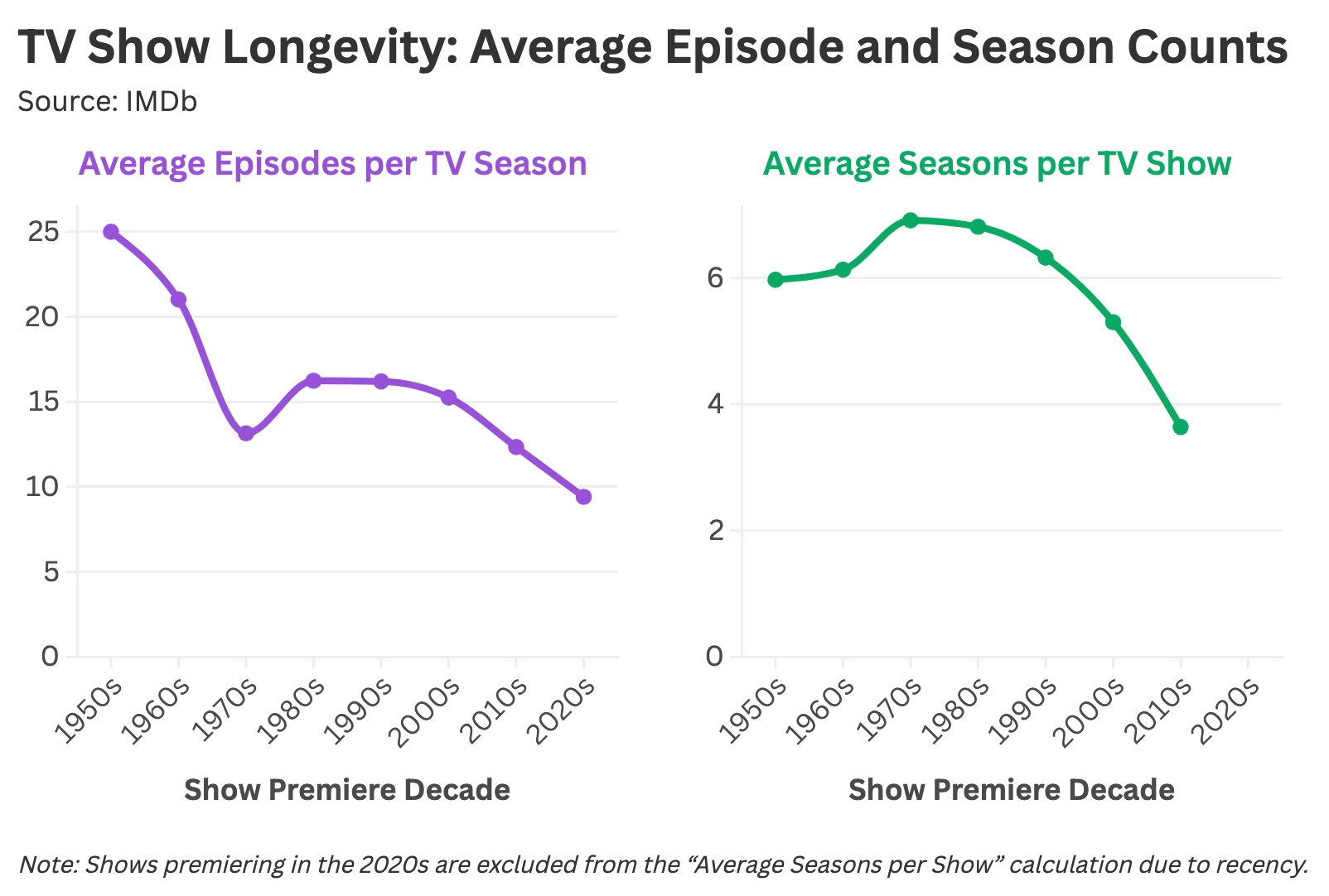
And when a series does run longer, it has usually survived a much tougher gauntlet.
Among shows launched before 2022, we find that fewer programs make it to a second season, but those that do tend to produce better sophomore installments.
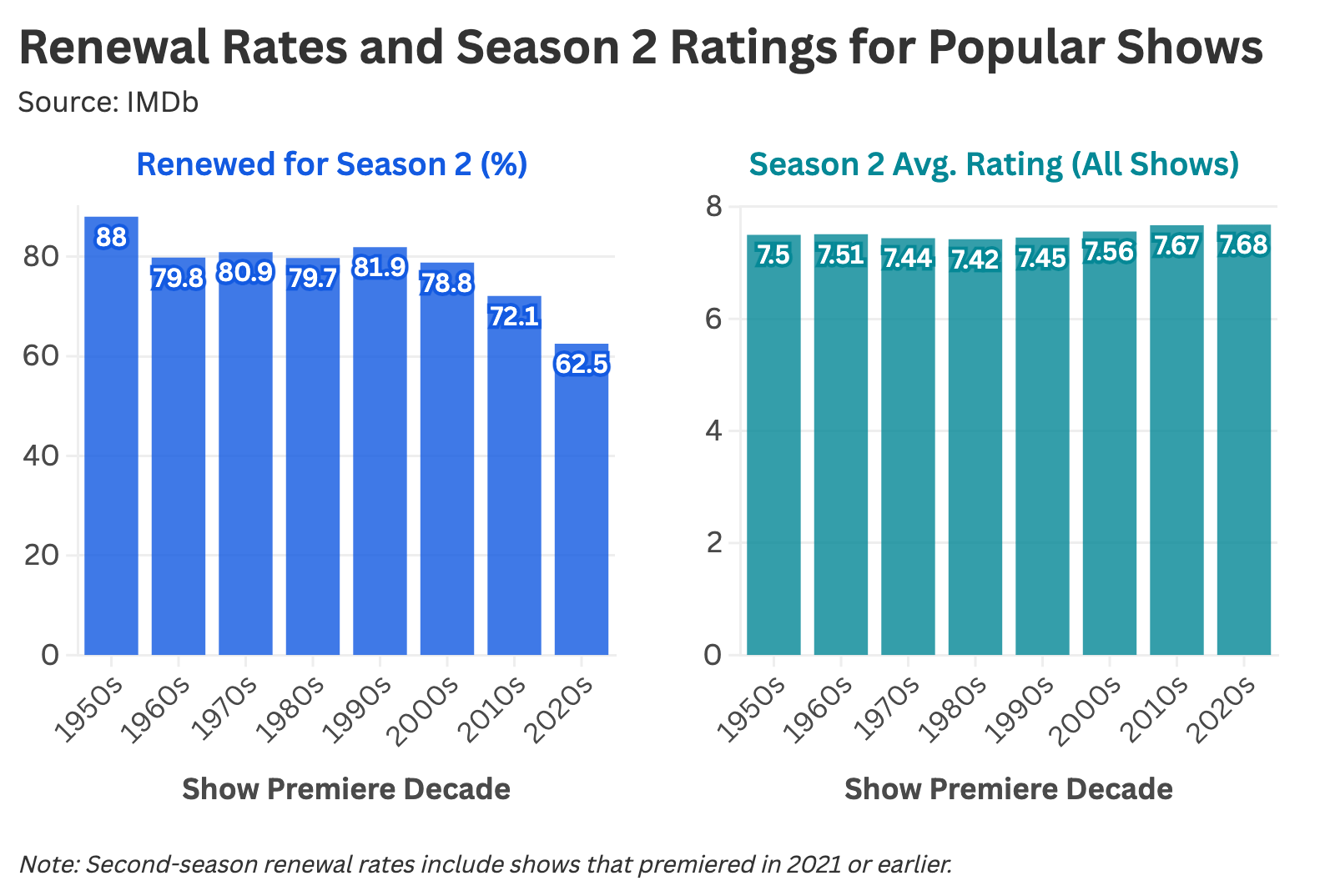
Taken together, these trends produce stronger finales: shows are less likely to linger for 11 seasons before limping toward an unsatisfying conclusion, and when a series does earn a second, third, or fourth season, its endurance is a testament to its quality.
Enjoying the article thus far and want more data-centric pop culture content?
Final Thoughts: What About The Pitt?
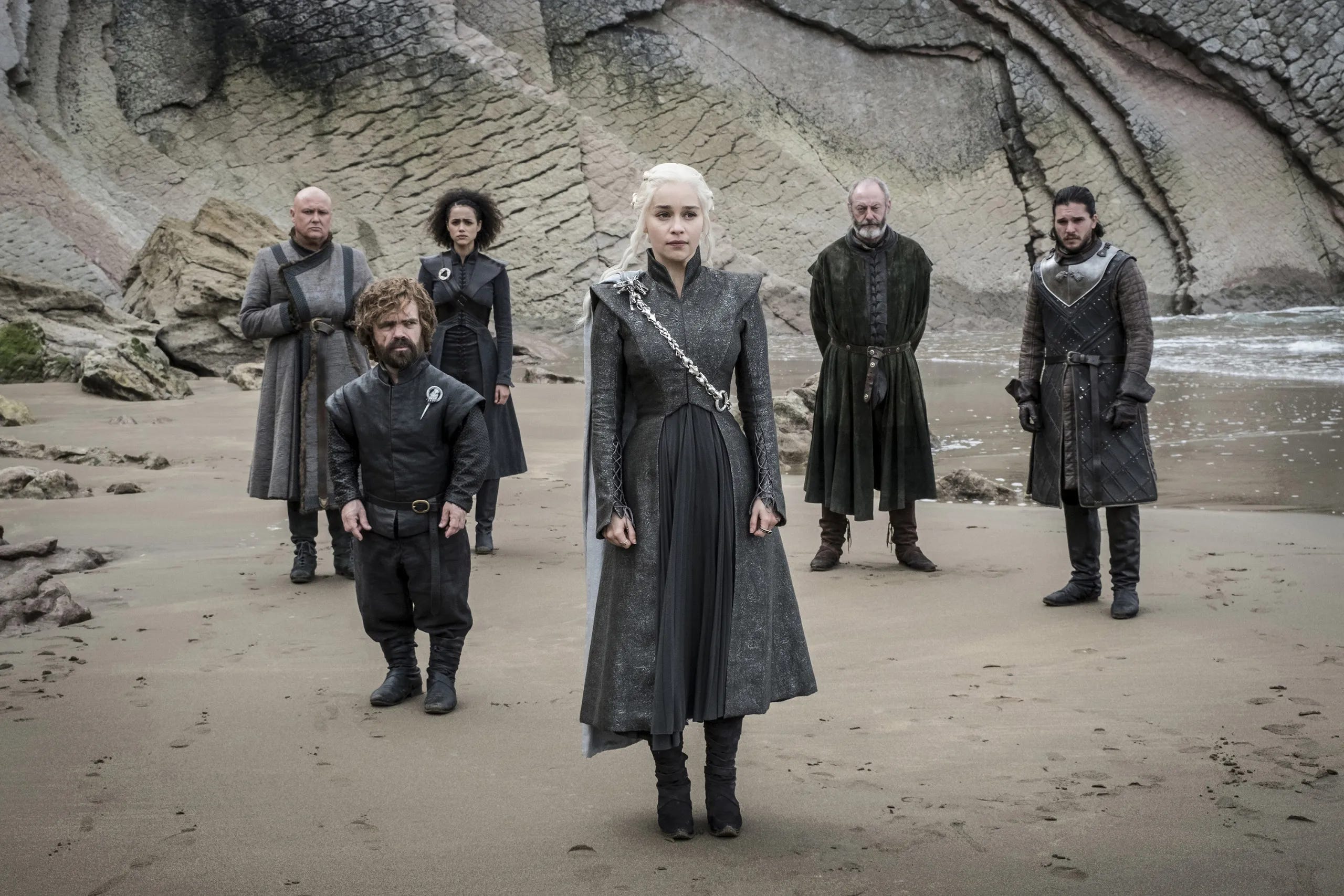
I have only participated in a weekly watch party for one show, and unfortunately, that show was Game of Thrones. By the time I exited adolescence, few series justified real-time engagement; most programs were consumed via streaming or TiVo. Game of Thrones remained the lone exception, for fear of spoilers ruining that week’s episode.
I was late to Game of Thrones, catching up through epic binge-watching sessions on a series of business trips. While I hate assigning emotional resonance to the act of sitting alone in a hotel room, these 5-hour watch sessions were exhilarating. And then the finale happened.
I still remember the collective groan from our watch party as the finale unveiled one of its many frustrating twists. All those hours binge-watching the Targaryens and Jon Snow were retroactively ruined. While I try my best to avoid sunk cost thinking, my Game of Thrones investment will forever feel like an absolute waste.
Such is the agony and ecstasy of television. The longer a show runs, the greater our emotional investment and the more likely it is to thrill or enrage us. A show can run years, sometimes decades, but an outsized burden is placed on its very last episode.
Which brings me to The Pitt, arguably the best show on television right now—or at least my favorite. For some reason, I find simulated leg amputations and mangled limbs deeply satisfying (and apparently I’m not alone). But how much can I give to this show if I have no control over its resolution?
What if:
The series’ main character becomes a villain, moving from ER Doctor to hedge fund manager, determined to drive the hospital out of business.
The show loses its control of tone, and the characters look into the camera and say, “It’s Pitt-ing time!” Whenever an emergency trauma arrives.
The entire series takes place inside a child’s mind as they stare at a snow globe of Pittsburgh.
Maybe the real goal of this analysis was reassurance: a reminder that disastrous endings are relatively rare, even if the worst finales loom large in our collective imagination. More often, a show’s conclusion will exceed expectations, or at least meet them, unless prolific showrunner Tommy Westphall finds a new way to disappoint us.
Enjoyed the analysis? Support Stat Significant, and unlock the data behind the insights.
Become a paying subscriber for interactive dashboards, free datasets, and to support independent journalism.
Paying subscribers get:
The Stat Significant Dataset Hub (Updated Weekly): a collection of free datasets across movies, music, TV, and economics.
Interactive Data Hubs:
Streaming TV: what people are watching on television.
Movies: the films watched in theaters and on TV, plus historical trends.
Music: the songs, artists, and styles dominating Spotify and TikTok.
Podcasts: the most-listened to episodes and series.
Wikipedia: the top pages trending on Wikipedia.
Get access with:
*Note: For best results, open this link in a web browser while logged in to your Substack account.
Want to promote your data tool or media publication to Stat Significant’s 25,800 readers? Email daniel@statsignificant.com
Need help with a data problem? Book a free data consultation
Connect with me on LinkedIn if you want to chat about a data project.
Like movies? Follow me on Letterboxd
Well this is interesting, and counter-intuitive. I would have expected fewer shows to "stick the landing," given how notoriously some endings have been treated. I would have loved to see where the Sopranos landed, as it has arguably one of the most controversial endings ever (oft-parodied, even), though I personally thought it was great.
It’s Pitt-ing time!