

Intro: From Hardware to Hard-Pressed
Prior to 2019, Apple was a hardware company—the force behind the iMac, the iPad, the U2-themed iPod, and so on. But on March 25, 2019, the company surprised both Hollywood and Silicon Valley by announcing Apple TV+, its entry into an extremely crowded streaming market. Unlike Disney or Netflix, Apple had neither a vast content library nor an established production apparatus. Inexplicably, the savvy, trillion-dollar hardware giant became a late entrant to a crowded, cost-intensive streaming battle.
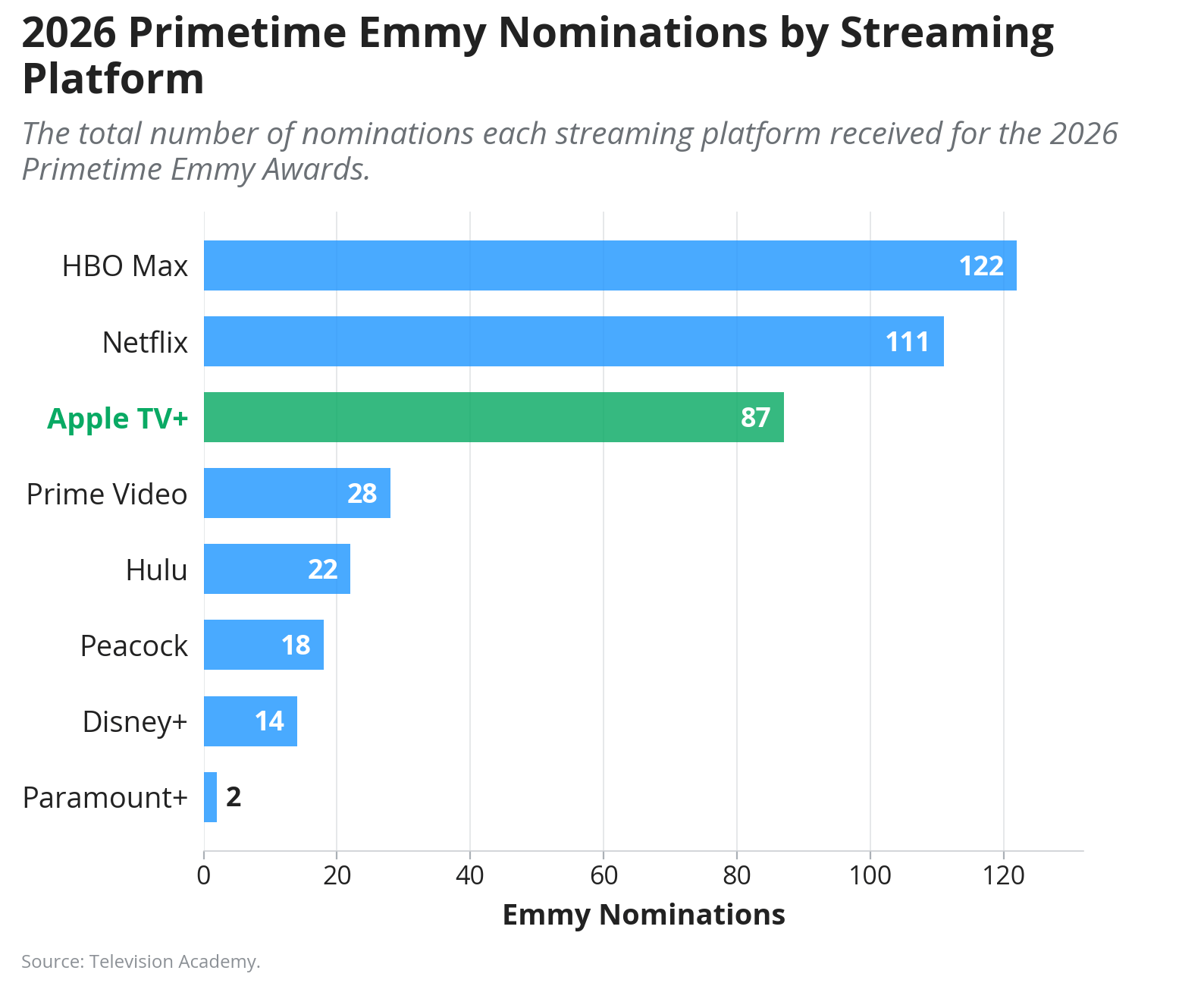
Fast-forward to two weeks ago, when the 2026 Emmy nominations were announced. Alongside returning prestige heavyweights like The Pitt and Hacks was a new crop of Apple TV+ series, including Widow’s Bay and Pluribus, reinforcing the platform’s reputation for producing programming that is both expensive and acclaimed. On paper, 2026 appears to be another triumphant year for Apple’s streaming ambitions. But not so fast. This barrage of Emmy recognition obscures a far less flattering truth for the streamer: despite its critical dominance, Apple TV+ remains one of the smallest platforms in the streaming landscape, struggling to attract a mass audience seven years after its launch.
So today, we’ll examine Apple TV’s remarkable track record, its struggle to gain ground in the streaming wars, and how the world’s most valuable company became an unlikely underdog.
Apple TV+: Prestige Darling, Streaming Loser
When this year’s Emmy nominations were announced, the studios leading the field were familiar award-show mainstays. First came HBO, television’s foremost destination for prestige programming. Next was Netflix, the industry’s most prolific streaming service, releasing hundreds of new shows each year. Then came Apple TV+—a platform with neither Netflix’s vast output nor HBO’s decades-long reputation for quality.
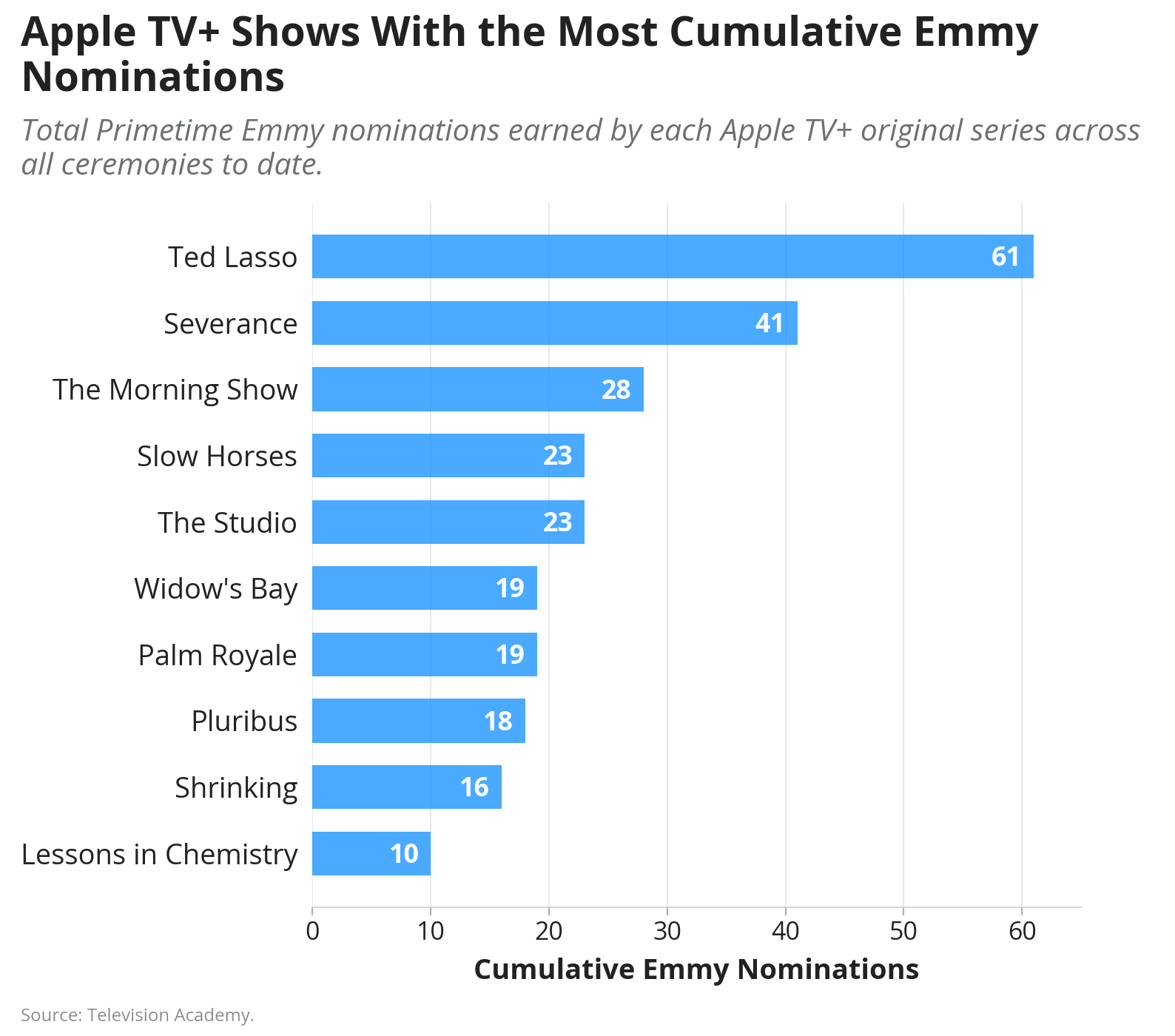
Despite having existed for only seven years, Apple TV+ has produced an impressive slate of original series, including Ted Lasso, Severance, The Studio, and Widow’s Bay. Of my ten favorite streaming shows of the past decade, around ~50% appear on this list.
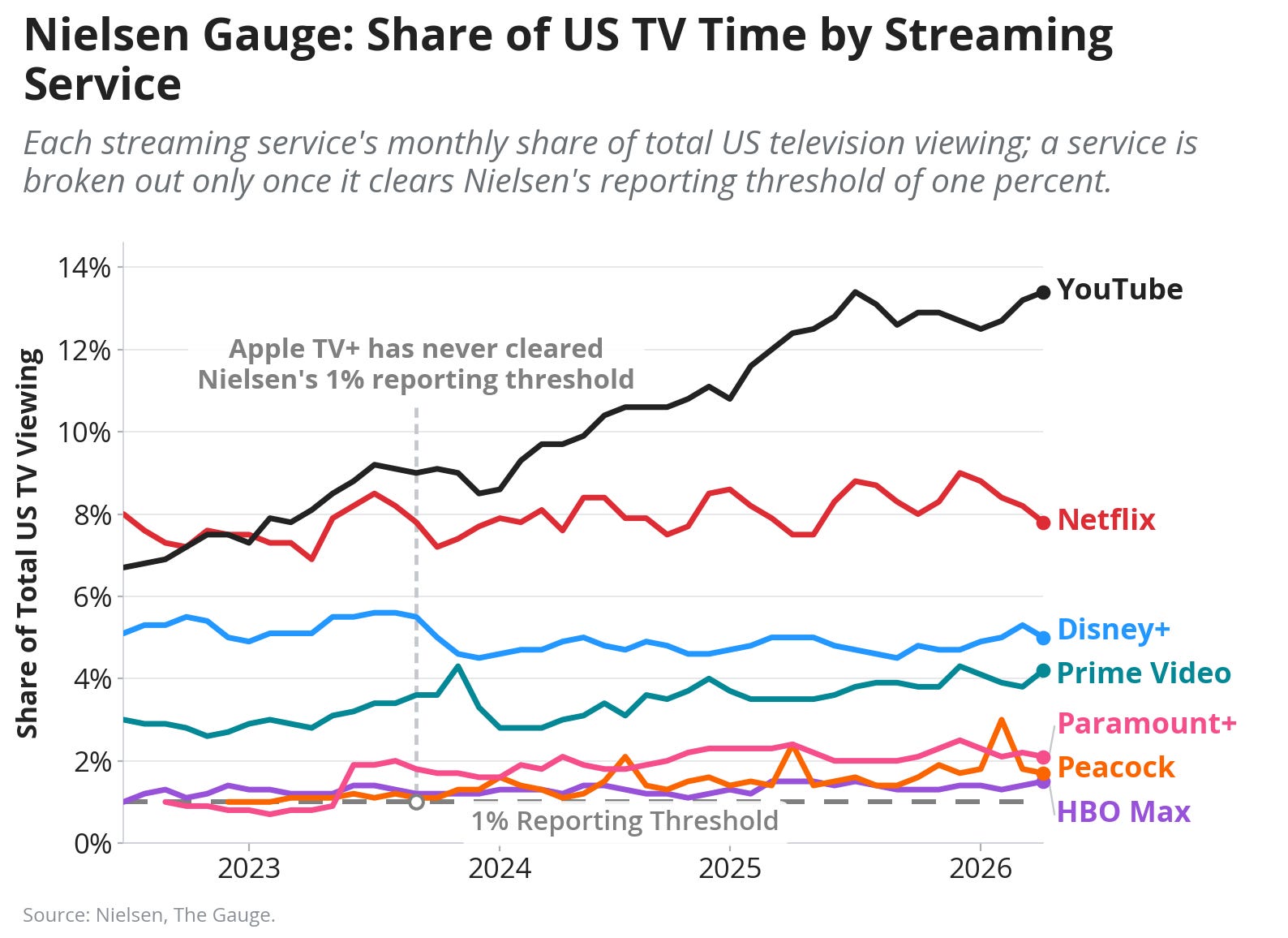
But apparently, I’m one of the few people watching. Apple TV has barely registered in Nielsen’s weekly streaming Top 10 since late 2023, aside from two small spikes when Severance managed to break through.
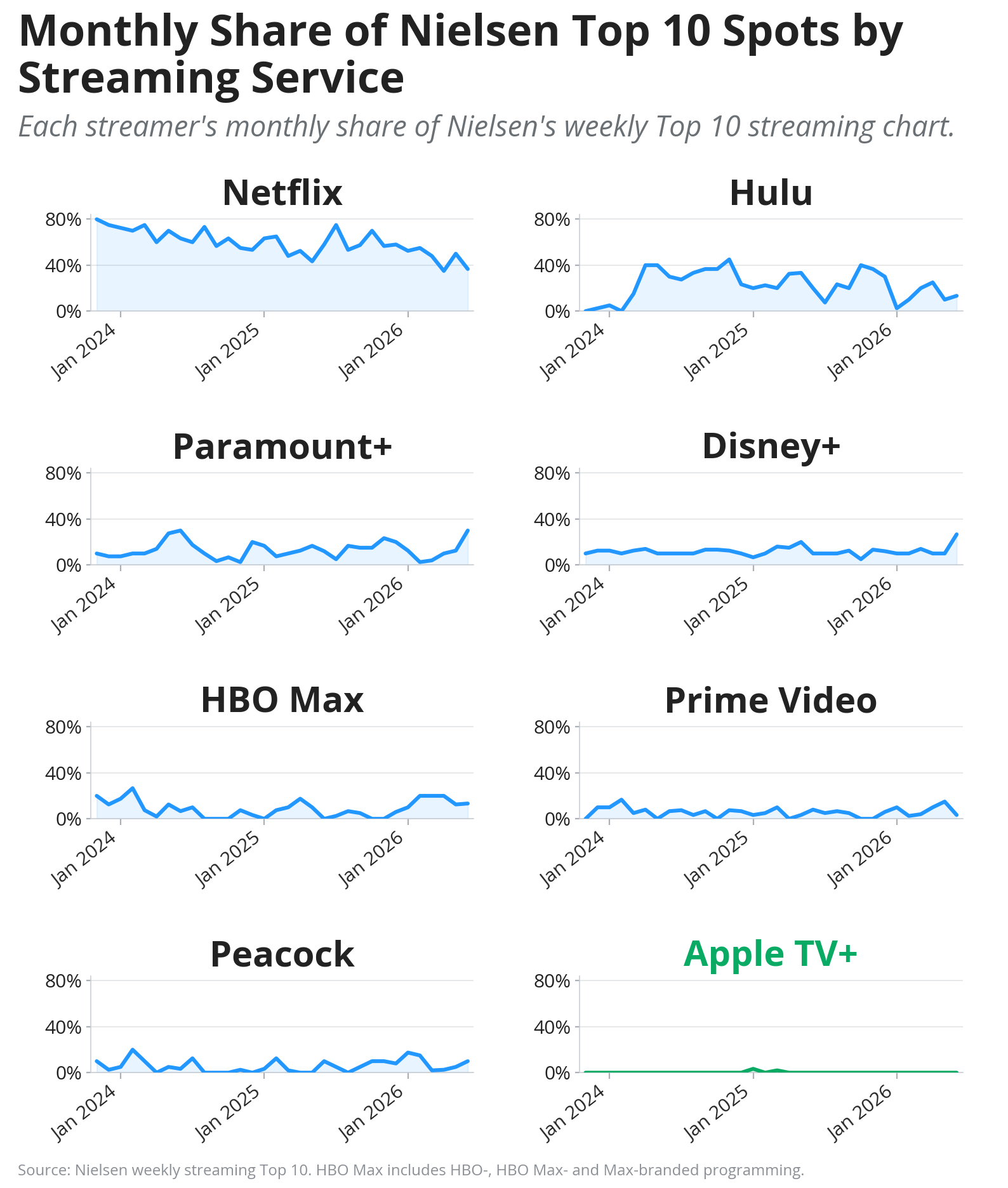
Meanwhile, a streamer like Paramount+, which received just two Emmy nominations this year, is doing just fine, having gone all in on Taylor Sheridan-produced content like Landman and Dutton Ranch—which people actually watch.
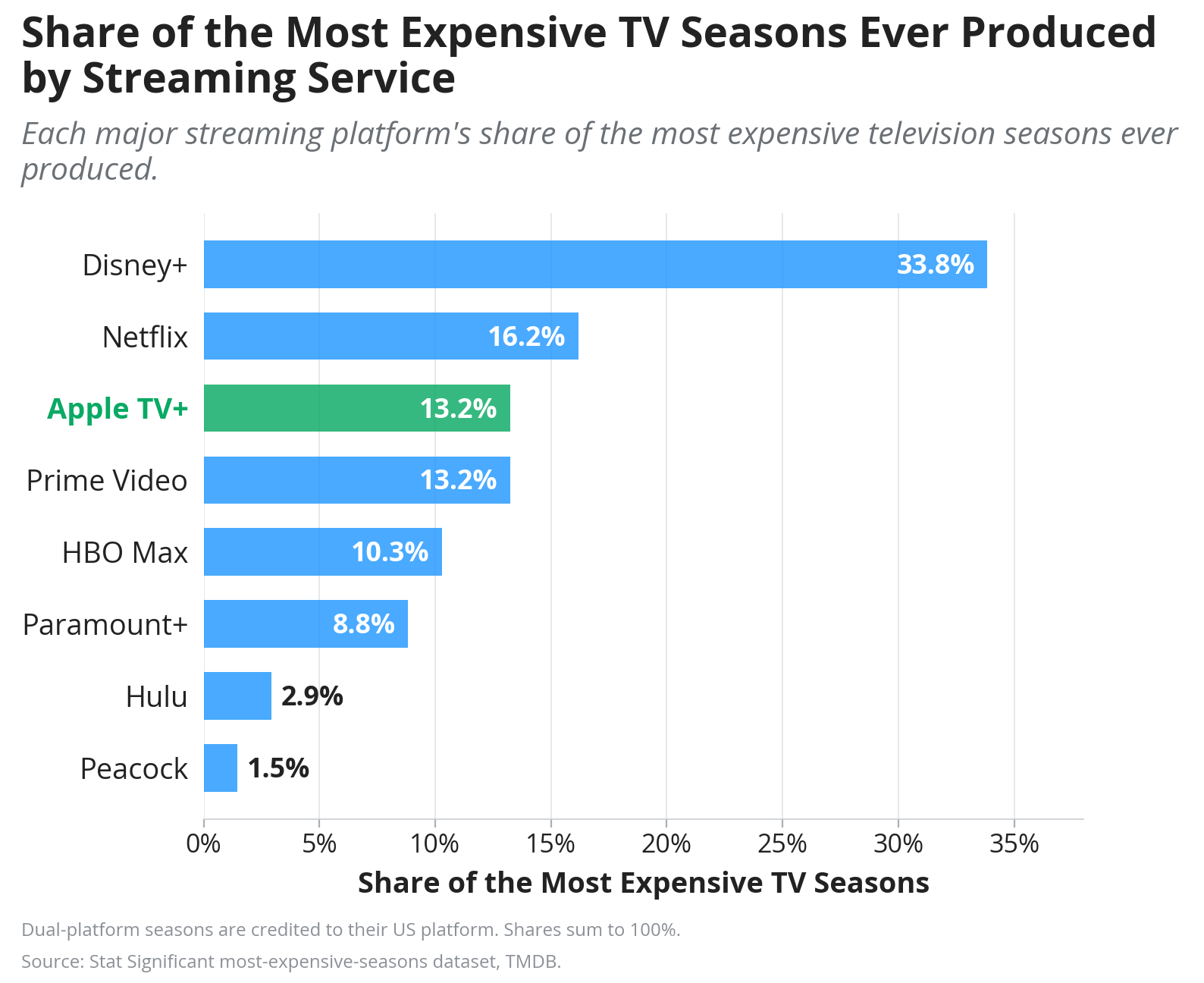
Apple TV+ has largely bought its way to Emmy acclaim. And if you read that last sentence and thought, “Don’t all streamers buy Emmys by spending money on shows?” The answer is “yes.” But Apple really, really wants those Emmys. Despite its brief existence and relatively small slate of originals, Apple accounts for over 13% of the most expensive television seasons ever produced, placing it third overall, just behind Netflix.
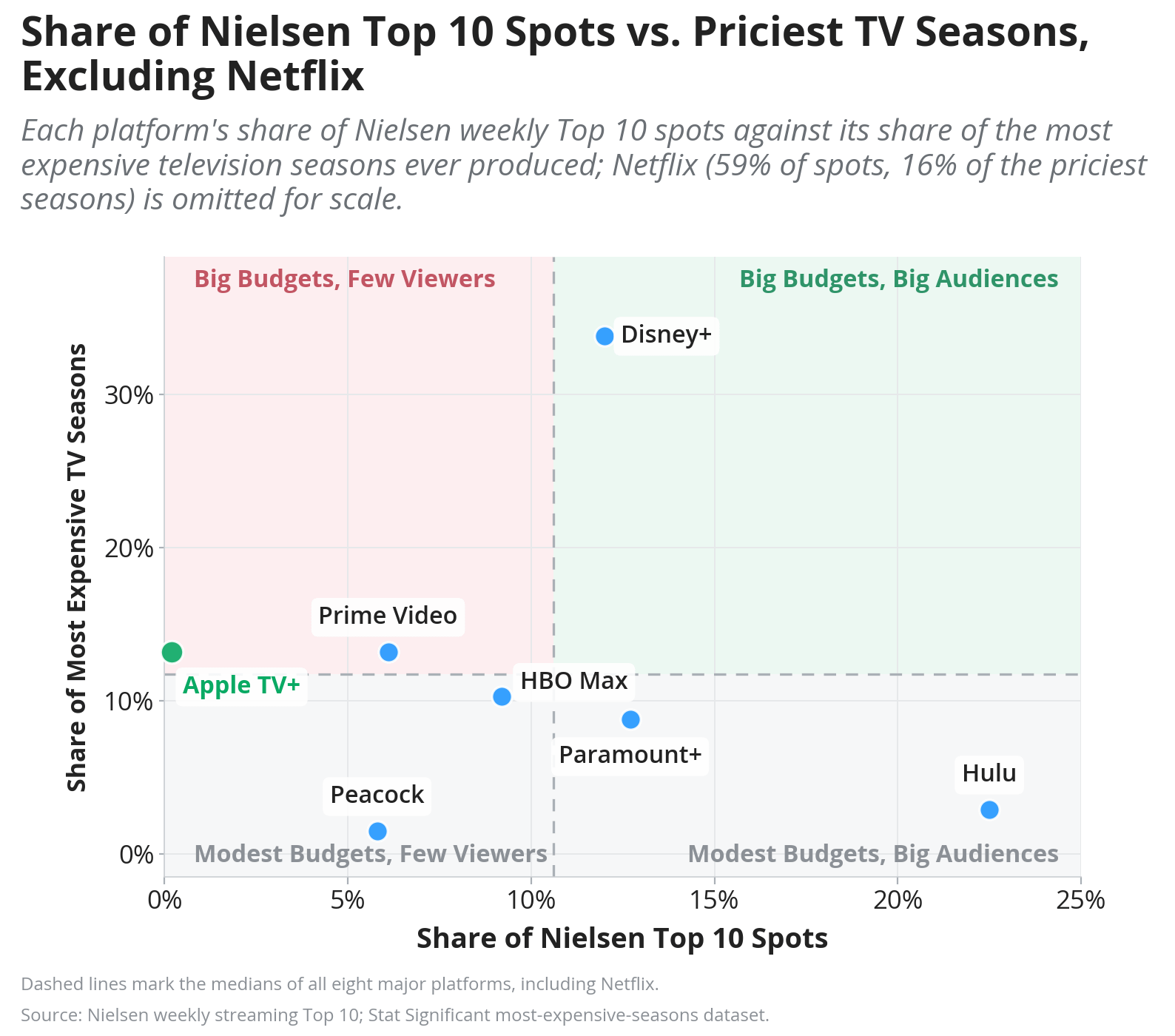
Plotting each streamer’s share of expensive television seasons against its presence in Nielsen’s weekly Top 10 places Apple alongside Amazon in the high-budget, low-viewership quadrant. Unsurprisingly, both services belong to tech behemoths for which streaming is little more than an expensive side quest.
Unlike Amazon, however, Apple has failed to translate runaway spending into widespread viewership. Each month, Nielsen publishes a breakdown of viewing share across major streaming platforms. I’ll save you the trouble of squinting at this chart: Apple TV+ has never attracted enough viewership to appear in the report, consistently falling below Nielsen’s 1% threshold.
It’s a confounding result for the world’s most valuable company, especially given Apple’s enormous reach. The tech giant can promote its programming across its entire ecosystem. Open the App Store, and you might see an ad for Ted Lasso or Severance. Rent a movie through Apple TV, and you may encounter a promotion for Widow’s Bay or The Studio.
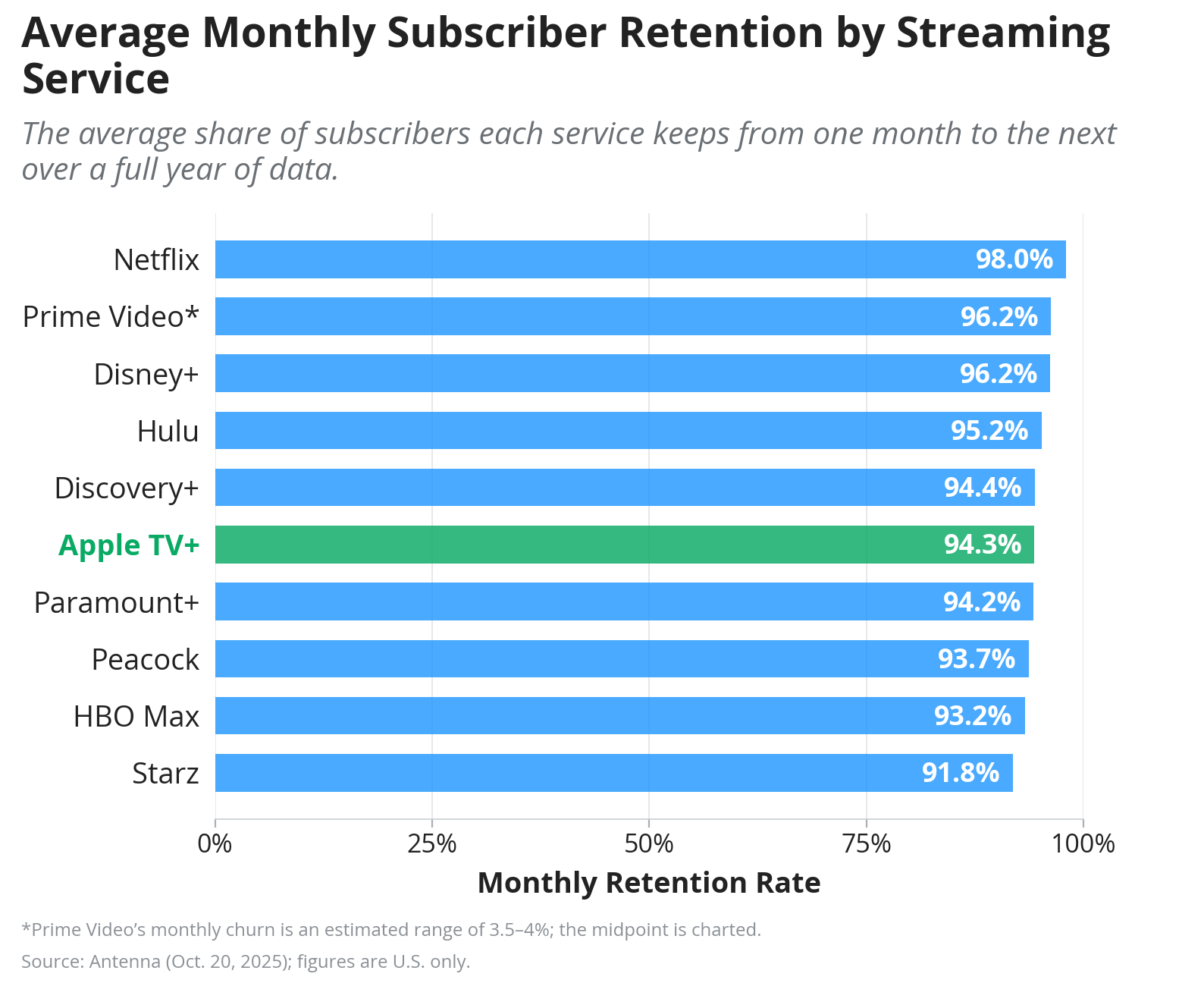
Stranger still, Apple TV actually retains subscribers at a respectable rate relative to its streaming competition. Its monthly retention figures place the platform in the middle of the pack, suggesting that Apple’s biggest challenge is not keeping viewers but persuading them to subscribe in the first place.
My takeaway from all this data—from the Emmy nominations to the solid monthly retention figures—is that Apple is paying the price for being a late mover in an extremely competitive market. Netflix was the first streaming service and benefited from that advantage, while Apple was basically the last and may never make meaningful inroads for that very fact.
Enjoying the article thus far and want more data-centric pop culture content?
Final Thoughts: Don’t We Want This?
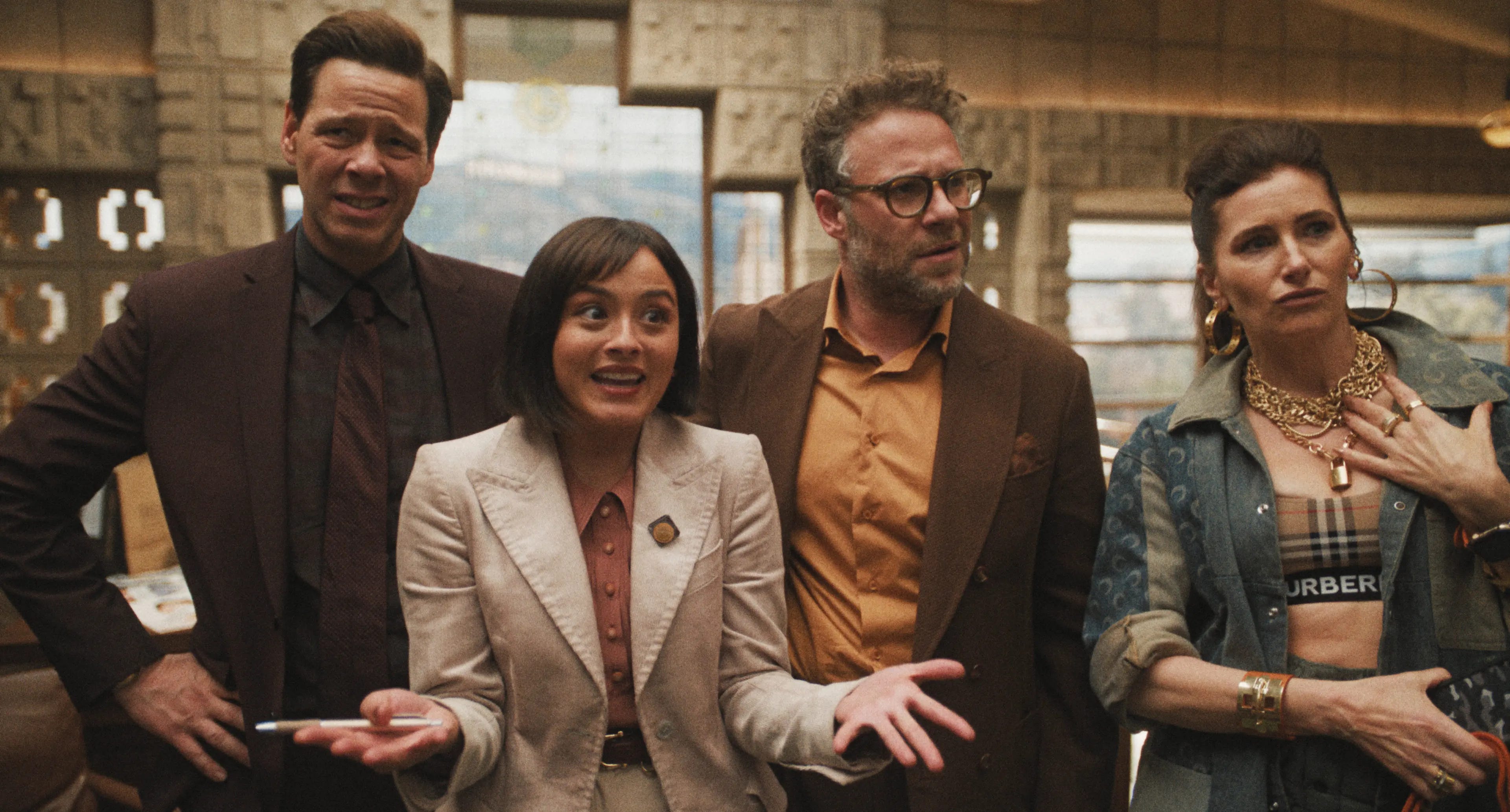
I am cursed to care about the entertainment industry, which means I am also cursed to follow its coverage. Trade publications like Deadline and The Hollywood Reporter often seem determined to punish those who dare to make commercial art. Make too much money from an artistically bankrupt project, and you are a cynical hack. Take a chance on something creatively ambitious, and you are an idiot.
I would like to believe this coverage has little influence on the industry itself, but that is far from true. Hollywood is governed by politics and popularity, and a studio can be publicly embarrassed into firing an executive or abandoning an entire creative strategy.
The result of this feedback loop is standardized art. The person green-lighting a script becomes preoccupied with their reputation and whether they might be chastised for trying something different.
Enter Apple TV+, the kind of entertainment company we claim to want: a studio that funds artistically ambitious projects and appears unconcerned with whether those projects immediately turn a profit. You may have read this entire essay assuming it was a takedown of the platform’s strategy. In fact, it is the opposite. Give me 100 Apple TVs!
Trade publications love ridiculing the streamer’s relatively small footprint, whether it’s Puck’s Matthew Belloni calling its lackluster viewership “the funniest and most underreported story in Hollywood” or Awful Announcing declaring that “Apple TV+ is a ghost town.” To these publications and their fellow haters, I have just one question: Why can’t we have nice things?
Why can’t we allow a trillion-dollar company to spend an infinitesimal portion of its wealth making excellent television? Why must we humiliate every Hollywood studio into conformity?
Steve Jobs once said that “People don’t know what they want until you show it to them.” Perhaps this logic also applies to the television platform spawned by his beloved brainchild. So let’s hope people realize they actually want this thing—before it’s too late.
Enjoyed the analysis? Support Stat Significant and unlock the data behind the insights.
Become a paying subscriber to get bonus graphics, interactive dashboards, downloadable datasets, and to support independent journalism.
Paying subscribers get:
Bonus Data Stories: Full access to the Monday Roundup, a weekly bonus edition with extra culture data stories, curated datasets, and recommended reads.
The Public Dataset Directory (Updated Weekly): A curated directory of public datasets from around the web.
Interactive Data Hubs: Interactive dashboards across Streaming TV, Movies, Music, Search Trends, Wikipedia, and more.
*Note: For best results, open this link in a web browser while logged in to your Substack account.
Want to promote your data tool or media publication to Stat Significant’s 26,200 readers? Email daniel@statsignificant.com
Need help with a data problem? Book a free data consultation
Connect with me on LinkedIn if you want to chat about a data project.
Like movies? Follow me on Letterboxd
Funny enough I think the branding geniuses at Apple created a branding problem. They named the hardware device Apple TV
and the streaming service the same thing! I suspect many people think they need an Apple TV device to watch Apple TV shows on their TV.
Apple TV+ not reaching the 1% threshold on Nielsen sounds like a big fail, but, the thing I also see there is HBO, the legendary TV brand, barely exceeding the 1%. And I would say Apple TV more than any other streamer is trying to emulate the HBO model. Selling a higher quality product rather than chasing mere viewership. For Apple TV+, ratings mean nothing, they only sell subscriptions.