

Intro: Cinema’s Totally-Real Revival
I’ve been writing this newsletter long enough that I can now revisit years-old essays with the benefit of hindsight. This is especially fun when an article ages poorly. Usually, it’s a stray sentence or chart that only I will notice. But every so often, subsequent real-world events render an entire piece meaningless.
And perhaps no essay has proven less predictive than my 2024 article “6 Reasons to Be (Cautiously) Optimistic About Movies in 2025.”
I would not recommend reading this piece, so I’ll provide a quick recap: I assessed the film industry’s post-pandemic woes, detailed six trends that signaled a return to pre-COVID moviegoing, and ended with an examination of the industry mantra “survive till ‘25”—a belief that if Hollywood could make it to 2025, some version of moviegoing equilibrium would be restored.
But 2025 came and went, and no great resurgence occurred. The box office was sluggish, Paramount imploded, Warner Bros. was put up for auction, and lizard king David Zaslav (Warner CEO) netted a cool $800M by running Hollywood’s oldest studio into the ground. The movies were not “so back.”
And now, four months into 2026, it seems like the movies may actually (kinda sorta) be “so back.” So here I am, once again, arguing that a theatrical resurgence is imminent—and once again, I have the data to prove it. This time, I’m right. No question.
So today, we’ll explore early signs of cinema’s totally-real revival, along with the persistent headwinds facing an industry that simply refuses to die—no matter what lizard king David Zaslav and lizard prince David Ellison throw its way.
Today’s newsletter is sponsored by The Stat Significant Dataset Hub
Access 235+ Curated Datasets to Elevate Your Analysis

Want the data behind the deep dives? The Stat Significant Data Hub gives you access to 235+ curated datasets across movies, music, TV, economics, and more.
New datasets are added weekly, with full archive access for Stat Significant paid subscribers. Since last week’s post, we’ve added 13 new datasets—spanning earthquakes, YouTube engagement, a global database of lotteries, and UFC fights.
1. The Box Office Is Up (Finally) and Less Franchise-Dependent
Box office is an imperfect metric for evaluating the health of the film industry, just as GDP is an imperfect measure of human flourishing. But it’s the best metric we have for assessing the health of a capital-intensive business—and by that measure, things are moving in the right direction.
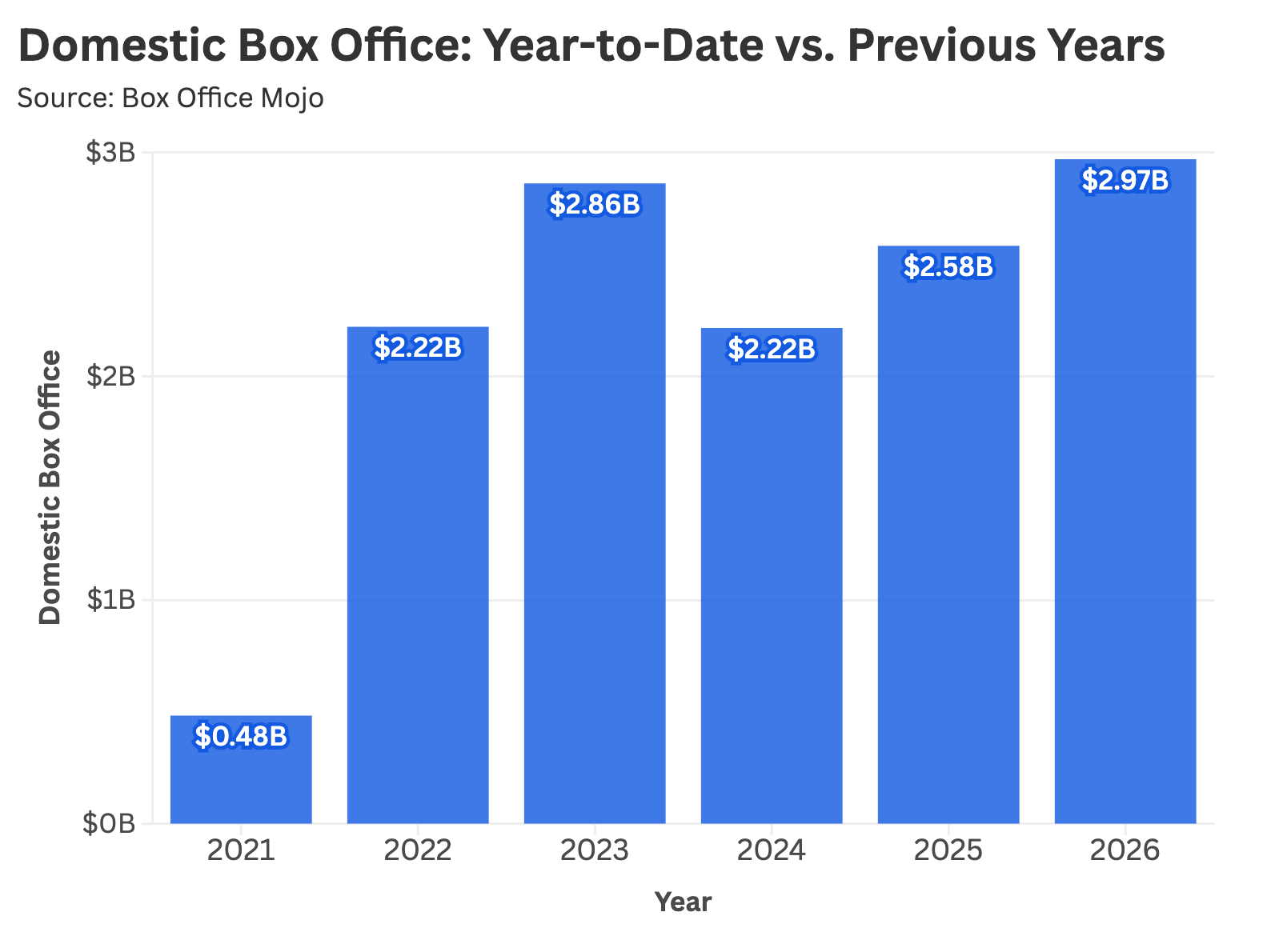
Year-to-date domestic box office is up after the down years of 2024 and 2025, which were dampened by protracted writers’ and actors’ strikes.
Better yet, of the 12 highest-grossing movies of 2026, 8 are unaffiliated with an existing franchise.
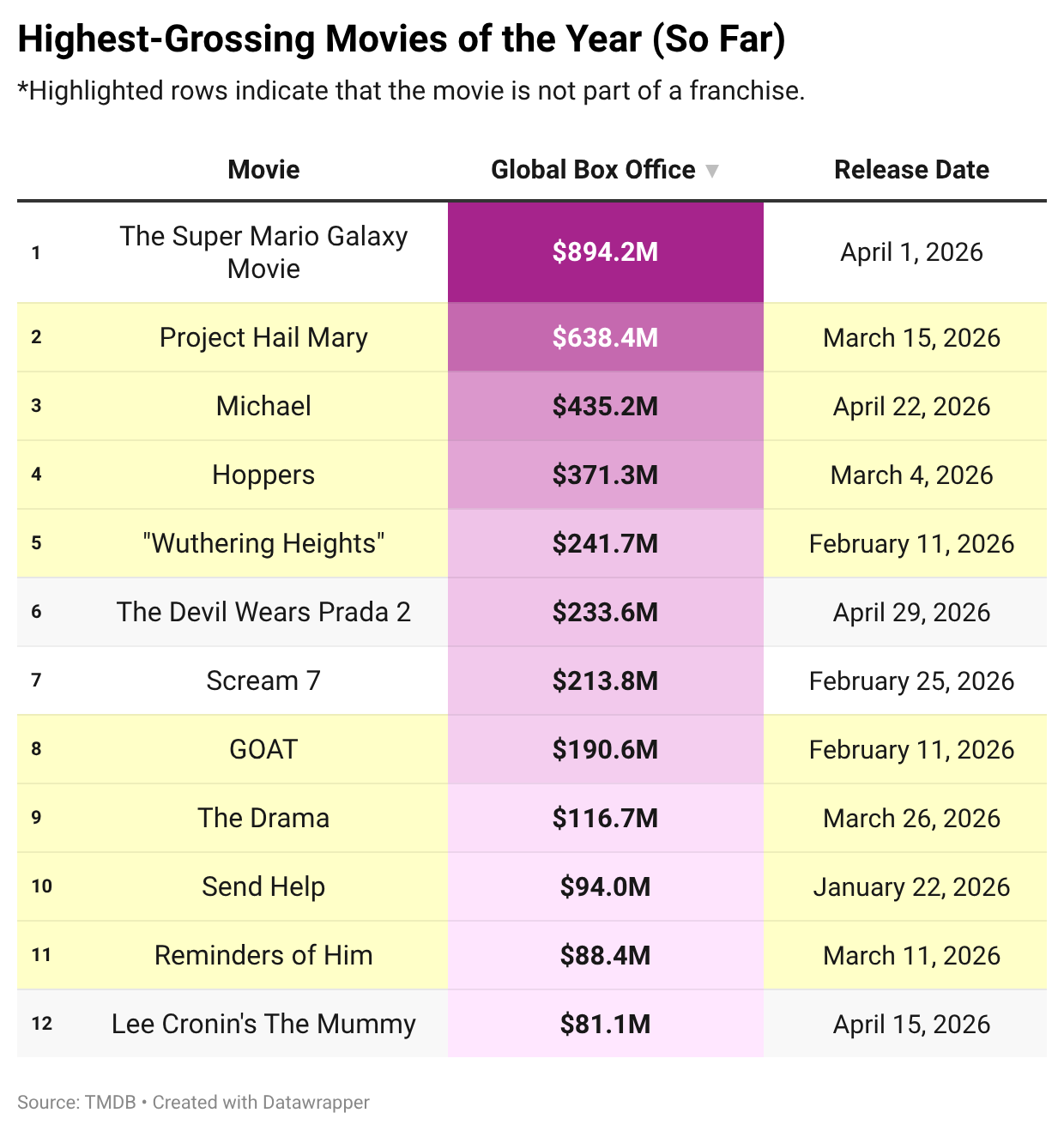
It pains me to include Michael among the standout “original” films on this list because:
It’s a music biopic, which is the lowest form of non-franchise filmmaking.
Who the subject is.
There will be a sequel about the second part of his life, which will probably skip some important sections of his Wikipedia page.
By the rules I’ve created, Michael technically counts.
This list will likely change over the coming months as the summer season delivers its usual wave of franchise entertainment. But for now, it offers a nice change of pace and a little hope.
2. More Movies Are Being Released in Theaters
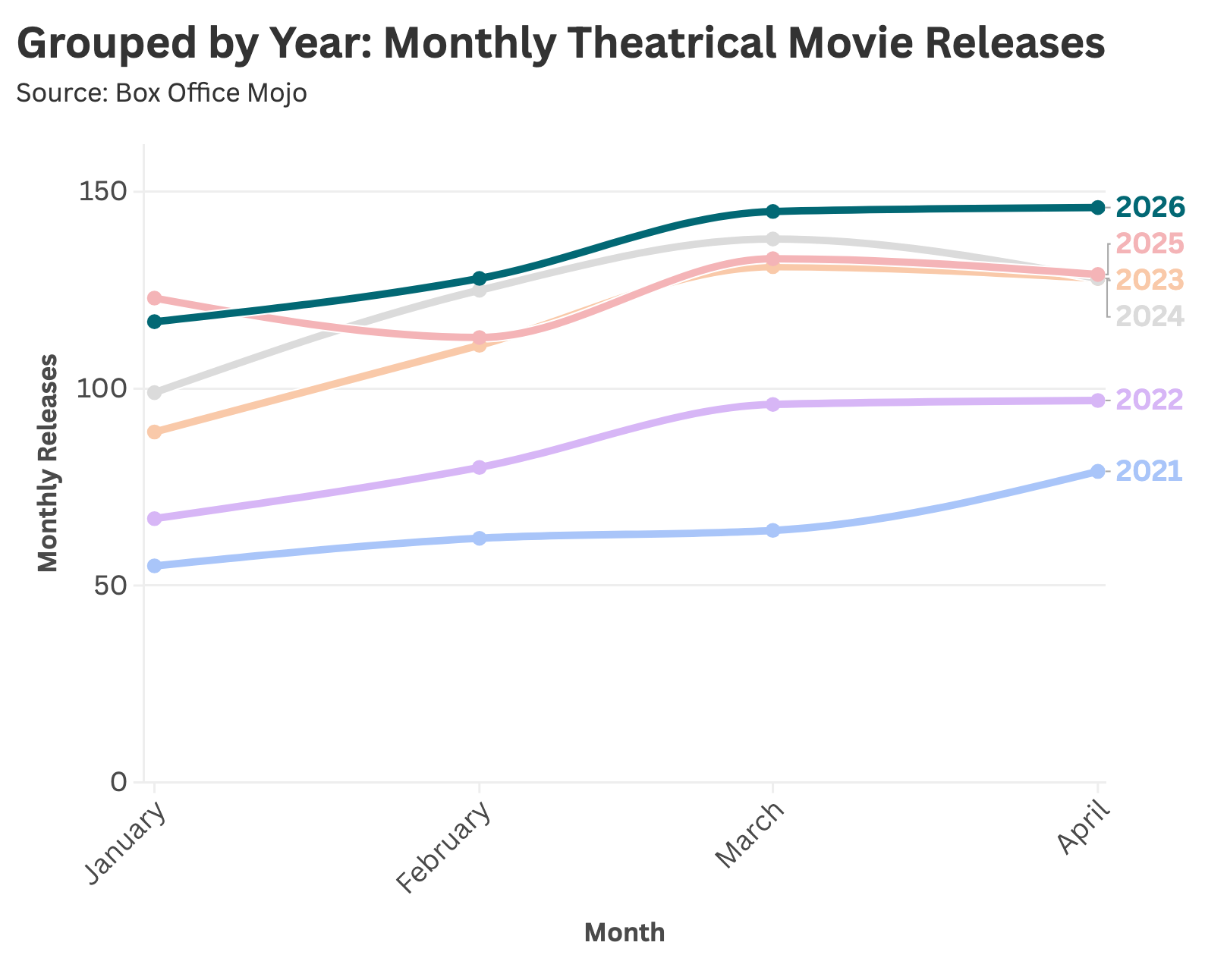
So far, 2026 has delivered the most theatrical releases of the post-pandemic era, outpacing every post-COVID year by at least 13%. The industry is adapting to shifting moviegoer tastes and learning how to sell films outside the Marvel universe, with recent box office successes in horror, animation, Colleen Hoover adaptations, other smut-adjacent literary phenomena, and video game movies. The result is a faster pace of content development and a broader definition of what works in theaters.
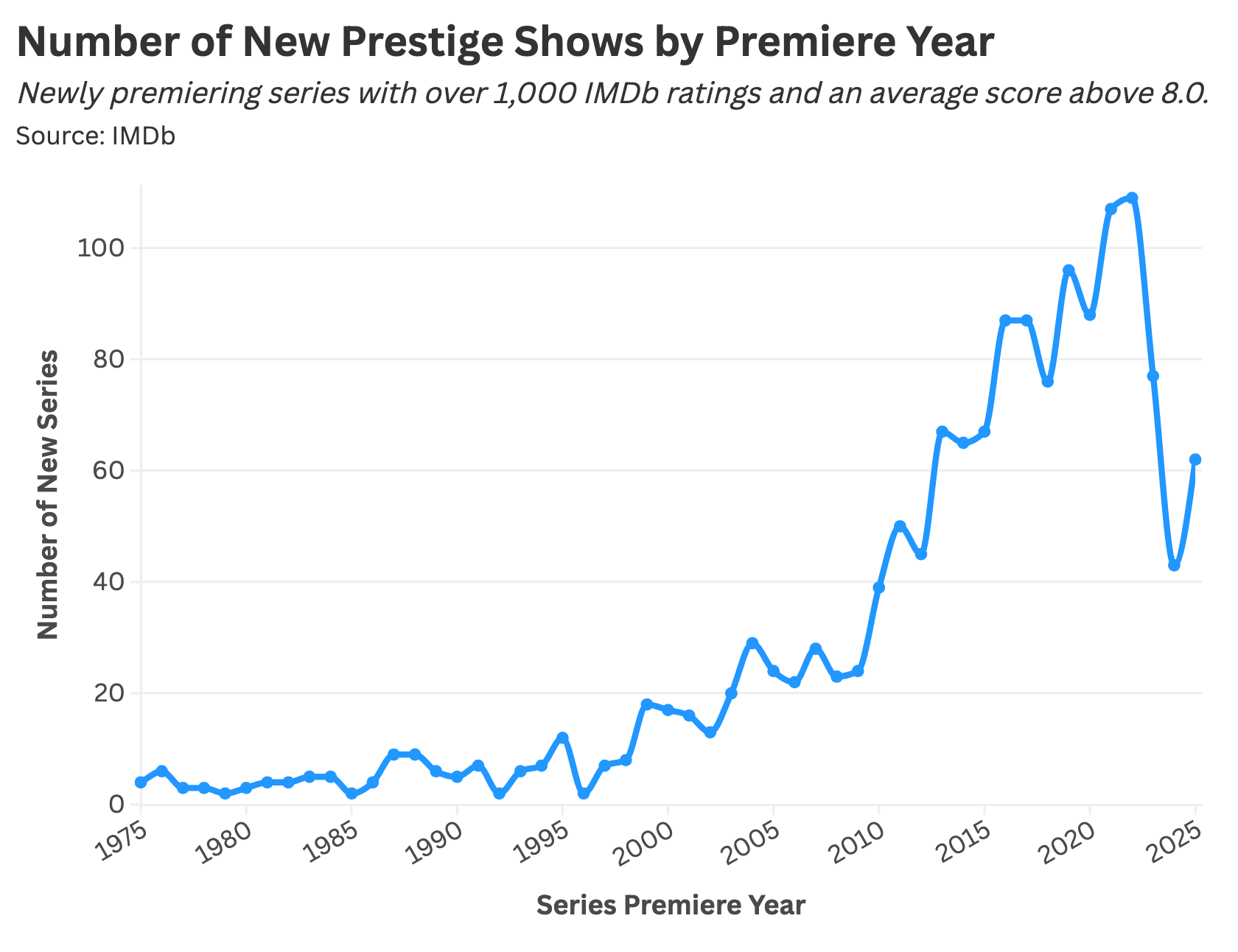
Meanwhile, television production has slowed. English-language series output has declined every year since its 2022 peak, and the buzzy “prestige” shows that once drove subscriber growth have become far less plentiful.
To add insult to injury, streamer subscription prices have skyrocketed just as content output has declined.
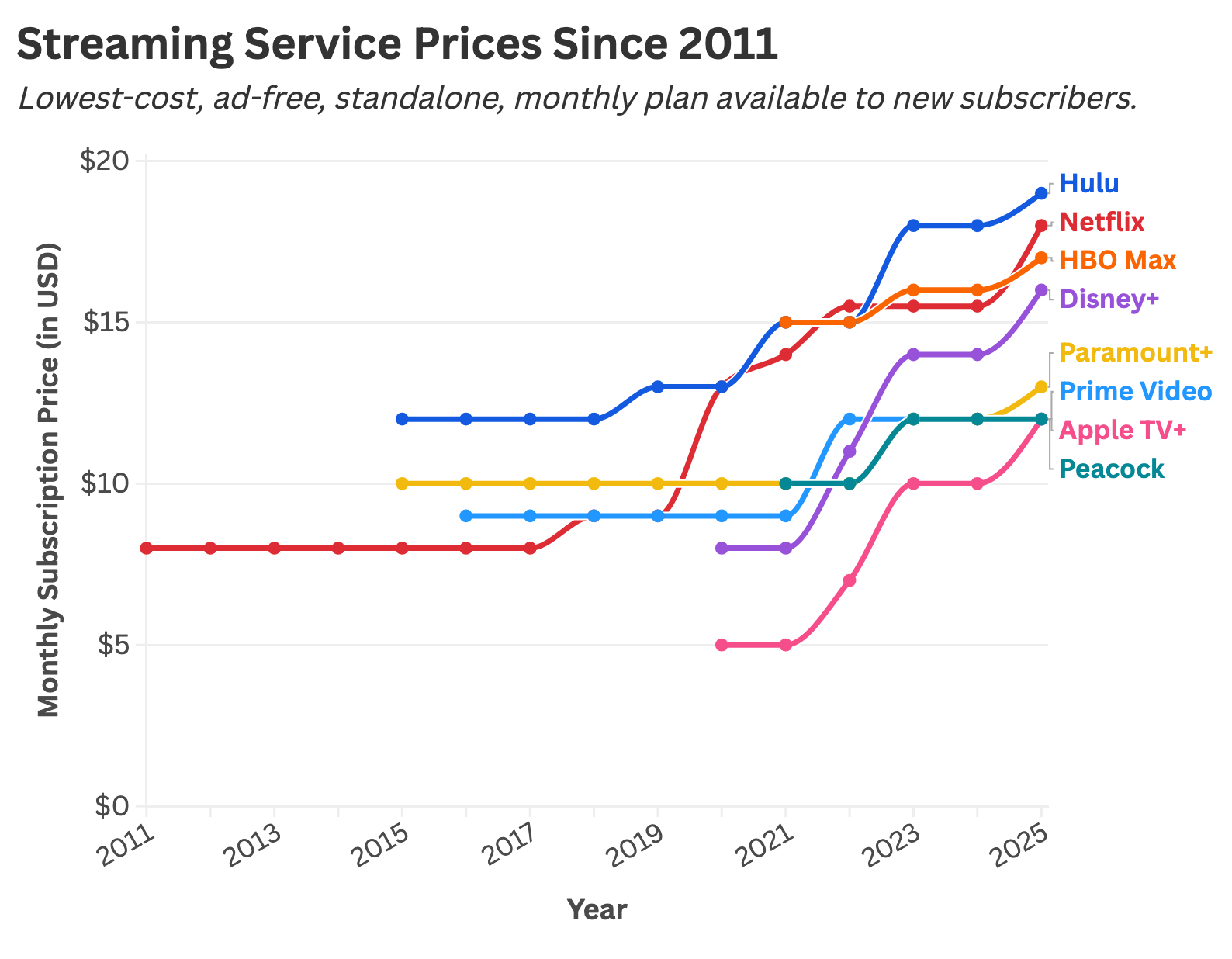
Streaming’s golden age is most likely over, and audiences seem increasingly willing to return to theaters.
3. Online Interest in Movies Is Rising
This next point is somewhat abstract, so bear with me. You probably noticed that I cited streaming data as evidence of a moviegoing resurgence, suggesting a zero-sum struggle between film and television. And while this concept is rather squishy, I do believe this tug-of-war exists, at least to some extent.
In a crowded attention economy, TikTok, YouTube, AMC theaters, Netflix, and other platforms all compete for our time. To reduce this phenomenon to a single corporate buzzword, these pastimes are battling for mindshare.
So, in this hypothetical mind-battle between film and television, which medium occupies a greater portion of the collective consciousness? To quantify the zeitgeist, I looked at Wikipedia traffic—specifically, the share of movie- and TV-related pages that appear among the site’s 100 most-searched entries.
Over the past five years, film pages have captured an increasing share of Wikipedia search traffic, while TV’s share has grown more slowly.
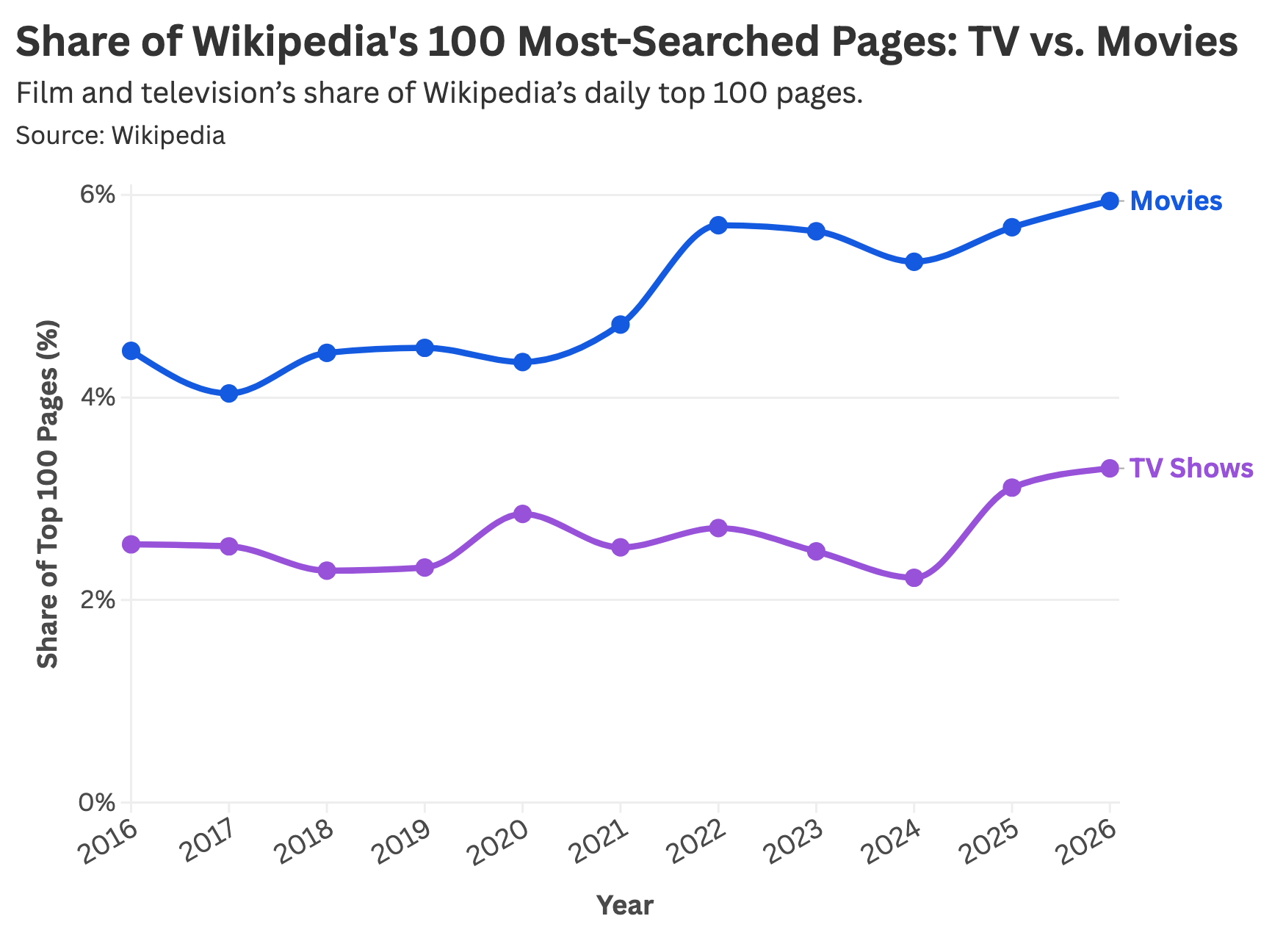
One explanation for TV’s relative decline is that there are simply more TV series than there were 10 years ago, making it harder for any one show to break through. Or perhaps movies have always been better suited to capturing collective attention, while TV caters to fragmented niches. In the streaming era, hardly anyone watches the same thing at the same time, except for The Pitt and the NFL.
4. Netflix Is Warming Up to Theatrical Releases
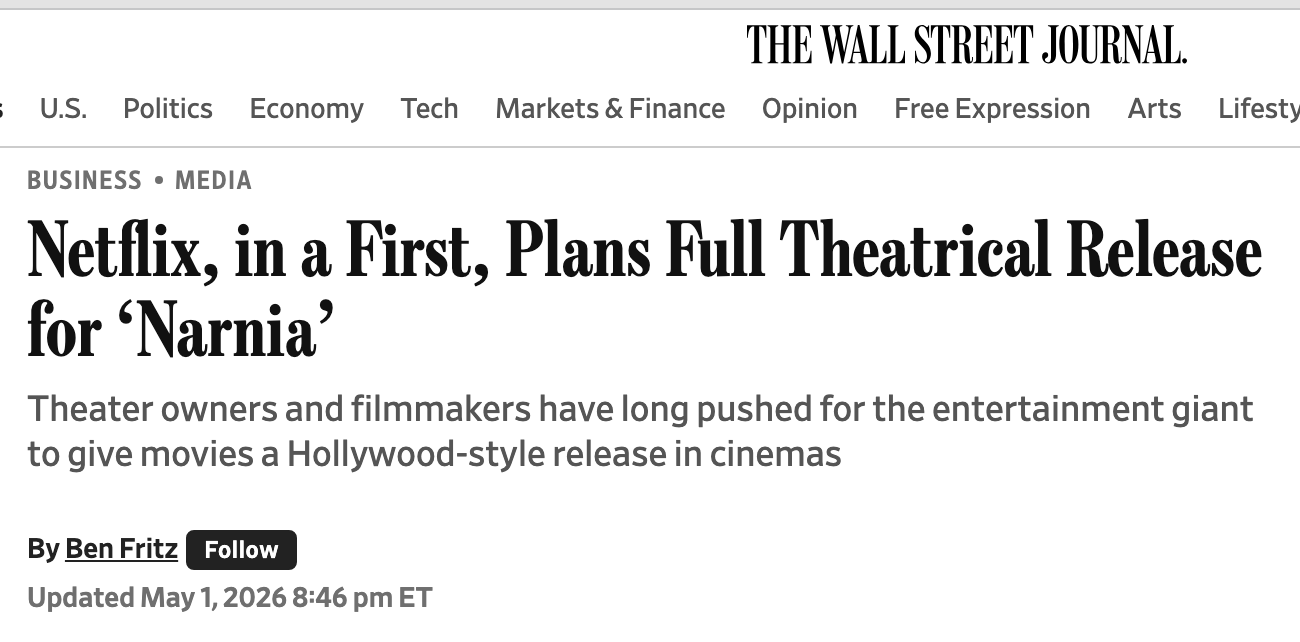
You read that correctly: Netflix is giving Greta Gerwig’s upcoming Narnia adaptation a legitimate theatrical release. The film will play in theaters for at least 45 days before moving to streaming, and unlike a typical Netflix big-screen release, Gerwig’s movie will play in easy-to-find multiplexes at normal showtimes (rather than a single 12-seat theater on the outskirts of town at 1 p.m. on a Tuesday).
So why is Netflix backtracking after years of shunning brick-and-mortar exhibition? A few reasons:
Money: Netflix is a public company tasked with satisfying Wall Street’s demand for infinite revenue growth. Getting into theatrical exhibition is a net new revenue stream that will grow faster than its legacy subscription business.
Insider knowledge of Warner Bros. finances: For a few days in 2025, Netflix successfully purchased Warner Brothers, before lizard prince David Ellison usurped their bid using Saudi oil money. During this strange liminal period when they didn’t-not-own Warner Brothers, Netflix got a look into the finances of theatrical exhibition, and presumably liked what they saw. Before losing the acquisition to Paramount, Netflix promised to release Warner Brothers movies in theaters and touted the strength of the theatrical business model.
Improving filmmaking craft: A “Netflix movie” has become shorthand for subpar filmmaking. The streamer has excelled at replicating the low end of the market, such as Hallmark movies and middling romcoms, but has minted few breakthrough hits beyond the occasional KPop Demon Hunters. Arguably, the biggest driver of this filmmaking deficit is directorial talent.
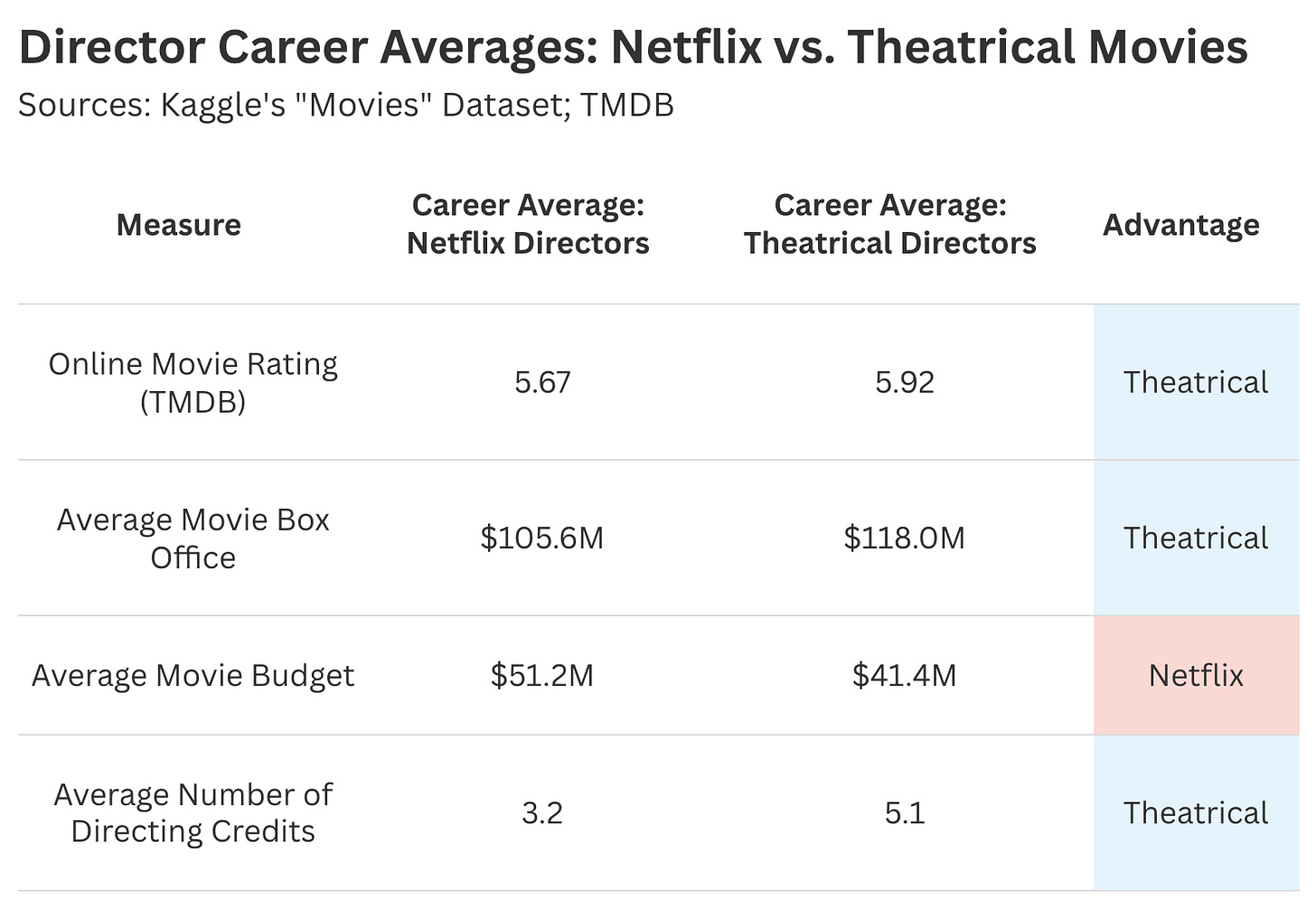
Established filmmakers like Greta Gerwig want to see their movies on the big screen and have avoided the service to secure theatrical commitments. The upcoming Narnia adaptation is the first time that the streamer has acquiesced to a director’s demand, and there is reason to believe that it may not be the last.
Enjoying the article thus far and want more data-centric pop culture content?
5. The Oscars Have a Path to Cultural Relevancy (in 2029)!
As of this moment, the Oscars are down bad. Viewership has fallen precipitously, and the broadcast remains tied to a legacy cable model that makes the ceremony hard to watch for the average cord-cutter.
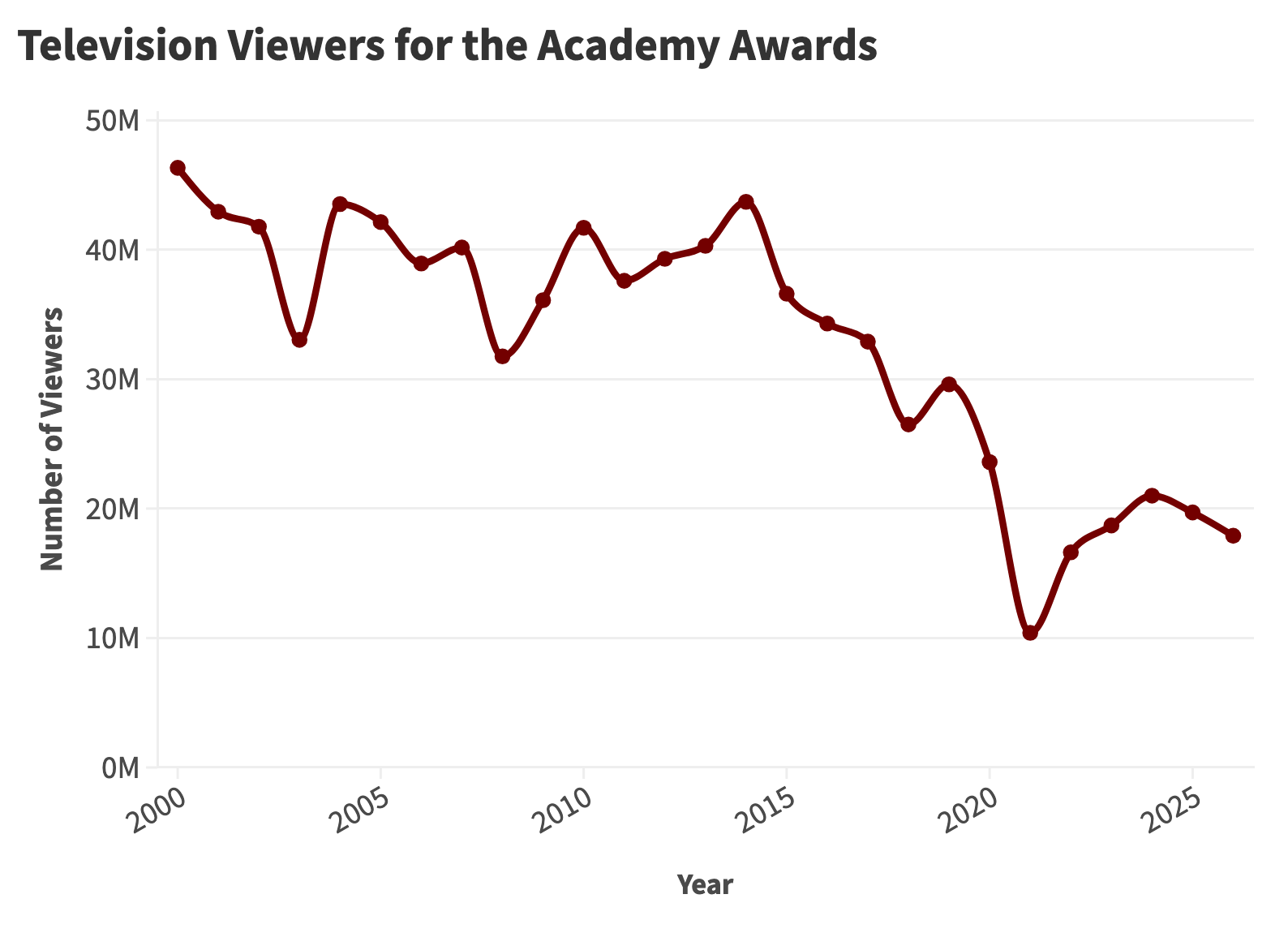
But that’s about to change! I think.
This past year, the Academy announced that the Oscars would move to YouTube in 2029, a far more accessible platform than your local ABC affiliate. YouTube is the sneaky winner of the streaming wars, capturing the largest share of TV viewing time by Nielsen estimates—and those figures don’t even include desktop viewing.
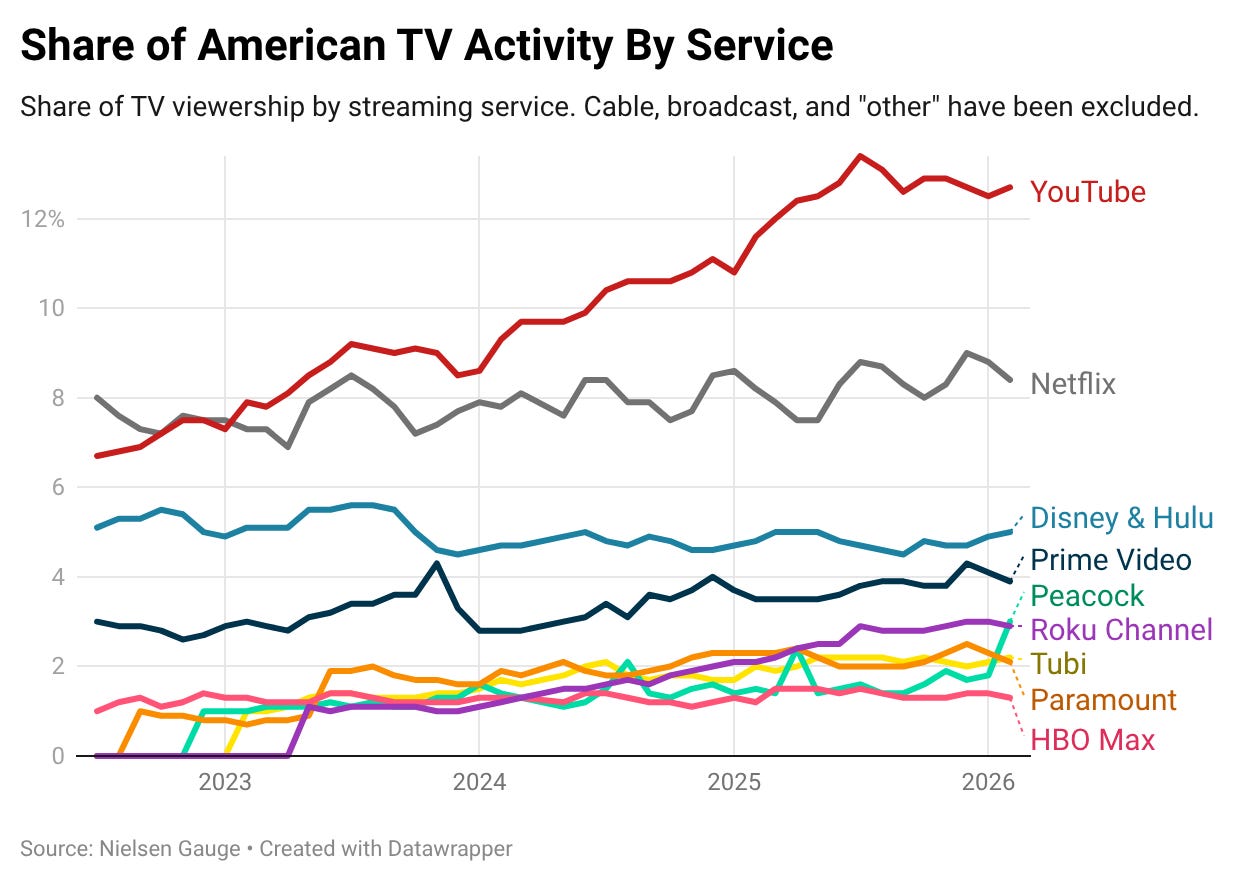
For a culturally diminished awards show, the move offers a much-needed lifeline: a chance to reinsert itself into the cultural conversation.
And then there’s gambling, which I don't approve of but which may prove beneficial to Oscar viewership. According to recent reports, the 2026 Oscars generated more than $120 million in bets on prediction markets like Kalshi and Polymarket, and that number will likely grow as these platforms see increased adoption.
Is it bad that some people will find their way into movie culture through gambling? Absolutely. Has sports betting helped pro leagues like the NBA and NFL deepen fan engagement? Also yes. The Academy Awards have always possessed a horse-race quality, and in a world where people will gamble on almost anything, someone will inevitably commoditize this metaphorical horse race.
6. The Physical Media Revival Is Upon Us
In writing this newsletter, I have continually returned to the topic of physical media because every time I revisit the data, I find another proof point for its continued resurgence. Take this latest example: for the first time in 20 years, search traffic for DVD players has started to grow.
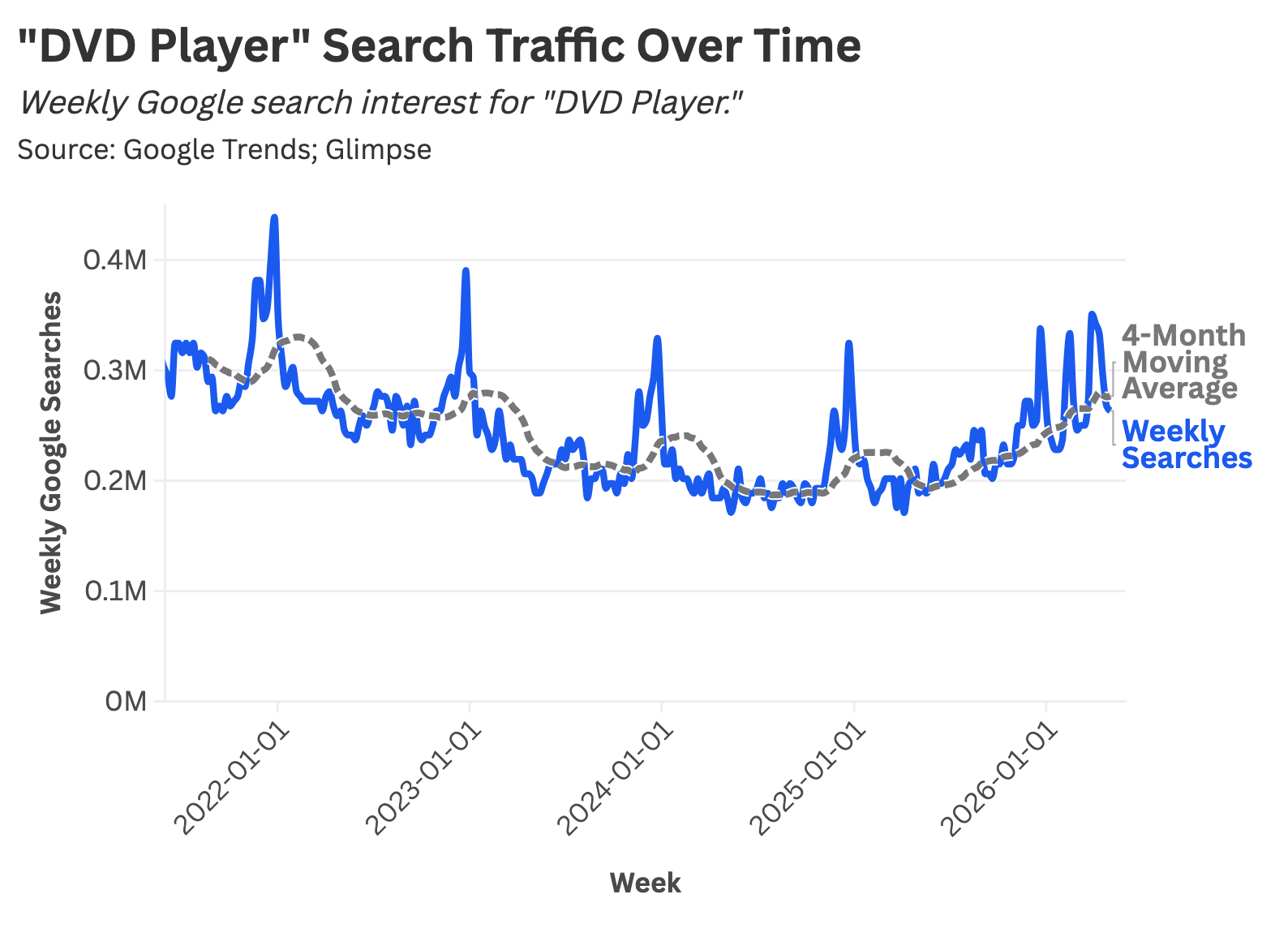
Obviously, this is still orders of magnitude removed from the DVD’s heyday, but it represents a minor reclamation for film nerds.
This revival is driven by demand for a more tangible movie culture—one where fans can own the things they love.
Boutique labels like Vinegar Syndrome, Arrow Video, and—most prominently—Criterion have turned Blu-ray collecting into a hobby for a certain kind of film obsessive, and rising search traffic suggests these brands are finding a wider audience.
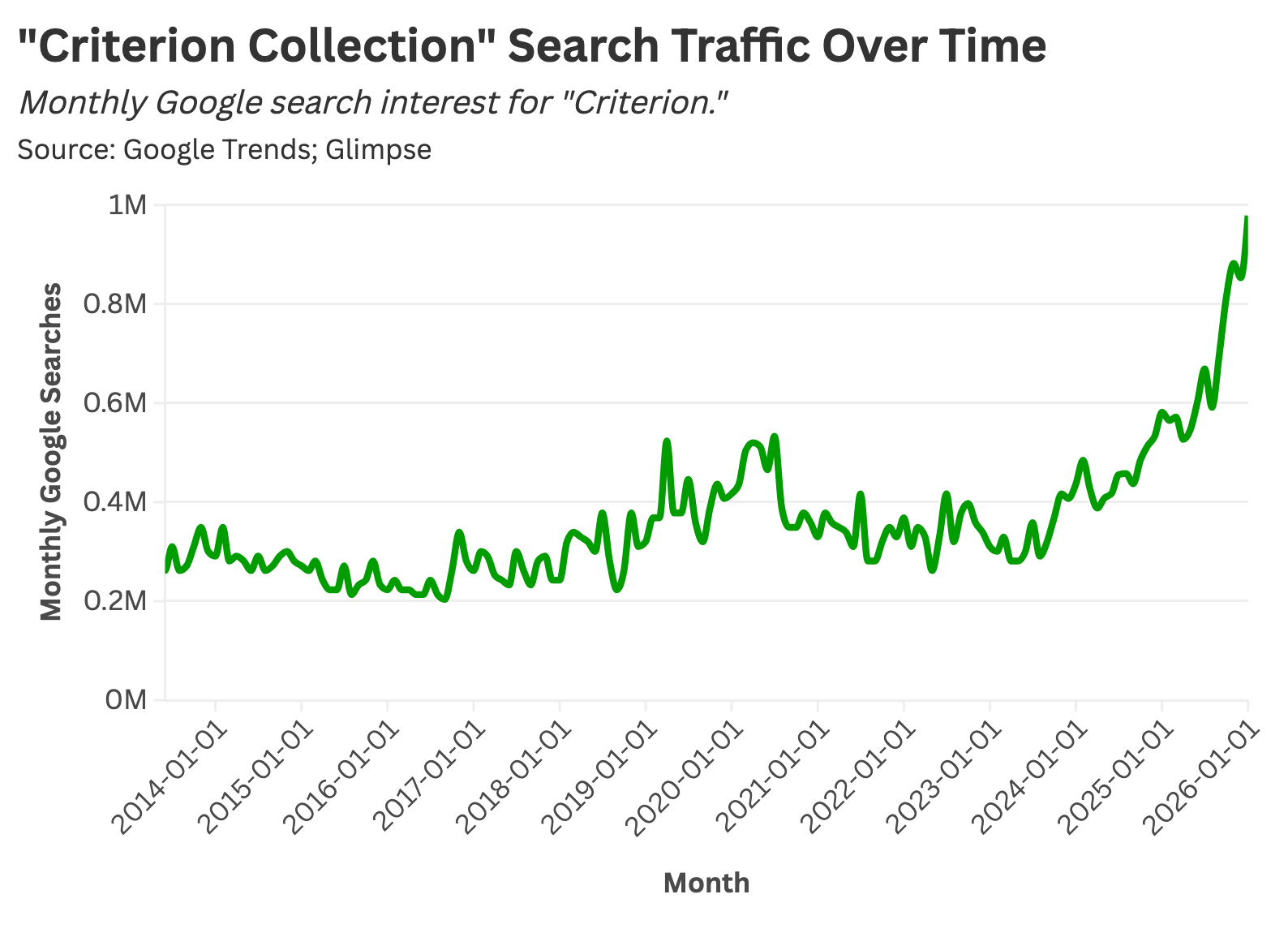
DVDs will never return to the $16 billion market they were in 2008, but they can remain a thriving niche for cinephiles seeking cultural ownership.
Final Thoughts: Karma
When I was nine years old, I won an iPod in a school raffle. Being nine, I didn’t know much about MP3 players, Steve Jobs, or the sentimental value of physical media. I owned two CDs—Barenaked Ladies and Smash Mouth—which I played once a day. That was the full extent of my music-listening life.
iTunes expanded my cultural horizons to something bordering on infinite. I could sample nearly every song in existence for 30 seconds at a time, buy the tracks I liked, and carry them around in my pocket. Suddenly, my Barenaked Ladies CD was a relic—a reminder of the “before time,” when you had to buy 12 songs to hear a single hit track.
Music had migrated online, turning the industry’s remaining physical spaces into artifacts from a pre-digital world. Every Friday, my mom and I would go to the mall, and on these trips we developed a strange little pastime: marveling at the ever-decreasing foot traffic inside Tower Records. It became a recurring game between the two of us: “Does Tower Records still exist?” Each trip we’d bet on its continued presence, and each trip we’d marvel at its protracted demise.
At the time, I never considered the subculture that might disappear with the record store, or the people who would lose one of the places they loved most. Decades later, I’m on the other side of this equation, where the game is something akin to “Does film culture still exist?” It’s not a perfect comparison, but the broader anxiety is familiar. Moviegoing is no longer at the center of culture, and the rituals around it are increasingly fragile.
For now, film culture persists, sustained by a handful of benevolent upstarts who may, or may not, be on the precipice of enshittification: Letterboxd, A24, The Criterion Collection, Mubi, etc. Yet this remains a delicate balance. Each year feels like a referendum on the continued existence of a certain subculture: one that believes cinematic craft can be commercially viable. And as long as that’s the case, I’ll keep writing these articles, like a violinist going down with the Titanic.
A broken clock is right twice a day, so at some point I’ll be rewarded for my optimism—even if just for a little while. That is, until the lizards of Hollywood muck things up beyond recognition.
Enjoyed the analysis? Support Stat Significant, and unlock the data behind the insights.
Become a paying subscriber for interactive dashboards, free datasets, and to support independent journalism.
Paying subscribers get:
The Stat Significant Dataset Hub (Updated Weekly): a collection of free datasets across movies, music, TV, and economics.
Interactive Data Hubs:
Streaming TV: what people are watching on television.
Movies: the films watched in theaters and on TV, plus historical trends.
Music: the songs, artists, and styles dominating Spotify and TikTok.
Social Media: what’s trending on Google, Reddit, TikTok, and YouTube.
Wikipedia: the top pages trending on Wikipedia.
Get access with:
*Note: For best results, open this link in a web browser while logged in to your Substack account.
Want to promote your data tool or media publication to Stat Significant’s 25,800 readers? Email daniel@statsignificant.com
Need help with a data problem? Book a free data consultation
Connect with me on LinkedIn if you want to chat about a data project.
Like movies? Follow me on Letterboxd
Why is David Ellison a "lizard" for theatrical releases exactly? Because of his politics? He has a track record of producing movies for theaters that have made money at the box office. Netflix does not. https://en.wikipedia.org/wiki/David_Ellison#Film
I would say Paramount/Skydance acquiring Warner Bros instead of Netflix is another good sign for theatrical in 2026.
It's a sure-fire indicator of nothing, but in the past 2 months I've watched more movies in the theater than the previous 2 years combined and I know there are at least 2 movies in the next month I'll be seeing in theater as well. This has a lot to do with the type and quality of the movies which is in line with what you describe: original content (vs. big-budget IP vehicles) with unique stories.