


Intro: Project Popcorn
Few decisions have reshaped moviegoing more than the stupidly named “Project Popcorn.” For those unfamiliar with this deeply lame corporate initiative, Project Popcorn was WarnerMedia’s 2021 plan to release every Warner Bros. film on HBO Max the same day it arrived in theaters. It was a short-term decision with one obvious goal: juice streaming numbers.
The experiment began with Wonder Woman 1984, then expanded to an entire year’s worth of releases. Over the next twelve months, Warner Bros. jettisoned its most anticipated projects to streaming: Tom & Jerry, Godzilla vs. Kong, Mortal Kombat, The Suicide Squad, Dune, King Richard, The Matrix Resurrections, and many more.
Inspired by Warner’s short-term thinking, other studios pursued similar streaming-first strategies, and the economics of Hollywood subsequently went haywire. Christopher Nolan left Warner Bros. for Universal, where he eventually made Oppenheimer and The Odyssey. Scarlett Johansson sued Disney, alleging that the day-and-date release of Black Widow violated her contract. All across Hollywood, studios were forced to compensate talent for the sudden erosion of once-lucrative back-end deals.
Yet Project Popcorn’s defining legacy was not any single lawsuit or bruised ego. Its real impact was resetting audience expectations about how soon a movie should arrive on streaming. Where there had once been a 5-month window between theatrical release and home viewing, audiences were suddenly told they could get top-shelf entertainment with no waiting period at all.
Studios eventually reversed course, restoring theatrical windows of 45, 60, or even 90 days. By then, however, viewer expectations had already shifted—perhaps forever.
So today, we’ll examine the relationship between theatrical moviegoing and streaming activity, estimate how much money Hollywood is leaving on the table, and explain why theaters remain the smartest way to launch a film.
Today’s newsletter is sponsored by Works in Progress
Works in Progress: A Guide to How the Future Actually Gets Built

Works in Progress is a print magazine that explores the breakthroughs—and bottlenecks—quietly shaping our world, from economics and urbanism to the frontiers of science and energy.
Its long-form, data-rich essays are read by people at Anthropic, OpenAI, MIT, and the Federal Reserve. Six beautifully designed print issues a year.
👉 Start reading Works in Progress
Why We Stopped Going to the Movies
When VHS and Betamax VCRs arrived in the late 1970s, Hollywood feared audiences would abandon theaters for at-home viewership. Universal and Disney even sued Sony, Betamax’s manufacturer, in an unsuccessful attempt to curb the technology’s adoption. By the mid-1980s, however, the industry had embraced VHS, and home video became a lucrative market worth roughly $10 billion a year.
The late 1990s brought DVDs, which offered enhanced picture quality, greater portability, and interactive bonus features. The format quickly supplanted videotape as the dominant mode of home entertainment, with annual DVD sales peaking at roughly $16 billion in 2005.
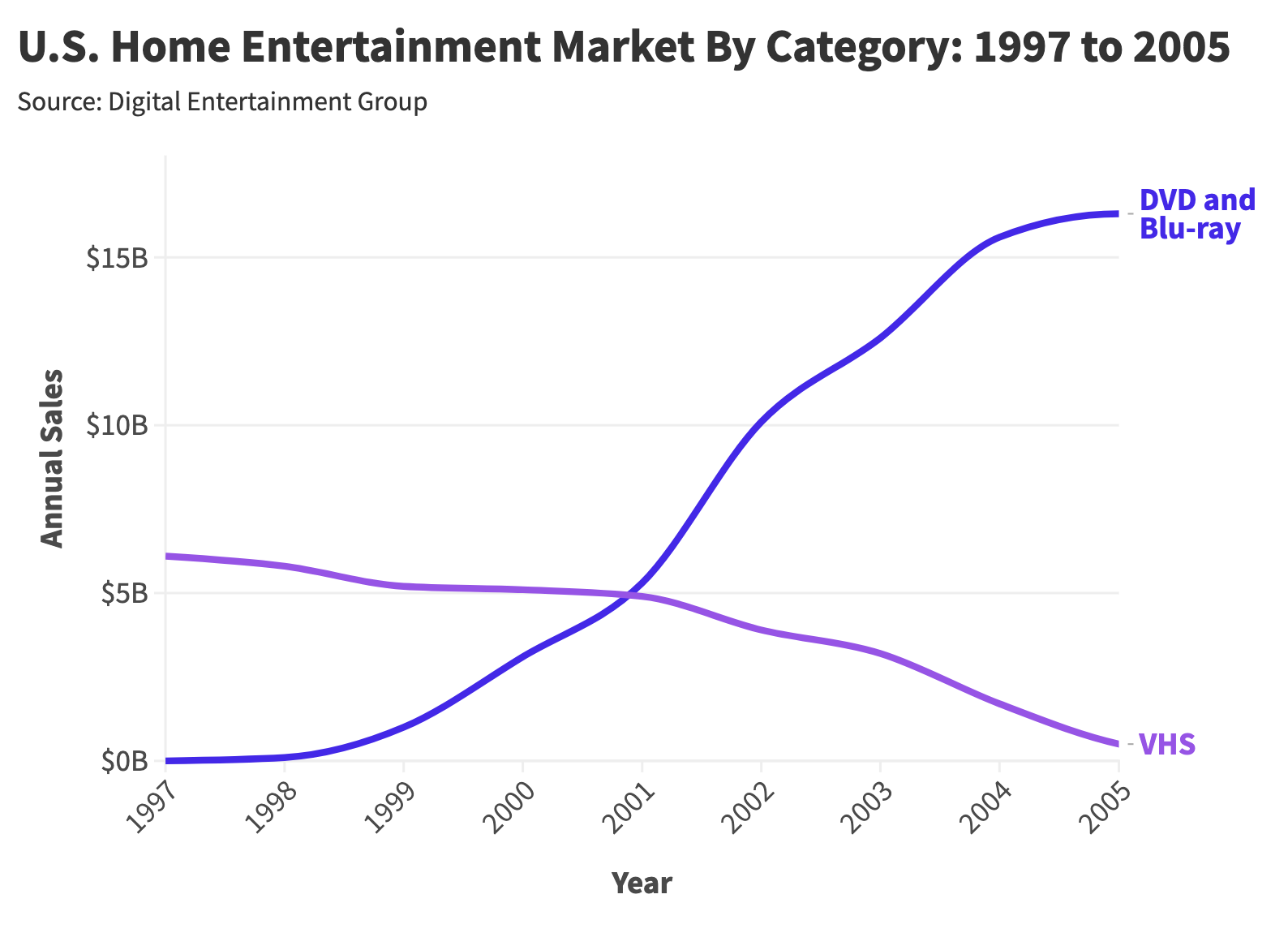
This dependable revenue stream enabled studios to take bigger risks. If a film underperformed in theaters, strong DVD sales eventually allowed it to turn a profit.
Based on a handful of case studies from the early 2000s, DVDs generated revenue equivalent to roughly 50% of a film’s international box office.
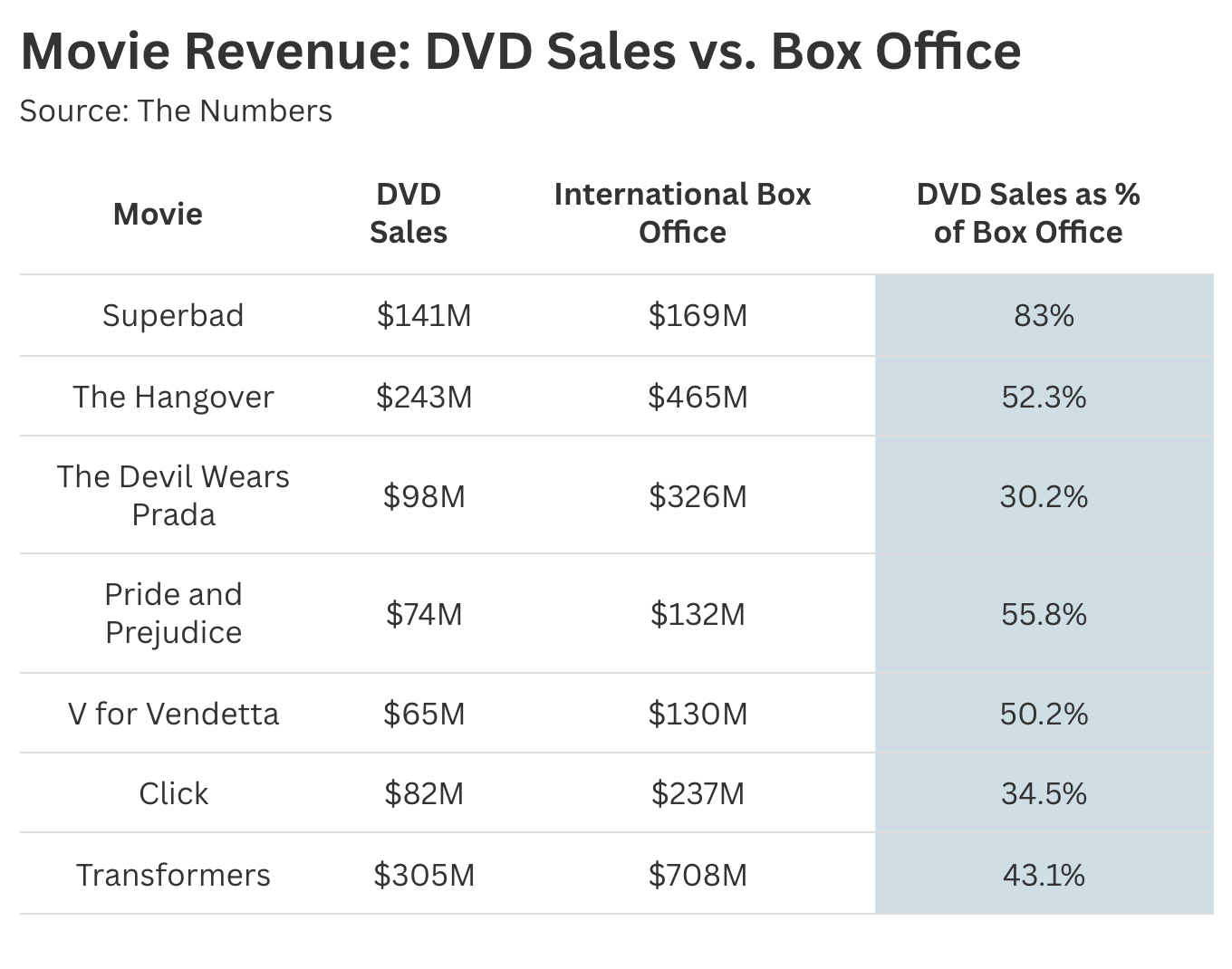
Crucially, VHS and DVD purchases did not cannibalize ticket sales because studios preserved a theatrical window of at least five months. By the time a film reached home video, it had often faded from public attention, prompting studios to launch an entirely different marketing campaign around its release on physical media. This windowing system trained consumers to treat the two formats as distinct purchases: a theatrical ticket paid for a communal, big-screen experience, while a cassette or disc allowed you to own the movie and rewatch it at home, albeit in lower quality.
That carefully managed distinction would be dismantled by technological disruption and the chaos of a global pandemic.
In January 2007, Netflix launched its streaming service, giving consumers instant access to a vast library of film and television for just $5 a month. Movie watching was no longer bound by physical constraints, and DVD sales plummeted as streaming subscriptions, digital rentals, and digital purchases grew into a market generating roughly $60 billion annually.
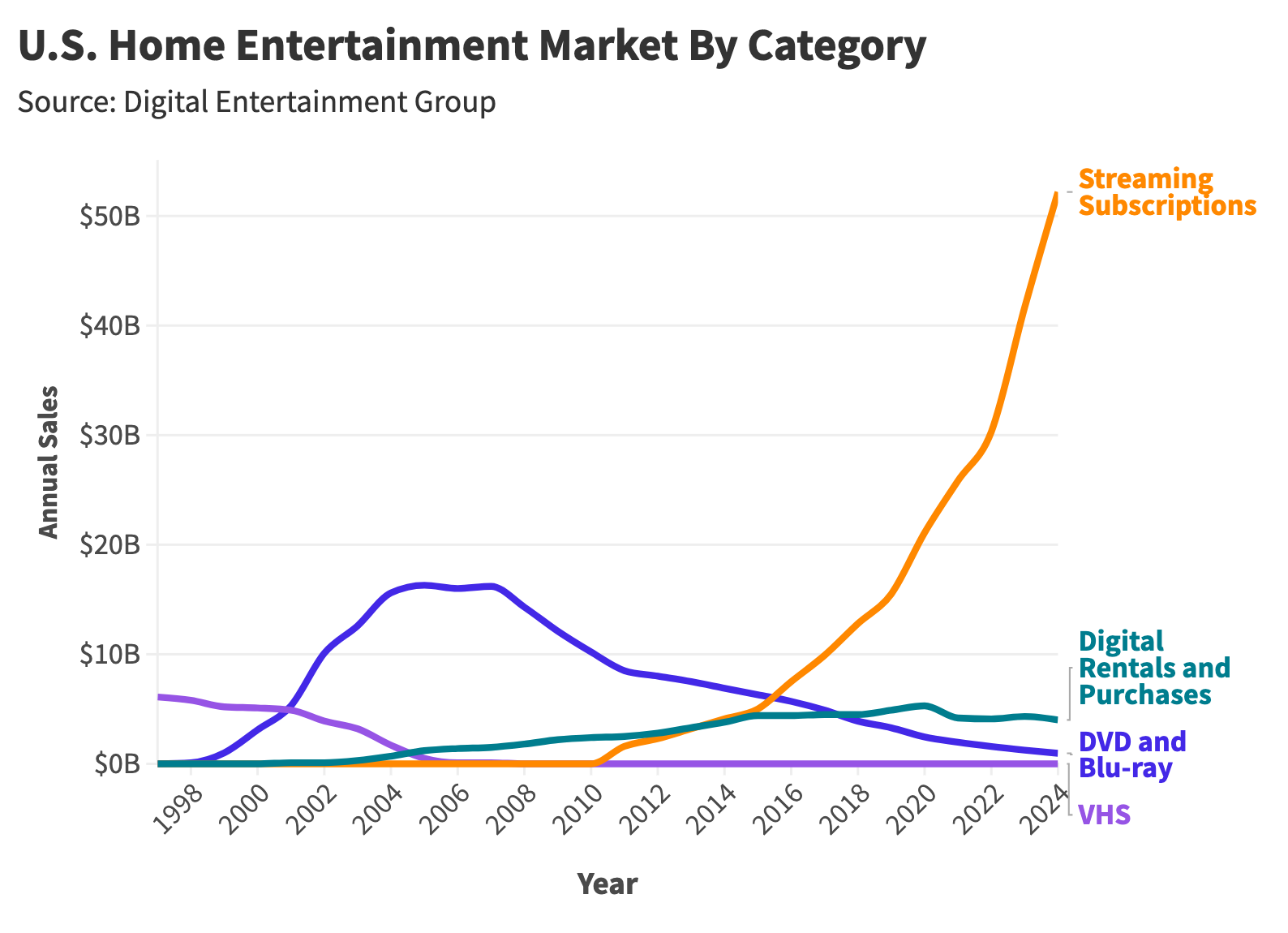
In 2020, the pandemic shuttered theaters across the country and forced Hollywood studios to collapse their traditional exclusivity windows, most notoriously through WarnerMedia’s “Project Popcorn.” Instead of waiting 180 days to watch a movie at home, audiences might wait just 14 days—or no time at all—upending decades of consumer expectations.
The dependable revenue once generated by DVD sales gave way first to premium video-on-demand, where viewers could rent or purchase films through platforms such as Amazon and Apple, and later to subscription streaming bundles such as Netflix. Once a movie was folded into a monthly subscription fee, however, its financial return became increasingly abstract.
Although premium video-on-demand is more convenient, data released by Universal suggests it generates only a quarter of the revenue of physical media sales.
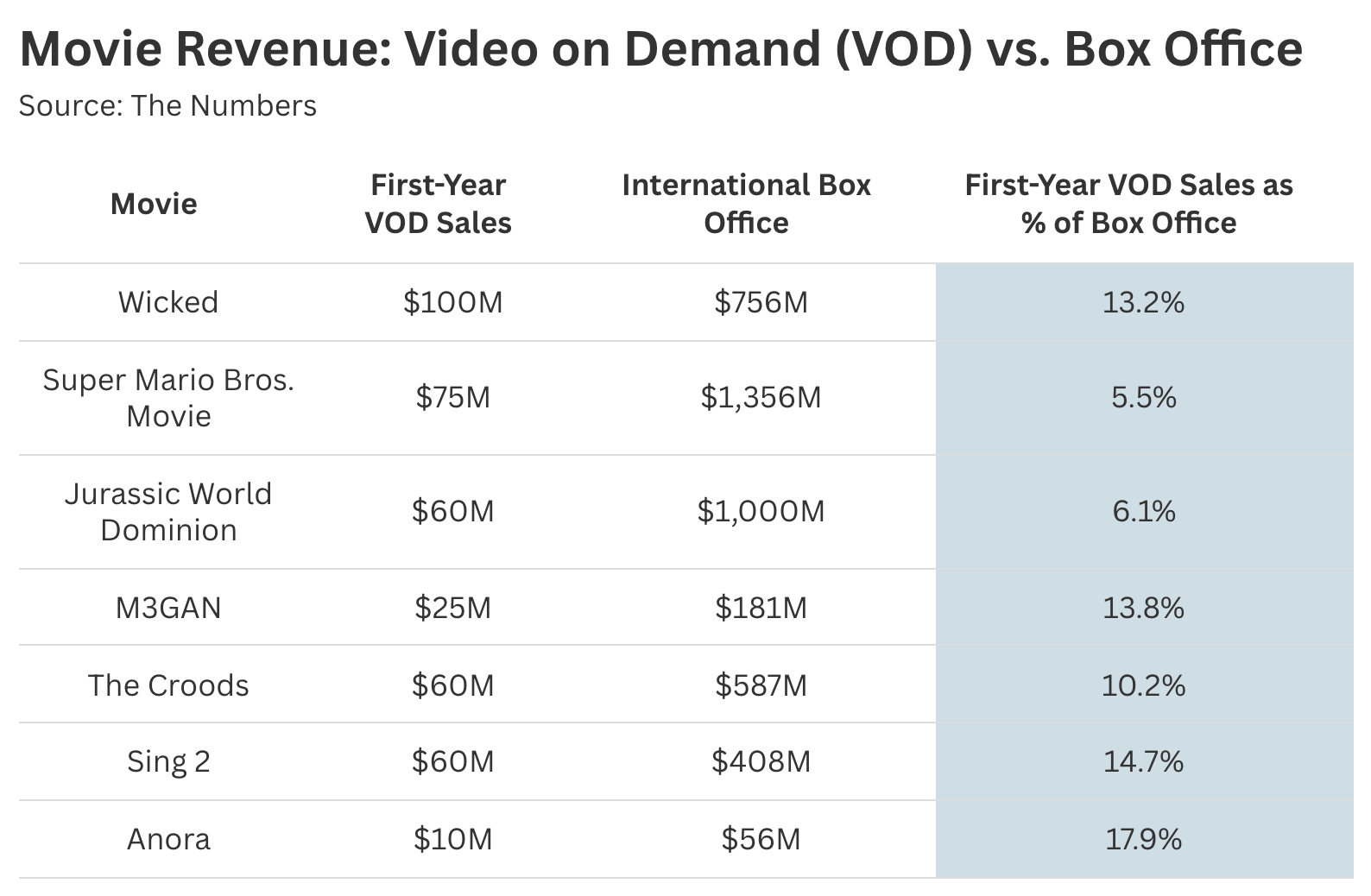
A digital rental costs between $3 and $20, with a single transaction covering an entire household—effectively turning four theatrical tickets into one purchase. For many consumers, waiting for a home release is therefore cheaper and logistically simpler. Recent case studies based on online review activity suggest that many—perhaps most—films now find their largest audience after leaving theaters, first through paid digital release and later through subscription streaming. This pattern is not universal, however, and varies considerably from film to film.
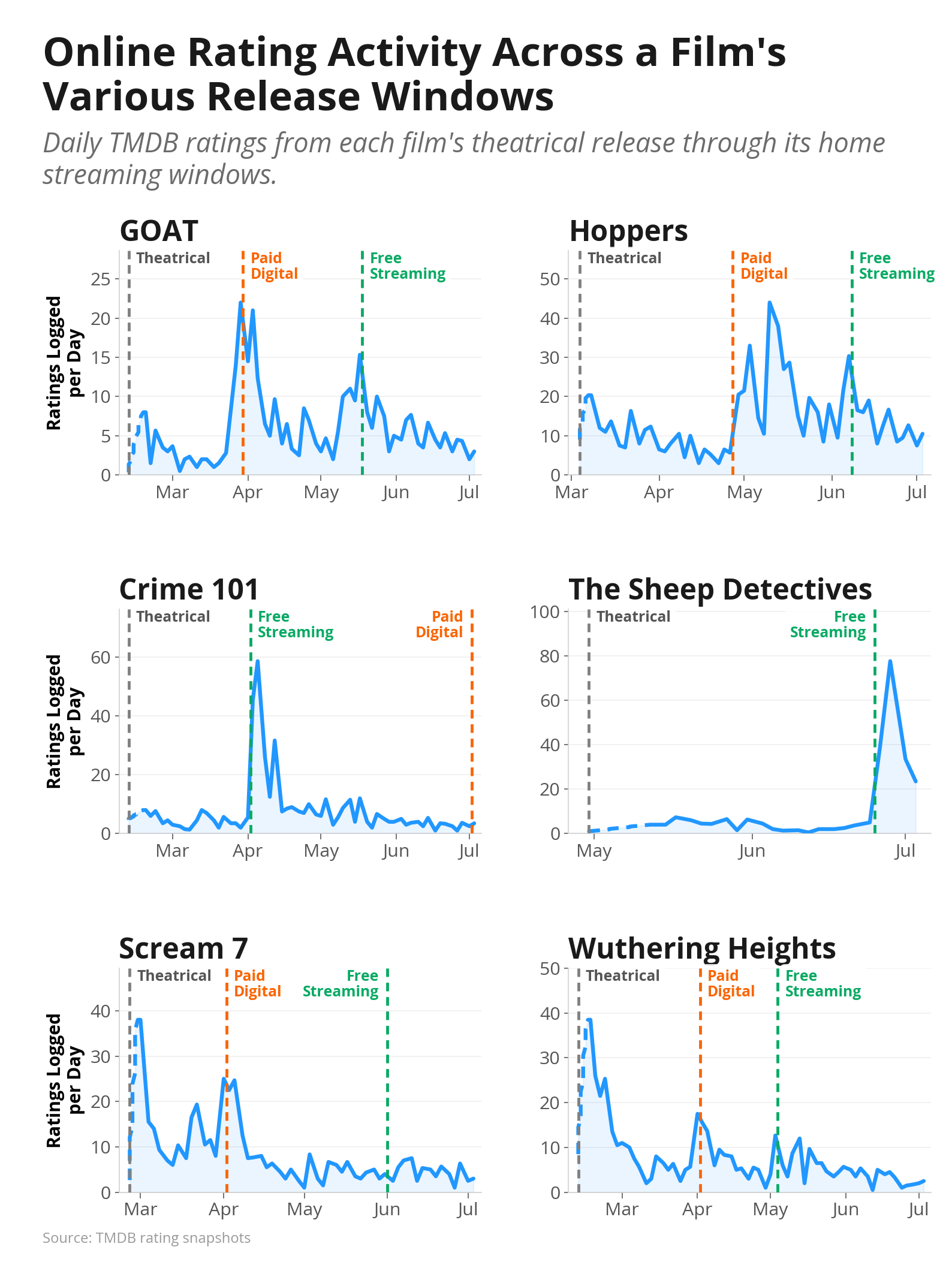
That said, across dozens of data points, the broader trend is clear: a sizable cohort of consumers has been trained to wait for streaming. The result is a new rhythm of movie consumption: theatrical releases generate a strong, sustained wave of attention; paid digital releases produce a sharp but fleeting spike in activity; and subscription services deliver a smaller second uptick.
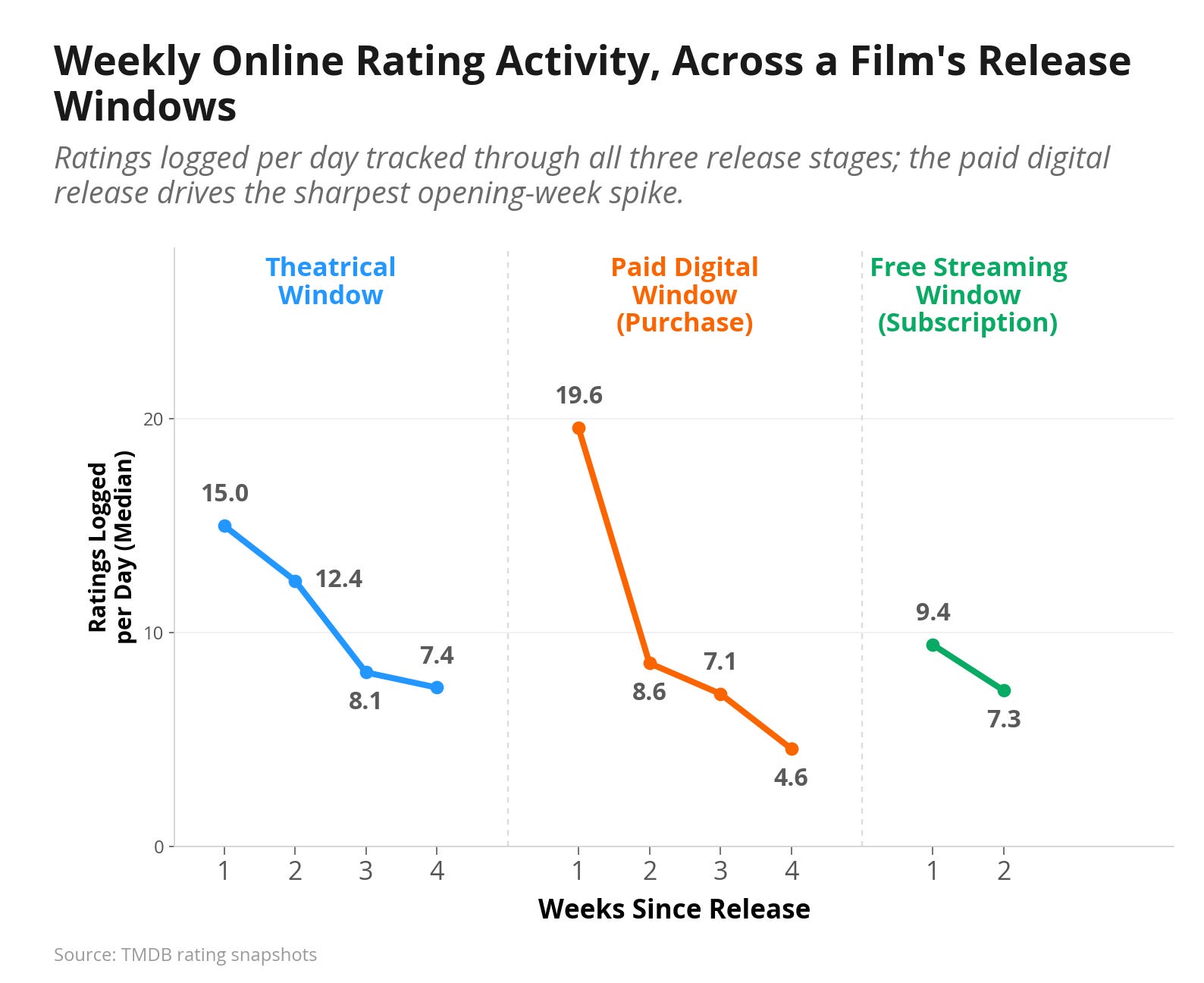
Perhaps most revealing is the first week of premium VOD, when online activity surges—evidence of pent-up demand among viewers who never planned to leave home.
Worse still, consumers appear to prefer this newfound bargain. Online film ratings vary sharply across the three release windows, producing a rather dispiriting finding for anyone who still believes in the magic of da’ movies: the less people pay to watch a film, the more they tend to like it.
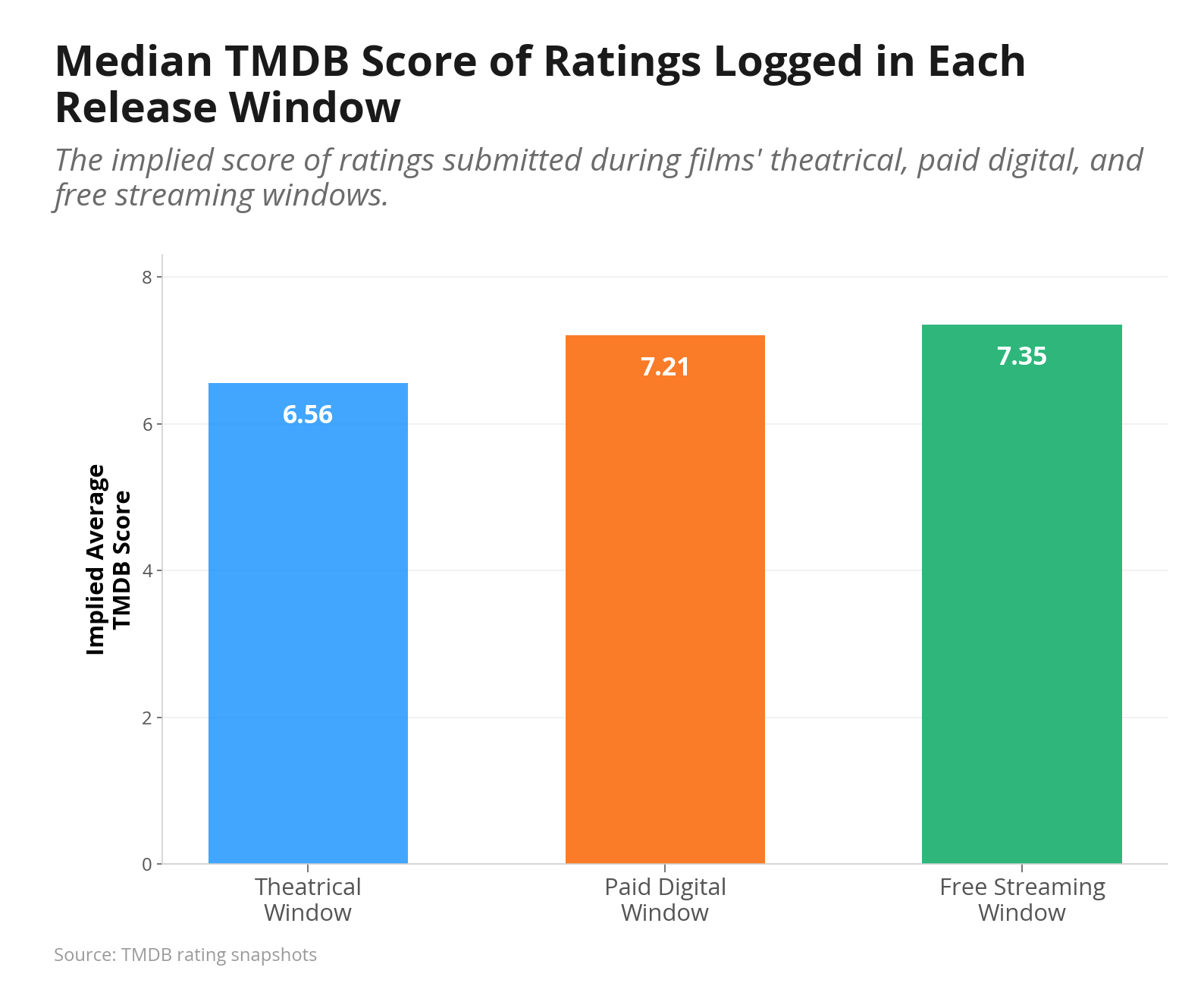
One caveat: these findings come from a limited sample of films released over the past six months, so I’ll revisit the analysis as more data accumulates. Still, the broader pattern is intuitive: a mediocre movie can be a rip-off when it’s a $35 trip to the theater, yet feel like a quaint diversion when bundled into an existing Netflix subscription. Price, in other words, may shape not only whether people watch a film, but how generously they judge it.
And if, like me, you still prefer seeing movies in theaters—even when surrounded by legions of tweens scrolling TikTok—take comfort in this: Hollywood still has a financial incentive to preserve the theatrical experience.
When we compare online review activity across distribution models and streaming windows, we find that films originally released in theaters consistently generate more engagement across all viewership periods—throughout their theatrical runs, paid digital releases, and eventual availability on subscription platforms—than movies released exclusively on streaming. This suggests that theatrical exhibition still serves as a signal of quality, giving audiences a reason to seek out the film later.
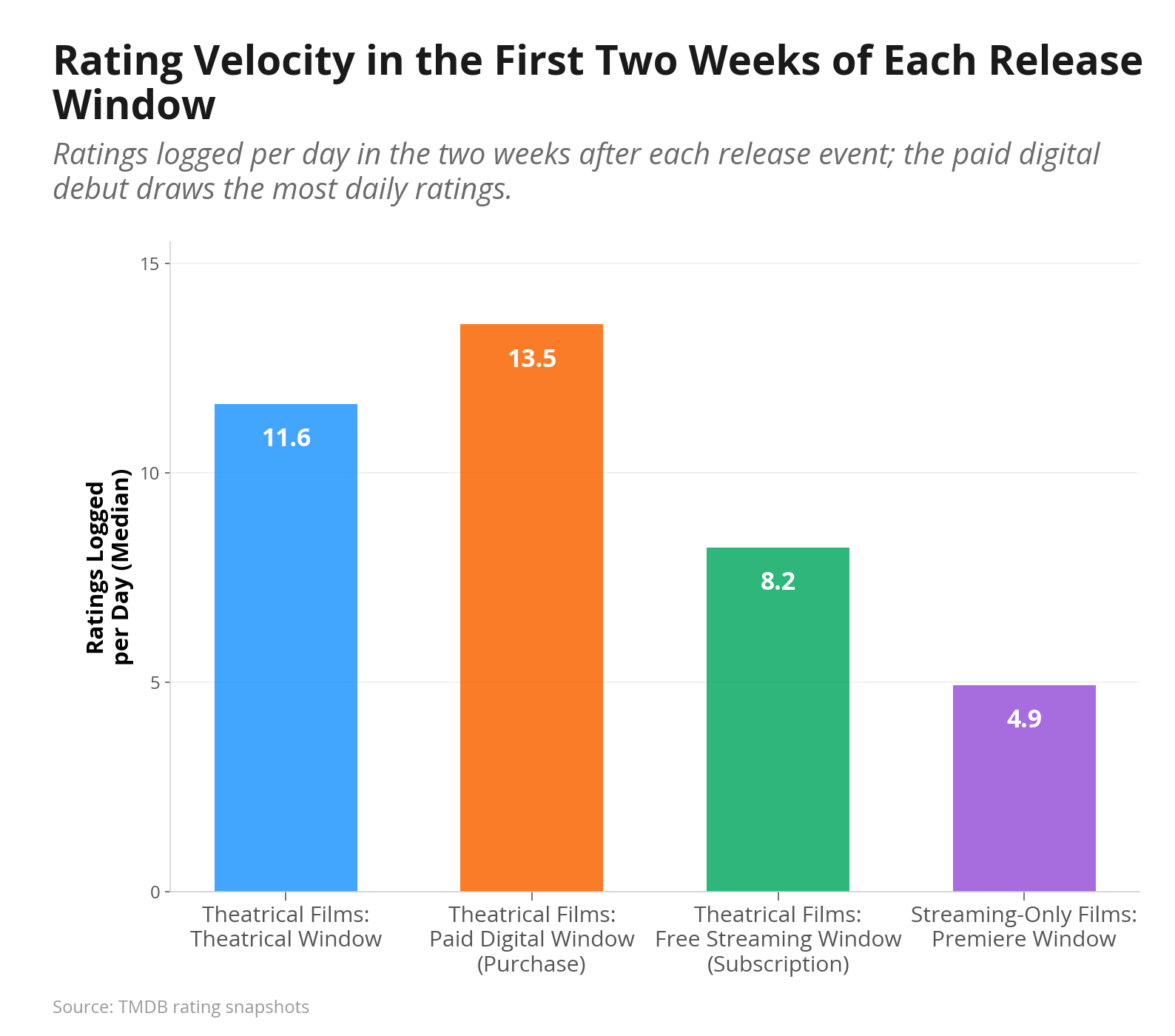
Perhaps theatrical audiences are not merely customers to be monetized, but early evangelists who will build enthusiasm among a cohort of late adopters who will watch the movie via digital rental. Marketing for theatrical releases may therefore accomplish two things at once: attracting committed moviegoers while seeding demand among hesitant at-home audiences.
Enjoying the article thus far and want more data-centric pop culture content?
Final Thoughts: Time, Money, and Diapers

In entertainment trade reporting, theatrical moviegoing is often framed as a noble pursuit, while those who wait for a home release are portrayed as ungrateful philistines who systematically destroy the arts with every Netflix selection. I never fully subscribed to this belief, but I didn’t exactly reject it either. Every time I went to a movie theater, I would pat myself on the back for doing my part—and reward myself with Cookie Dough Bites. And then I had a kid.
Before my son was born, people would offer unsolicited advice that I’d immediately ignore. They’d say things like, “Nothing can prepare you for how much your life will change,” “Time becomes a luxury,” or “Your world will never be the same.” One person even told me they had missed all seven seasons of The West Wing because they were “too busy having kids.” That’s seven full seasons—22 episodes apiece! I disregarded every warning and well-meaning recollection, thinking to myself: “You don’t know me!” Then I’d move on with my day, convinced that I was somehow above conventional wisdom.
Well, all these people were right, and I am a dingus. There is now a growing catalog of movies that I may miss because I am too busy having kids—or, at the very least, I will not see them in theaters.
There was once a meaningful trade-off between staying home and going to the movies. Theaters offered something you could not replicate in your living room: high-definition video, better sound, and access to a film five months before it reached physical media. That trade-off has largely disappeared. I can now watch Hollywood’s best movies on my above-average television within weeks of their debut, spend less money, and never miss my son’s bedtime. Unfortunately, everybody wins—other than movie studios.
At this stage of my life, moviegoing comes with more friction than it once did—a fact Christopher Nolan chose to ignore when he made The Odyssey three hours long. Three hours! Where exactly am I supposed to find a five-hour block required to get to a theater, watch an adaptation of a book I was forced to read in high school, and make it home again? Of course I will go. Once a film major, always a film major. But I have responsibilities now: a kid to put to bed, charts to make for your entertainment, and diaper trash to empty. This new diaper-trash-oriented existence does not easily accommodate three-hour epics, 30 minutes of trailers, an AMC promo featuring Nicole Kidman, and a post-trailer car insurance commercial.
I don’t entirely understand how someone could miss seven full seasons of The West Wing, but it was also a different time—a time before DVR, before TiVo, before Netflix, and before Project Popcorn. Now people don’t really have to miss anything. All they have to do is wait two to four weeks.
Enjoyed the analysis? Support Stat Significant and unlock the data behind the insights.
Become a paying subscriber to get bonus graphics, interactive dashboards, downloadable datasets, and to support independent journalism.
Paying subscribers get:
Bonus Data Stories: Full access to the Monday Roundup, a bonus edition with extra culture data stories, curated datasets, and recommended reads.
The Public Dataset Directory (Updated Weekly): A curated directory of public datasets from around the web.
Interactive Data Hubs: Interactive dashboards across Streaming TV, Movies, Music, Search Trends, Wikipedia, and more.
*Note: For best results, open this link in a web browser while logged in to your Substack account.
Want to promote your data tool or media publication to Stat Significant’s 26,200 readers? Email daniel@statsignificant.com
Need help with a data problem? Book a free data consultation
Connect with me on LinkedIn if you want to chat about a data project.
Like movies? Follow me on Letterboxd
This is reminding me of a conversation I had with my husband when our kids were both under seven:
"We haven't been to the movies in eight years."
"That's not true! I saw Frozen, and you saw The Lego Movie."
It does eventually get to a fun point where you can take your kids to the movies and they won't sing loudly to the screen or do anything that gets you thrown out, not that my kids ever did that. ;) We did stop going to the movies though, because of covid and cost. Only recently have we returned as a family and it's because of the emergence of cheap revival theaters -- theaters where we can see old movies on the big screen for under ten dollars. We saw The Lost Boys, Nightmare on Elm Street, etc. I'm curious how this deal factors into your data. There used to be one or two theaters that did this, but now the theater in the mall is doing it too, just to stay afloat, and it really brings in Gen X/Millennial families with Gen Z/Gen Alpha kids.
I will say this as a cheer-you-up attempt: Once your youngest child reaches a certain age, a lot of the restrictive facets of being a parent slowly disappear, and going to the movies, even long ones, doesn't seem like something so impossible. Hang in there :)