


Intro: The Peak of Peaks
If you had to pinpoint the peak of the Peak TV era, May 2023 would make for a compelling choice. Prestige mainstays like Succession, Barry, Ted Lasso, and The Marvelous Mrs. Maisel were airing their final seasons, while acclaimed newcomers like Yellowjackets, Beef, and Silo were gaining momentum.
These shows emerged from the post-pandemic production rebound and were filmed before Hollywood was upended by writers’ and actors’ strikes, industry-wide layoffs, and a disastrous Netflix earnings report that sent the streaming business into recession.
Flash forward to last week, when I opened my streaming dashboard and encountered a rather discouraging sight. Across the four most recent weeks of Nielsen Top 10 data, television was dominated by two categories: 1) syndicated cable series finding a second life on streaming and 2) shows adapted from existing intellectual property (IP). Not a single title was both recently released and wholly original. Yikes!
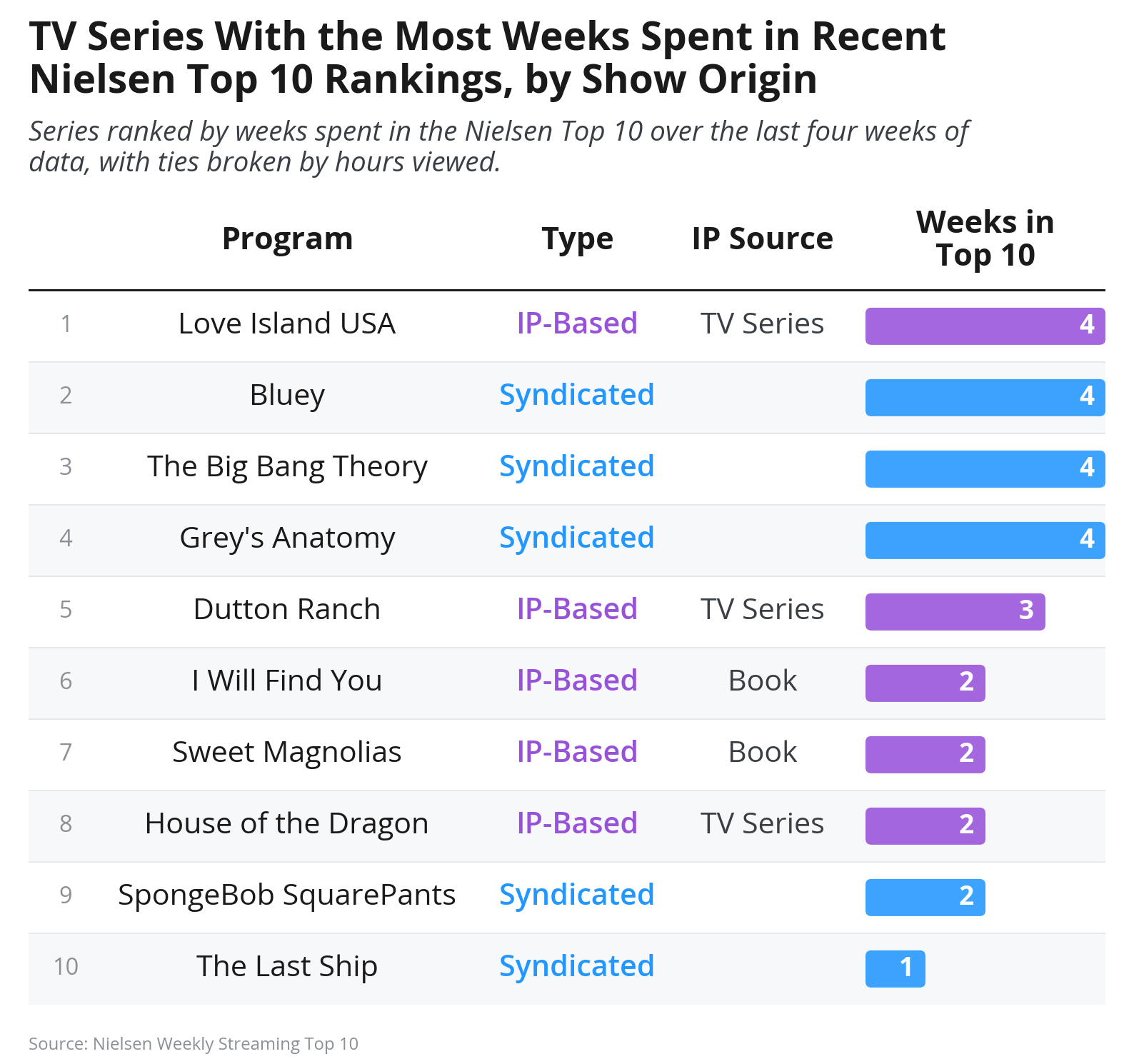
The most likely explanation is that this data offers a random, unrepresentative snapshot. Perhaps television simply experienced a few “down” weeks dominated by derivative programming. In that case, I’m overreacting. Silly me!
But what if I’m not overreacting? What if the shows breaking through each week have fundamentally changed, and today’s TV landscape is a far cry from that of May 2023? What if streaming has settled into a new normal?
So today, we’ll examine the rise of television’s slop era, the industry forces driving these programming decisions, and whether viewers are better off than they were 30 years ago.
The Rise of TV’s Slop Era
Thus far in 2026, television has been dominated by long-running syndicated cable programs like Grey’s Anatomy and SpongeBob SquarePants, along with adaptations of popular franchises such as House of the Dragon and Andor. Of all the TV shows to appear on Nielsen’s weekly Top 10 chart in 2026, just 20% qualify as “original,” meaning they are neither syndicated nor tied to existing intellectual property. Meanwhile, a paltry 4% of charting programs are new series that are also “original.”
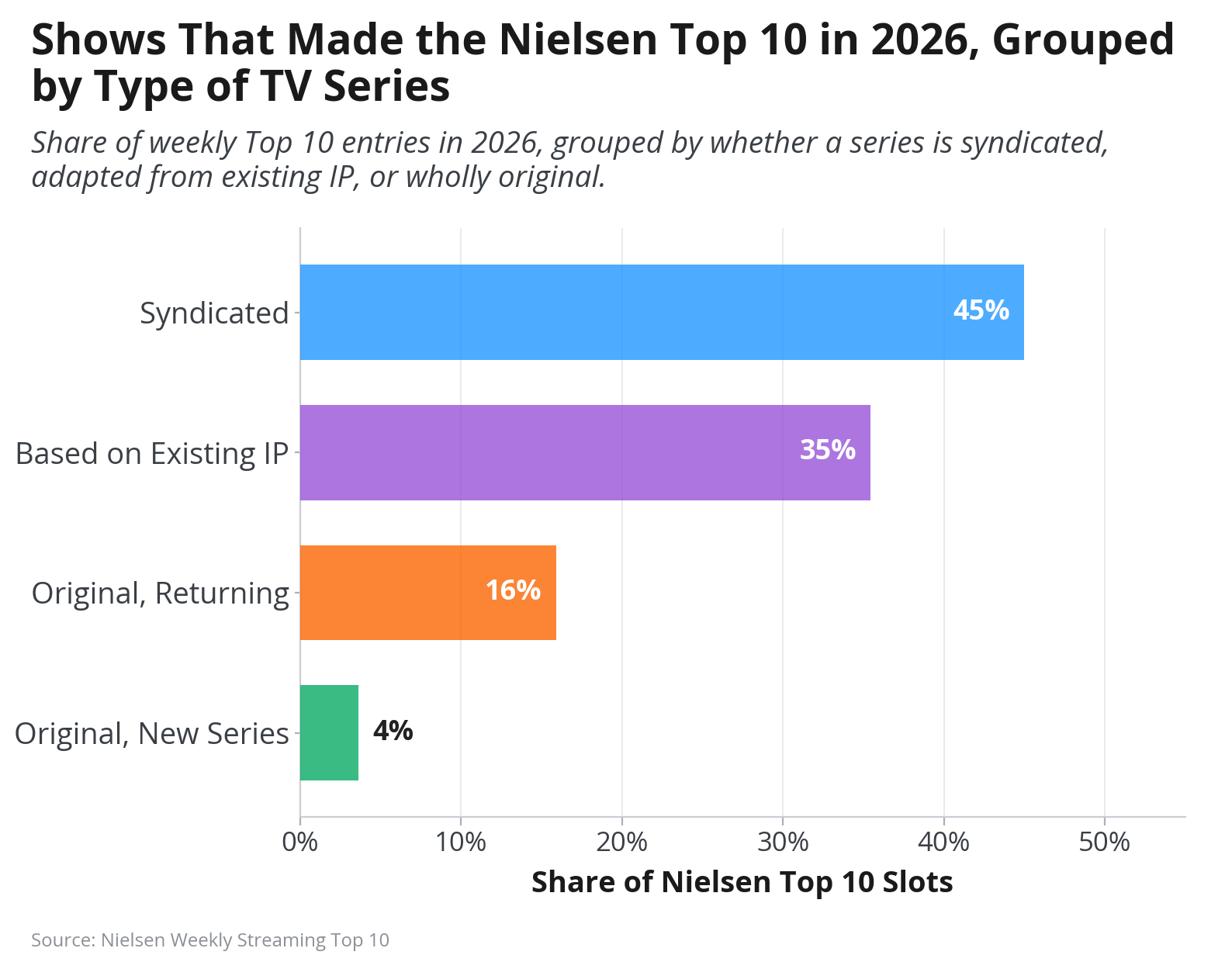
This paradigm shift had been brewing since the early 2010s, as television saw a decline in long-running programs, a surge in new series, and a growing appetite for adaptations of novels, comic books, and video games (in short, IP).
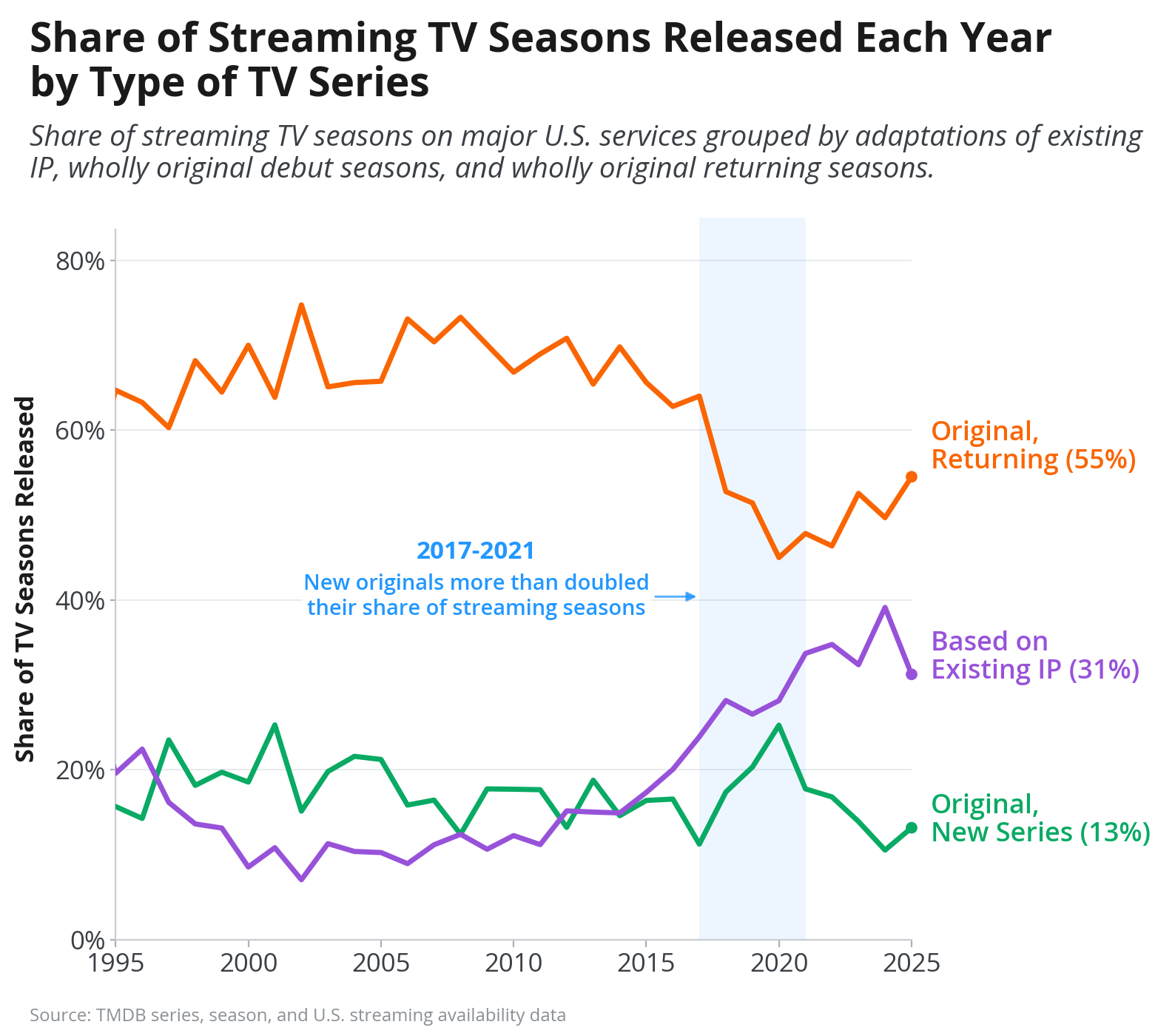
You’ll also notice that during the early streaming wars, from 2017 to 2021, television saw a brief uptick in newly launched and entirely original shows. By 2025, however, this rare breed had fallen to an all-time low, accounting for just 13% of TV seasons.
So what happened? How did television become “newer” even as many of these “new” shows were adapted from non-new books, comics, and video games?
This programming change began in 2013, as nascent streaming services flooded the market with flashy series in a race for subscriber growth. As such, television production steadily increased through 2022, ushering in an era of content abundance.
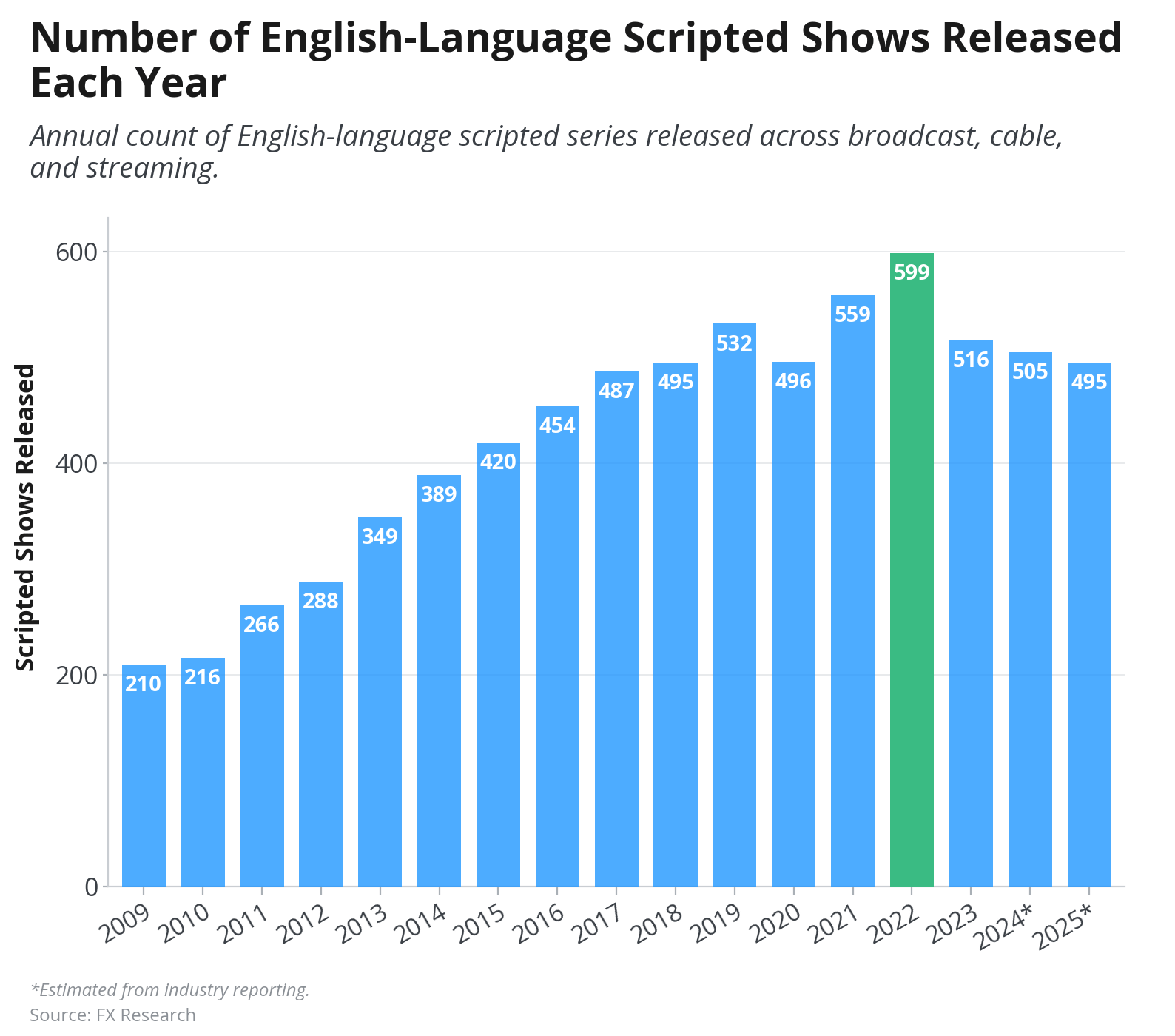
Thus began a golden age for small talk. If you worked a boring corporate job, you could fill almost any awkward silence with a simple question: “Watching anything good right now?” The answer was always “yes.” Stranger Things, The Queen’s Gambit, Game of Thrones, Big Little Lies—there was rarely a dull week.
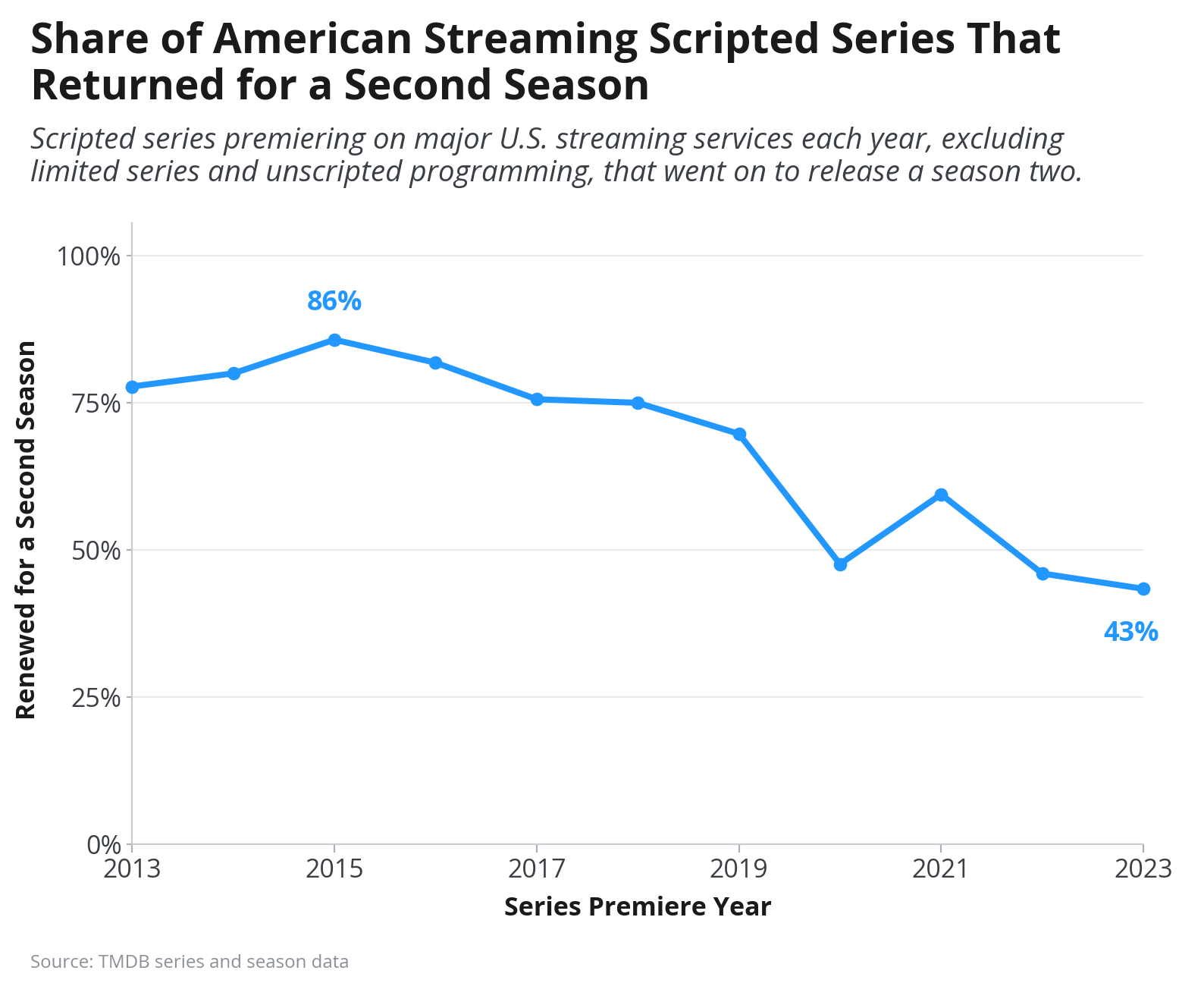
Of course, this unprecedented boom in original programming also produced plenty of flotsam. As streamers grew their catalogs with new programs, second-season renewal rates plummeted. A platform like Hulu might add 20 shows in a given year—20 brand-new tiles!—but only 8 of those tiles would make it to season two.
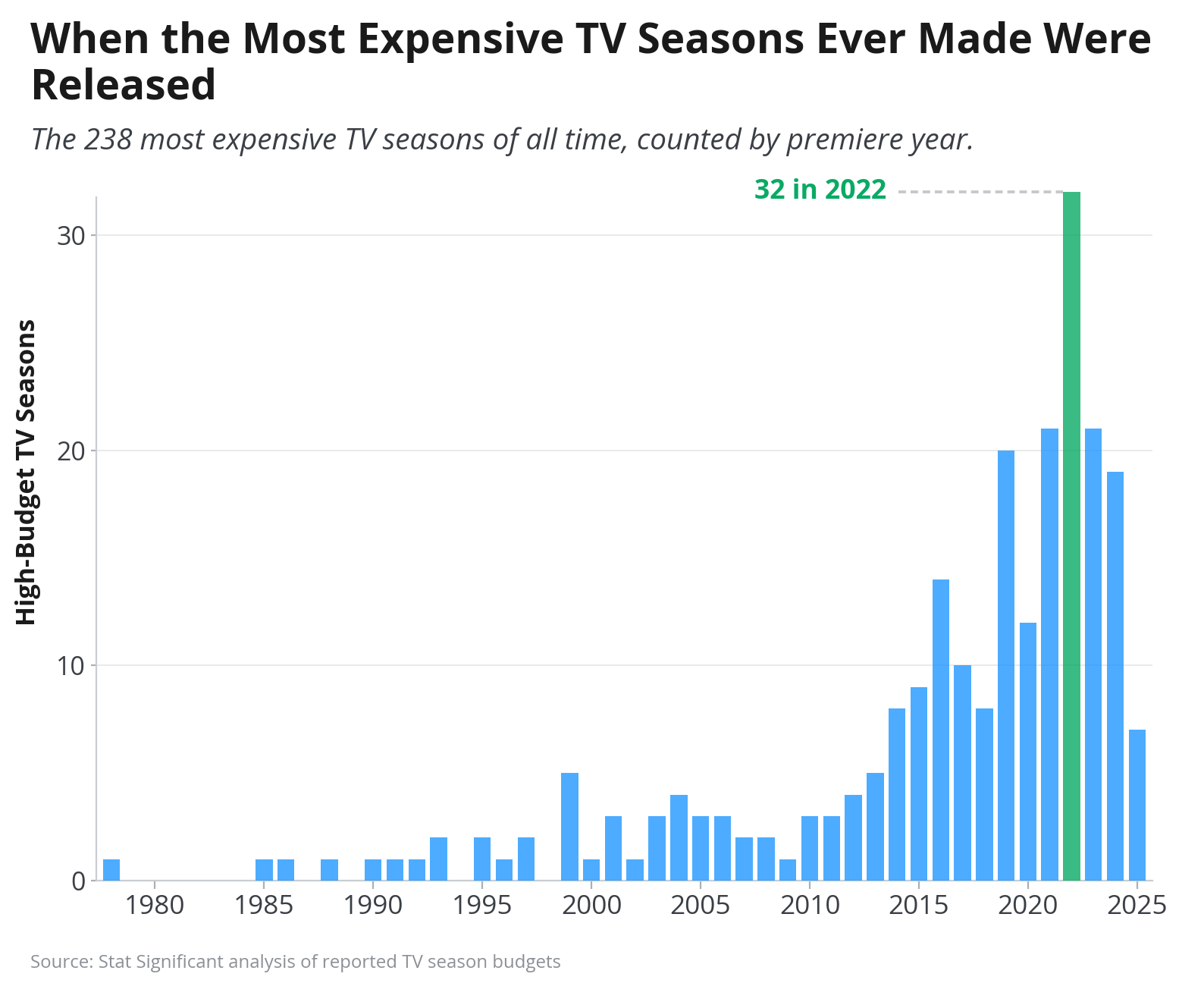
All the while, the budget for the average television show skyrocketed. When we examine the most expensive TV seasons of all time, nearly 80% fall within a ten-year period between 2015 and 2025.
So, to recap:
New TV show volume increased.
The price tag of this programming also increased.
And the renewal rate of these new (and expensive) shows fell precipitously because many of these programs never found an audience.
So, let’s say you’re running a streaming platform—what do you do? First, you make fewer shows, an easy way to cut costs. Second, you reduce the risk of this diminished slate failing by betting on familiar intellectual property. And guess what? This content performs spectacularly because you’re preying on the nostalgia of Star Wars fans and comic book devotees. Now you get promoted—congratulations—and you can use your newfound riches to buy a jet ski or dinosaur skull. Well done!
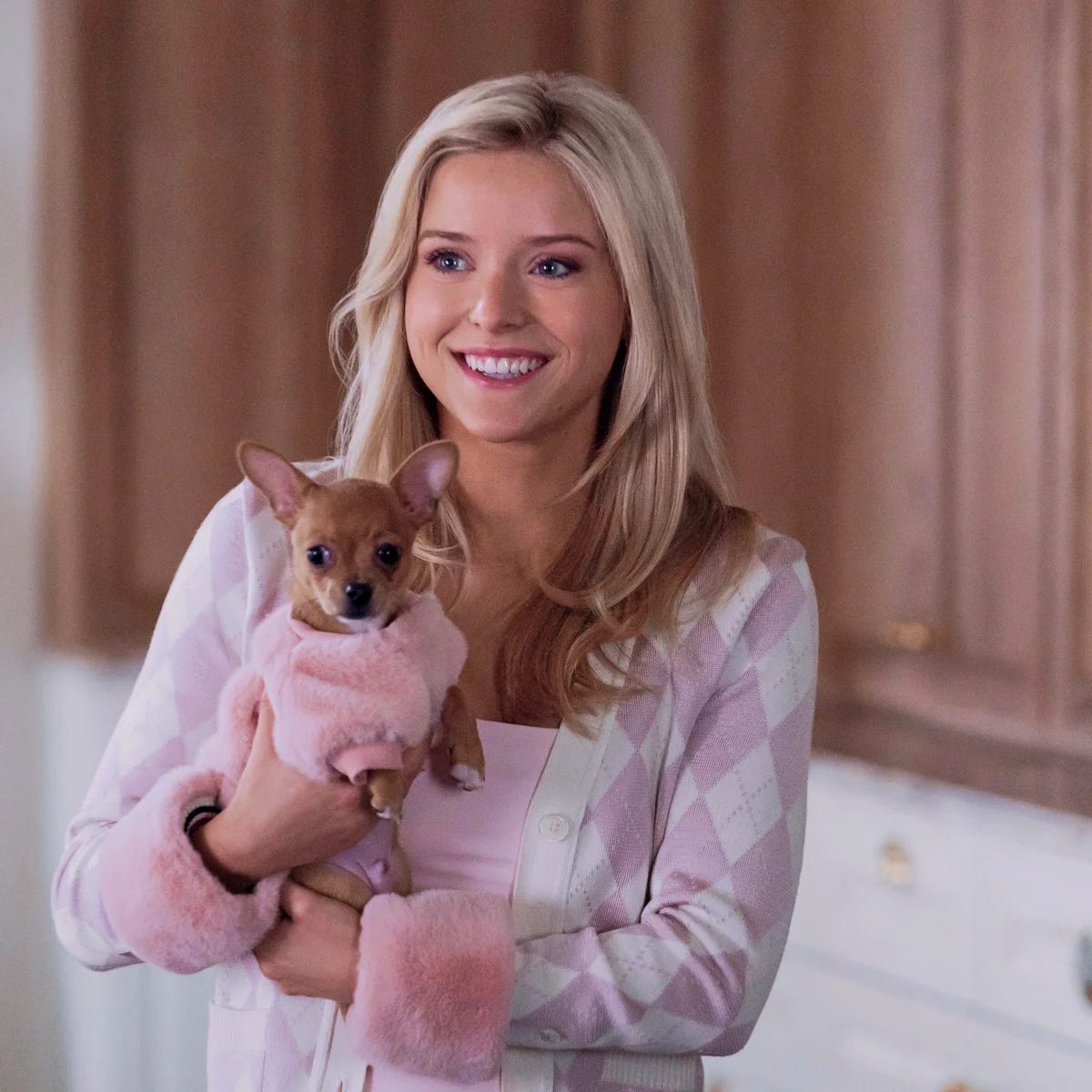
This logic is how we end up with a soulless series like Elle, an origin story for Reese Witherspoon’s character in Legally Blonde and a worthy addition to an ever-expanding canon of “Who asked for this?” content.
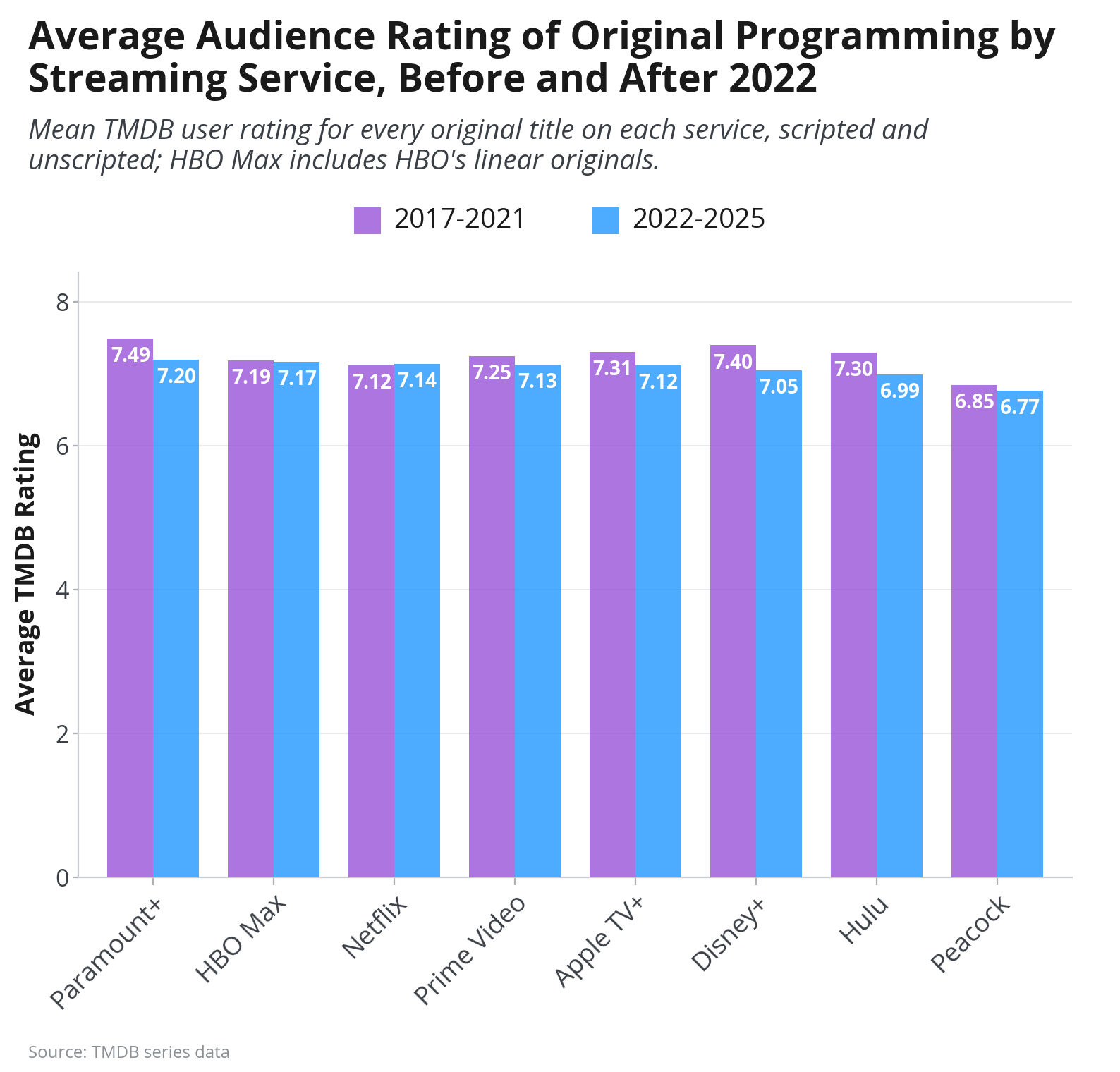
If you’ve recently fired up [insert streaming platform of choice] and struggled to find a compelling selection, know you are not alone. With the exception of Netflix and HBO, pretty much every streamer has seen a marked dip in online acclaim over the last four years, as once-riveting television has given way to derivative, low-effort content.
In the absence of buzzy prestige programming, viewers are retreating to the past, bingeing the back catalogs of long-running cable shows like Grey’s Anatomy, Suits, and The Big Bang Theory. New series may come and go, but Big Bang’s Sheldon Cooper is eternal.
The phrase “peak TV” began as industry jargon, but has since come to define a distinct era in television history. TV’s golden age is over, and May 2023 marked its final flourish as television’s true “peak” came during a narrow three-year window, from 2018 to 2020, when the typical series was quantifiably above average.
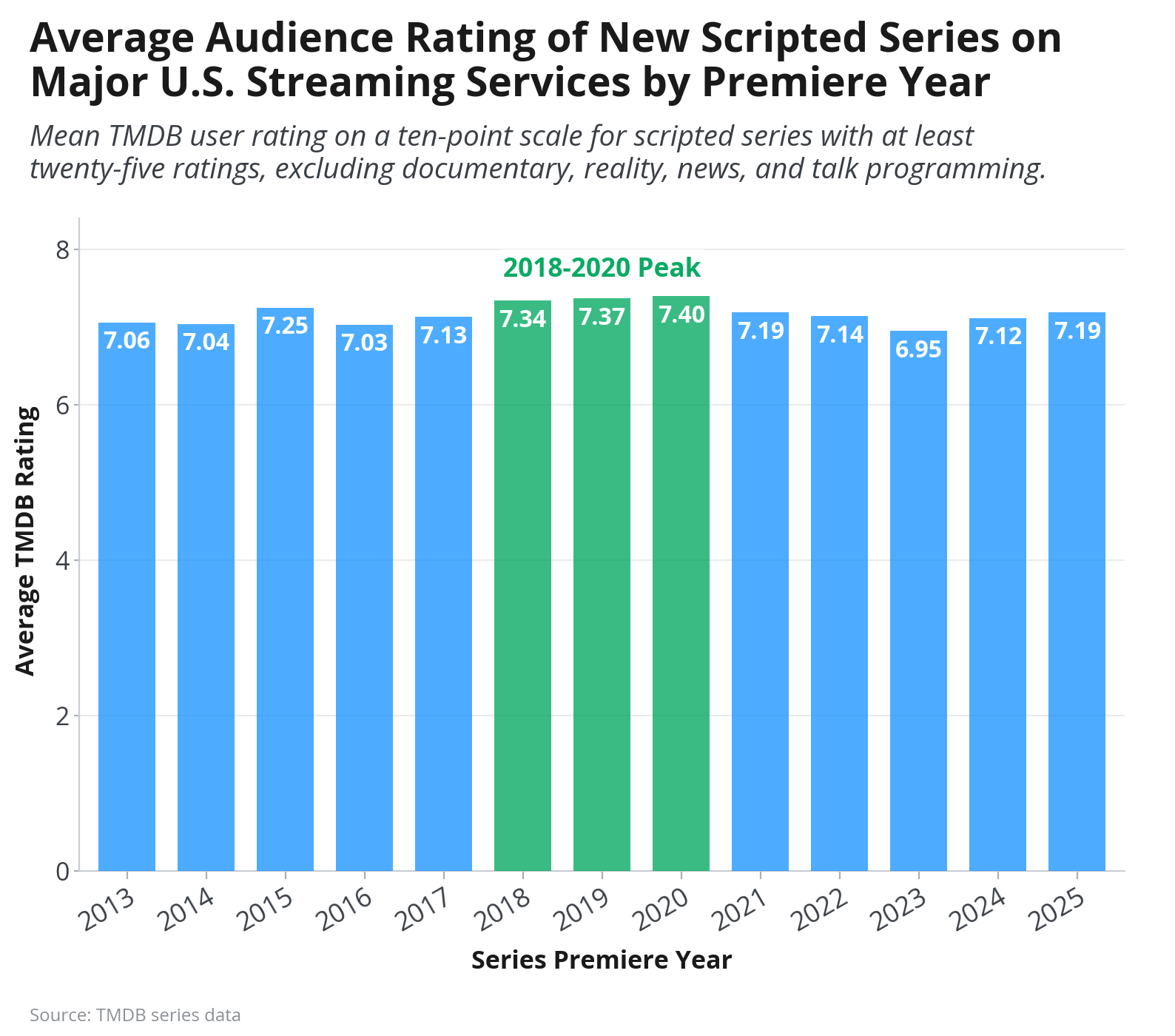
Yet our expectations for television remain anchored to this fleeting 36-month period of artistic ambition and programming abundance. Every year, I tell myself, “This will be the year that TV returns to normal.” And every year I’m wrong. The uncomfortable truth is that TV has already returned to “normal.” 2019 was simply the exception.
Enjoying the article thus far and want more data-centric pop culture content?
Final Thoughts: Consider the Maximizer
Your view on the current state of television likely depends on whether you are a satisficer or a maximizer. I usually dislike theories that group all humans into one of two personality types, but I’m okay with this one because it conveniently works for the point I’m about to make.
If you’re a satisficer: you are easily satisfied (unsurprisingly!) and enjoy whatever is put in front of you. When you fire up Netflix, you look no further than the Top 10 carousel because—heck—you’ll enjoy any show about a serial killer offing people in the American Midwest. If it’s good enough for the Top 10, it’s good enough for you!
If you’re a maximizer: you know that somewhere out there is a Platonic ideal for superb TV programming—the perfect streaming show—and you will not rest until you find this elusive piece of content. Worse yet, you still remember the glory days of 2018 and 2019, when every TV series rocked. You peruse Netflix, Hulu, and Paramount+ for 15 minutes at a time, hoping that it will somehow open a portal to this golden age of television programming.
At first pass, you may think that I harbor some sort of disdain for the satisficer—that I consider myself better than a person who excels at being content. But, honestly, I’d rather be content.
Most likely, TV’s pre-pandemic high point will never be replicated because the economics no longer make sense, which means I will spend the rest of my life telling my children and my children’s children about a three-year period in my twenties when TV was slightly above average.
Had this explosion of high-quality television never happened, I’d have no complaints about today’s streaming landscape. I’d happily watch my Game of Thrones spin-off, my Yellowstone prequel, my beloved Sheldon Cooper, and my SpongeBob reruns without expecting anything more from television. I’d just be satisfied.
Enjoyed the analysis? Support Stat Significant and unlock the data behind the insights.
Become a paying subscriber to get bonus graphics, interactive dashboards, downloadable datasets, and to support independent journalism.
Paying subscribers get:
Bonus Data Stories: Full access to the Monday Roundup, a weekly bonus edition with extra culture data stories, curated datasets, and recommended reads.
The Public Dataset Directory (Updated Weekly): A curated directory of public datasets from around the web.
Interactive Data Hubs: Interactive dashboards across Streaming TV, Movies, Music, Search Trends, Wikipedia, and more.
*Note: For best results, open this link in a web browser while logged in to your Substack account.
Want to promote your data tool or media publication to Stat Significant’s 26,200 readers? Email daniel@statsignificant.com
Need help with a data problem? Book a free data consultation
Connect with me on LinkedIn if you want to chat about a data project.
Like movies? Follow me on Letterboxd
Oooh this looks good. That said I think slop has been round in telly since the dawn of tv
You have my dream job: data and writing about movies!
I'm a Maximizer, but I won't rewatch my favorite TV series, Succession. I have a thing for experiencing things once and then searching for the next best new thing. It doesn't work for my relationships, but now that I think about it, I should rewatch some of my favorite shows.