


Intro: The Most Popular Song in Human History
Let’s imagine the year is 3026 and the human race is long gone, having perished in [insert some horrible tragedy that Al Gore predicted]. A group of extraterrestrial beings arrives on our planet, curious to study our culture and use archival information to piece together how we lived.
In an effort to understand our art, they stumble upon extensive record-keeping from the Billboard Hot 100. These aliens crunch the numbers and subsequently deduce that the greatest tune in human history was none other than Ella Langley’s “Choosin’ Texas,” which, as of this writing, has topped the Billboard Hot 100 for 24 weeks, an all-time record, surpassing Mariah Carey’s “All I Want for Christmas Is You.”
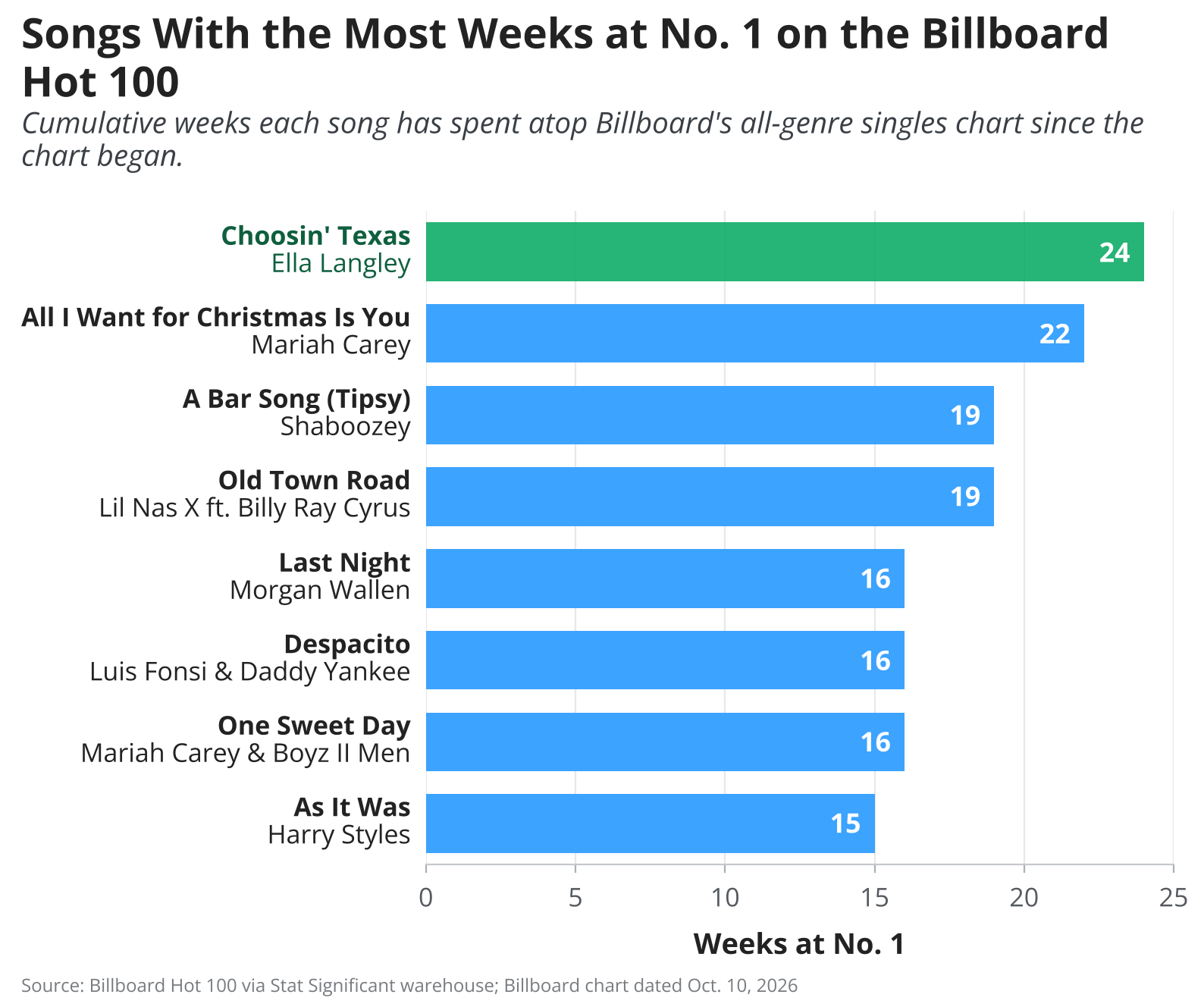
Now I ask you, the reader: Would this encapsulation of our culture feel accurate? Is “Choosin’ Texas” really the greatest song humankind has to offer? Perhaps more absurdly: Have you ever heard this song?
Such is the curious case of an above-average tune that has experienced unprecedented commercial success. According to the music industry’s foremost record keeper, “Choosin’ Texas” is the most popular track of the last 70 years—a distinction that makes you question how Billboard (and its charts) came to such a conclusion.
So today, we’ll examine the remarkable commercial longevity of “Choosin’ Texas,” deconstruct how Billboard compiles its marquee Hot 100 list, and explore why this song is uniquely predisposed to that longevity (as measured by Billboard).
The Most Popular Song You’ve Never Heard
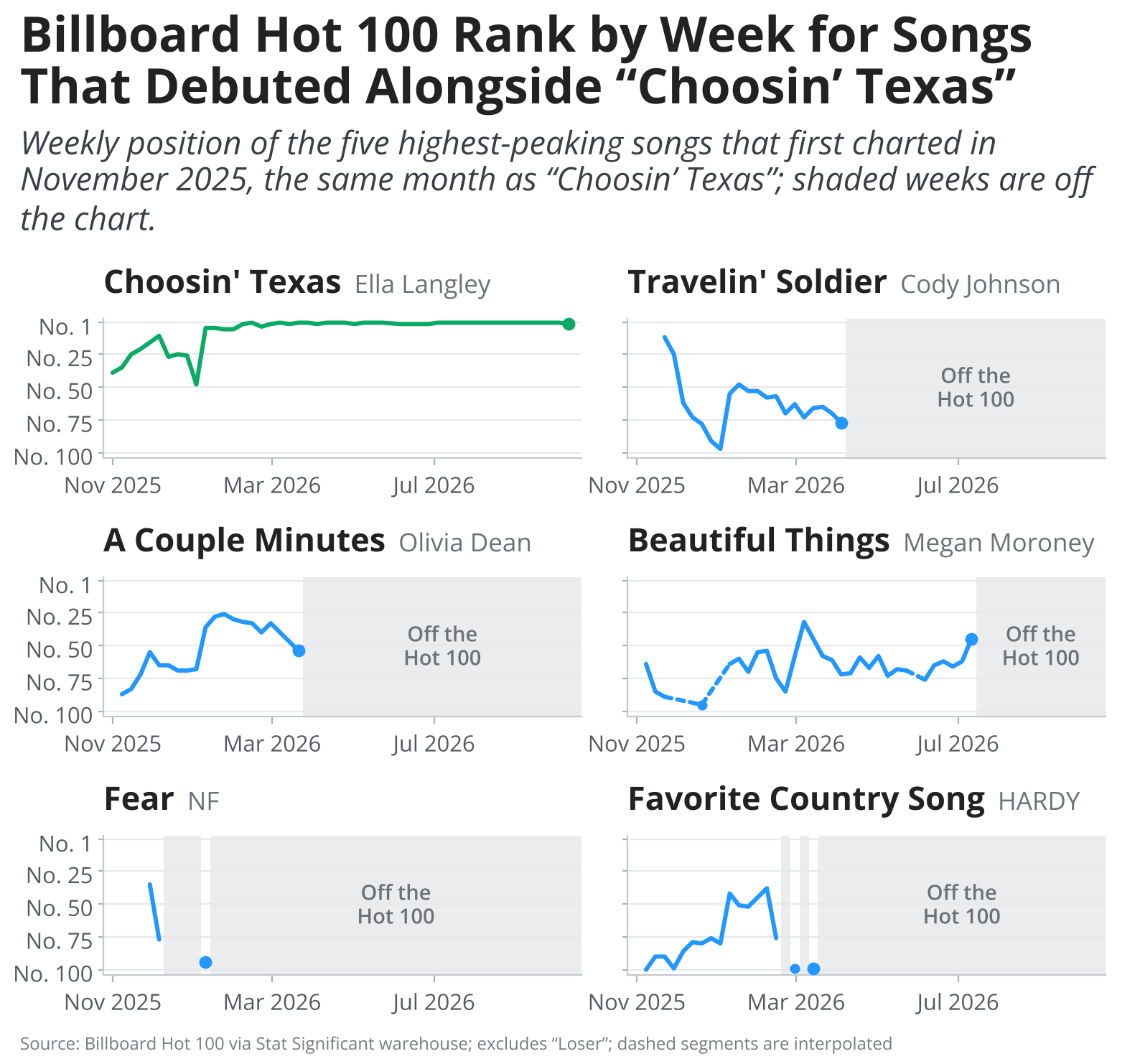
Ella Langley’s “Choosin’ Texas” debuted on the Billboard Hot 100 in November 2025, appearing at #39 for the week of November 1st. What happened next makes the song an all-time outlier. In its first wave of listenership, “Choosin’ Texas” peaked at #5 before falling as low as #48. At this point, one could reasonably assume the song would keep falling down the charts until it left the Hot 100 and faded into cultural obscurity.
But the song caught an epic second wind, climbed to the top of the charts, and has stayed there for nearly six months. Compared with other tracks that debuted on the Hot 100 that same November, its slow rise and lasting success are remarkable.
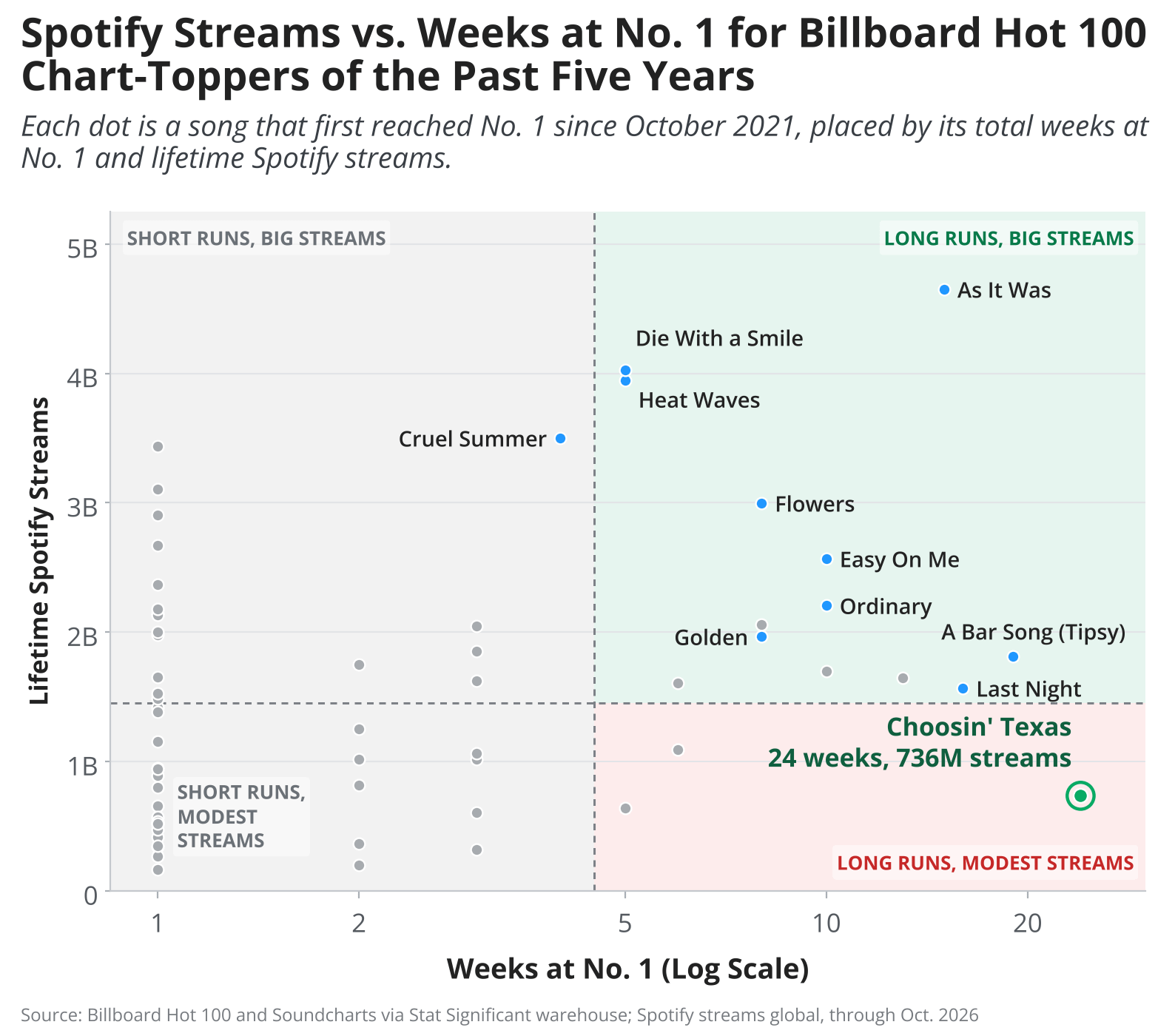
And here’s where things get really strange: Despite its record-breaking run atop the Billboard Hot 100, “Choosin’ Texas” is one of the least-streamed #1 hits of the last five years. When we compare all-time Spotify streams with weeks spent at #1, the song stands alone, combining an unusually long reign with relatively modest streaming numbers.
The track also has a much smaller streaming footprint outside the U.S., never reaching No. 1 on Spotify’s global chart and spending just four days in the global top 10.
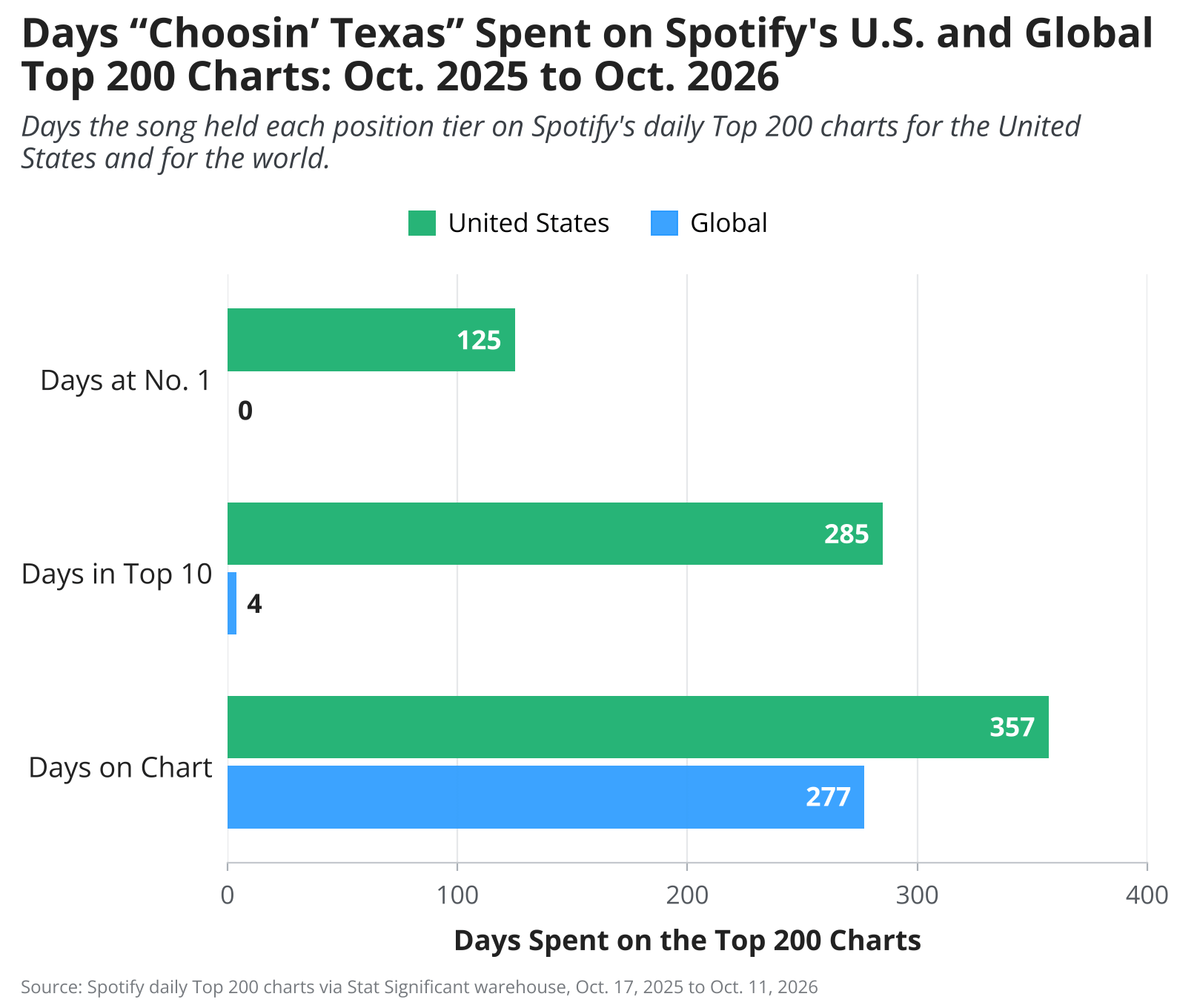
This isn’t unusual for a country song, given the genre’s predominantly American audience. Still, the divide between domestic and international listenership is striking for a song this popular.
The track’s remarkable staying power has perplexed critics, prompting country music detractors to look for explanations, starting with the stagnation of music culture.
The central argument is that music culture now evolves more slowly, with fewer songs dominating the zeitgeist and popular hits spending longer stretches atop the Billboard charts—a phenomenon the data supports. As of 2026, more than half of the songs in the Billboard Hot 100’s top 10 have already spent at least 20 weeks on the chart.
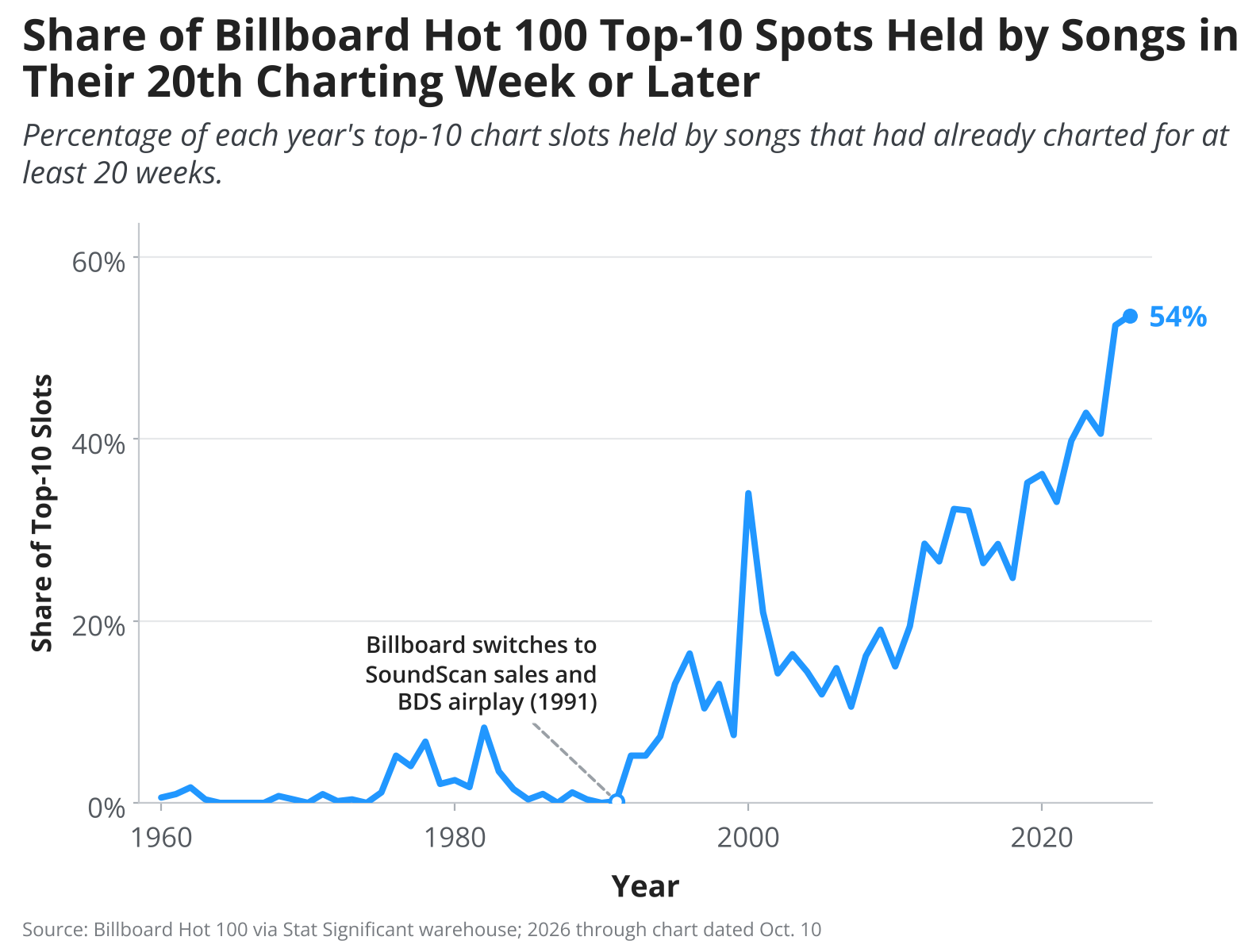
This has likely contributed, at least in part, to the longevity of “Choosin’ Texas.” Yet the same phenomenon could just as easily apply to any other song that reached the Billboard top 10 over the past year. So the question remains: why this particular tune?
To answer that, we need to examine how Billboard’s 70-year-old ranking system actually works.
Billboard’s job was much simpler in the 1960s, when chart rankings largely depended on record sales and radio airplay. Today, the publication must find a way to measure and compare several forms of music consumption, including:
Paid music streaming
Free, ad-supported streaming
Radio airplay
YouTube views
Physical and digital music sales
Billboard reconciles these different forms of listenership by converting them into a common metric: song sales. Under this system, a certain number of streams equals a single song sale—for example, 100 paid subscription streams count as one song sale.
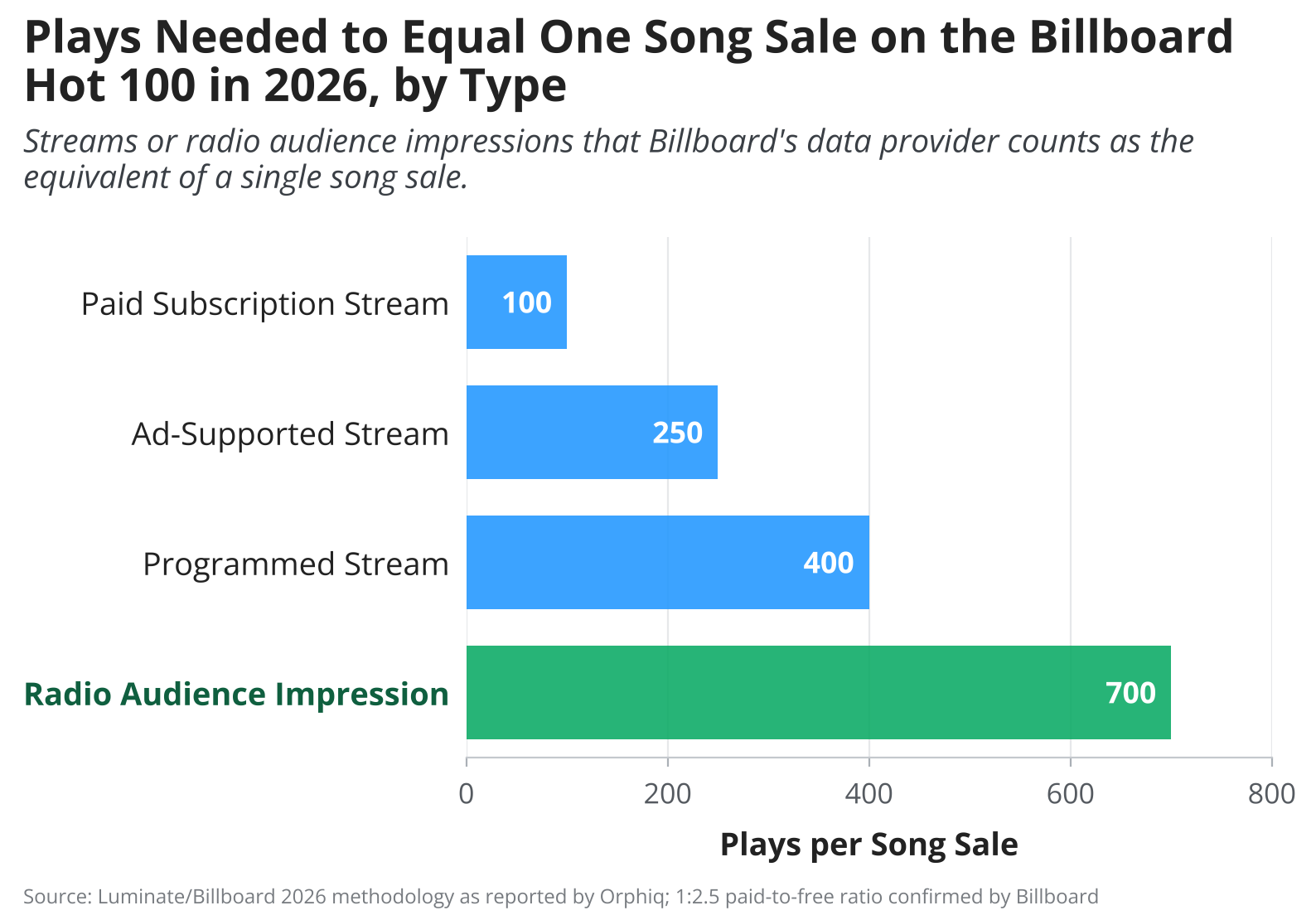
Most of these measures cover some variation of streaming, a medium in which “Choosin’ Texas” currently lags behind other chart-topping songs. Which brings us to radio play.
If you want to see this song’s highly specific cultural reputation in a single chart, look no further. The track’s weekly streaming activity has remained flat for months, while its radio play continues to climb.
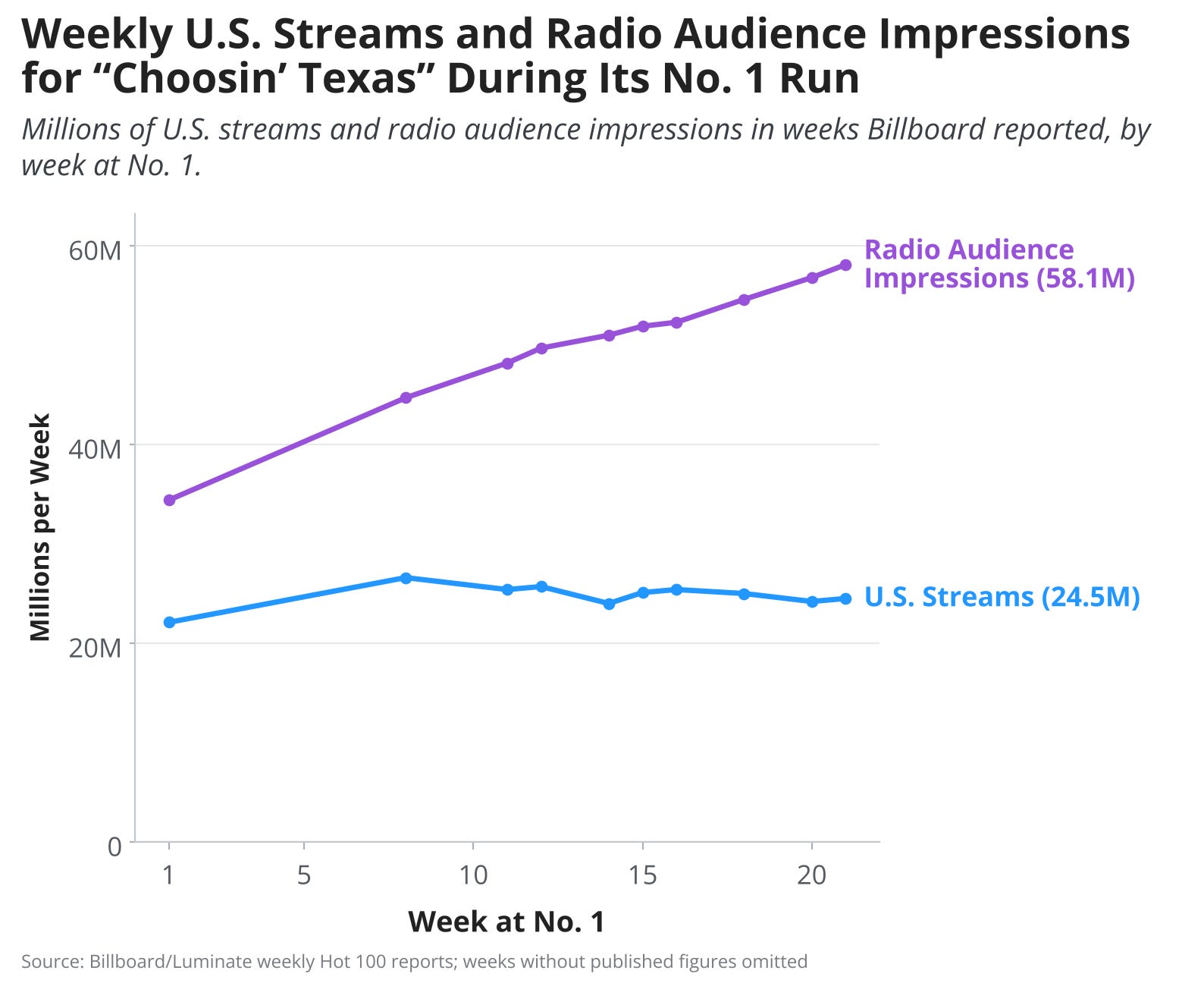
Country music fans have been among the slowest to embrace streaming because of a mix of cultural and technological factors, from subpar internet quality in many rural areas to long-standing listening habits. As a result, country is the second-largest radio format in the United States.
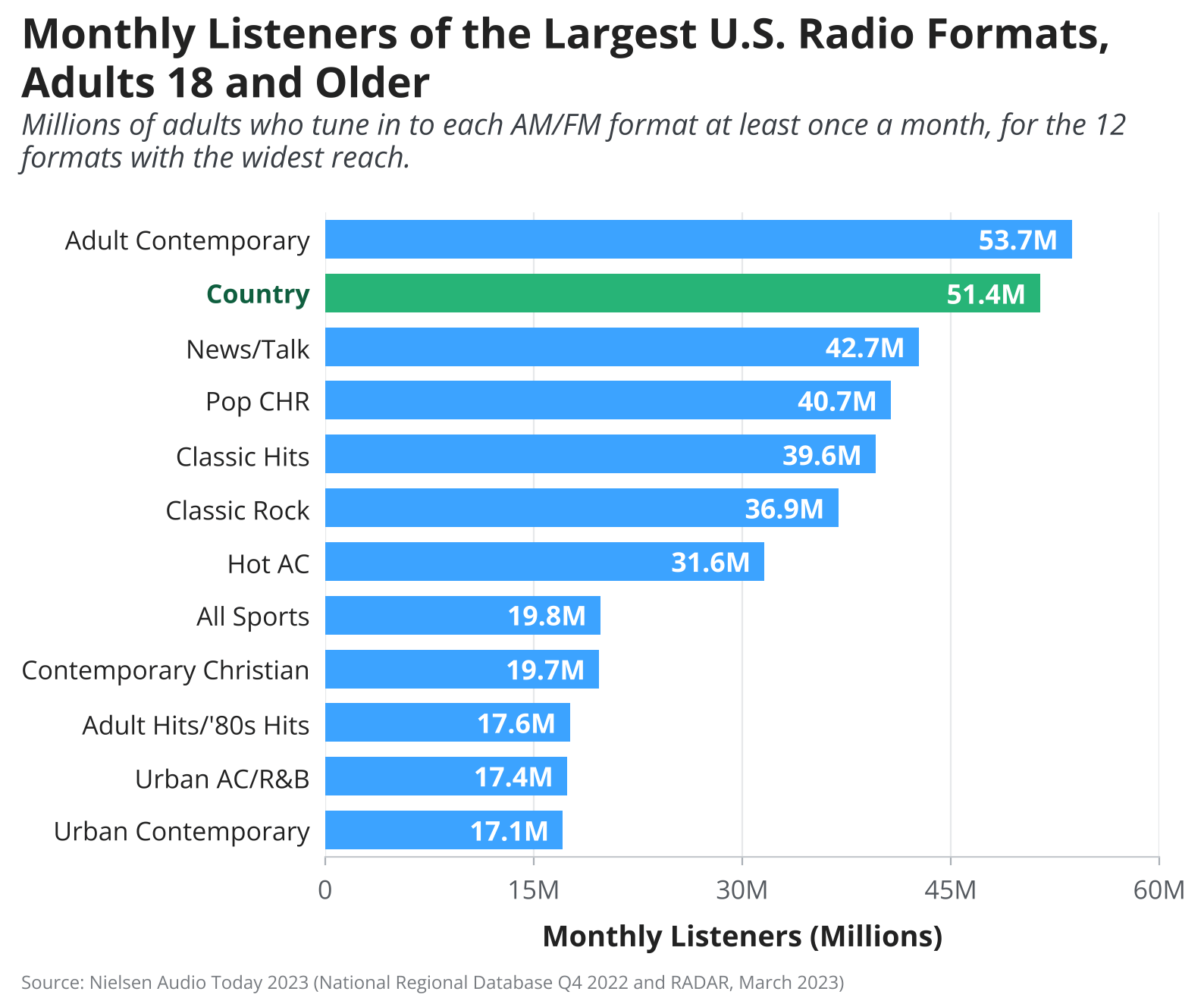
Said differently, country radio’s sizable audience is probably hearing “Choosin’ Texas” with remarkable frequency. Indeed, the track has become a country music staple, accumulating an estimated 291 times as many streams as the average charting country track this year—a level of dominance unmatched in any other genre.
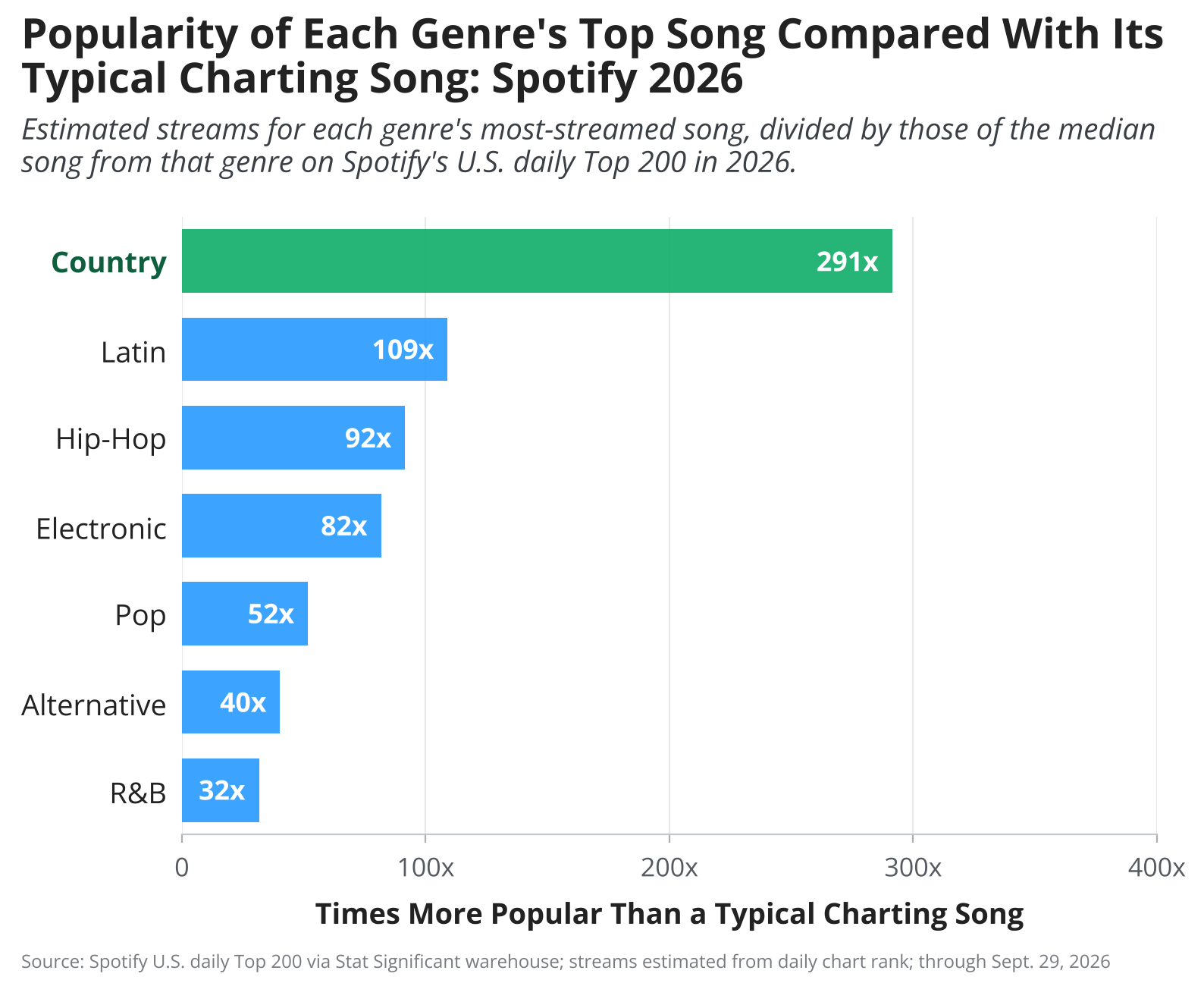
It’s a strange mix of factors that raises questions about whether the song deserves its extraordinary chart dominance and whether Billboard rankings have ever really mattered. On one hand, Ella Langley’s surprise hit has dominated the charts despite smaller streaming numbers. On the other hand, people are listening to this song, just not through the channels music critics typically use.
Enjoying the article thus far and want more data-centric pop culture content?
Final Thoughts: A Legitimate Expression of Popular Taste

Let’s return to our hypothetical alien explorers in the year 3026. These curious extraterrestrials are once again investigating our cultural heritage. They stumble upon a database maintained by the Recording Industry Association of America (RIAA) and decide to use its album-sales data to identify the most popular music artists in American history.
Now, who do you think tops this hypothetical list? The Beatles? Elvis Presley? Taylor Swift? Michael Jackson? Nope, none of these pop stars.
By this measure, the most popular musician in American history is country star Garth Brooks.
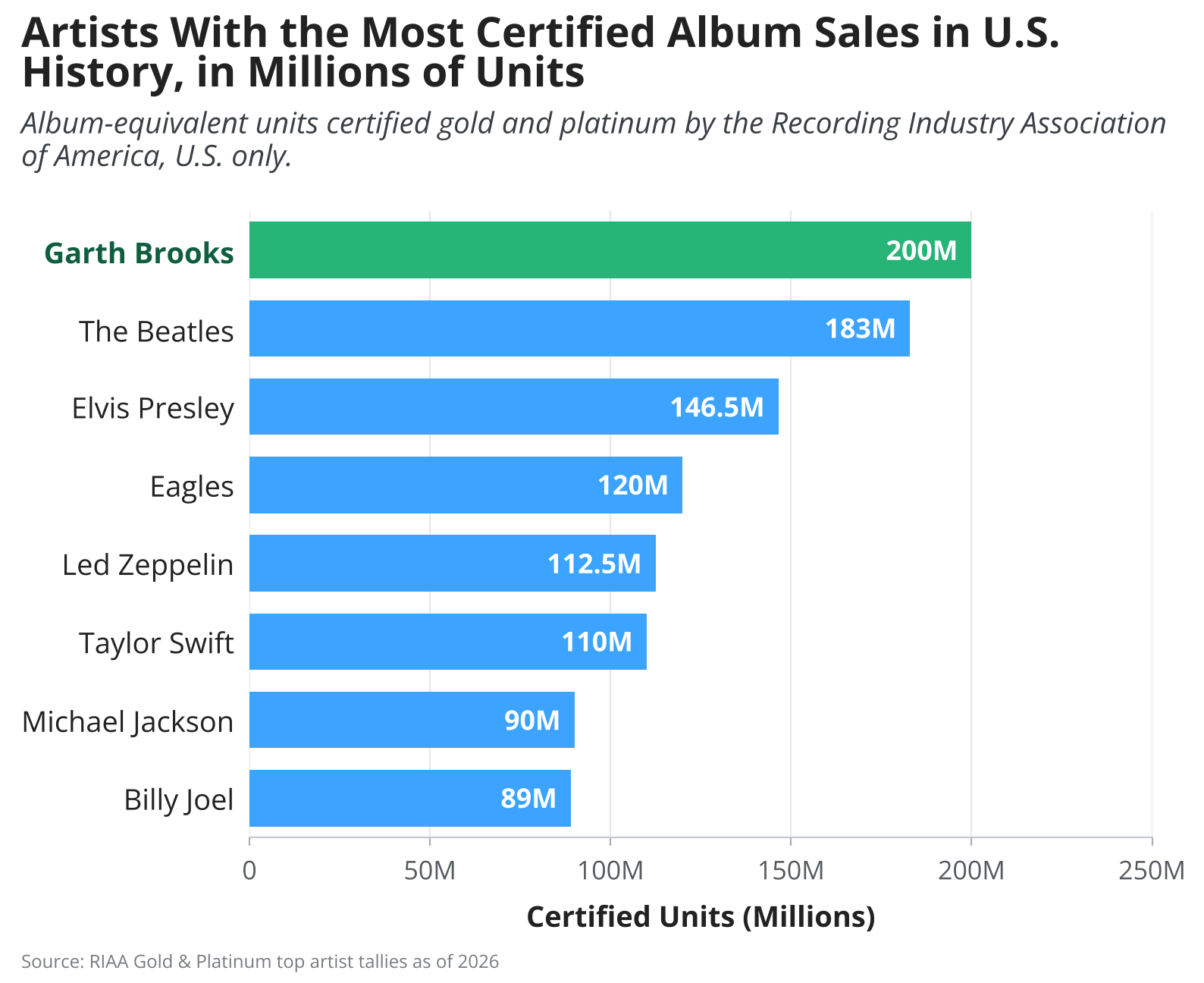
Garth Brooks was the most popular artist of the 1990s by orders of magnitude, selling out massive stadiums and spurring a country music revival across the United States.
An apparent parallel exists between Garth Brooks’ underappreciated commercial dominance in the 1990s and the chart-topping longevity of “Choosin’ Texas” today. Cultural tastemakers have long overlooked country music, favoring album-oriented rock as the pinnacle of music artistry. As a result, people often treat a country musician’s commercial achievements as aberrations rather than legitimate expressions of popular taste.
And so, in order for these listeners and their preferences to be taken seriously, people really, really have to like something. That brings us to “Choosin’ Texas,” a song that some combination of country listeners and country radio DJs really, really like, so much that it has taken on a life of its own, as if it were trolling music journalists.
It’s a testament to the insularity of various cultural silos. For many streaming users, this song’s preeminence is considered an arithmetic error. For country radio devotees, the track’s tenure atop the Billboard charts is exceedingly obvious. For aliens attempting to recreate our culture 1,000 years later, the entire ordeal will be extremely confusing.
Enjoyed the analysis? Support Stat Significant and unlock the data behind the insights.
Become a paying subscriber to get bonus graphics, interactive dashboards, downloadable datasets, and to support independent journalism.
Paying subscribers get:
Bonus Data Stories: Full access to the Monday Roundup, a weekly bonus edition with extra culture data stories, curated datasets, and recommended reads.
The Public Dataset Directory (Updated Weekly): A curated directory of public datasets from around the web.
Interactive Data Hubs: Interactive dashboards across Streaming TV, Movies, Music, Search Trends, Wikipedia, and more.
*Note: For best results, open this link in a web browser while logged in to your Substack account.
Want to promote your data tool or media publication to Stat Significant’s 26,200 readers? Email daniel@statsignificant.com
Need help with a data problem? Book a free data consultation
Connect with me on LinkedIn if you want to chat about a data project.
Like movies? Follow me on Letterboxd
This song which I’ve never heard of broke the record of the most torturous song ever made. It could be someone farting on a snare drum and I’d be its most biggest fan. Anything that drives out the song that ruined Christmas for a thousand generations I will gladly support. Sadly Mariah is thawing out once again right now………..
If country radio is contributing most to this song's success, my question is why they haven't gotten sick of hearing it? It's a decent song but everyone gets a little tired of hearing the same things over and over. Are people still actually requesting it at these stations? Do the stations pay attention to requests or do they continue playing it because it remains so high on the charts? Then again, are these even "live" deejays? Maybe they're not actually hearing it!