


Intro: “If It’s in the Top 10, It Must Be Good.”
When choosing a TV show or movie, I tend to make the process harder than it needs to be. I’m burdened by the irrational belief that I should always be watching the best possible thing, which inevitably leads to endless research on Letterboxd and Metacritic. Quite frequently, I spend so much time searching for the perfect program that I end up watching nothing.
My wife, however, is unburdened by this self-imposed standard. She’ll gladly watch whatever Netflix places in front of her: Trainwreck: Poop Cruise, Squid Game: The Challenge, Too Hot to Handle, and other streaming curiosities. When I ask how she ultimately chose, say, a 6-part crime docuseries about the Amish, she usually offers the same rationale: it was in the Netflix Top 10. And when I tell her that this movie or show looks bad, she’ll shrug and say something like, “If it’s in the Top 10, it must be good.”
The conversation usually ends there because I can’t argue with the vague credibility of Netflix’s top ten titles—until now.
So today, we’ll examine whether Netflix’s Top 10 actually signals quality, how these hallowed content options stack up against other services, and whether you’re better off choosing a program at random.
Should You Trust the Netflix Top 10?
Digital marketplaces like Netflix, DoorDash, and Amazon often struggle with problems of abundance. Given a near-limitless catalog of restaurants or movies, consumers can suffer from analysis paralysis.
To address this champagne problem, tech companies employ hundreds of workers dedicated to “search and discovery.” The mandate of these teams is decidedly straightforward: get people to watch, click, or buy more stuff. Over time, these companies have converged on a familiar toolkit: personalized recommendations, improved search results, optimized thumbnails, and other subtle nudges designed to reduce friction.
In February 2020, Netflix added a new tool to this playbook: a daily list of the most popular shows and movies on its platform, displayed directly inside the app. The feature quickly became a hit, generating ongoing media coverage of its 10 trending titles and prompting other streaming services to create their own Top 10 lists.
But helping people choose faster is not the same as helping them choose better. So does the Netflix Top 10 actually lead viewers to better recommendations? Or does it simply make popular titles feel more worthwhile?
To answer one of streaming’s great conundrums, I pulled every Netflix Top 10 entry since the feature’s inception, along with its corresponding user rating on TMDB. By this measure, the average TV series trending in the Top 10 is approximately 1% more enjoyable than a non-trending Netflix title, yet still scores below the average series available on Paramount+, HBO, Disney+, or Hulu.
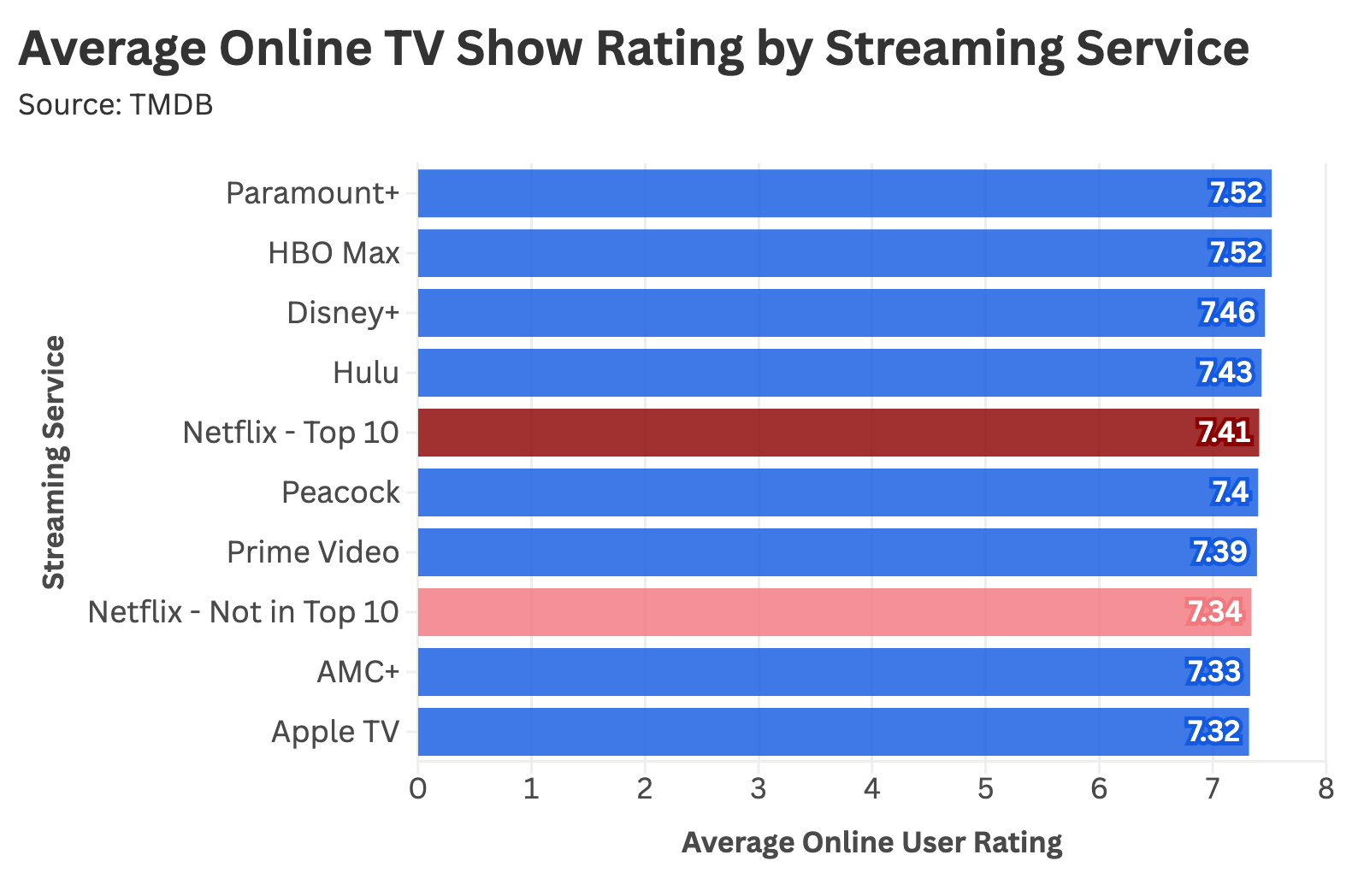
Within Netflix’s own ecosystem, the Top 10 offers a modestly useful signal of TV show quality. But once you compare Netflix against the broader streaming landscape, its trending titles are no better than an HBO or Paramount+ series chosen at random.
That said, this calculation only covers television. What about da’ movies—a business Netflix seems determined to drive into the ground?
Using the same methodology, we find that the average Netflix Top 10 movie is about 0.5% worse than a Netflix film that never earns this distinction. In fact, Netflix’s Top 10 films rank among the weakest content bundles in streaming, outperforming only Peacock, Prime Video, and AMC+.
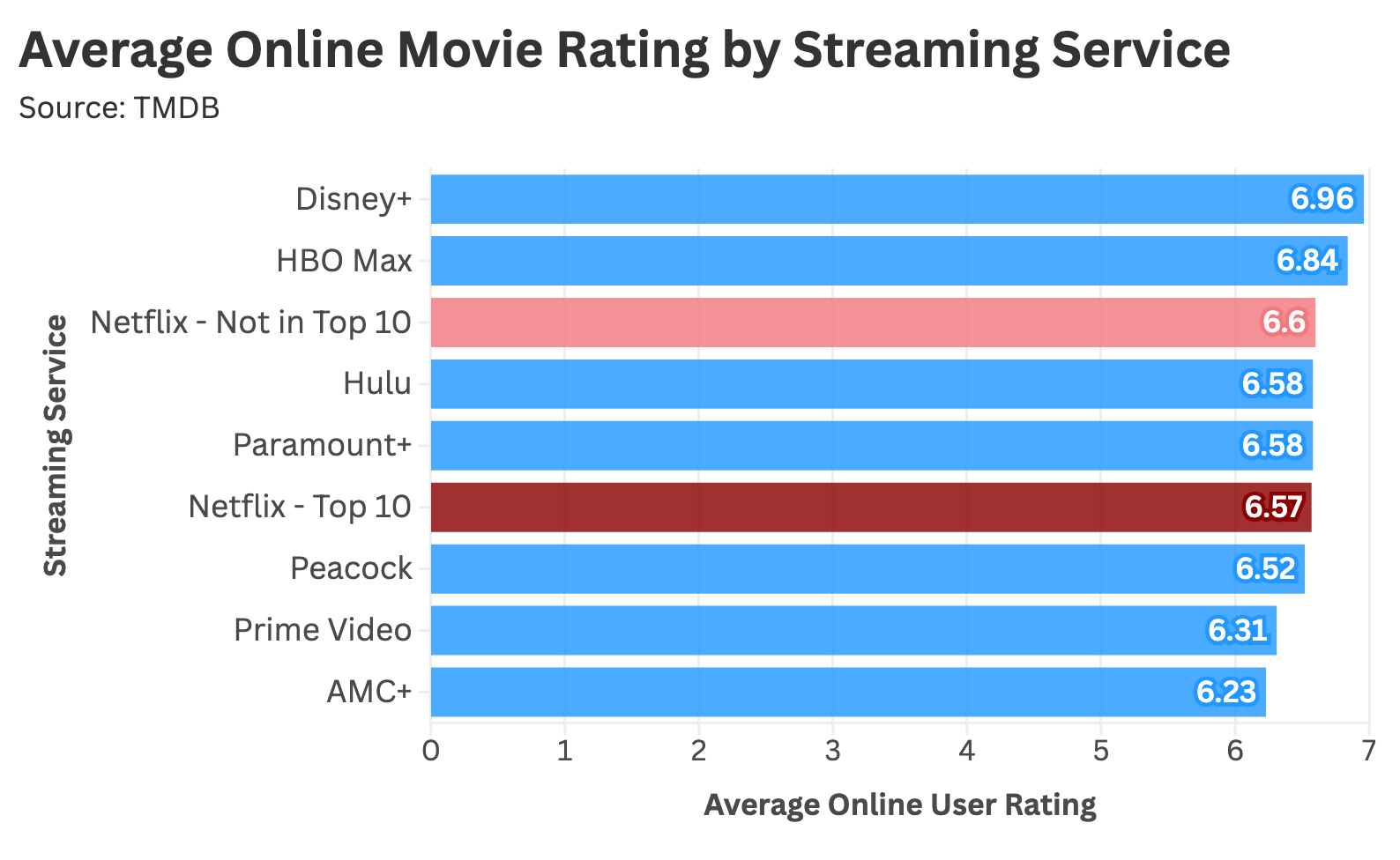
Sometimes data can be beautiful, and in this case, quite amusing. For movies, landing in Netflix’s Top 10 seems to carry the cultural prestige of a middling Rotten Tomatoes score. Yikes.
This finding hints at an unflattering truth: Netflix heavily promotes its Originals across the platform, muscling them into the Top 10—and most of the streamer’s movies are quite bad.
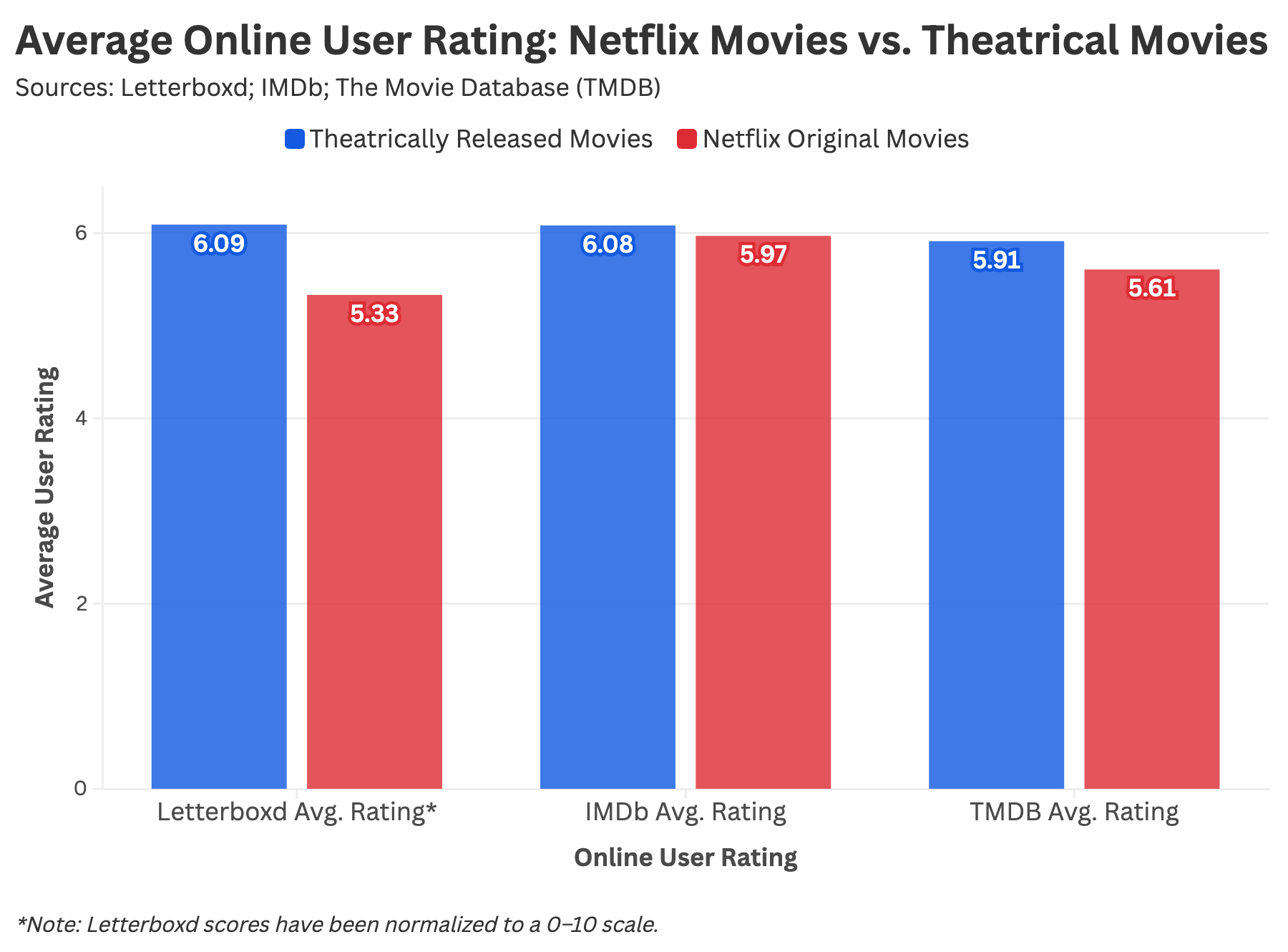
Between 60% and 80% of Netflix’s Top 10 titles are Netflix Originals, meaning the chart effectively showcases the streamer’s best work. By that measure, Netflix’s output is getting worse: over the past six years, the average trending show has become less acclaimed, while its trending movies have remained consistently below average.
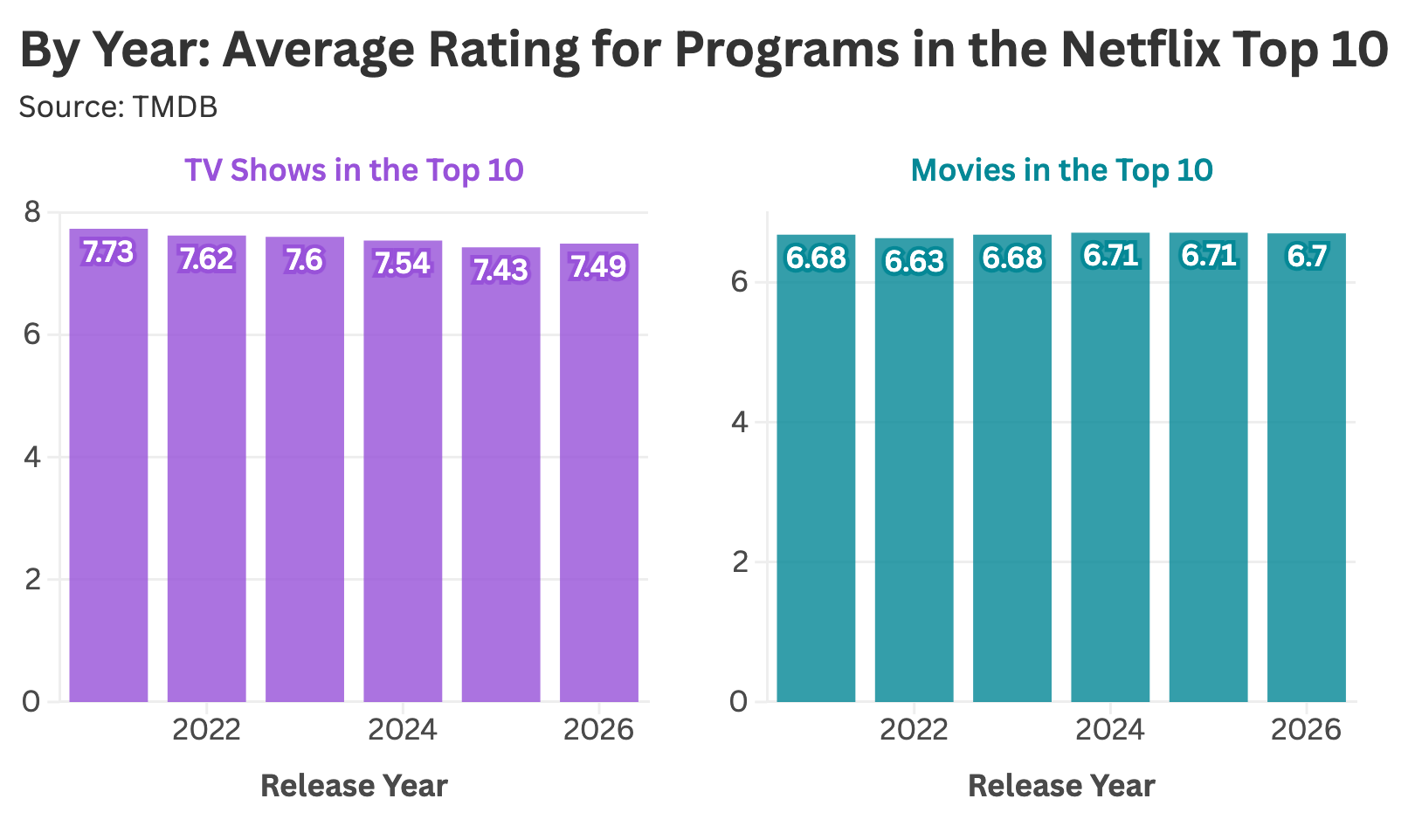
My best guess is that this pattern reflects Netflix’s pullback in spending as it pivots from growth to profitability, a process internet theorist Cory Doctorow has dubbed “enshittification.” The Top 10 no longer signals the best of streaming so much as the easiest content to manufacture: dating shows, celebrity documentaries, cooking contests, and numerous docuseries about Ted Bundy or the Menendez brothers.
Yet there’s also another possibility: maybe Netflix is still producing prestige films and shows, but they’re underrepresented on its best-of charts. So is the Top 10 actively boosting lower-quality titles at the expense of acclaimed programming? To test this, I flipped my analysis: instead of asking whether Top 10 titles are well regarded, I asked whether highly rated titles tend to perform better on the Top 10 charts.
By this measure, the more acclaimed a show or movie is, the worse it ranks within the Top 10.
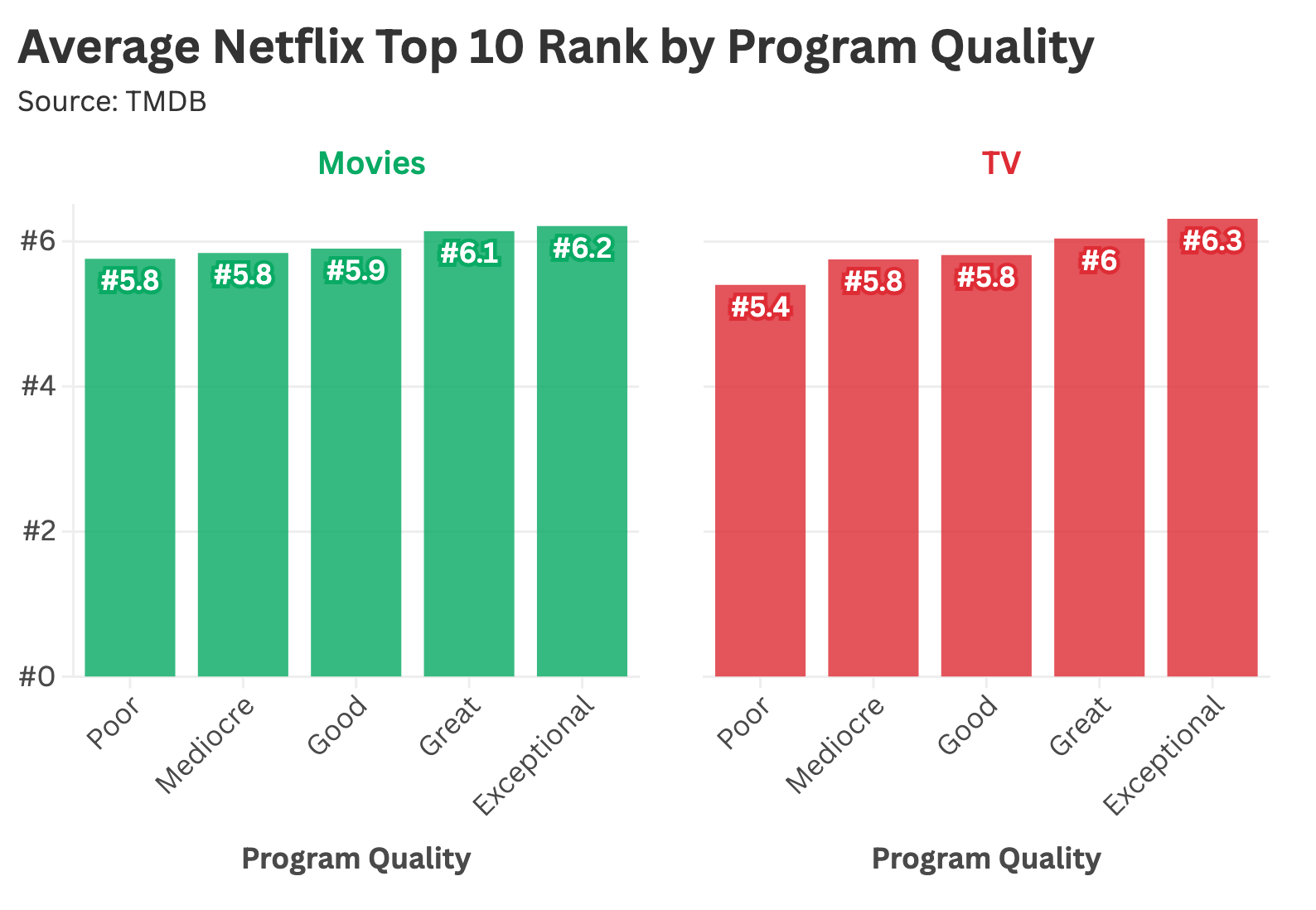
Taken to its logical extreme, you’re better off choosing a show situated at #9 than one sitting at #2. If that conclusion sounds implausible, it should: our metric is being distorted by a major confounding variable—time.
Netflix’s biggest hits—Stranger Things, Adolescence, and Wednesday—all make the Top 10 and then stay there for weeks. As of this writing, KPop Demon Hunters has remained within the Top 10 for 46 straight weeks and currently sits at the #9 spot.
Which means that perhaps the most valuable indicator of content quality is not whether a show reaches the Top 10 or where it sits on the chart, but rather how long it remains there.
By this marker, the relationship between program acclaim and platform visibility is clear: higher-quality shows stay on the charts for longer.
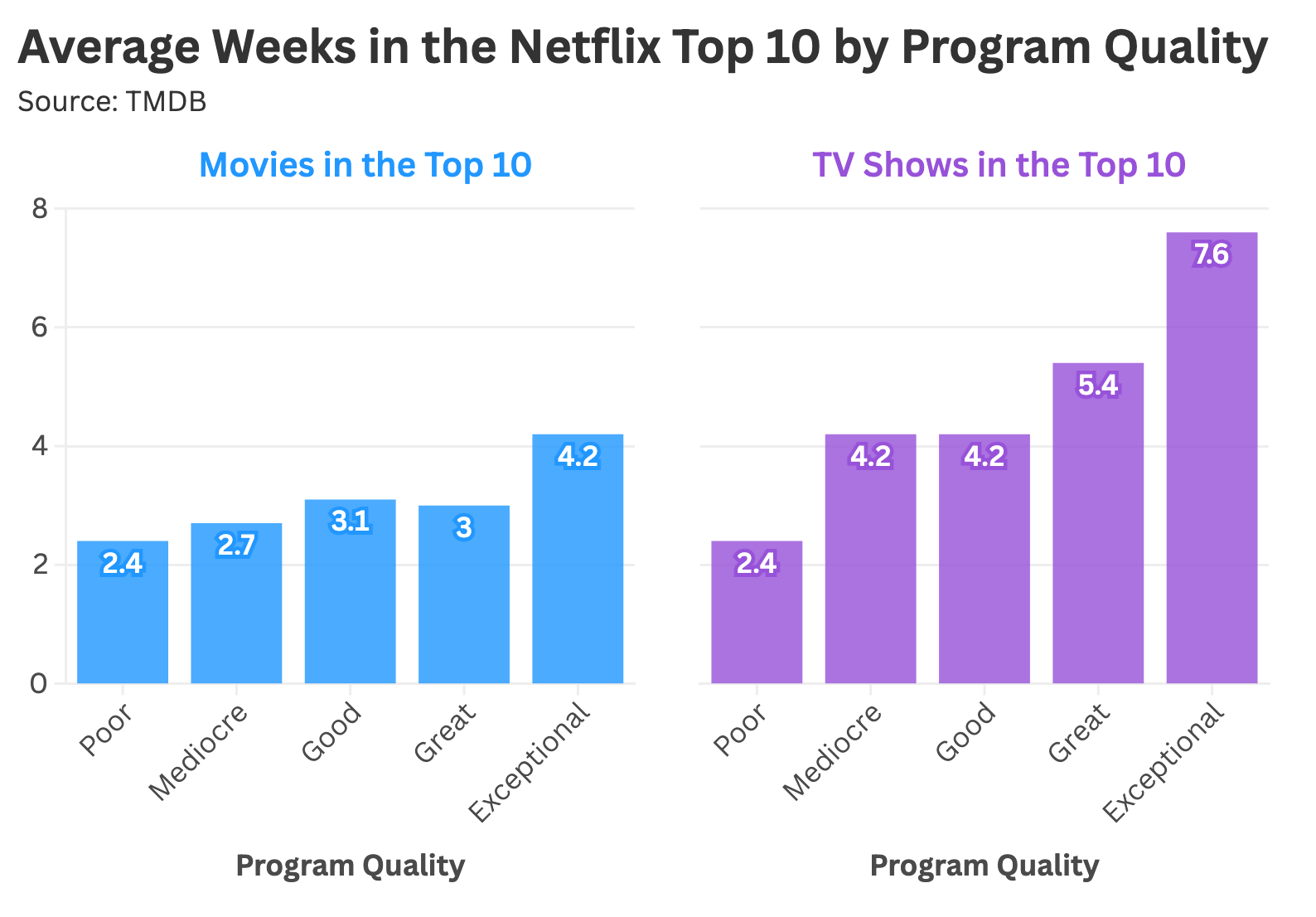
Here lies a bizarre quirk of the Netflix Top 10 as a search-and-discovery tool: arguably its most useful piece of information—the amount of time a title persists on the chart—is not displayed in the app. Instead, viewers are shown a ranking that reflects a single moment in time, making the Top 10 less a marker of quality than a shortcut for decision-making.
Functionally speaking, the feature is no different from a promo code on Booking.com or an average star rating on Amazon: it reduces the friction of content discovery, making it easier to pick something and press play.
Enjoying the article thus far and want more data-centric pop culture content?
Final Thoughts: All The Good Movies

When I was 11, I stumbled upon a TV special chronicling the American Film Institute’s 100 Greatest Movies. Enthralled, I watched it again the following week, printed out the full list, and vowed to watch every title before I turned 13. This proved somewhat problematic, since it meant seeing A Clockwork Orange and Silence of the Lambs well before my teenage years. But I persevered nonetheless. On a random Thursday, you’d find me watching Citizen Kane or One Flew Over the Cuckoo’s Nest. I was a pretty cool 12-year-old.
After working through the age-appropriate titles on AFI’s list, I moved on to Roger Ebert’s Great Movies book series, which eventually led me to critics like Pauline Kael and Richard Roeper. There was an endless archive of movies to discover, and these critics—with their well-argued recommendations—became guides in my quest to see All The Good Movies.
By today’s standards, however, this discovery process seems byzantine. You’d read the opinions of a few professional critics, ask friends what they thought, and then make an active effort to track the movie down. So much effort!
When Netflix arrived, it promised something more dynamic: personalized recommendations, tailored thumbnails, and a vast library organized around your preferences. It was Roger Ebert, AFI, IMDb, and Letterboxd folded into one product.
And yet people still struggled to find something to watch. They always have, and I guess they always will. It was at this point that some product manager figured they could increase platform conversion if they created a “trending” section, and thus the Netflix Top 10 was born.
This new feature promoted populism at the expense of personalization. All you really know is that other people are watching that thing—never mind if those people have completely different tastes. The end result is an amorphous recommendations tool that appears democratic, while remaining extremely easy for Netflix to shape.
But is there anything wrong with that? Depends on what you want from television.
Best I can tell, there is little difference between picking a show at random and choosing from the Netflix Top 10. If your goal is simply to watch something and pass the time, then great—this feature gets you there faster.
But if you believe, as I do, that you should always be watching the best possible thing, then “because it’s in the Top 10” is not much of a justification.
Enjoyed the analysis? Support Stat Significant, and unlock the data behind the insights.
Become a paying subscriber for interactive dashboards, free datasets, and to support independent journalism.
Paying subscribers get:
The Stat Significant Dataset Hub (Updated Weekly): a collection of free datasets across movies, music, TV, and economics.
Interactive Data Hubs:
Streaming TV: what people are watching on television.
Movies: the films watched in theaters and on TV, plus historical trends.
Music: the songs, artists, and styles dominating Spotify and TikTok.
Social Media: what’s trending on Google, Reddit, TikTok, and YouTube.
Wikipedia: the top pages trending on Wikipedia.
Get access with:
*Note: For best results, open this link in a web browser while logged in to your Substack account.
Want to promote your data tool or media publication to Stat Significant’s 25,800 readers? Email daniel@statsignificant.com
Need help with a data problem? Book a free data consultation
Connect with me on LinkedIn if you want to chat about a data project.
Like movies? Follow me on Letterboxd
More people should be subbed to this! Stat Significant never leaves me frustrated that an obvious chart is missing. In this one, I'm so pleased that we got to see forwards and backwards on the quality vs top10 data.
I've always been skeptical about Netflix's Top 10 lists. How do we actually know these are their most viewed films and TV shows? There doesn't appear to be an outside company, like A.C. Nielsen for broadcast TV, that is determining the rankings. My suspicion is the lists only reflect what they WANT to promote to subscribers...or worse what they're getting paid to promote! (Sorry, I'm pretty cynical about such things!)