

Today’s essay draws on insights from two Stat Significant data hubs: the Spotify Trends Report and the Pop Music History Report. These pages feature 30+ interactive charts, updated weekly, tracking what people are listening to and how music trends evolve—with the underlying data available for download. Check out The Spotify Trends Report.
Intro: New Music is Bad Music
Past a certain age, all new music starts to sound like bad music. For as long as pop has existed, there has been a reliable cohort of older listeners ready to dismiss today’s Top 40 as inferior. According to these elders, the best art was made—quite conveniently—when they were between the ages of 13 and 26. Anything outside this window is judged, by some vague and unverifiable standard, to be worse.
This generational bias is easily quantified. In a 2021 YouGov poll, respondents of varying ages were surveyed on their favorite musical era. Each generation—predictably, and quite stubbornly—chose the music of their youth.
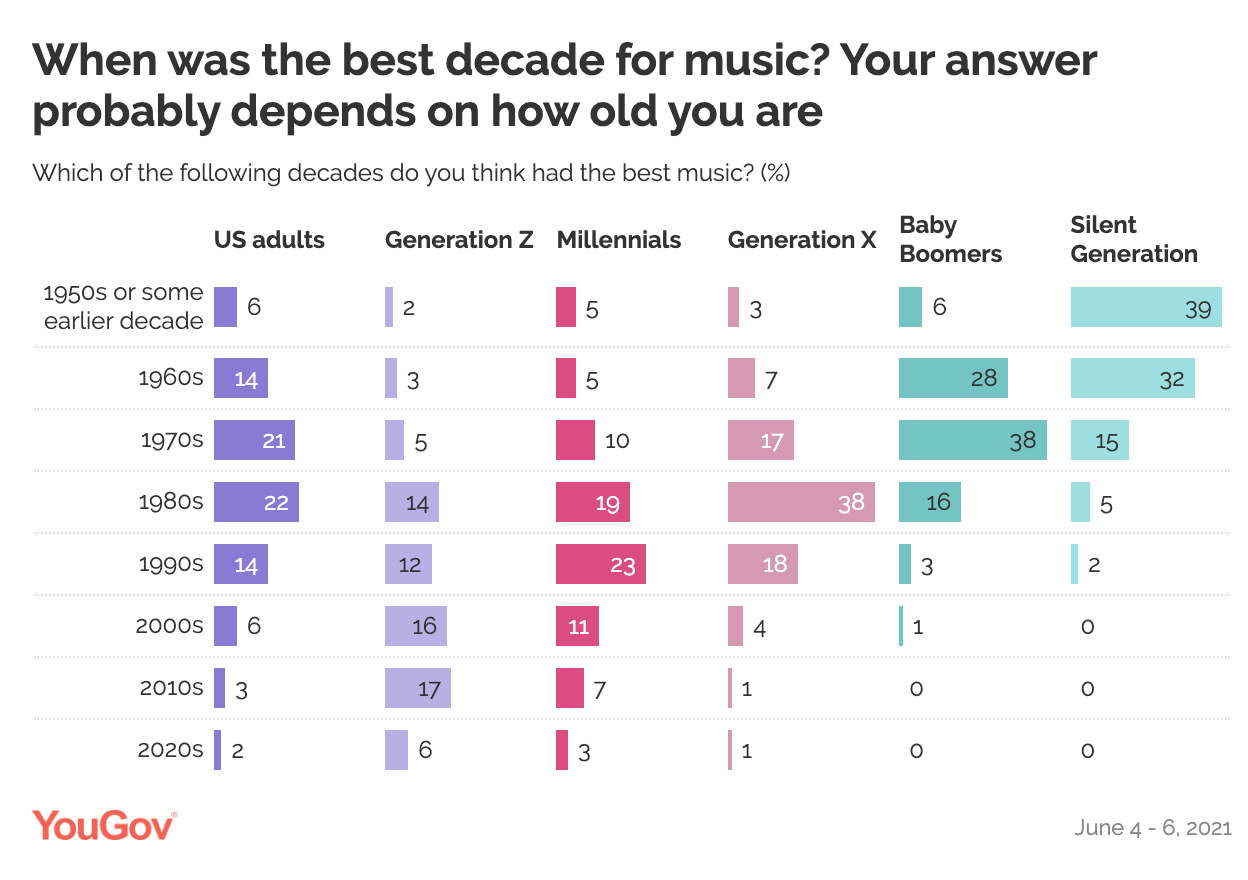
In other words, whether modern music is good or bad depends on who you ask. Or does it?
Recently, while analyzing some Spotify Top 50 data, I noticed that newly released songs were losing popularity. If this reads as vague, know that’s intentional, since we’ll delve into the specifics shortly. As I dug deeper into the charts, a larger question emerged: how can we systematically measure the relevance of Top 40? Are newly released songs losing their cultural foothold, or is our perception distorted by confounding variables? Given the subjectivity of music taste, can we meaningfully evaluate whether the songs of 2026 are less loved than those of 1975?
So today, we’ll examine the case for and against the continued relevance of newly released music, and consider what our findings signify for aspiring musicians and listeners clinging to the songs of their youth.
The Case for New Music’s Growing Popularity
In the 20th century, owning a chart-topping song meant buying an entire album—purchasing a bundle of 10 to 14 tunes to get one hit track. This changed with the introduction of digital distribution, which enabled single-song consumption on platforms like iTunes and Spotify. Today, one hit song can function as a standalone commercial enterprise, garnering billions of streams on Apple Music and YouTube.
Much of this shift reflects a longstanding listener preference: when given the option, consumers prefer to pick and choose songs across artists and albums—a dynamic the industry has increasingly rewarded. Since the Billboard Hot 100 launched in 1958, record labels and distributors have steadily shifted from maximizing album sales to extending the commercial lifespan of individual hits. As a result, the average Billboard-charting song has nearly doubled its stay on the Hot 100.
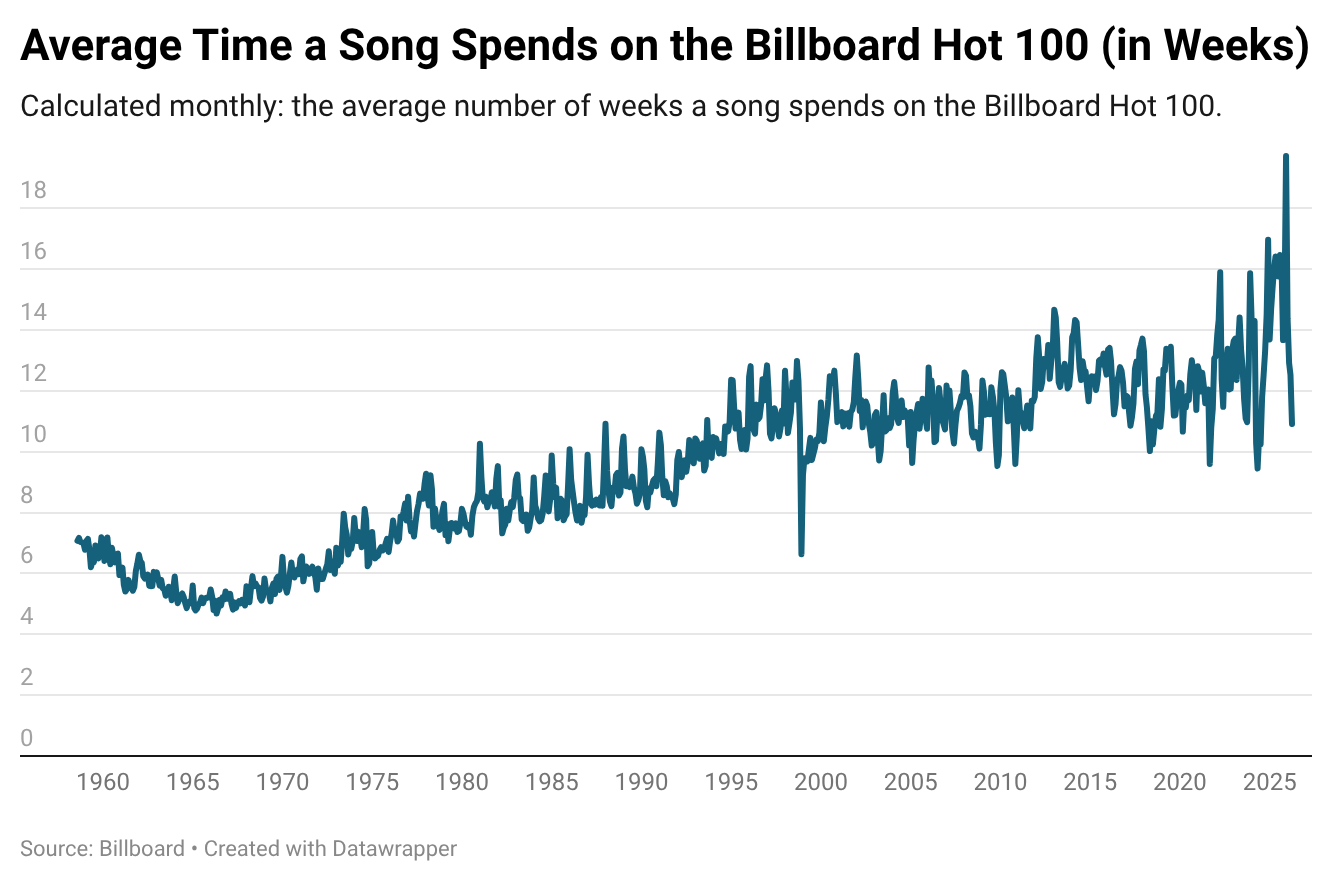
So what does this trend mean in practice? First, and perhaps quite confoundingly, the most commercially successful songs in recorded pop history are simply the newest ones. Case in point: “Lose Control” by Teddy Swims spent a combined 112 weeks on the Billboard Hot 100—spanning both a summer and winter Olympics—making it the longest-tenured track in the chart’s 70-year history.
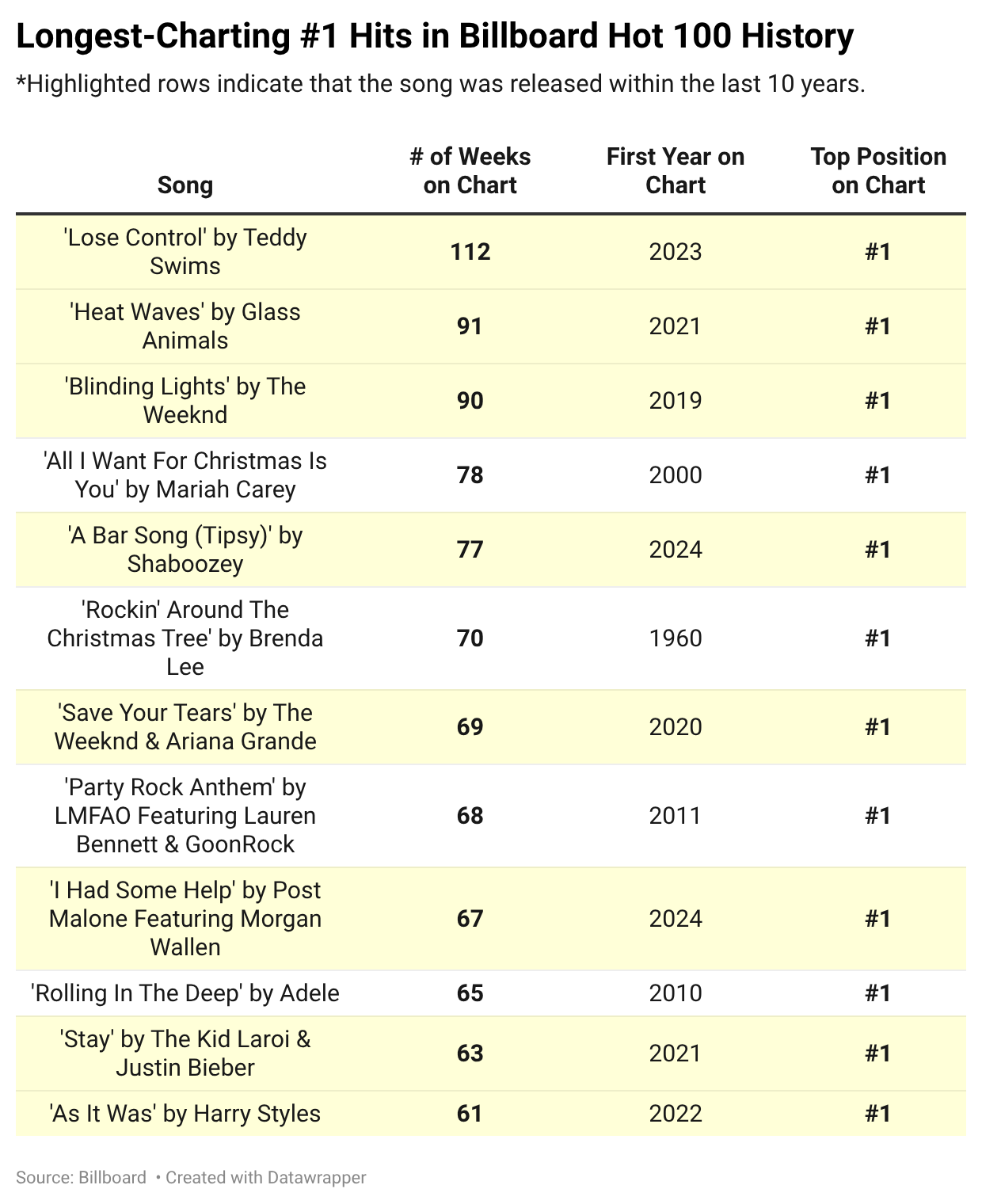
Had you given me a blind taste test to identify the most consumed song in music history, I would not have picked “Lose Control” over “Hey Jude” or “Respect.” So yeah, you heard it here first: Teddy Swims tops The Beatles. As does LMFAO’s “Party Rock Anthem”, which is a song that—checks notes—really stinks.
So how do we reconcile Swims’ chart-topping dominance with the reality that he did not write a song better than “I Will Always Love You” or “Bohemian Rhapsody”? The answer is momentum. When a modern song—or a cluster of songs—catches on, it’s amplified throughout the streaming ecosystem via playlist curation and, most powerfully, through algorithmic recommendations. Success compounds, making big-name releases that much bigger.
When we examine the artists with the most Billboard-charting songs of all time, our list is dominated by contemporary acts at the peak of their powers, like Taylor Swift, Morgan Wallen, and The Weeknd.
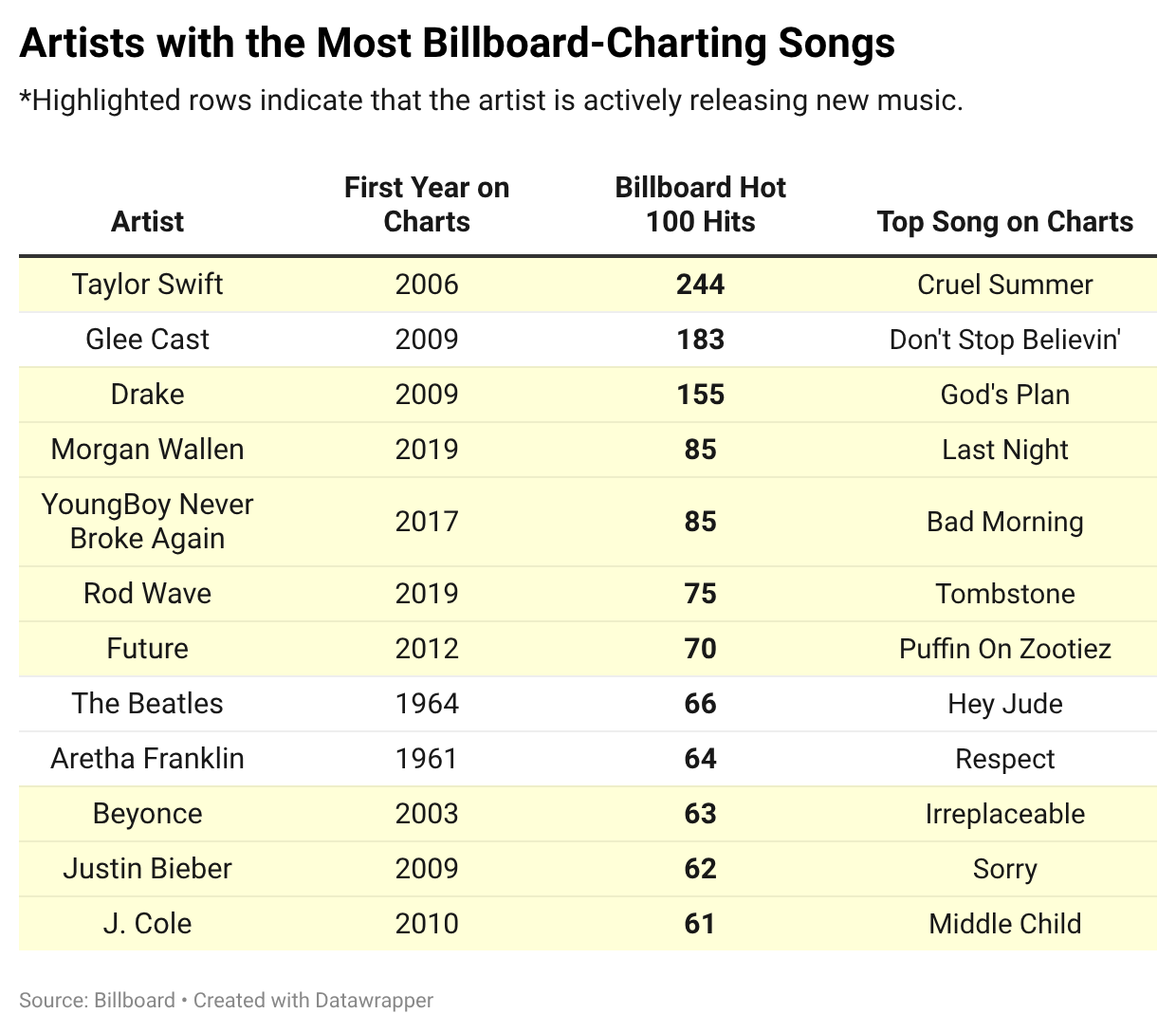
We can attribute this hierarchy to a phenomenon I’ll call the New Music Friday Effect. In the streaming era, new music is typically released on Friday, as codified by Spotify’s prominent New Music Friday playlist. I’ve always found this decision counterintuitive, since streaming activity is much higher during the week when people are working, but whatever, some nerd at Spotify arbitrarily chose Friday, and the music industry recalibrated itself around this decision. So it goes.
Major artists have adapted to this condensed release timeline by building anticipation ahead of Friday drops and using playlist placement as a major accelerant. If you checked a trending music playlist from October 2025, you’d see Taylor Swift’s The Life of a Showgirl overtaking the charts. Instead of slowly rolling out singles, Swift can release a full album at once and let the algorithmic hype machine handle much of the promotional work.
So does this mean newer music is actually more popular? Yes and no. Recent releases can dominate attention for months, and sometimes years, but that success is concentrated among a narrow class of superstars and mega-hits. The Taylor Swifts, Drakes, and Morgan Wallens of the world benefit enormously from New Music Friday and the playlist ecosystem. But the rise of this elite tier has come at the expense of smaller acts trying to break through.
Working-class musicians must contend with a Taylor Swift track released four months ago, and, quite surprisingly, a Fleetwood Mac song from the late 1970s or Radiohead’s “Creep” from the mid-1990s.
The Case for New Music’s Declining Popularity
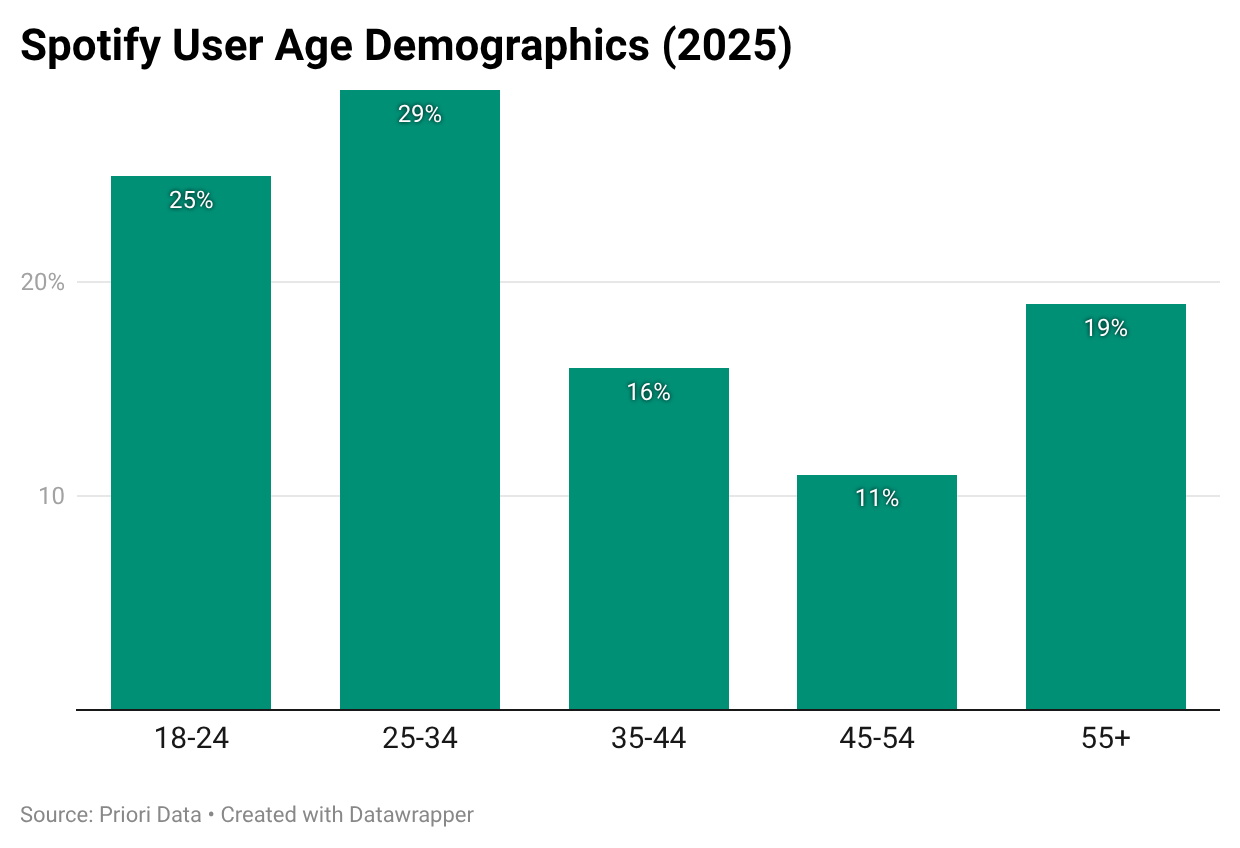
Spotify’s marquee charts and playlists are heavily informed by listener demographics. The platform’s earliest adopters skewed younger, giving contemporary hits an outsized presence on the streamer—particularly youth-driven genres like hip-hop. But as Spotify scaled, older cohorts began reshaping its streaming ecosystem, lifting classic rock and late-20th-century alternative into heavy rotation. By 2025, roughly 30% of listeners were over 45, a meaningful shift from the platform’s early user base.
So what does this mean in practice? Well, over the past five years, a growing share of Spotify’s Top 100 has gone to decades-old tracks like The Killers’ “Mr. Brightside” and Fleetwood Mac’s “Dreams.” Each holiday season, the platform sees a pronounced spike in Christmas classics, followed by a sustained rise in canonical hits from The Killers and Radiohead.
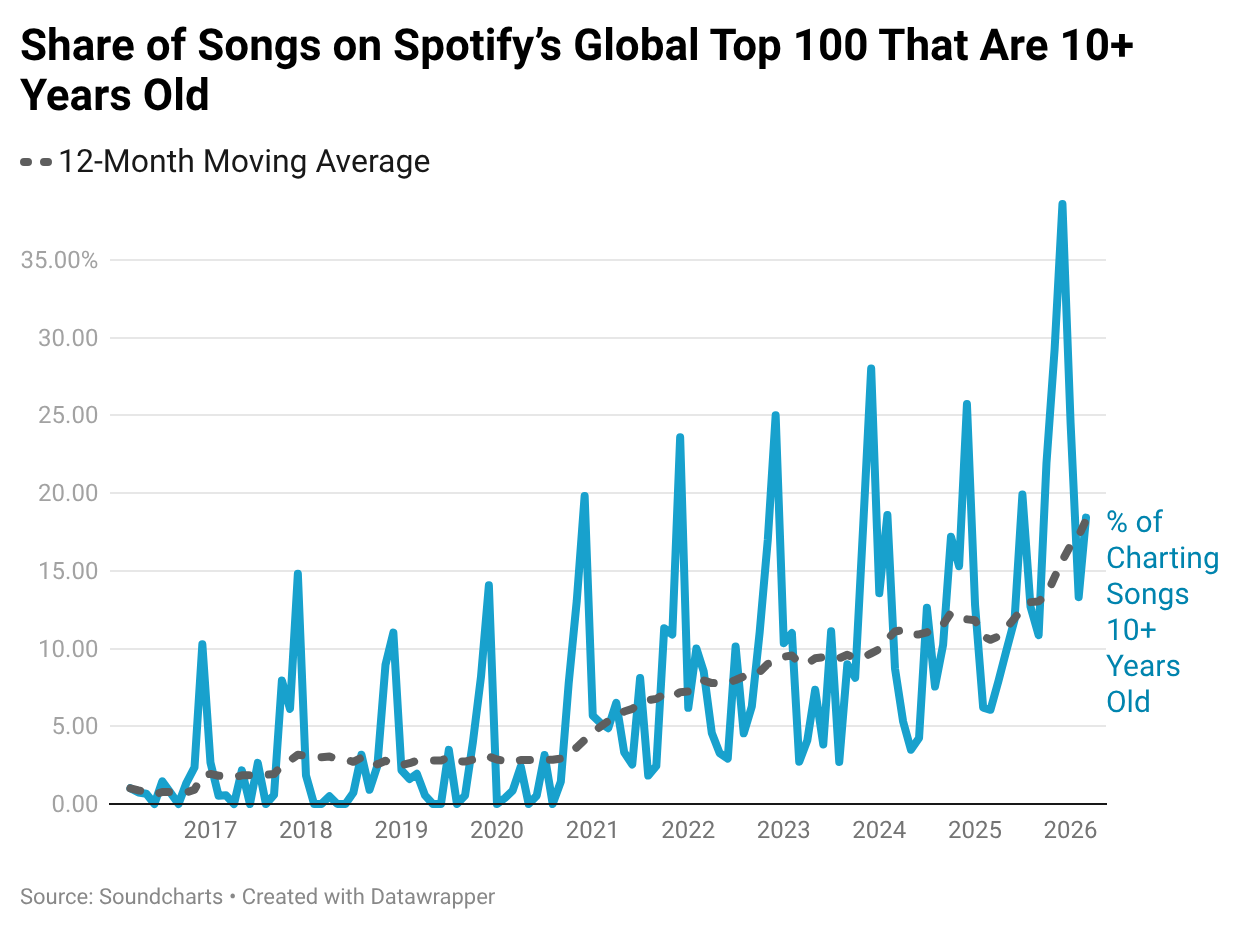
As of this writing, the following songs have made Spotify’s Top 50 almost every day for the last three months:
“Mr. Brightside” by The Killers (2004)
“Dreams” by Fleetwood Mac (1977)
“Iris” by Goo Goo Dolls (1998)
“Creep” by Radiohead (1992)
“Sweater Weather” by The Neighbourhood (2012)
"505" by Arctic Monkeys (2007)
To recap, we’ve observed two parallel forces reshaping modern music consumption over the last decade:
Elite artists and mega-hits are occupying an ever-growing share of charts and playlists.
Older songs are increasingly durable within the streaming zeitgeist.
Taken together, these structural shifts have effectively boxed out a proverbial “middle class” of mainstream musicians. Without the momentum of existing celebrity or nostalgia, new songs struggle to gain a foothold on streaming platforms.
These dynamics have led to a drastic increase in the average time a track trends in Spotify’s Top 50, while also resulting in a significant dip in the number of new songs charting each year.
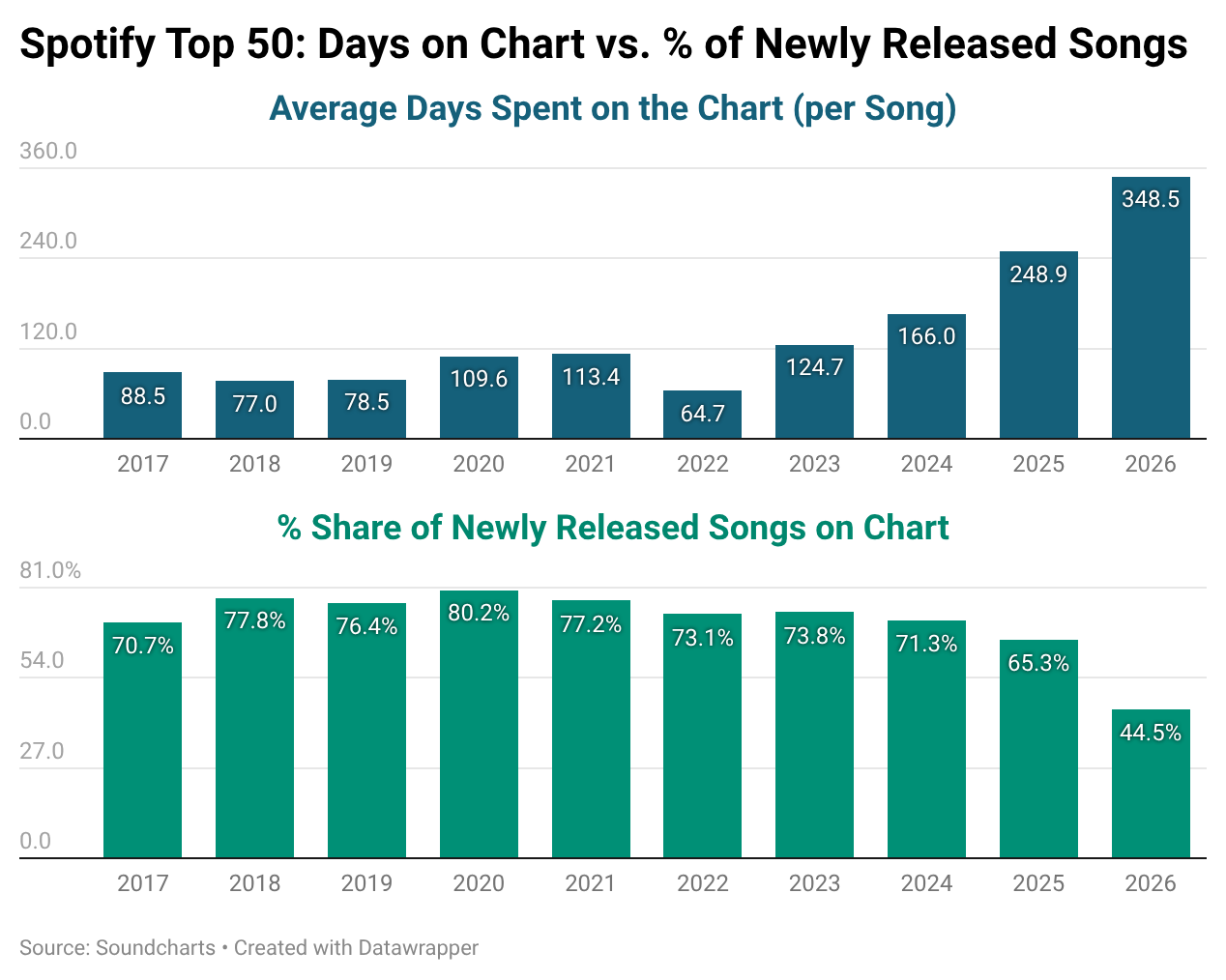
There are countless ways to illustrate the erosion of novelty within mainstream culture, but I chose to approach this particular issue through the prism of my favorite musical phenomenon: the one-hit wonder.
The one-hit wonder has given us so much: The Macarena, The Cotton-Eyed Joe, 867-5309, and What Does the Fox Say? Few things inject more novelty into a dance party than a hit song from an artist devoid of long-term commercial staying power. Yet the one-hit wonder may be a thing of the past. As of 2021, the share of one-time entrants on the Billboard Hot 100 has fallen to an all-time low.
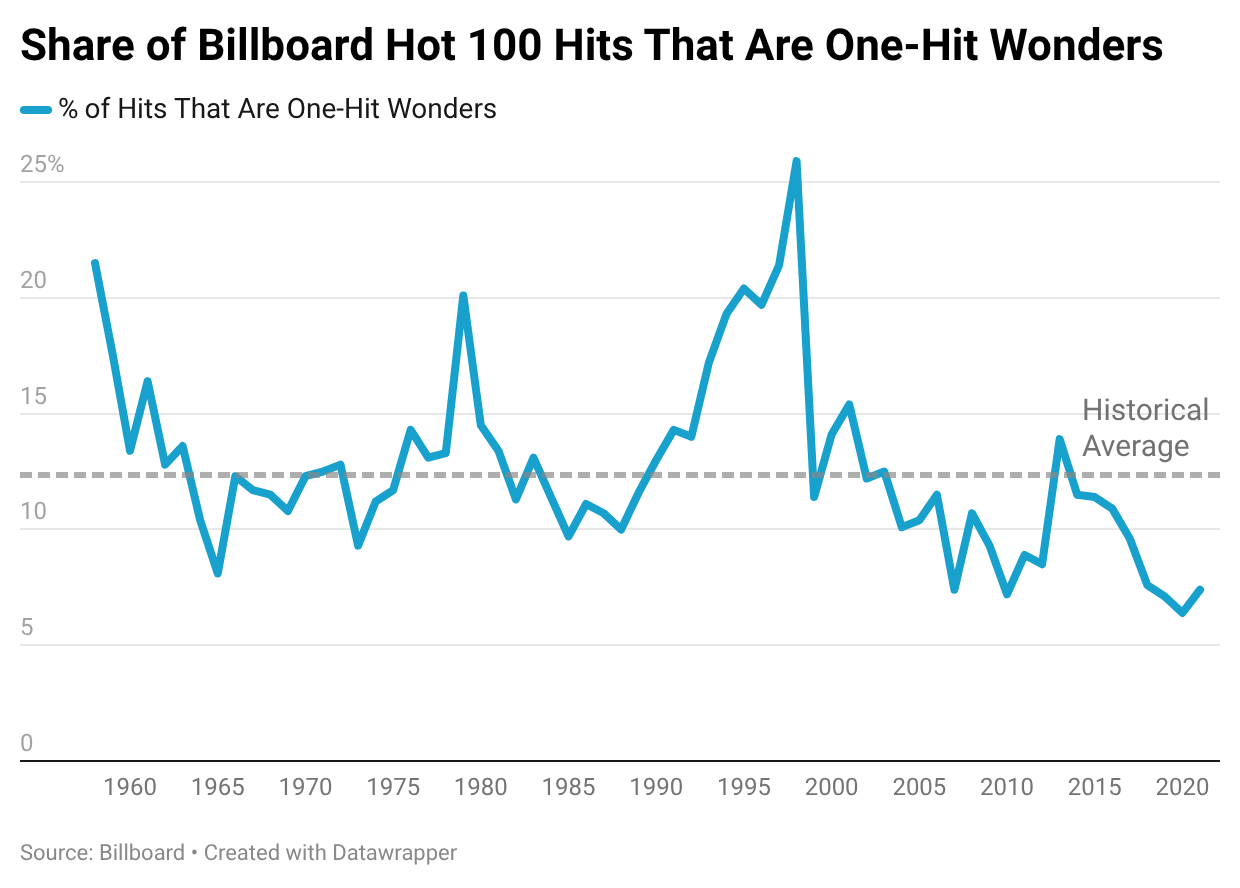
The one-hit wonder represents an extreme case of fleeting music stardom, while also serving as an effective proxy for a vast middle class of musicians boxed out of the Top 40. In a landscape dominated by elite superstars and nostalgic hits, how does anyone break through?
Enjoying the article thus far and want more data-centric pop culture content?
Final Thoughts: What Controls the Zeitgeist?
Popularized in the late 19th century, the German word Zeitgeist describes the defining cultural climate and artistic touchstones of a given era. The term’s usage expanded throughout the 20th century to interrogate the rise of mass-distributed media like recorded music, big-budget filmmaking, nationally syndicated newspapers, and broadcast television. Prior to the digital age, the zeitgeist was heavily shaped by intermediaries, including radio DJs, studio executives, record labels, journalists, and culture critics.
The 21st century promised disintermediation—with digital platforms like Spotify connecting artists and listeners directly, absent gatekeepers. In theory, collective preference would emerge organically, expressed through algorithmic recommendations.
At their core, algorithms are designed to give us what we want, often serving as a mirror of our collective id—revealing unfortunate truths hiding in plain sight. In the case of new music, algorithmic curation suggests that we may have long overvalued novelty. In a flattened digital landscape, absent critics and DJs, listeners tend to default to inertia—gravitating toward nostalgic favorites or months-old Taylor Swift songs rather than taking a chance on something new. Perhaps the zeitgeist isn’t always defined by recency.
I have mixed feelings about these trends:
On the one hand, all musicians should be able to make a living. More novelty is good. Art matters. We shouldn’t get lost in abstractions because some of the best moments of our lives are soundtracked to music.
On the other hand, there may have been a musical middle class propped up by invasive radio curation and record label lobbying. Now, in an unmediated digital marketplace, these acts no longer get their 15 minutes in the zeitgeist.
Perhaps the next generation of listeners will be the first to favor a different cohort’s music. Maybe Gen Beta and Baby Boomers will converge on the same cultural consensus: that new music isn’t the best music. Whether that’s a sign of progress or stagnation depends on who you ask.
Enjoyed the analysis? Support Stat Significant, and unlock the data behind the insights.
Become a paying subscriber for interactive dashboards, free datasets, and to support independent journalism.
Paying subscribers get:
The Stat Significant Dataset Hub (Updated Weekly): a collection of free datasets across movies, music, TV, cultural trends, and economics.
Interactive Data Hubs:
Streaming TV: what people are watching on television.
Spotify & TikTok: the songs, artists, and styles dominating Spotify and TikTok.
Pop Music History: a deep dive into music history, Billboard chart performance, genre trends, and song composition.
Social Media & Search: what’s trending on Google, Reddit, TikTok, and YouTube.
Wikipedia Traffic: the topics capturing global attention, as told by Wikipedia.
Get access with:
*Note: For best results, open this link in a web browser while logged in to your Substack account.
Want to promote your data tool or media publication to Stat Significant’s 25,200 readers? Email daniel@statsignificant.com
Need help with a data problem? Book a free data consultation
Connect with me on LinkedIn if you want to chat about a data project.
Like movies? Follow me on Letterboxd
Spotify's nerds didn't pick Friday as Global Release Day – Beyoncé and piracy did. See https://time.com/6961069/beyonce-music-industry/ and https://www.vox.com/2015/2/26/8116201/friday-new-albums-beyonce
I would argue that a curated zeitgeist is a good thing, as is a curated "culture"... and the quarter century plus experiment that is the internet has proven this. Curated culture doesn't mean the elite curators are "right" or that such a culture is "better"... just that there IS a culture (or zeitgeist) at all. A flattened environment of lowest common denominator choices is not a culture, it is anti-culture... anti-zeitgeist.
Culture requires a clash of hierarchies. My high school and college days sat squarely in the '80s... 1981-1989, so my adolescence was shaped by 70's rock, while my real musical awakening was shaped by the overthrow of that via Punk, New Wave, Industrial, Goth, Alternative, alongside Hip-Hop and Electronica. Those "zeitgeist" movements can only happen in rebellion toward the previous standards... and every off-shoot and subculture that would resonate down the decades was CULTIVATED and CURATED by elites within that sub space.
Culture and zeitgeist arises out of the clash of ideas and arguments over "good and bad" and human battles for the hearts and minds of listeners (or readers or viewers or whatever audience matters). Having anything and everything without forces... HUMAN forces... trying to sway you with argument and bombast... that isn't culture. That is soup.
The internet throws all of human existence into a giant stew, bubbling away the spice and flavor and strange exhilarations... and provides a thin, bland gruel that we are INHUMANELY fed by machines that tell us this is what we want.
It is not.