

Today’s essay uses data from Stat Significant’s Streaming Report—a suite of interactive charts, updated weekly, that tracks what people actually watch across streaming. You can explore The Streaming Report’s 20+ deep-dive graphics here.
Intro: Awe-Inspiring
The mythologist Joseph Campbell once wrote, “Awe is what moves us forward,” while astronaut Neil Armstrong mused that, “Mystery creates wonder, and wonder is the basis of man’s desire to understand.” I could pile on more awe-centric quotes, but the gist is this: the universe is unknowable, filled with endless mystery for mortals and data journalists alike. Just when I understand the machinations of our big, beautiful planet and its cultural patterns, I review some streaming data and realize I know nothing.
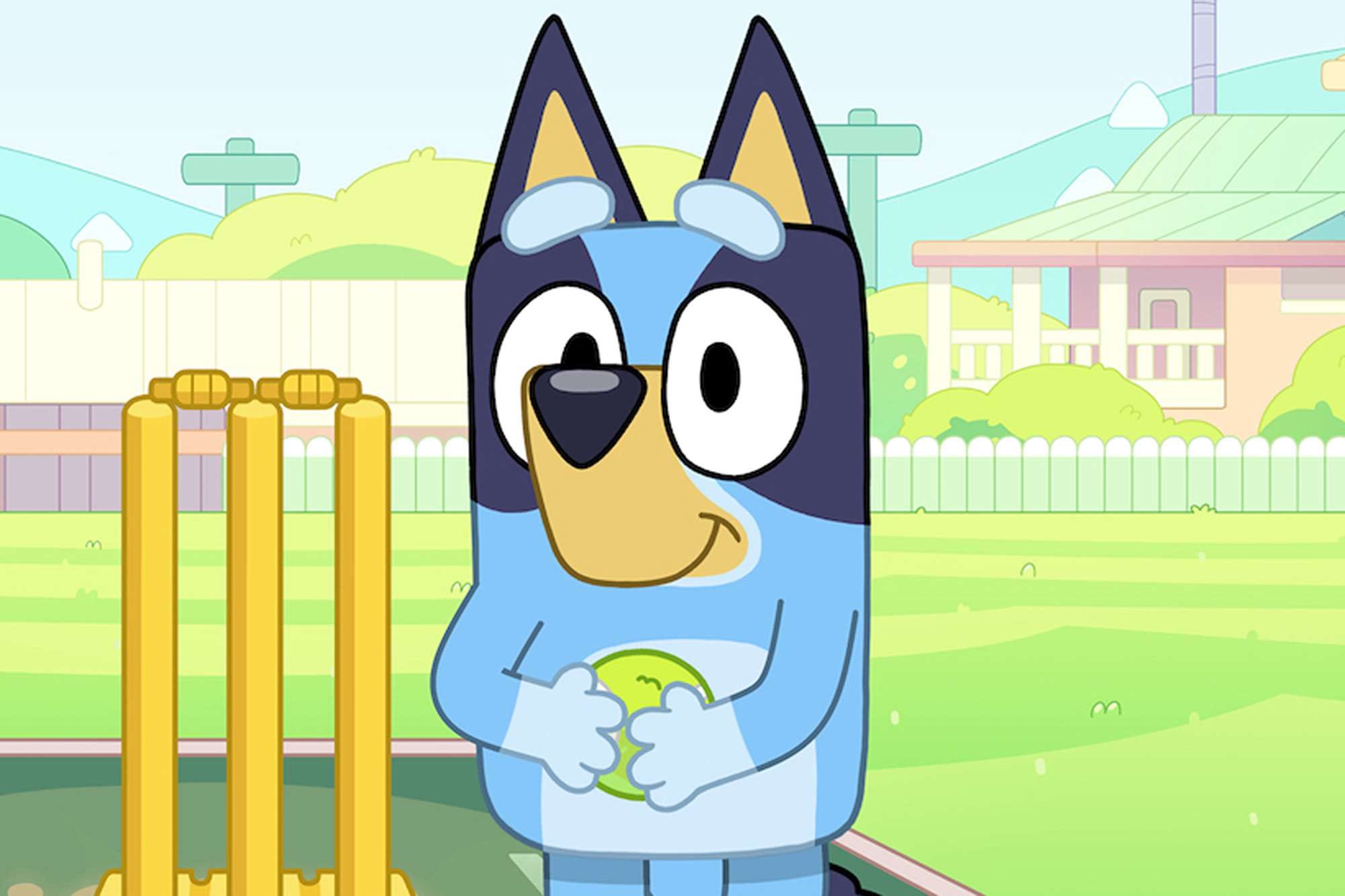
Such was the case while building a recent streaming dashboard, where I discovered that the most valuable show on television isn’t Stranger Things, Squid Game, or even the Sopranos back-catalog, but an Australian kid’s cartoon about a dog named Bluey. For parents of young children, this is painfully obvious. For everyone else, it’s surprising, perhaps even awe-inspiring for how little we know.
Bluey’s success is one of the great case studies of the streaming era—a show that reveals what people actually want from television and the fundamental shortcomings of the platform that hosts it. That an Australian children’s cartoon became Disney+’s biggest hit is, paradoxically, a testament to everything the century-old conglomerate gets wrong.
So today, we’ll dig into the Bluey phenomenon, explore the unexpected winners of the streaming wars, and examine what the show’s success reveals about Disney’s strategic failures.
Why Bluey is the Biggest Show on Television
Bluey was originally commissioned by the Australian Broadcasting Corporation (ABC), where it premiered on public television in October 2018. In 2019, Disney struck a deal with ABC and BBC Studios to acquire international broadcasting and streaming rights, and the show made its way onto Disney+ when the platform launched in early 2020. What followed was beyond anyone’s wildest expectations.
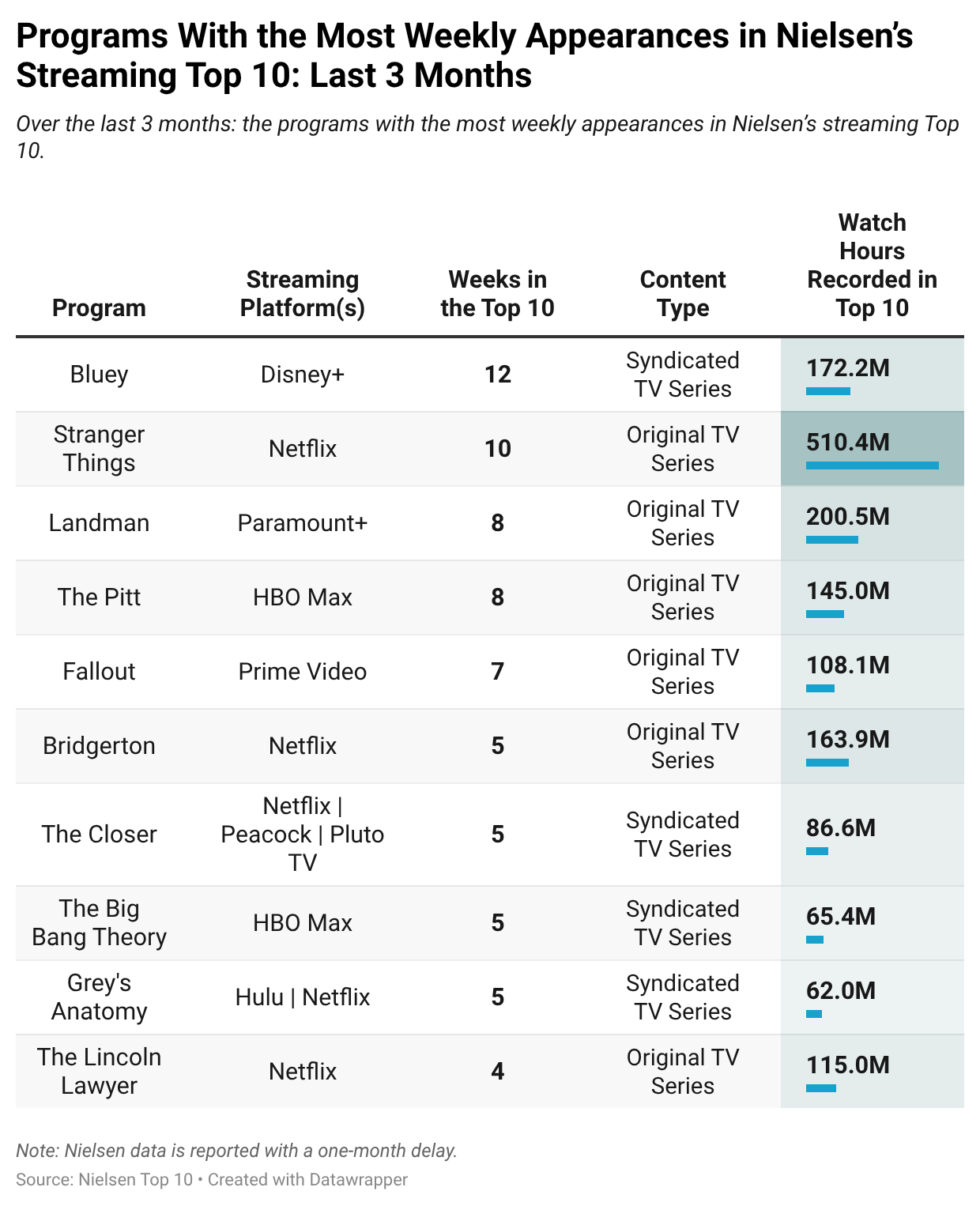
Every week since late 2023, Nielsen has published a ranking of the 10 most-streamed programs in the U.S. Over the past three months, Bluey has appeared on this chart every single week, demonstrating a level of staying power that far exceeds prestige hits like The Pitt and Landman.
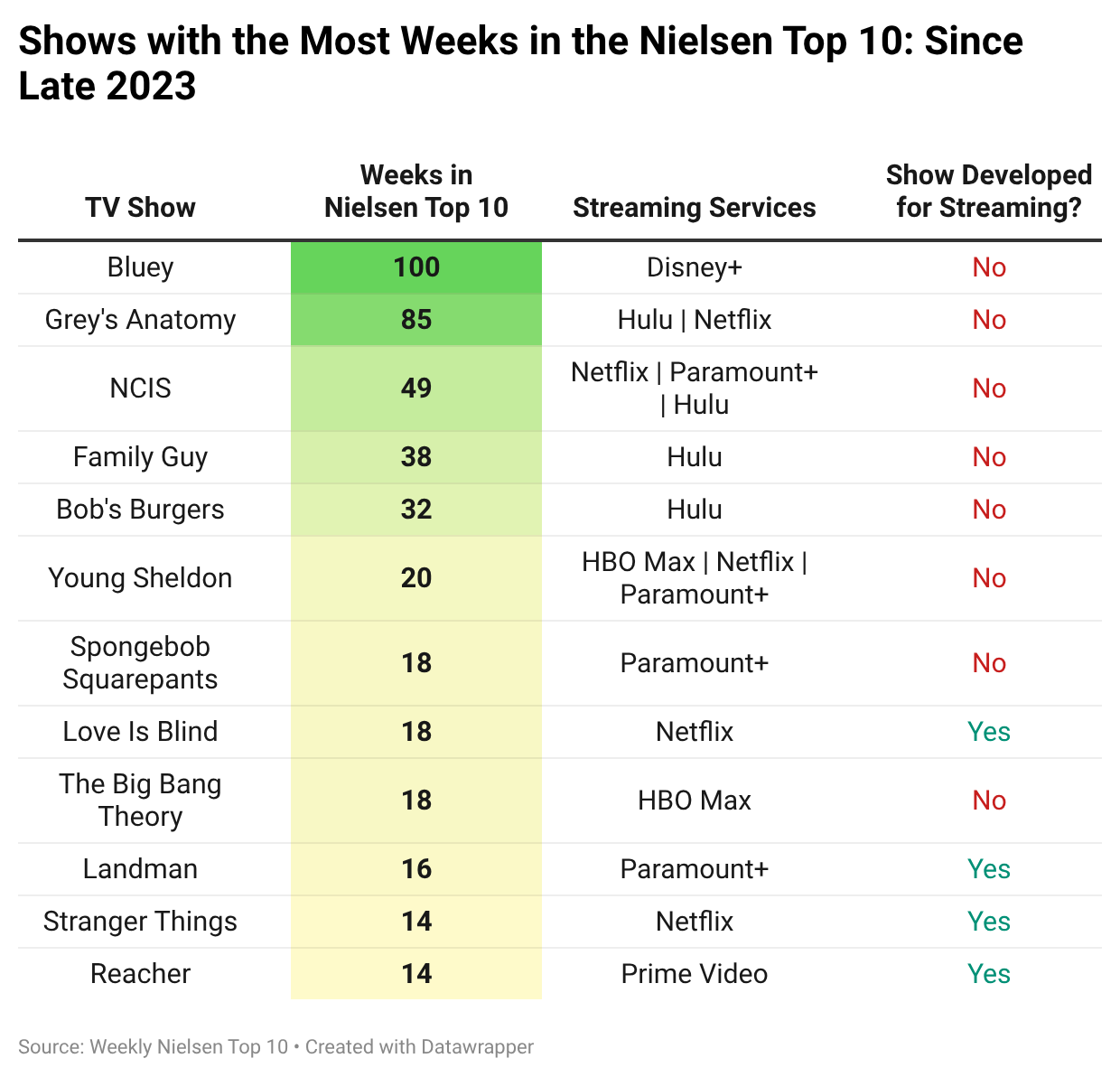
But wait, there’s more: across the 101 weeks captured in this Nielsen Top 10 dataset, Bluey has appeared on the chart a staggering 100 times.
The next-closest shows are Grey’s Anatomy, NCIS, Family Guy, and Bob’s Burgers—all syndicated content with deep back catalogs whose popularity predates streaming. Only further down the list do true streaming-era hits begin to appear, like Love is Blind, Landman, and Reacher.
Bluey’s success—and the success of other Nielsen mainstays offers two lessons for TV tastemakers:
The Power of Children’s Programming: Bluey, SpongeBob, Family Guy, and Bob’s Burgers are widely consumed by adolescents and teenagers. These shows have extensive episode catalogs that lend themselves to binge-watching. I exhibited the same behavior when I was a kid, except I was consuming reruns of Full House and Boy Meets World when I got home from school.
Syndication’s Silent Streaming Domination: Coverage of the streaming wars is hyperfixated on new and expensive series like Stranger Things and Masters of the Air, but in reality, an outsized share of viewership goes to long-running cable shows dumped on streaming services.
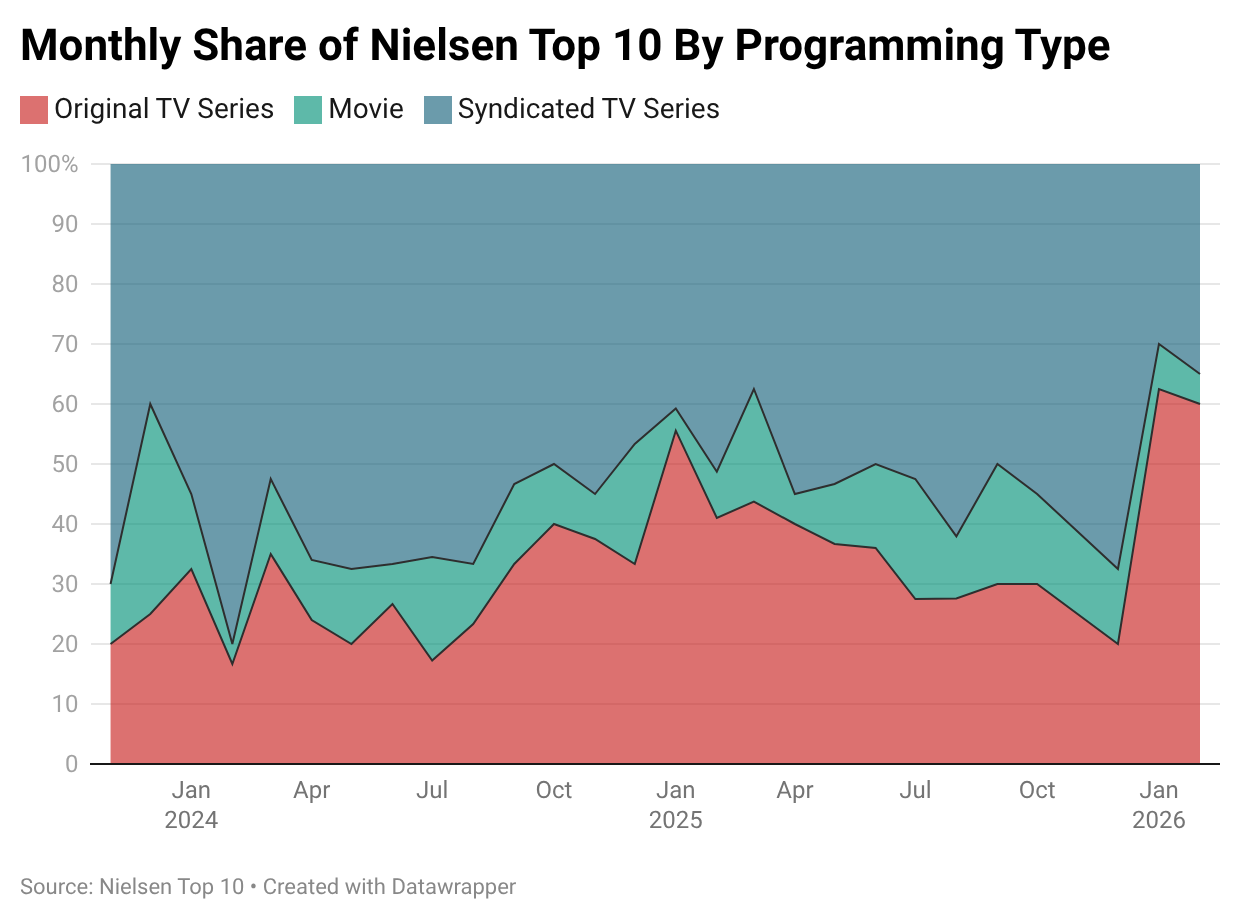
Indeed, when we look at the breakdown of Nielsen-charting programs by content type, around 60% to 70% of spots go to syndicated programs like Grey’s Anatomy and Bluey.
In a TV landscape dominated by long-running, widely recognizable programs, Disney has stumbled onto the ultimate prize. At first glance, it looks like a major win for the Mouse House—but beneath the surface, Bluey’s success reveals deeper strategic shortcomings.
Despite its vast film library and unmatched brand recognition, Disney—along with its subsidiary Hulu—is a distant third in streaming viewership and has ceded meaningful audience share since 2022.
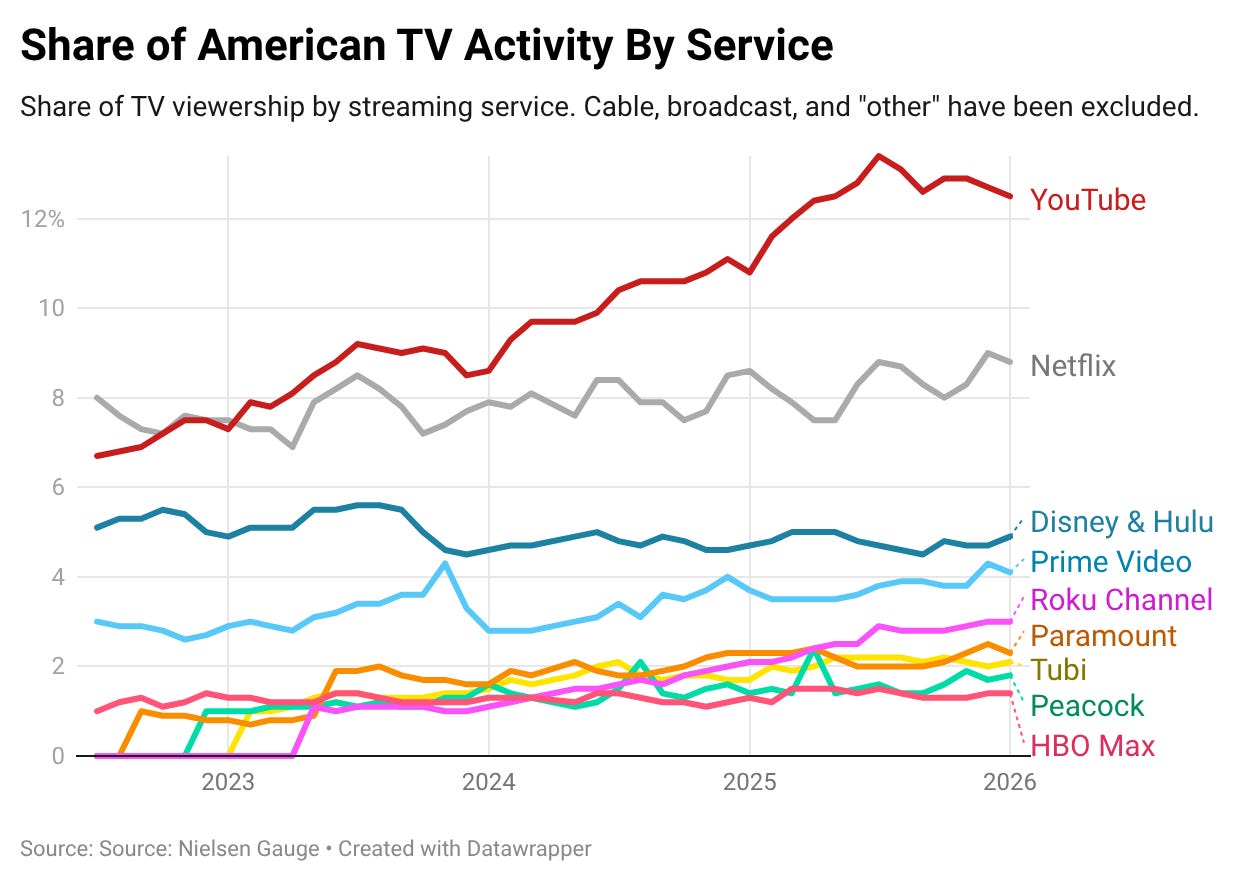
Even with the single biggest program on streaming, Disney draws half the viewership of Netflix—a gap made even more glaring by one inconvenient detail: Disney doesn’t own Bluey. One recent estimate suggests the Australian series accounts for 29% of all Disney+ watch time, which raises an uncomfortable question: if Bluey were to run away, how much of that audience would leave with it?
In fact, since late 2023, the top shows on Disney+ and Hulu have been dominated by syndicated staples like Bluey and Grey’s Anatomy—with the latter program also licensed to Netflix—while streaming-first hits like Andor and The Secret Lives of Mormon Wives draw far less viewership.
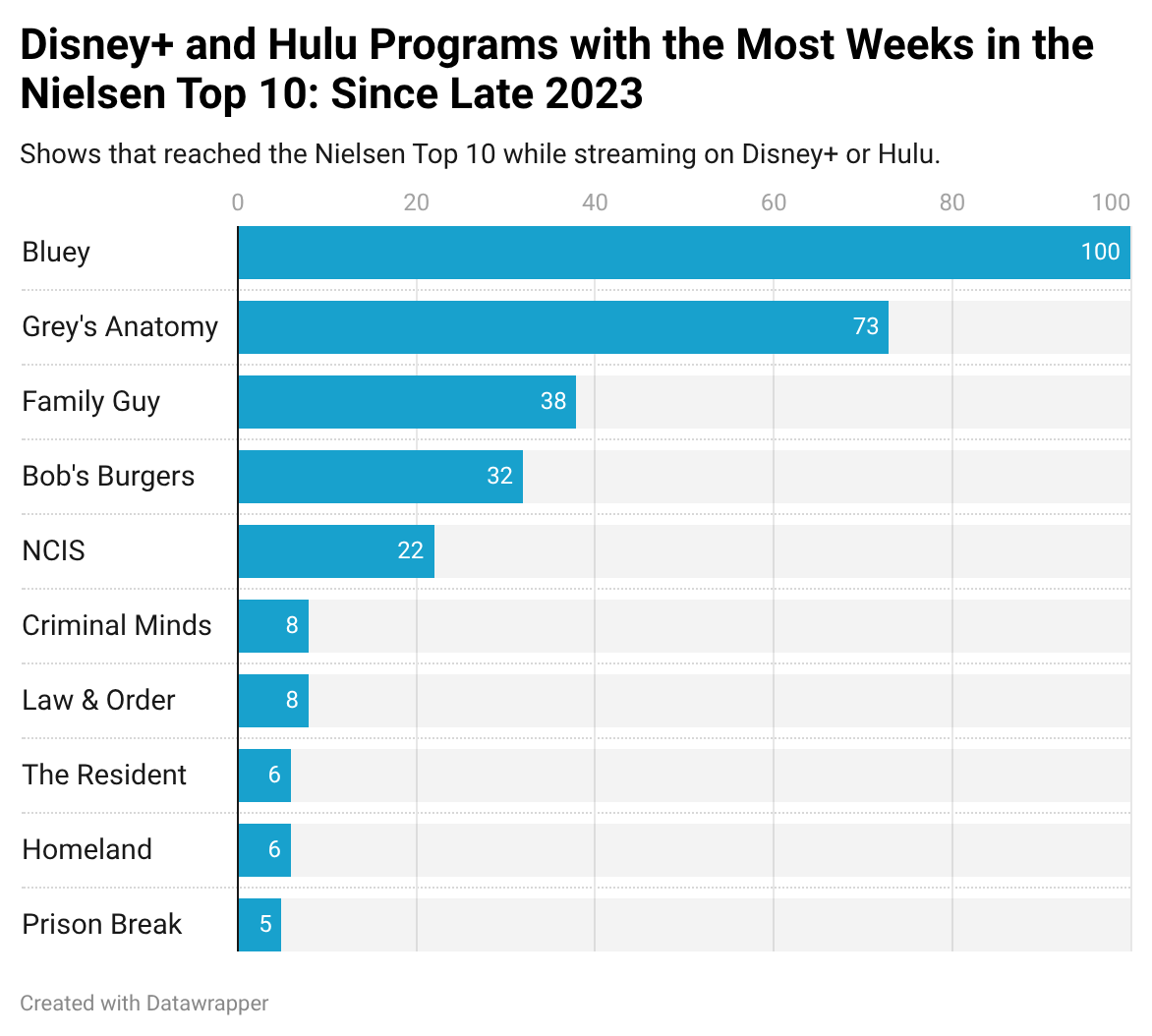
On paper, this seems like a win: if syndication and familiarity are the secret sauce, Disney can keep licensing decades-old shows that toddlers and teenagers will happily binge.
But beneath this ostensible advantage lies Disney’s core problem—one that cuts across both film and television: the hundred-year-old conglomerate struggles to create anything new. At some point, this lack of innovation will cause problems for Disney. For example, what would happen if Bluey secedes from Disney and launches its own service called Bluey+ Max?
Historically, Disney+ and Hulu have captured a combined 25% of Nielsen’s Top 10 streaming chart. But if Bluey were to leave the platform and we exclude titles that make the chart while on multiple services (e.g., streaming on Netflix and Disney+ at the same time), that combined share drops to 8.4%.
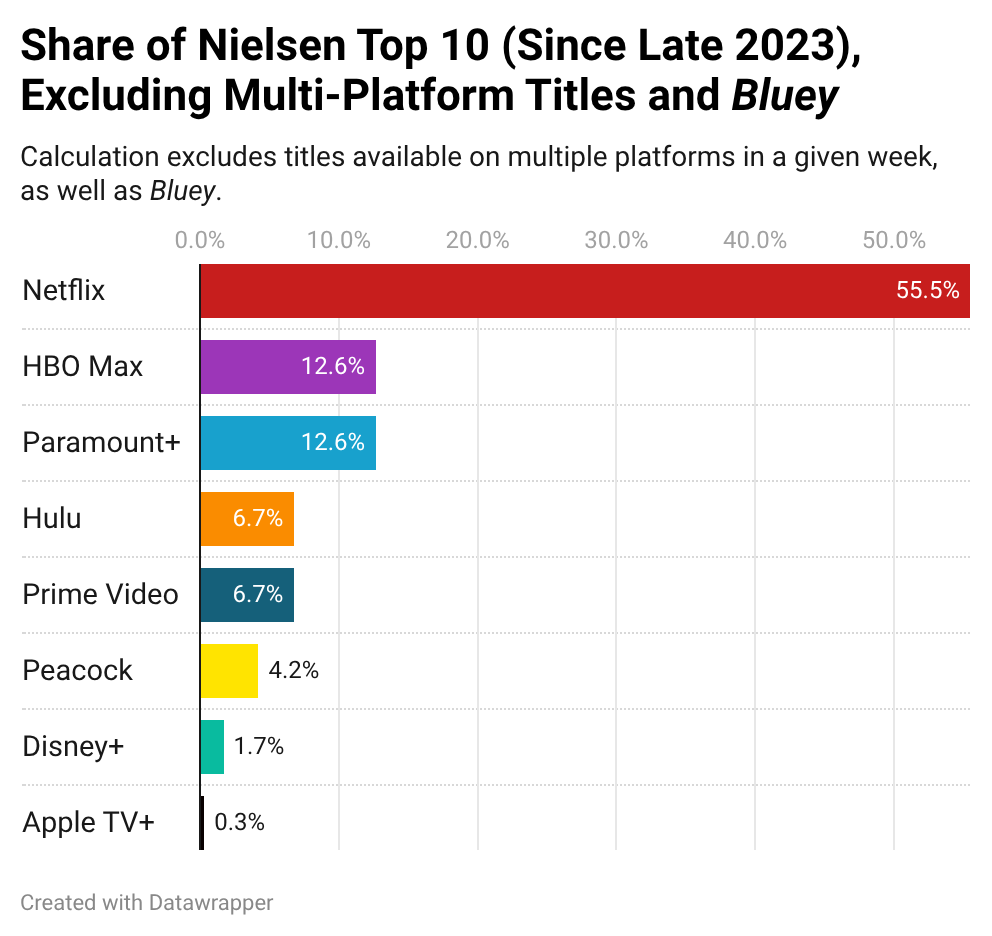
Streaming subscriptions thrive on week-to-week engagement. If your kid is a Bluey-holic and craves their daily or weekly dose of adorable Australian canine, then you will remain a Disney+ subscriber until your child moves on to Family Guy or goes to college.
Enjoying the article thus far and want more data-centric pop culture content?
Final Thoughts: The Allure of Glowing Tablets
I recently had a kid (yay!), and one day I brought him into my office to bounce in his BabyBjörn while I answered a few emails—because parents can have it all. After a few minutes of bouncing, I noticed something strange: complete silence. No coos, no giggles, no fussing. I looked up and saw him locked onto my desktop monitor, wide-eyed and perfectly still—captivated by his first-ever screen.
Then came a familiar wave of good old-fashioned parent guilt. Was he supposed to be looking at screens this young? Was I rewiring his brain in real time? Had I compromised his analog purity? I had no good answer to these questions, so I turned him away from the monitor, at which point he started to fuss.
It was at this moment that I realized how easy it would be to turn him around and pacify him with a screen, and how this impulse would remain evergreen: from toddlerhood with Bluey to adulthood with NCIS and Grey’s Anatomy.
I am not advocating for or against screens as part of someone’s parenting philosophy. What I can say is that there is probably some deep-seated drive associated with glowing tablets, not unlike the instinctive comfort of sucking, rocking, and white noise.
But the pull of screens is only part of the story. Equally important is what we choose to watch on them. The streaming wars have trained us to value novelty above all else—to subscribe for the latest prestige release. Yet so much of this programming is strangely disposable. We race through a buzzy limited series, talk about it for a week, and then move on to the next new thing, rarely to return.
Yet hiding in plain sight is an entirely different class of TV programming defined not by novelty, but by abundance and familiarity—call it comfort viewing. For this silent majority, lack of newness is an asset, as is volume. Shows like The Office and Friends endure because they soothe us, filling time and regulating mood (by way of glowing tablet).
Perhaps familiarity is more powerful than awe, or at least more than we care to admit. In this light, Disney is actually well-positioned for a streaming landscape built around comfort consumption, serving us reheated leftovers and licensing binge-able commodities. Audiences aren’t chasing astonishment every time they press play. More often than not, they just want to be pacified by their old friends—Peter Griffin, Sheldon (both young and old), Meredith Grey, and, of course, Bluey.
Want more data like this?
Become a paying subscriber for interactive dashboards, free datasets, and to support independent data journalism.
Paying subscribers get:
The Stat Significant Dataset Hub (Updated Weekly): a collection of free datasets across movies, music, TV, cultural trends, and economics.
Interactive Data Hubs:
The Streaming Report: what people are watching on streaming.
The Spotify & TikTok Music Trend Report: the songs, artists, genres, and styles dominating Spotify and TikTok. And the older hits that refuse to fade.
Pop Music History: a deep dive into music history, Billboard chart performance, genre trends, and song composition.
Get access with:
*Note: For best results, open this link in a web browser while logged in to your Substack account.
Want to promote your data tool or media publication to Stat Significant’s 25,200 readers? Email daniel@statsignificant.com
Need help with a data problem? Book a free data consultation
Connect with me on LinkedIn if you want to chat about a data project.
Like movies? Follow me on Letterboxd
The difference is that Bluey is actually good.
Bluey is children programming like The Muppets, Looney Toons and Rocky and Bullwinkle…