

Now Live: New Data Hubs for Tracking Music Trends
Today’s essay on hip-hop uses data from two of Stat Significant’s interactive data hubs:
The Spotify & TikTok Trend Report: a real-time view of the songs, artists, genres, and styles dominating Spotify and TikTok. And the older hits that refuse to fade.
A History of Popular Music: a deep dive into music history, Billboard chart performance, genre trends, and song composition.
Each page features interactive graphics that update daily or weekly, with underlying datasets often available for download. Paying subscribers get full access to the reports, with 7-day trials available.
Intro: Kendrick Curiosity
Traditionally speaking, the Super Bowl halftime show is designed for people in their mid-thirties. Each year’s headliner must carry broad name recognition, spark nostalgia, and—most importantly—appeal to the demographic advertisers value most. In many cases, this honor functions as a late-career coronation, a sign that an artist’s cultural peak has passed. If pop music thrives on novelty, the Super Bowl stands as the opposite.
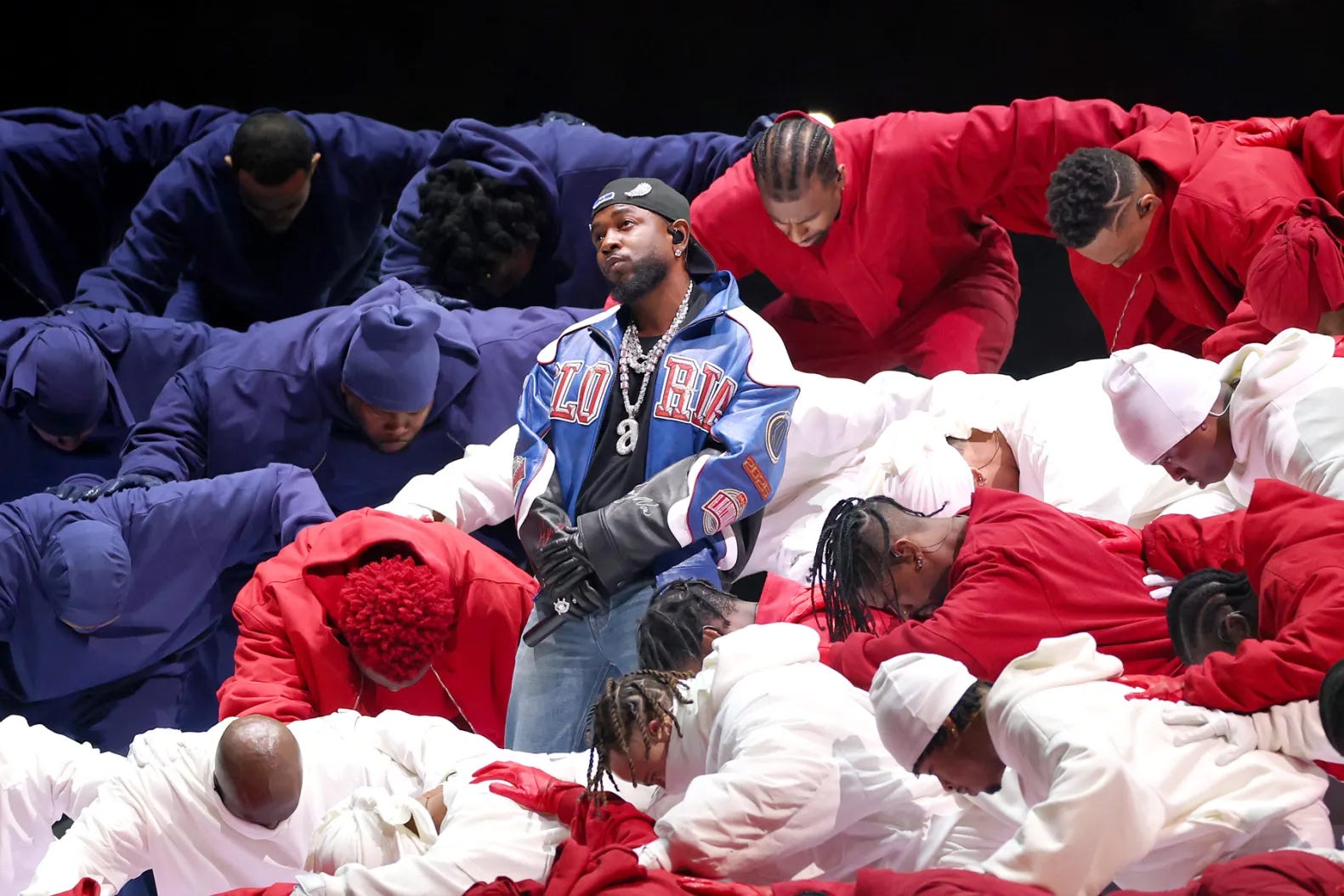
Yet in 2025, the NFL defied conventional wisdom by selecting Kendrick Lamar as its Super Bowl headliner. Here was an artist at the peak of his powers, a few years removed from a Pulitzer Prize, and months removed from a feud with Drake that consumed the internet.
In the aftermath of the 2025 halftime show, my dad—a culturally curious Baby Boomer—took a sudden interest in Kendrick Lamar, sending me a stream of think pieces on the performance’s significance and the lyrical complexity of the rapper’s music. As this deep dive continued, I found myself wondering what his appreciation said about the state of hip-hop: was my dad’s Kendrick-curiosity evidence of the genre’s continued expansion, or a harbinger of impending obsolescence?
Flash forward to today, when hip-hop is allegedly in decline and media outlets are quick to eulogize the art form. CNN recently asked, “Are We Living Through a Rap Drought?”, while Rolling Stone warned, “Hip-Hop Has Slid on the Charts. YouTube’s Exit [From Billboard Tracking] Will Only Make it Worse,” and Complex contradicted these claims by arguing, “Rap Music Was Declining, But It’s Back.” In short, my dad killed hip-hop. Not actually (love you, dad!)—though the growing narrative surrounding the genre’s commercial decline has caught my attention. Is hip-hop receding from the mainstream? And if so, why?
So today, we’ll explore hip-hop’s meteoric rise and supposed fall, the genres gaining traction in recent years, and the forces that shape music popularity.
Is Hip-Hop in Decline?
Nothing is sacred in popular music. What feels ubiquitous today can quickly become obsolete. Consider four defining genres of 20th-century pop culture: rock, hip-hop, pop, and soul.
Each one of these formats has ridden its own wave of adoption and irrelevance. Rock hit a staggering peak in the mid-1980s before falling off. Soul saw its heyday in the 1960s before evolving into modern R&B and hip-hop. Pop came into its own with drum machines and digital production in the early 1980s. And hip-hop captured the countercultural energy rock left behind in the early 1990s.
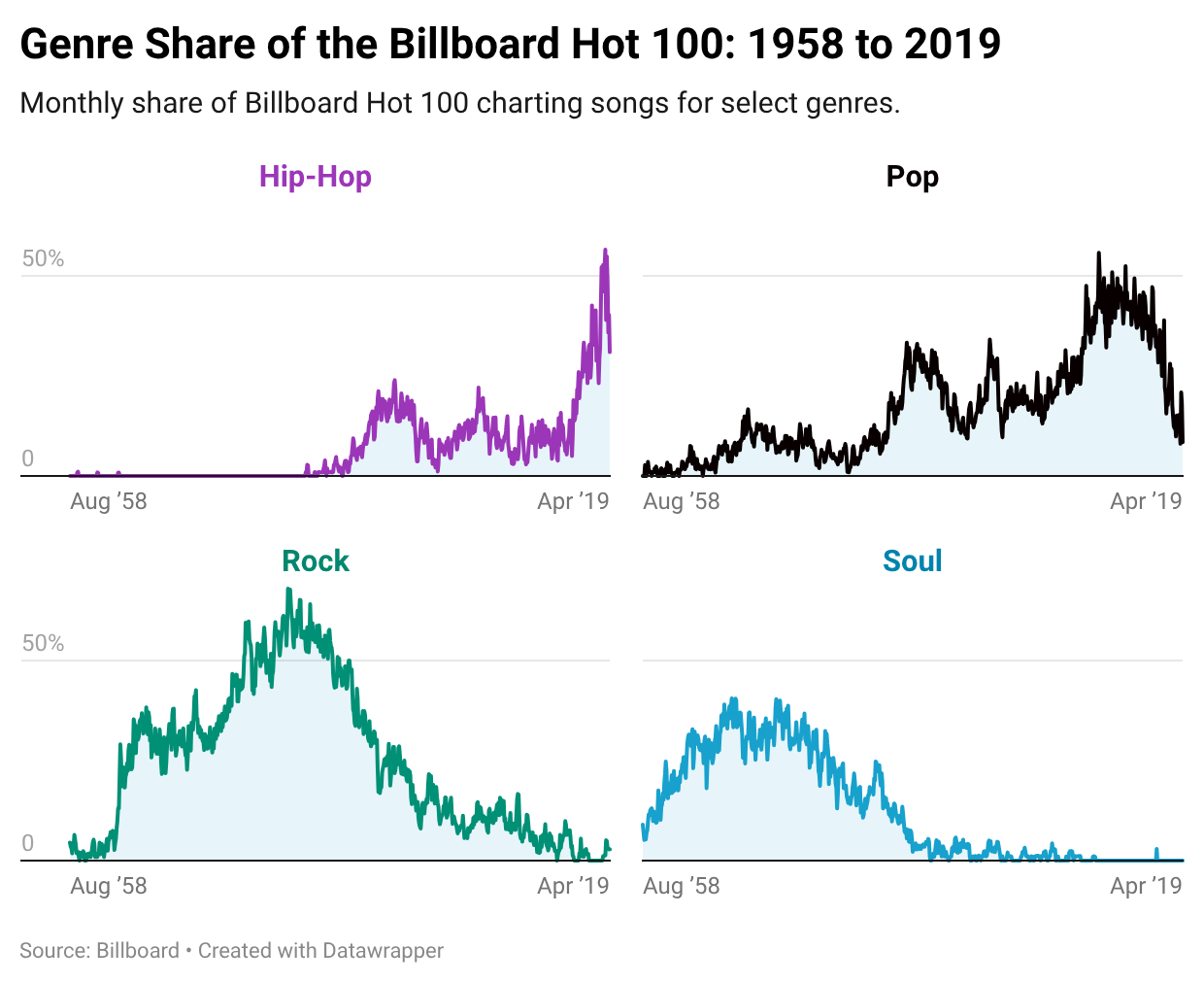
Hip-hop eventually solidified itself as the defining sound of the digital age—at least thus far. Among the 20 artists with the most Billboard-charting hits (all-time), seven are hip-hop acts—a remarkable feat for a genre that first entered the mainstream in the mid-to-late 1990s.
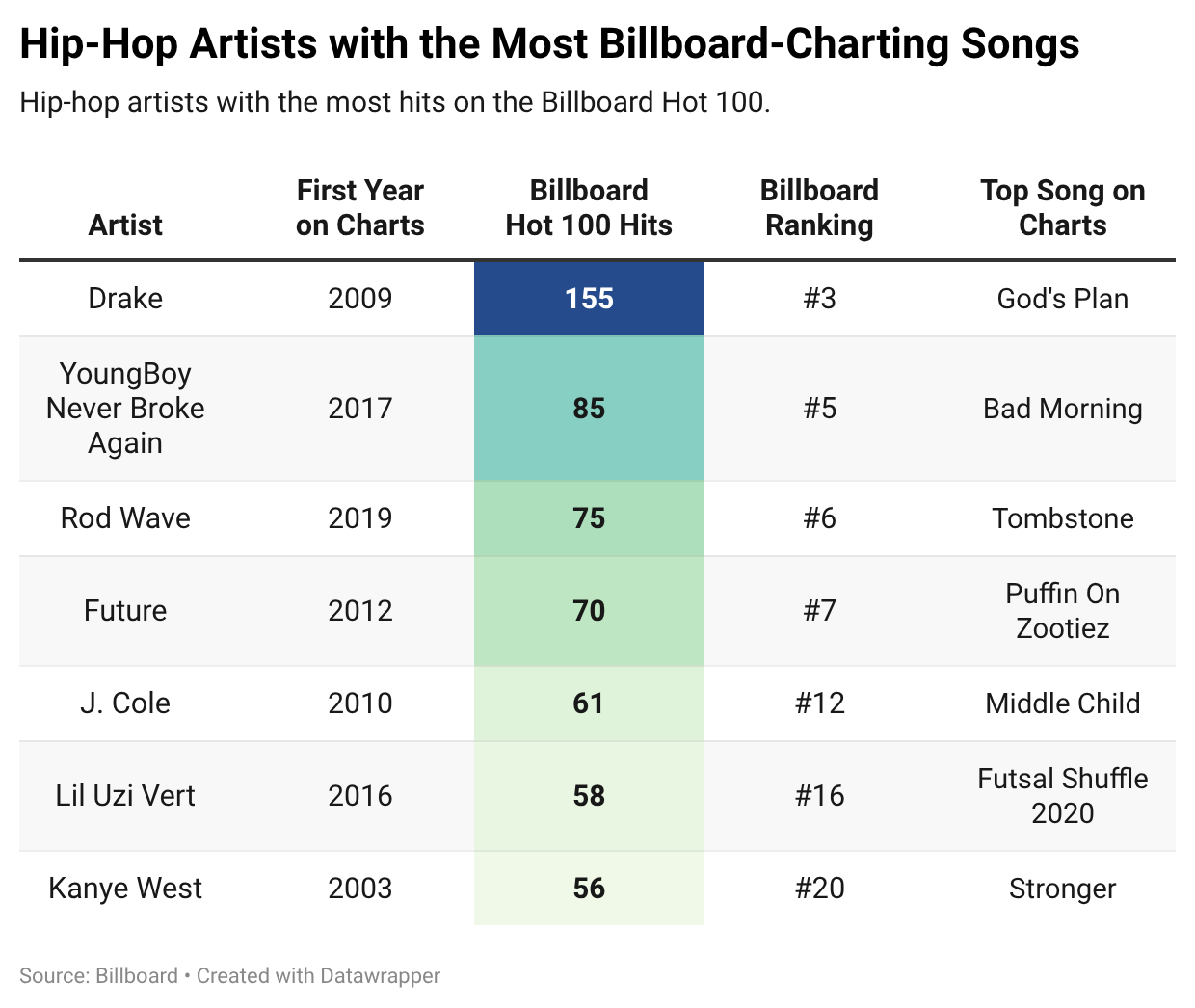
When we look at the ages of these category-defining artists, most are still relatively early in their careers, making Kanye West something of an elder statesman at 48 years old:
Kanye West: 48
Drake: 39
YoungBoy Never Broke Again: 26
Rod Wave: 27
Future: 42
J. Cole: 41
Lil Uzi Vert: 30
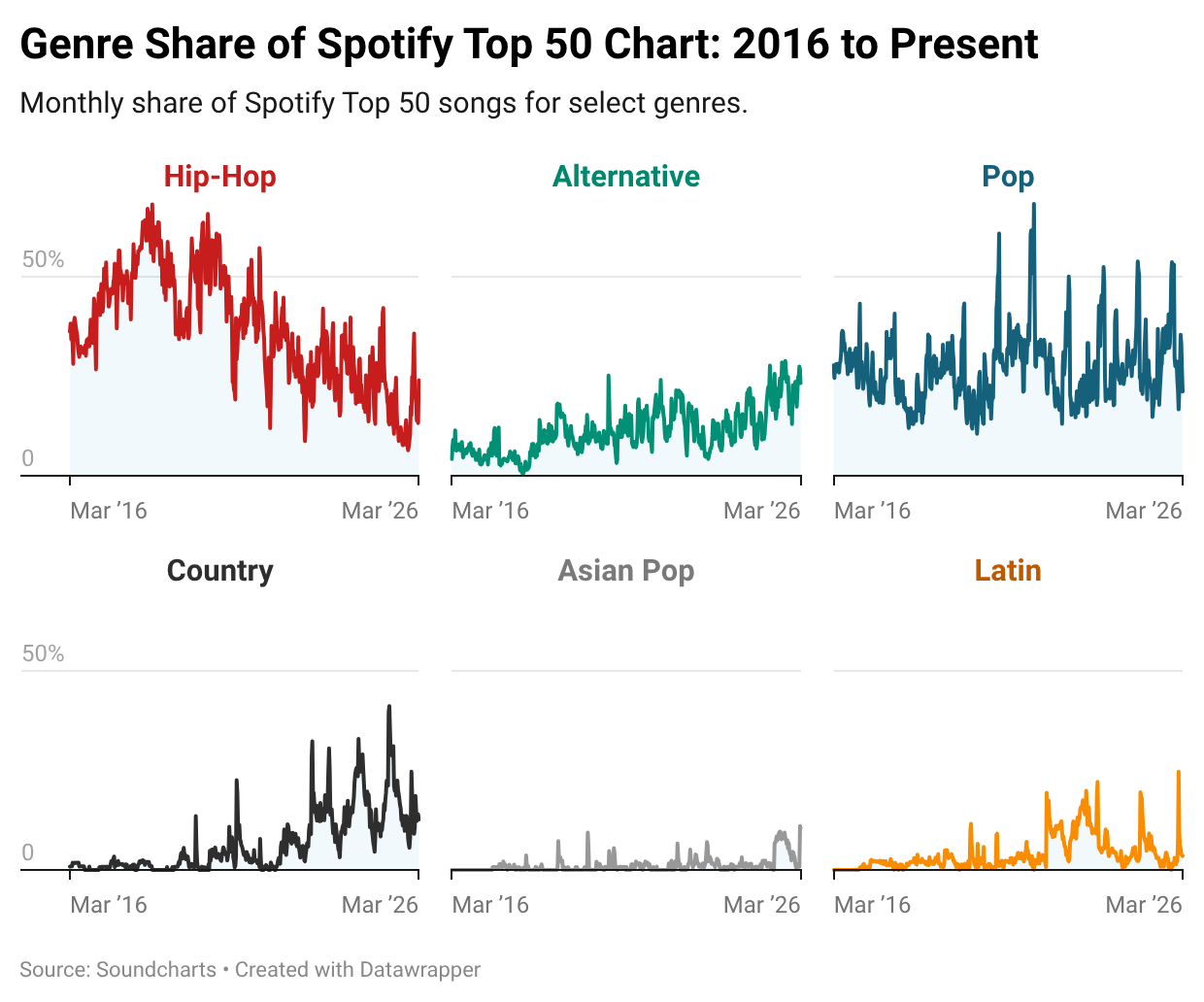
And yet, rumors of a hip-hop recession are indeed true. Over the past two years, the genre’s share of Billboard and Spotify hits has slipped, and in October of 2025, Billboard reported a week with zero hip-hop songs in the Top 40—the first such absence in more than 35 years.
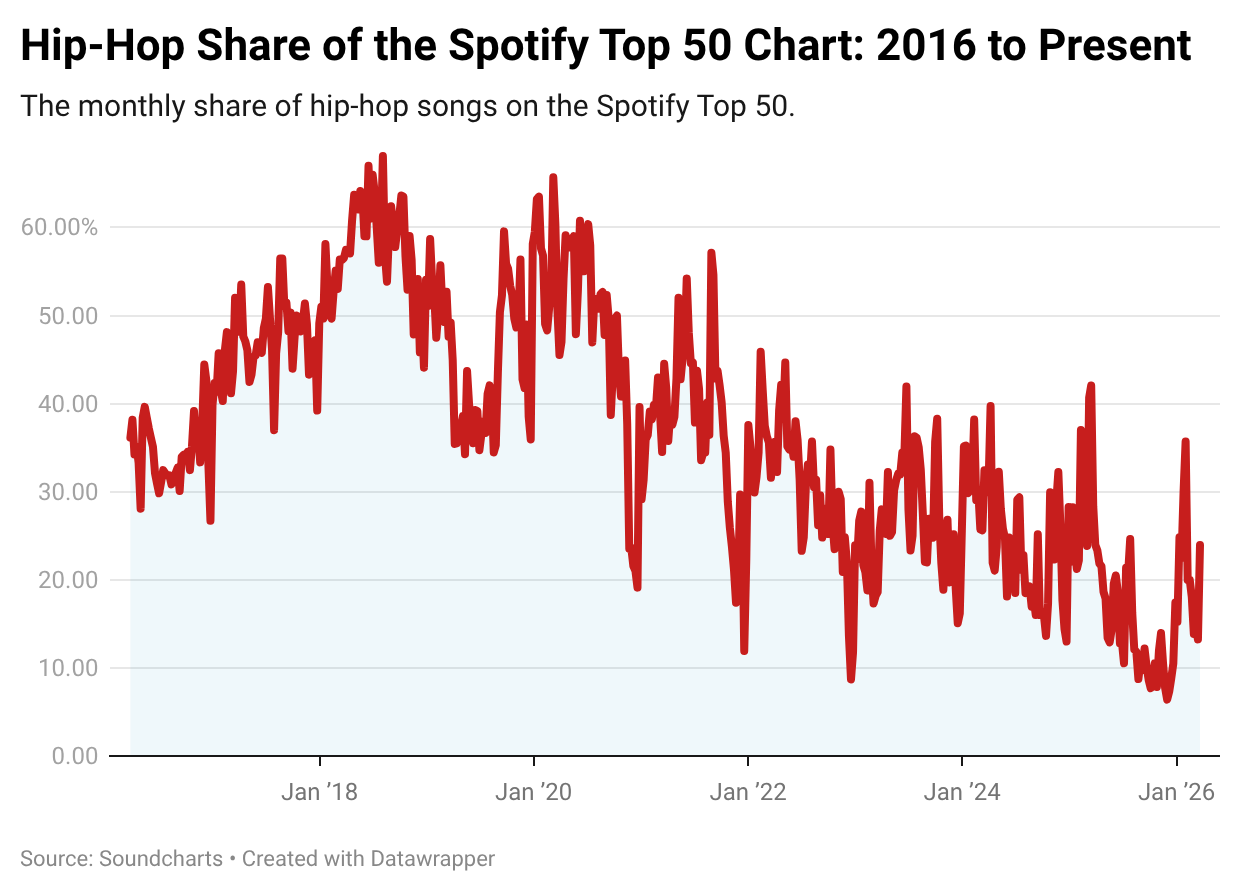
So, what’s filled the space hip-hop once dominated? A blend of new arrivals and familiar mainstays. Latin music—led by Bad Bunny—and Asian pop, powered by K-pop acts like BTS, have expanded their global footprint. At the same time, legacy formats are resurging: country is booming, driven in large part by Morgan Wallen, while the loosely defined “alternative” category continues to gain share across the charts.
It is at this point that we’ll probe one of the universe’s greatest mysteries: What is alternative music? When I think about the creation of the “alternative” label, I like to imagine a high-stakes hostage situation that went something like this:
Captor: “Come up with a new genre that is both rock but not classic rock that can’t use the word rock!”
Hostage: “What? No!”
Captor: “Do it!”
Hostage: “No, I can’t—it’s too difficult!”
Captor: “Do it, or things will get bad!”
Hostage: “Fine! Fine! Alternative.”
Captor: “Alternative to what?”
Hostage: “Nothing. Just alternative.”
Captor: “Ah, yes, perfect! That’s the type of vague semantical nonsense that will be displeasing to all.” [Captor lets out an evil laugh]
END SCENE
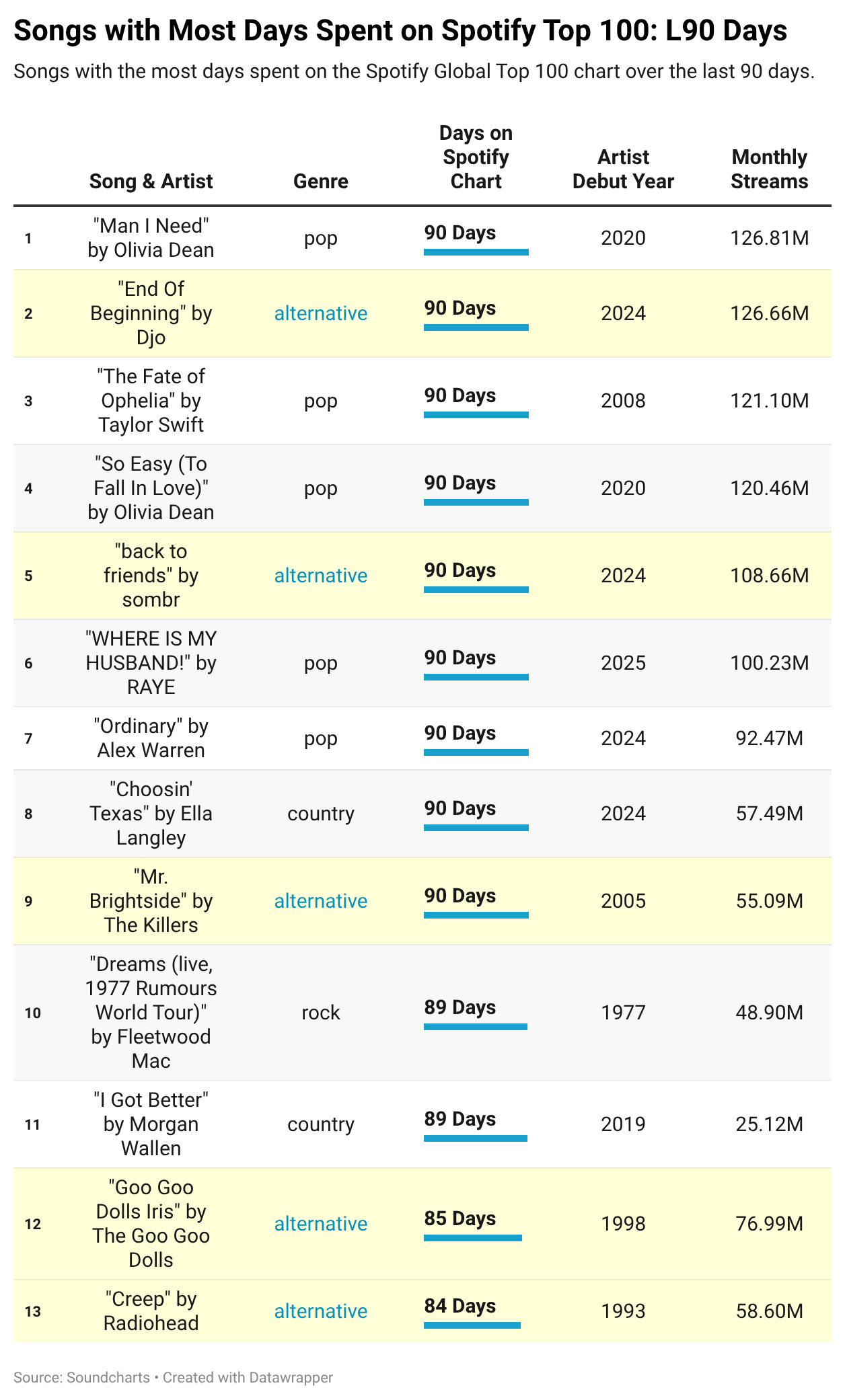
Joking aside, this deliberately vague category has carved out a real presence on both the Billboard and Spotify charts. To better understand the shape of “alternative” today, we can look at the songs dominating Spotify’s Top 100 over the last 90 days—a mix of newer artists like Djo and Sombr alongside nostalgic mainstays like The Killers and Goo Goo Dolls.
And here is where things get kinda weird: in a flattened digital landscape like streaming, an artist competes with both new and old songs alike.
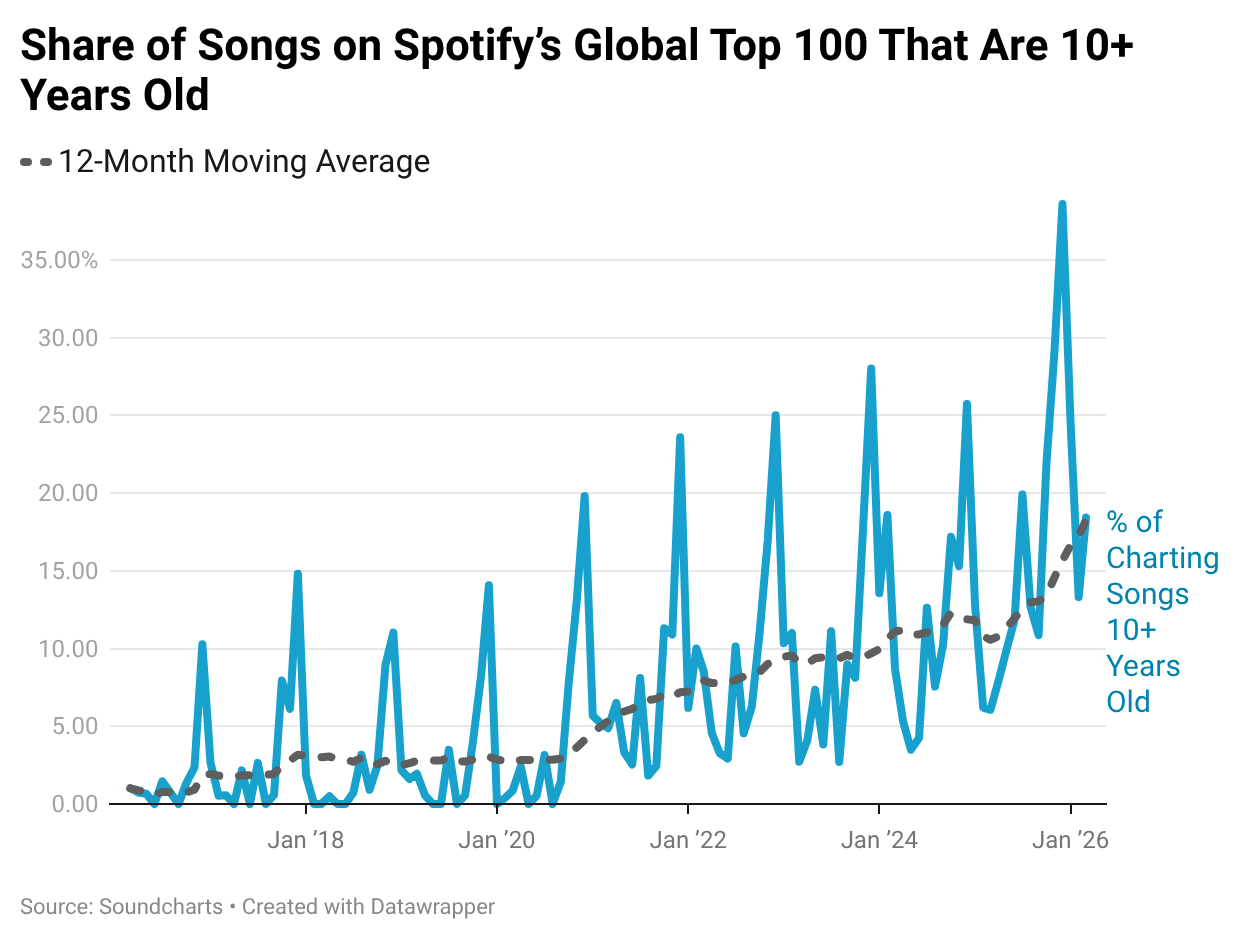
Over the past five years, an increasing share of Spotify’s Top 100 has gone to older tracks like Radiohead’s “Creep” and Fleetwood Mac’s “Dreams.”
Once a year, Spotify sees an abrupt uptick in trending Christmas classics during the holiday months, followed by an ever-increasing share of older tracks from canonical acts like The Killers and Radiohead.
So how do we reconcile this constellation of datapoints into a single, cohesive narrative about hip-hop’s current dip? In my view, we can’t.
All told, the genre’s shifting popularity is best understood through four broad hypotheses:
Streaming adoption laggards: Hip-hop uniquely benefited from early streaming adopters in the 2010s. Younger listeners—who were predisposed to the genre—were among the first to embrace platforms like Spotify, giving hip-hop an outsized digital footprint. More recently, late adopters—like country fans, older cohorts, and global audiences—have rebalanced the charts, lifting genres like country and K-pop.
Other styles offering greater novelty: Latin music and K-pop have introduced fresh sounds to the mainstream, while country is enjoying a resurgence, driven by artists like Shaboozey and Morgan Wallen, who infuse hip-hop beats into traditional country tracks.
Commercial oversaturation: Rock’s spectacular decline is often used as a template for analyzing the ascension and obsolescence of other genres. In rock’s case, the format became commercially oversaturated—through glam metal and stadium rock—and gradually lost its countercultural edge. Soon after, youth culture abandoned the genre entirely. Some observers see a similar pattern emerging in hip-hop, where ubiquity may be diluting its appeal.
Hip-hop was never meant to be mainstream: Personally speaking, I’m not a fan of this theory. The argument reads like a post hoc justification rather than a causal force. At an individual level, most artists are incentivized to get streams and sell out concerts because that’s what’s in their best interest. A coordinated pullback from the mainstream seems unlikely, even if some fragmentation benefits the genre’s long-term evolution.
There is also a distinct possibility that this entire episode is simply a blip. A major artist like Drake could return with a big release in the coming months—reinvigorating the genre’s cultural footprint—and this period will be canonized as a brief, highly unusual lull.
Enjoying the article thus far and want more data-centric pop culture content?
Final Thoughts: Failure to Innovate
My writing process usually starts with a cultural hypothesis, followed by analysis to determine whether the topic merits an article. Around 75% of the time, it does—and I ultimately write the essay (hooray!). The other 25%? I essentially assign myself a homework problem that I cannot solve, which is a humbling outcome for a 32-year-old (sad!).
This essay was one of the rare cases where I stumbled onto a topic by accident. As such, my immediate reaction was disbelief. I’m not a hip-hop fan; if anything, the music I gravitate toward is at least two cultural cycles removed from whatever defines modern hip-hop.
Unsure whether my findings were legitimate, I did what any good statistician would: I asked a roomful of random dudes. Several of my brother-in-law’s friends self-identify as hip-hop fans, so I posed two questions to this group: (1) Is the genre actually in decline, and (2) if so, why?
The consensus was surprisingly consistent. My gaggle of guys agreed the genre was past its peak, and pointed to the same signal of decline: a lack of new, exciting artists. Does this insight qualify as anec-data? Absolutely. But it gestures toward something broader: the sense that hip-hop’s current moment is one of stagnant cultural innovation (allegedly).
Step back, and the genre’s shifting popularity follows a familiar arc seen across domains, from BlackBerry phones to TV sitcoms to rock music, in which a cultural form rises through innovation and subversion, scales on the strength of its novelty, and is eventually undermined by the very forces that fueled its ascent, such as:
Changes in distribution that reshape consumption and competition: Streaming is no longer novel. As adoption has saturated, late-adopting audiences and their tastes are now fully reflected in major playlists and Top 100 charts. The result is a more crowded landscape, with hip-hop competing not just across genres, but across eras, as older songs resurface alongside new releases.
Cultural drift: Once controversial enough to be banned from record stores, hip-hop now headlines the Super Bowl, an event watched by ~75% of Americans. The art form is no longer anti-establishment or exclusive to youth culture.
Lack of (intra-genre) innovation: Genres sustain themselves by evolving, either through new subgenres or breakout artists who redefine the sound. When that pipeline slows, so does cultural momentum.
Hip-hop is far from extinct, but it does require some degree of reinvention to avoid the same fate as rock. Its next phase hinges on artists who will take the genre somewhere new—ideally in a direction my dad won’t understand.
Want more data like this?
Become a paying subscriber for interactive dashboards, free datasets, and to support independent data journalism.
Paying subscribers get:
The Stat Significant Dataset Hub (Updated Weekly): a collection of free datasets across movies, music, TV, cultural trends, and economics.
Interactive Data Hubs:
The Streaming Report: what people are watching on streaming.
The Spotify & TikTok Music Trend Report: the songs, artists, genres, and styles dominating Spotify and TikTok. And the older hits that refuse to fade.
Pop Music History: a deep dive into music history, Billboard chart performance, genre trends, and song composition.
Get access with:
*Note: For best results, open this link in a web browser while logged in to your Substack account.
Want to promote your data tool or media publication to Stat Significant’s 24,800 readers? Email daniel@statsignificant.com
Need help with a data problem? Book a free data consultation
Connect with me on LinkedIn if you want to chat about a data project.
Like movies? Follow me on Letterboxd
This is amazing and glad you have covered Hip-Hop so well here.
One potential driver I see that is missing I think is the breakdown of the typical collaboration - competition duality that fueled innovation in hip-hop music. In the "blog era", rappers needed to collaborate with each other much more in order to cross over and share fan bases which meant strong incentives for oneupmanship between themselves, while also self enforcing certain norms and skillsets required for rappers to respect and therefore want to collaborate with you. This is the period where free online mixtapes and remixes were rife, which was allowed as digital monetisation was minimal and exposure was king. This was fired up by trusted select group of blog writers who would determine the music that aligned with those guidelines and effectively anointing who would come next.
In that 2014 - 2018 period, streaming/social media (especially non friend recommendation feeds)/ media changes meant that it was easier than ever for rappers to monetise previously too small distribution channels without having to align with any others, there was no incentive to remix others music/feature with them as much, as that meant splitting royalties more than may be needed, social media would do the hard work to find their top fans for them, and there was the explosion of someone somewhere making reviews willing to say the music was the best of all time or the worst thing they've ever heard and be agreed with.
Initially this was good for hip hop as artists that were being truly creative but blocked out of the limelight by old channels were now able to shine and break through. But by COVID, it had run through the pre refined pipeline of talent waiting in the trenches and no further builds up new talent to take the reins.
I think the Kendrick v Drake feud was effectively pent up demand for that previous competition, exploding beyond any rap fans wildest dreams and giving whiplash to the entire industry, effectively burying any further incentive for working together on the largest scales.
I am not sure where it goes from here, but I like the thought of the "remixing" of hip hop styles into Latin, k-pop, country (I think you may also miss the impact of afro beats growth) that seems to be brewing and I think the next stage is legacy hip hop artists being the flag bearers for some of that. Other genres are also likely to absorb some hip hop styles and be where the kids gravitate too.
On a final note, I wonder how much of this is also the attention economy becoming more competitive, especially with the youth, and music as a whole suffering as a result. One I am sure you may ponder if you have not already done so!
Yes, hip-hop is receding, for many of the same reasons as other genres before it receded: an aging-out listening base who consume less of the media (through lifestyle attrition), mainstreaming contributed to a loss of perceived edginess, loss of novelty (newer genres capture the attention of the younger listeners), and an increasing aversion to its cookie cutter commercialization.
Purely anecdotally, I'm also sensing (based on social media content), that there seems to be a growing interest in more traditionally created and played music, that includes standard melodic and harmonic lines - an interest in instruments and vocalists. Very young content creators are putting out what I would classify as traditional structure that does not incorporate rap or hip-hop stylings.
I can envision a time when "classic hip-hop" will develop a following, and will then become the "Dreams" version of old-time hits that appear in the streaming charts long after the original date of release.
Hip-hop as a standalone genre is receding, but it has influenced and been absorbed, to one degree or another, into currently very popular genres... pop, country and maybe also alternative. So, in that sense, it's already been baked into the music of the day.