

Welcome to the Monday Roundup (sent on Tuesday this week because of a U.S. national holiday)!
The Monday Roundup is a weekly bonus edition featuring data-driven culture stories, curated datasets, and recommended reading.
Your regular Wednesday essay stays free for everyone—this is strictly additive.
Today’s edition has six new data stories. Free readers get the first two; paid subscribers get the full thing, plus datasets and recommended reading. Enjoy!
In Today’s Roundup:
Original Data Stories: Shrinking TV season gaps, newsroom layoffs, the economics of sequels and reboots, the music-catalog gold rush, Hollywood’s endless M&A cycles, and music’s physical media resurgence.
Recommended Reads: Notable data journalism and pop culture reads from around the web.
Unique Datasets: Ten publicly available datasets, covering everything from AI music catalogs to how artificial intelligence is depicted in movies.
Trend 1: Is the Time Between TV Seasons Going Up or Down?
In the early days of the streaming wars, showrunners were encouraged to take their time developing and shooting a second or third season, because increased quality could (conceivably) net Apple TV or Peacock thousands of incremental subscribers. The result was an era of ever-ballooning gaps between seasons. Alas, industry consensus has shifted—quite drastically, I might add.
In a recent interview with The Wrap, WME TV co-head Erin Junkin discussed a renewed industry-wide focus on TV season wait times, claiming that Netflix and Apple are “trying to figure out a way to cut down on the time it takes for their shows to come back.”
To this, I say: hallelujah. I’m tired of watching explainer videos before a new TV season because the previous one aired 33 months ago (i.e., Severance).
Some of the best TV shows of the 21st century have taken nearly four years between installments, including personal favorites like Stranger Things, Fargo, and Atlanta.
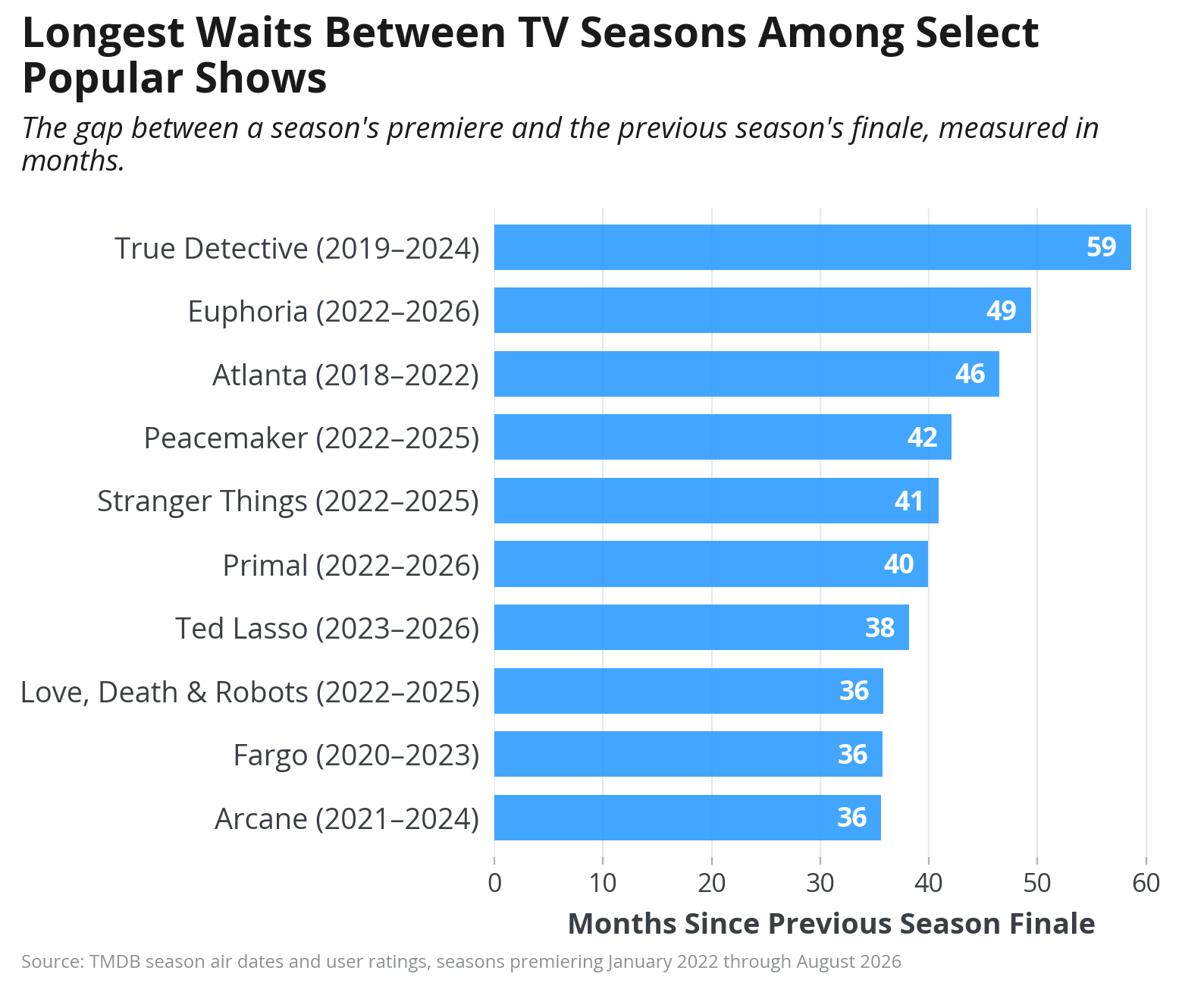
Alas, these ever-growing wait times may finally be coming to an end. After weathering an industry-wide spending binge, a global pandemic, and the 2023 writers’ strike, studios have begun shrinking the gaps between TV seasons.
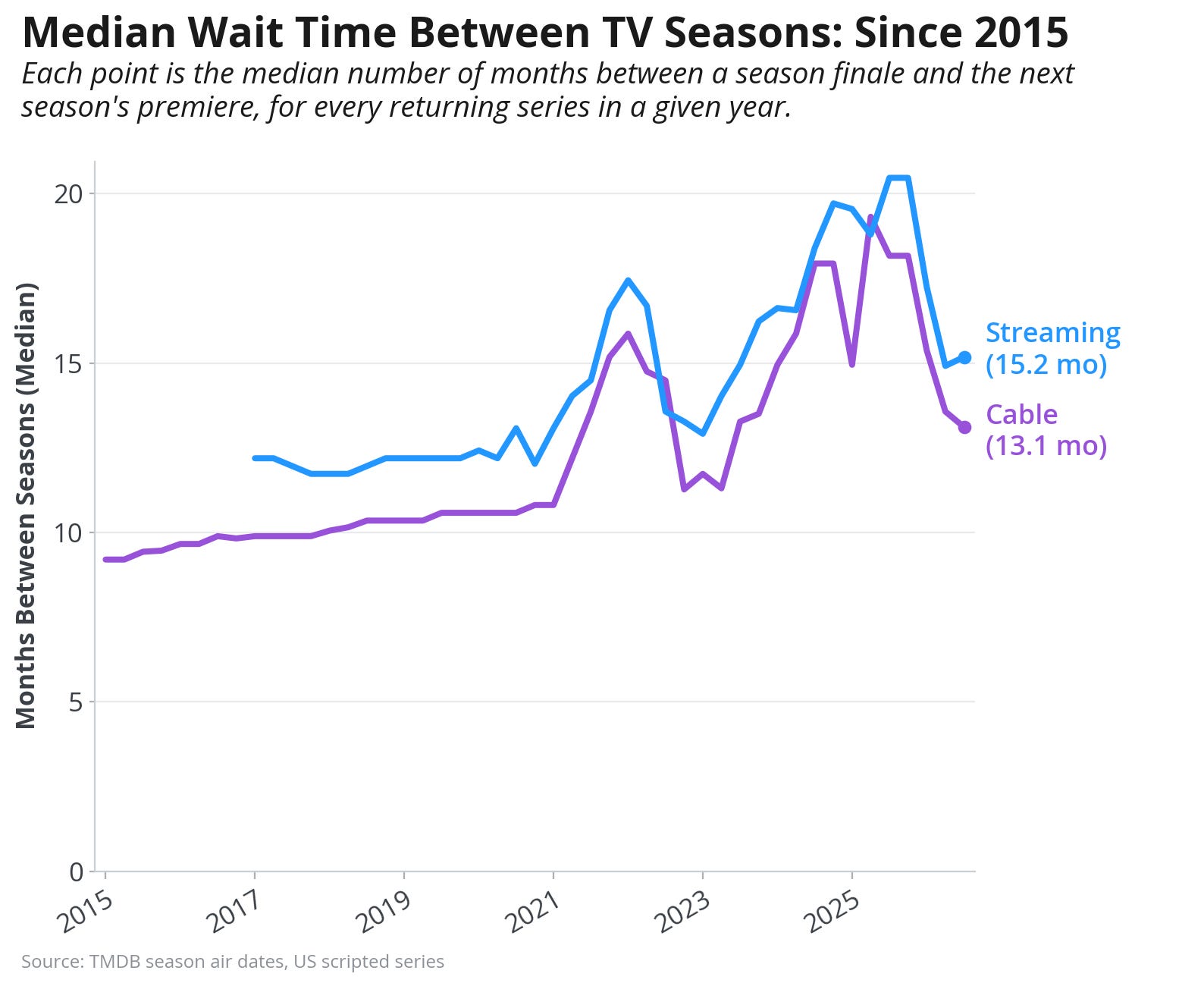
Personally, I still think 15 months between a first and second season is too much. I’d take a nominally worse final product in return for not having to do active research on why I liked a show in the first place.
Trend 2: Newsroom Layoffs
I try to strike a balance between dispiriting trends and uplifting stories. Unfortunately, this particular analysis focuses on newsroom employment, and is therefore not an “uplifting story.” In fact, pretty much the opposite.
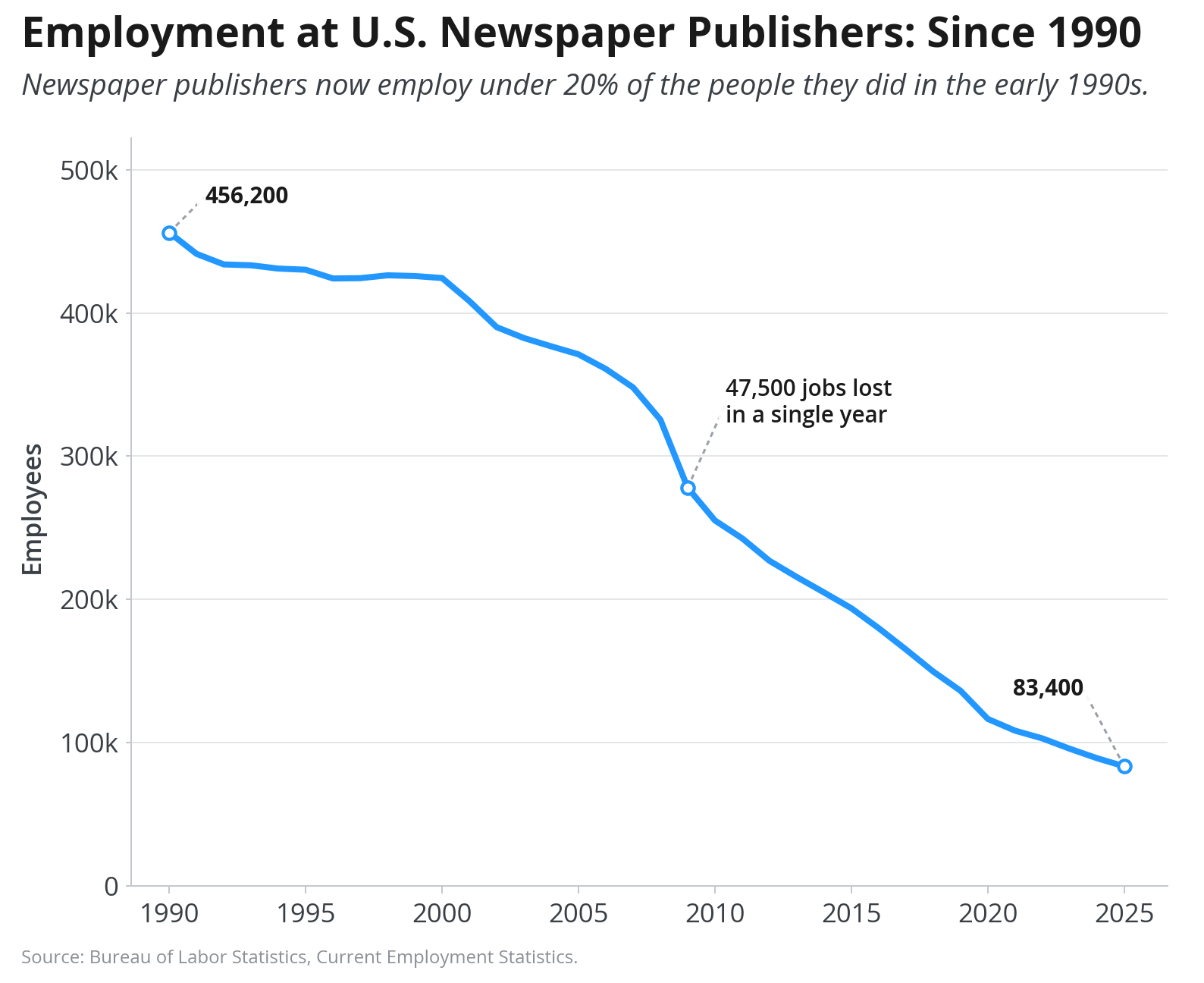
Pick any moment in time over the last decade, and you’re likely to find a bummer anecdote about mass layoffs at a once-reputable newsroom. One such case: two weeks ago, New York’s WNBC eliminated its investigative reporter position as part of an ongoing wave of job cuts.
Legacy news outlets have had a rough 25 years, with current employment levels below 20% of what they were in the early 1990s.
Newspaper publishing is one of many media industries “eaten” by the internet, along with radio, periodicals, and broadcast television. In fact, if you want to see Silicon Valley’s impact on the media landscape, look no further than this chart, where the aforementioned verticals shrink whilst tech grows.
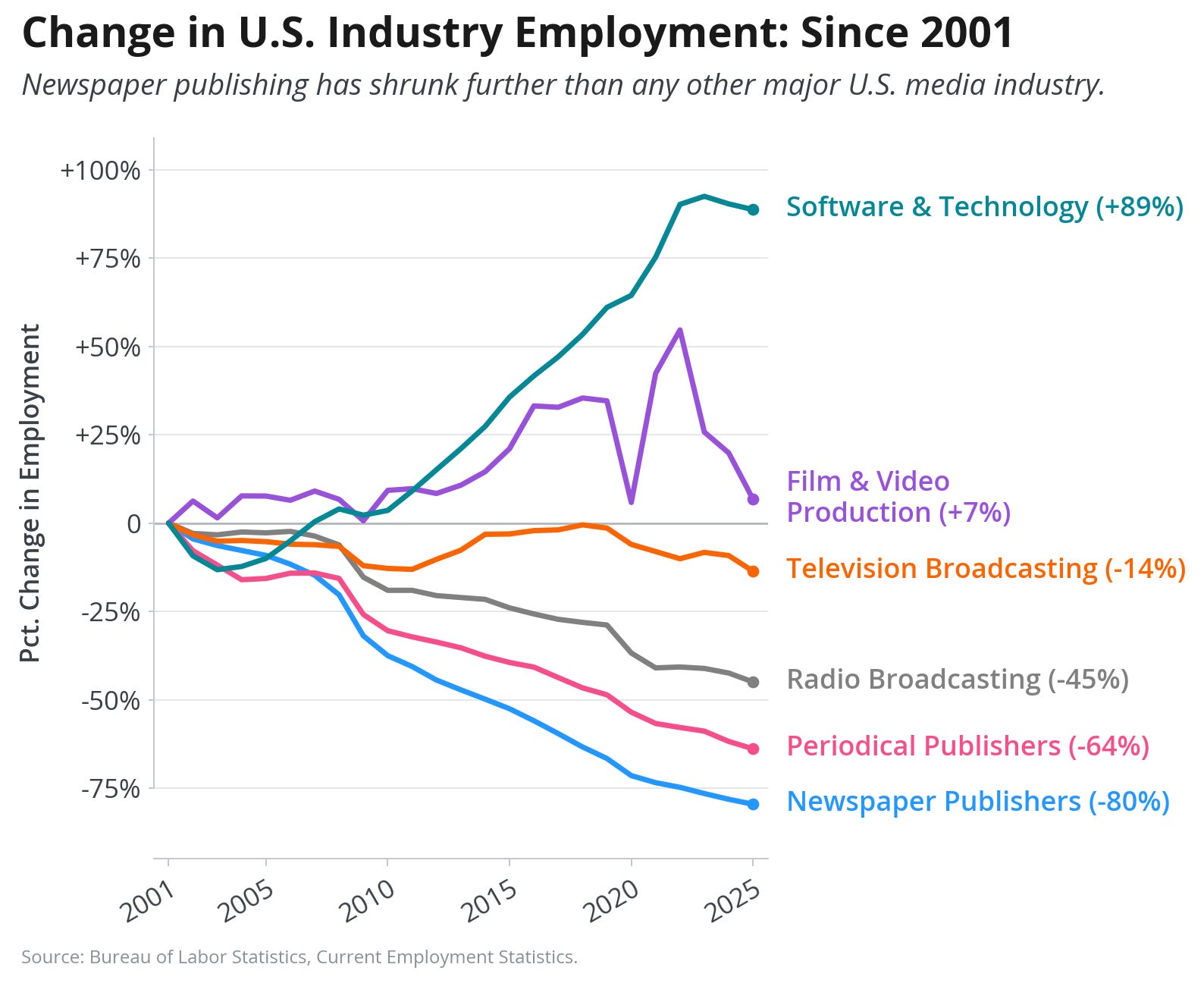
Information acquisition has become more efficient, in the broadest sense, but that efficiency has come at a cost. What economists typically call “productivity” could also qualify as “economic destruction that is counterproductive to human flourishing.”
Trend 3: The Sequel Sweet Spot: Too Soon or Too Late?
Tom Cruise has gone back to the well, mounting another legacy sequel to a hit film from the 20th century (à la Top Gun: Maverick). This time, Cruise will be starring in a sequel to the racing movie Days of Thunder. If you’re unfamiliar with this slightly-above-average film, don’t worry—your dad, or your dad’s dad, will be awaiting this reboot with bated breath.
Days of Thunder 2 is the latest entry in a surprisingly not-so-terrible lineage of legacy sequels, alongside the aforementioned Top Gun, Mad Max: Fury Road, Blade Runner 2049, and Twisters. The currently untitled Days of Thunder sequel is slated for 2028, meaning there would be a 38-year gap between the newest installment and its predecessor—the third-largest gap among an ever-expanding cohort of franchise reboots.
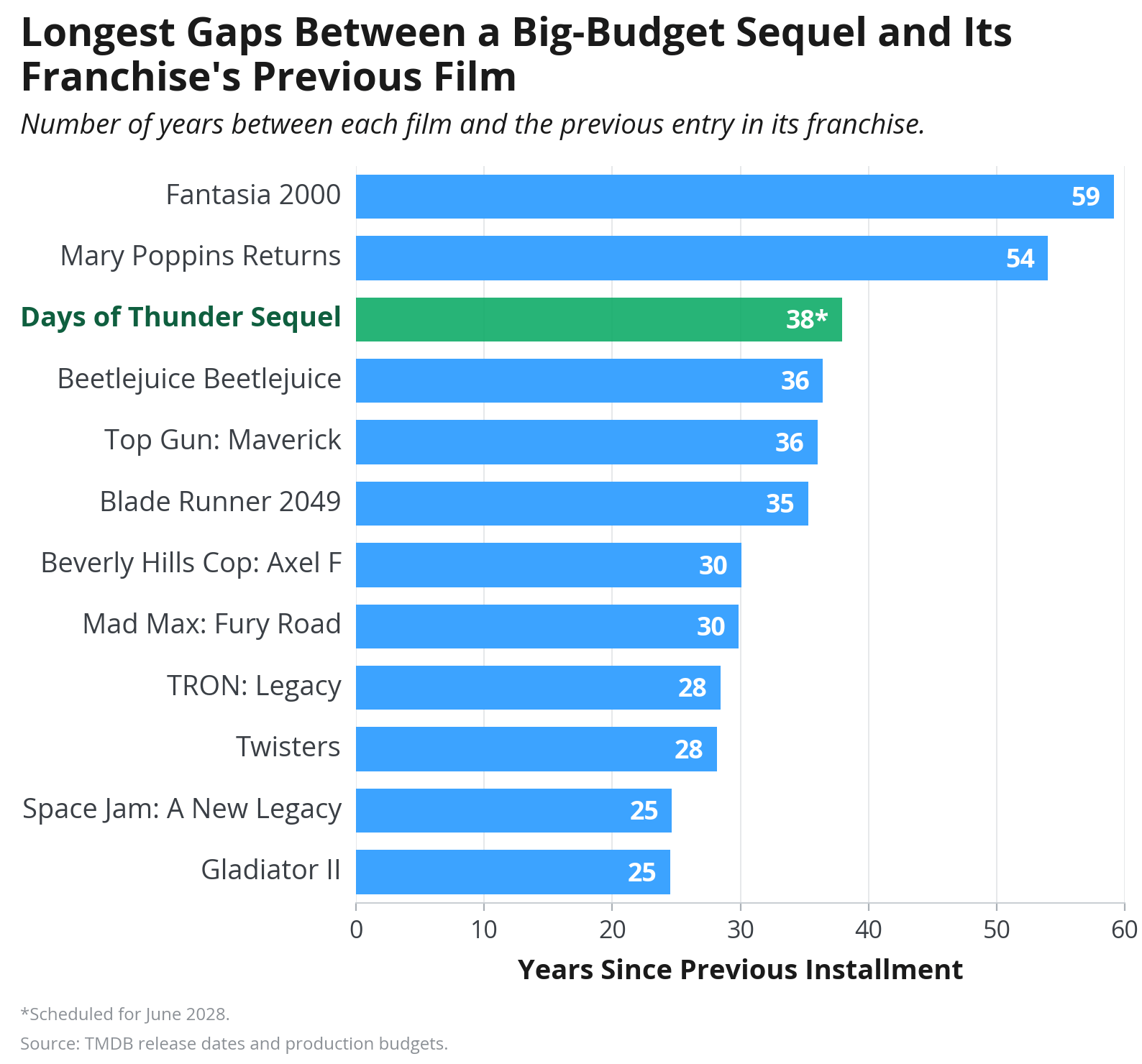
On the one hand, a large gap between installments comes with risk, as franchise devotees may age out of moviegoing (because older folks are less likely to go to theaters). On the other hand, conventional wisdom is that a gap between a sequel and its originator can prove beneficial, with a franchise’s prolonged absence heightening nostalgia and making its return feel more like an event. So where is the sweet spot? When is a reboot or sequel too soon—or too late?