

Intro: The Greatest “Worst Movie” of All Time
In 1978, film critic Michael Medved and his brother Harry published “The Fifty Worst Films of All Time,” a compendium of cinema’s most spectacular failures. Tucked into the book’s final pages was a mailing address inviting readers to submit their nominees for all-time stinkers—an afterthought that would eventually unearth a cinematic gem.
Numerous respondents, including film critic Roger Ebert, contacted the Medved brothers to protest a single omission: Ed Wood’s legendarily terrible Plan 9 from Outer Space. After obtaining a rare print of the film, the Medveds enthusiastically crowned Plan 9 “the worst movie of all time,” showcasing this find in their follow-up book, “The Golden Turkey Awards.”
Released in 1959, Ed Wood’s Plan 9 from Outer Space is a low-budget sci-fi yarn about aliens who resurrect the Earth’s dead as zombies. Wood’s masterpiece features glaring continuity errors, cheap special effects, heavy use of footage from unrelated projects, and wooden, over-the-top acting. The film’s sets are unmistakably fake, including a cardboard gravestone that simply falls over while in frame.
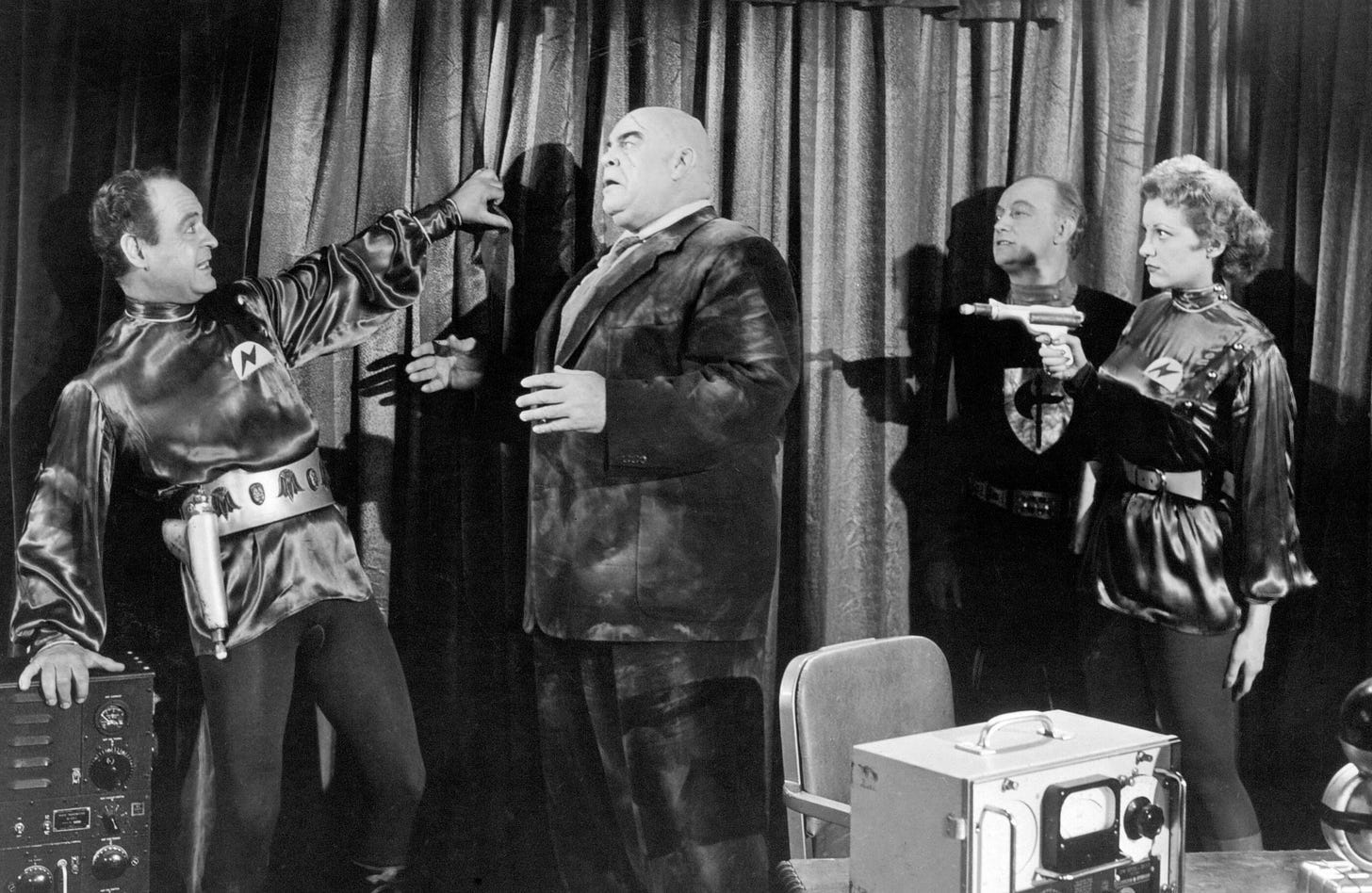
Following its coronation in the “Golden Turkey Awards,” Plan 9 was embraced by cinephiles and quickly became a staple of the midnight movie circuit. Yet the film’s revival came with a divided cultural reputation: some celebrate its ineptitude, while others simply consider it bad (with no sense of irony).
Ed Wood’s bizarro sci-fi masterpiece sits within a highly specific canon of polarizing films—movies subject to intense adoration or derision. People watch these films and hail them as misunderstood classics or ridicule them as artistic malpractice. So today, we’ll examine the most polarizing movies in cinema history, investigate the traits that make these works so unique, and explore why divisive filmmaking is on the decline.
The Most Polarizing Movies of All Time
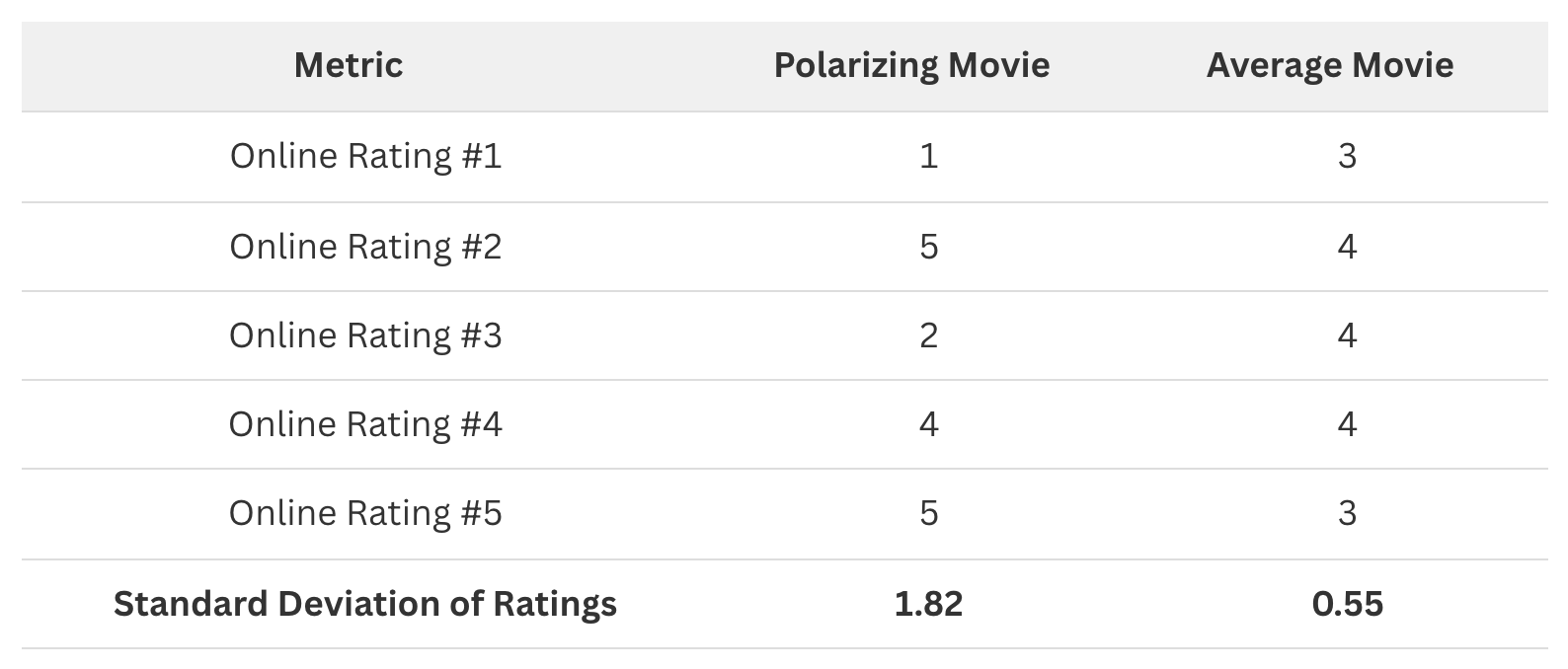
We’ll use variance amongst online movie reviews as an indicator of polarization. When reviewers disagree on a film, its ratings tend to fluctuate between low and high marks (i.e., one star and five stars). Meanwhile, the “average” film usually receives scores within a much tighter range. Our analysis will use the standard deviation of online ratings to identify divisive films, calculated as follows:
When we calculate our variance metric by film, our resulting list is headlined by Plan 9 from Outer Space, followed by works spanning a wide range of genres, budgets, and subject matter.
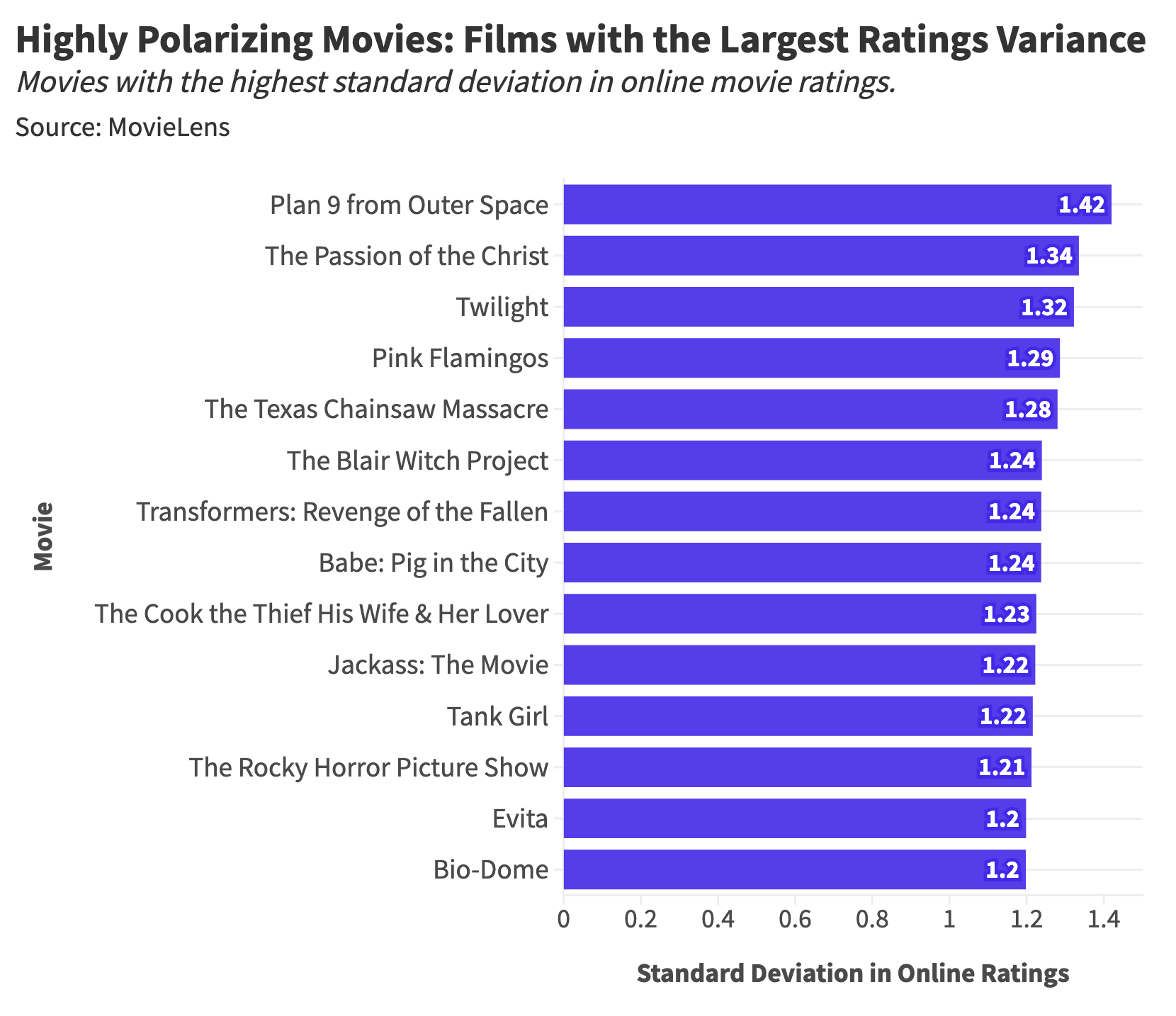
We can sort this collection of movies into a few categories:
Low-Budget Cult Classics: Rocky Horror Picture Show, Pink Flamingos, and Plan 9 from Outer Space are eclectic low-budget releases that found enthusiastic audiences among camp devotees. These movies developed dedicated followings through midnight screenings at arthouse theaters and became infamous for transgressive content. For example, the climax of Pink Flamingos features a drag queen named Divine eating literal dog poop, which some filmgoers find endearing. Part of the appeal of these films is their failure to resonate with general audiences.
Inescapable Franchise Films: Most franchise films are engineered for mass appeal—but mass appeal does not preclude mass irritation. Twilight, Transformers, and (somehow) Babe are serialized stories that provoked backlash due to their combination of mediocrity and ubiquity. Few franchises illustrate this dynamic better than Twilight. Though the series debuted to mixed critical reception, its cultural footprint in the late 2000s was inescapable, shaping fashion, spawning waves of young-adult romance novels (and a romantasy subgenre known as “Vampire-smut”), and driving tourism to Forks, Washington, a real town where the series was set. People either embraced Twilight with fervent devotion or despised its omnipresence.
The Passion of the Christ: I’ve never seen The Passion of the Christ. I was a kid when the film premiered, but I vividly remember the grown-ups around me being unusually cranky about this movie. Based on my limited research, this project reads like an alphabet soup of polarizing cultural flashpoints: graphic violence, overt religiosity, an unconventional release outside the traditional studio system, and a director, Mel Gibson, emerging from a public-relations debacle. Mercifully, this film predated social media.
Horror Movies That Went Mainstream: In horror, box office success is often loosely tethered to conventional measures of quality. Genre enthusiasts are largely indifferent to critical opinion—they’re buying tickets to experience visceral scares in a communal environment. But what happens when a horror film crosses over into the mainstream? Hits like The Blair Witch Project and Texas Chainsaw Massacre made their way into the zeitgeist, and may have proven a bit much for the average moviegoer.
These observations emerged from a small set of highly polarizing films, prompting a natural follow-up question: do the same patterns persist across thousands of other releases? The answer is largely yes. When we aggregate rating variance by genre, horror elicits the most polarized audience response.
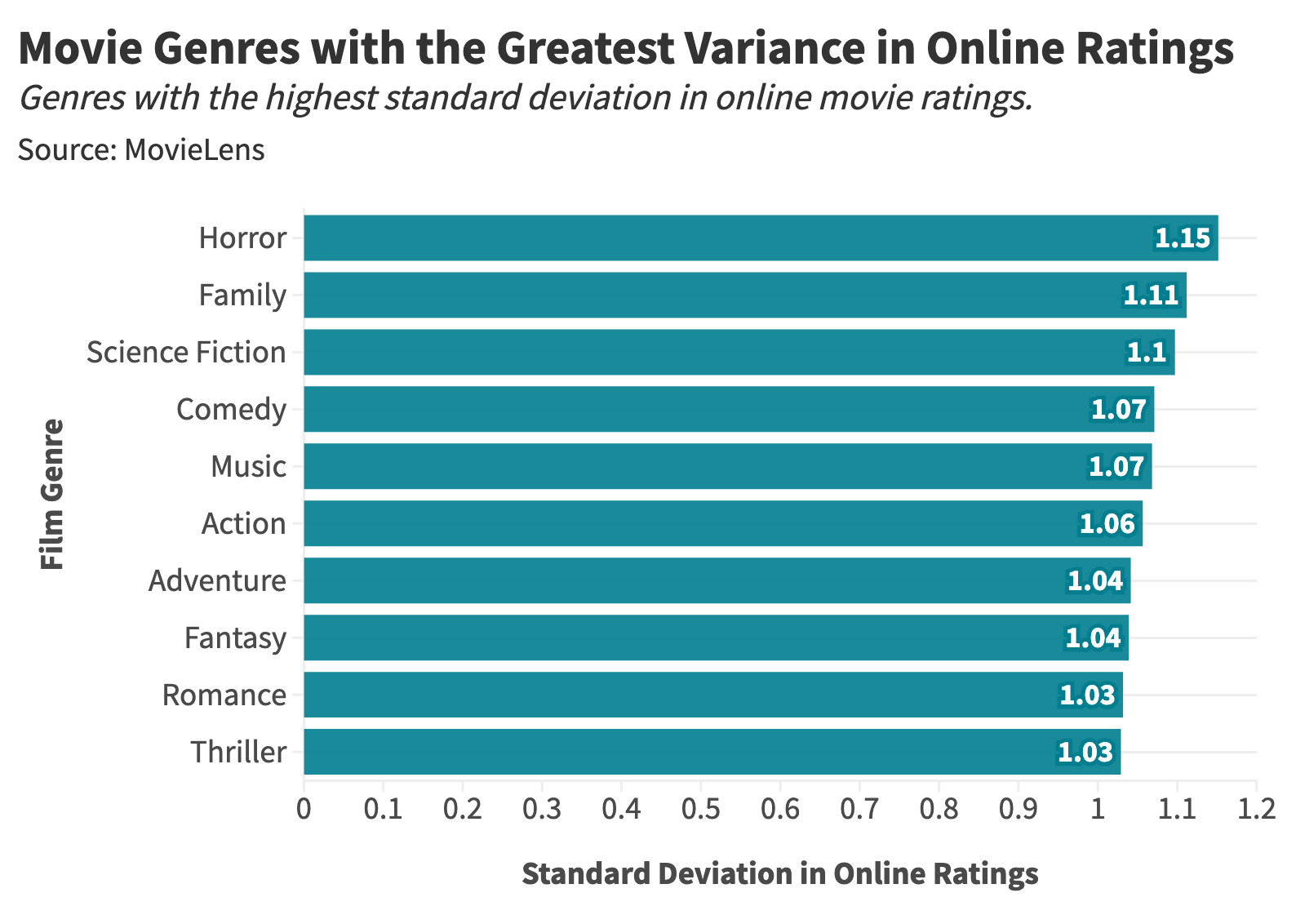
Family films are also subject to significant rating variance, as they must appeal to both parents and children. Younger audiences may love Ice Age: Continental Drift (the fourth Ice Age movie), while older audiences may be frustrated that they have to watch this film in the first place.
Genre, however, is decidedly broad. To dig deeper, we’ll analyze review polarization by user-generated movie tags—online labels that capture elements of story, cast, and filmmaking, such as “3D,” “Africa,” “Bill Murray,” “violent,” or “whimsical.”
When we aggregate rating variance by MovieLens tag, systematic patterns emerge across production economy (low budget, franchise), subject matter (Jesus, bad science), and genre (musical, horror).
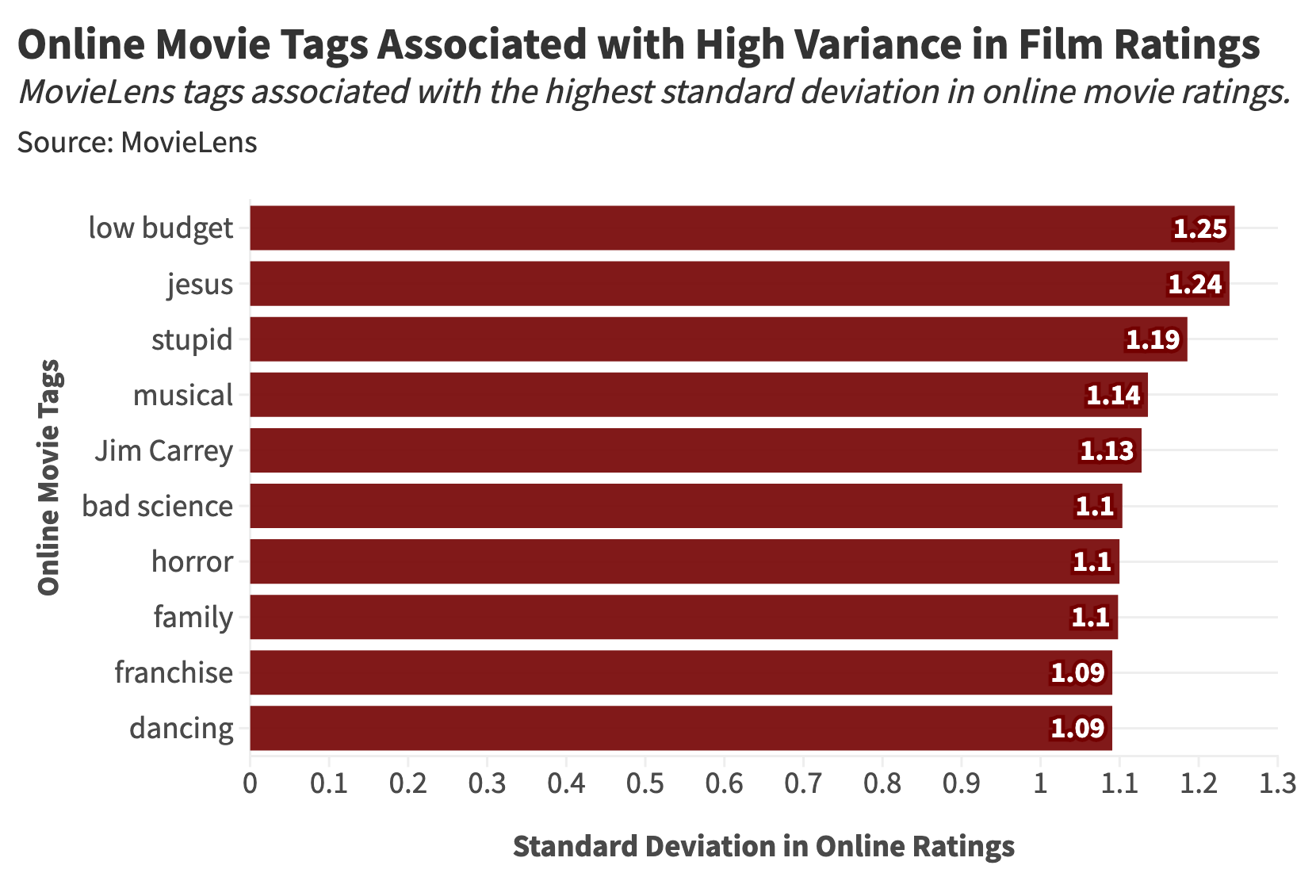
Using these tags, we can engineer the ultimate polarizing film: a low-budget horror musical franchise about Jesus that is “stupid,” full of dancing, and stars Jim Carrey.
While we’ve gone to considerable lengths to quantify these patterns, many studio executives have absorbed the same lessons through industry lore and lived experience. Hollywood has long oscillated between cycles of imitation and overcorrection—swinging from trend-chasing to heightened risk aversion. So how has this dynamic shaped divisive filmmaking over the past century?
When we calculate rating variance by release year, we observe an increase in review variability starting in the late 1970s, followed by a relative decline beginning in the early 2000s.
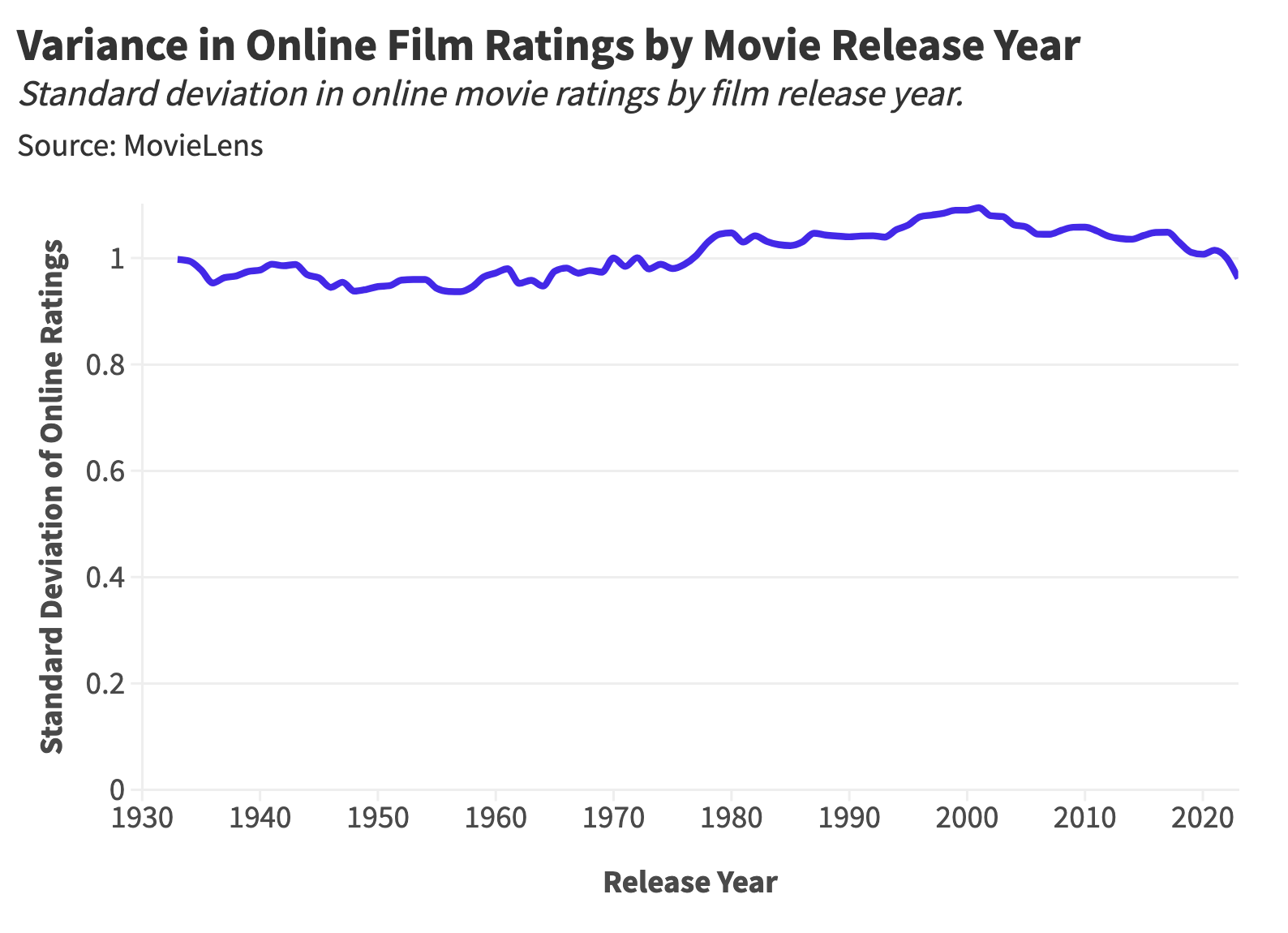
The rise and subsequent decline of review polarization reflect social and economic conditions that shaped both daily life and industry norms:
The 1970s to late 1990s: From the late 1970s through the 1990s, transgressive filmmaking proliferated in B-movie silos before slowly entering the mainstream. Horror franchises like Friday the 13th and A Nightmare on Elm Street normalized graphic violence, while erotic thrillers (Basic Instinct, Fatal Attraction) and action blockbusters (Predator, Rambo: First Blood Part II) expanded the acceptable limits of sex and brutality in Hollywood movies. In the early 1990s, the rise of independent cinema further accelerated these shifts, as filmmakers operating outside studio constraints produced celebrated hits (Pulp Fiction, Reservoir Dogs) and deliberately provocative works (Kids, Natural Born Killers). By the end of the century, boundary-pushing storytelling was no longer niche.
2000s to Today: Beginning in the early 2000s, Hollywood shifted toward franchise filmmaking, as The Lord of the Rings and Sony’s Spider-Man proved the value of serialized stories built on intellectual property. Expansive cinematic universes such as Marvel’s MCU were designed to appeal to the widest possible audience, leaving little room for risk-taking. At the same time, ascendant social media platforms like Twitter and Facebook introduced an instant feedback loop for moviemakers, where small creative choices—such as Peter Rabbit’s depiction of a character with an anaphylactic blackberry allergy—could spark overwhelming criticism. Together, these forces pushed modern films toward greater uniformity, prioritizing predictability over provocation.
Enjoying the article thus far and want more data-centric pop culture content?
Final Thoughts: Disagreement for Better Conversation
I was a film major in college, which means “discussion sections” played an outsized role in determining my grades. These sessions were essentially movie-themed book clubs where no one wanted to speak (because they were hungover or had not watched the film, often both). One course in particular, which focused on world cinema, was notorious for painfully underwhelming discussions. That is, until we watched Lars von Trier’s The Idiots.
Lars von Trier’s The Idiots follows a group of young adults who feign mental disability as a form of social experimentation and liberation. The movie courted considerable controversy for its depiction of disability and its unsimulated sex scenes (centered on characters pretending to be disabled). During the movie’s premiere at the Cannes Film Festival, critic Mark Kermode was kicked out of the screening for screaming, “It is shit!” at the screen.
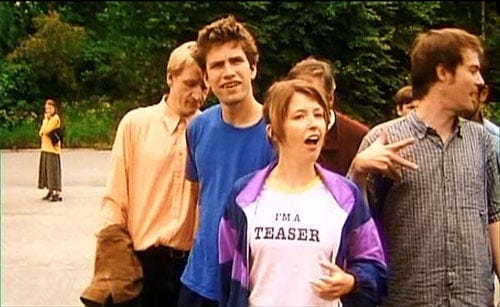
For some reason, our professor decided to make The Idiots the focus of a week’s worth of material. While I was pretty unhappy to think about this movie for a full seven days, the resulting class discussion was surprisingly lively. Students disagreed on nearly every element of the movie. Was The Idiots an incisive Marxist critique, or was it low-minded garbage masquerading as an incisive Marxist critique? Did the movie’s depictions of disability and sexuality go too far, or was excess necessary for the director to prove his point?
I remember these conversations vividly. In fact, this remains the only college discussion section I can recall years later. Turns out that disagreement—when productively channeled—can amplify a film’s impact. I did not enjoy watching The Idiots, nor would I recommend this movie to anyone, but I did genuinely enjoy discussing it with my peers.
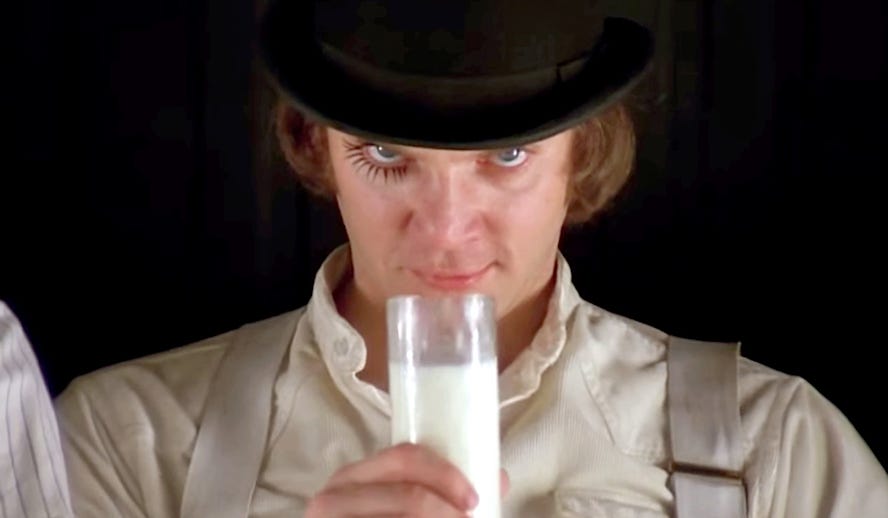
Transgressive works like A Clockwork Orange, American History X, and Oldboy aren’t intended to elicit one standard reaction. These movies endure because viewers experience an array of emotions.
Failing isn’t fun, nor is losing money or being told that your work “is shit.” Yet conversations about art are far less thrilling when everybody agrees.
Want to promote your data tool or media publication to Stat Significant’s 23,800 readers? Email daniel@statsignificant.com
Need help with a data problem? Book a free data consultation
Connect with me on LinkedIn if you want to chat about a data project.
Like movies? Follow me on Letterboxd
Clockwork Orange is a masterpiece
Great analysis. Our culture has been reduced to art that's designed to be liked rather than felt, which produces the exact kind of consensus mediocrity that nobody remembers.