

Intro: London is for ABBA-Lovers
If you love ABBA, then London is the place for you. You can begin your day by attending a production of Mamma Mia!, where you’ll listen to theatrical singers belt ABBA classics like “Dancing Queen.” Then you can take the Tube to ABBA Arena, a purpose-built stadium that seats over 3,000 people, where you can watch holograms of the band perform “Take a Chance on Me.” And if you’re hungry after a long day of ABBA consumption, you can head over to Mamma Mia! The Party, a theatrical dining experience where you’ll eat a four-course Greek meal while being serenaded with more ABBA tunes. And if your ABBA appetite has yet to be quenched, you can return home to watch Mamma Mia! the movie and its sequel, Mamma Mia! Here We Go Again, or you can play ABBA: You Can Dance, a dance-dance-revolution-style video game on Nintendo Wii.
London is essentially Las Vegas for ABBA tourism, a central hub for fanatics to celebrate their beloved pop act with near-religious devotion. If you think the deification of this ‘70s music group is overkill, well, you’re severely underestimating the band’s cultural imprint.
Somehow, a group of quirky Swedes and their catalog of happy-go-lucky pop tunes has become the basis for lucrative intellectual property that rivals the Fast and Furious franchise. So today, we’ll explore ABBA’s unique appeal and the band’s enduring commercial afterlife.
ABBA’s Unique Commercial Longevity
A key facet of ABBA’s origin story begins with tax regulation. In the 1970s, Sweden introduced taxation laws surrounding the deductibility of poorly styled work clothing. Those who could prove that their work outfits were unwearable in everyday life could claim these clothes as tax deductions. Seeking financial relief, the newly formed ABBA decided to capitalize on this incentive, and, out of frugality and tax strategy, the band’s aesthetic was born.
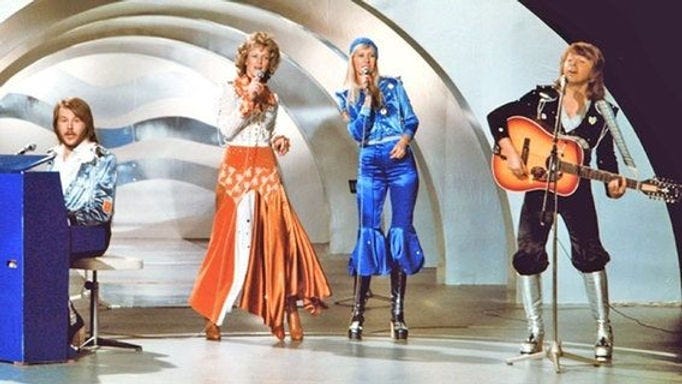
A few years later, ABBA catapulted to international fame after winning the Eurovision Song Contest, propelled by their flamboyant stage outfits and the hit track “Waterloo.”
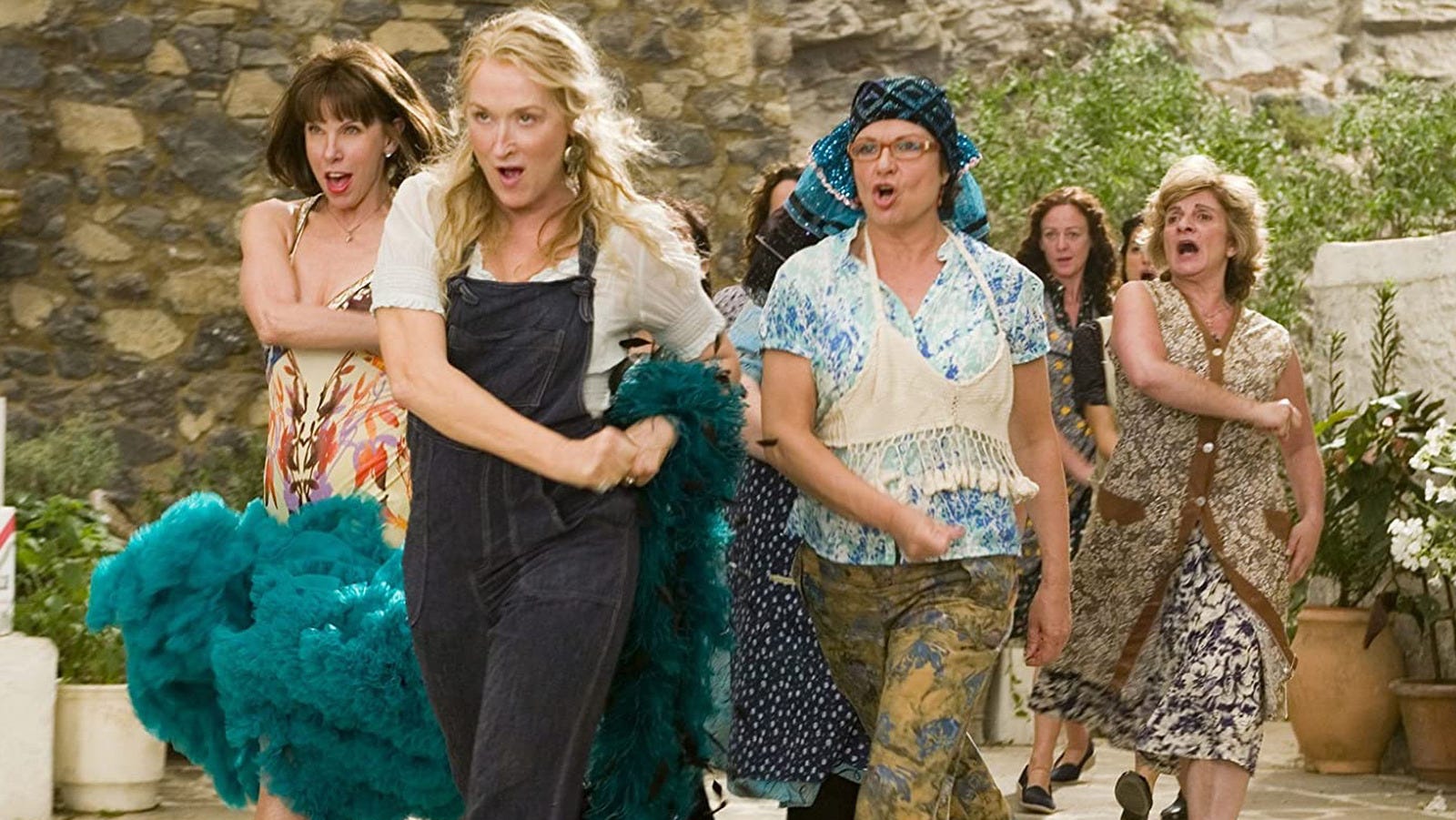
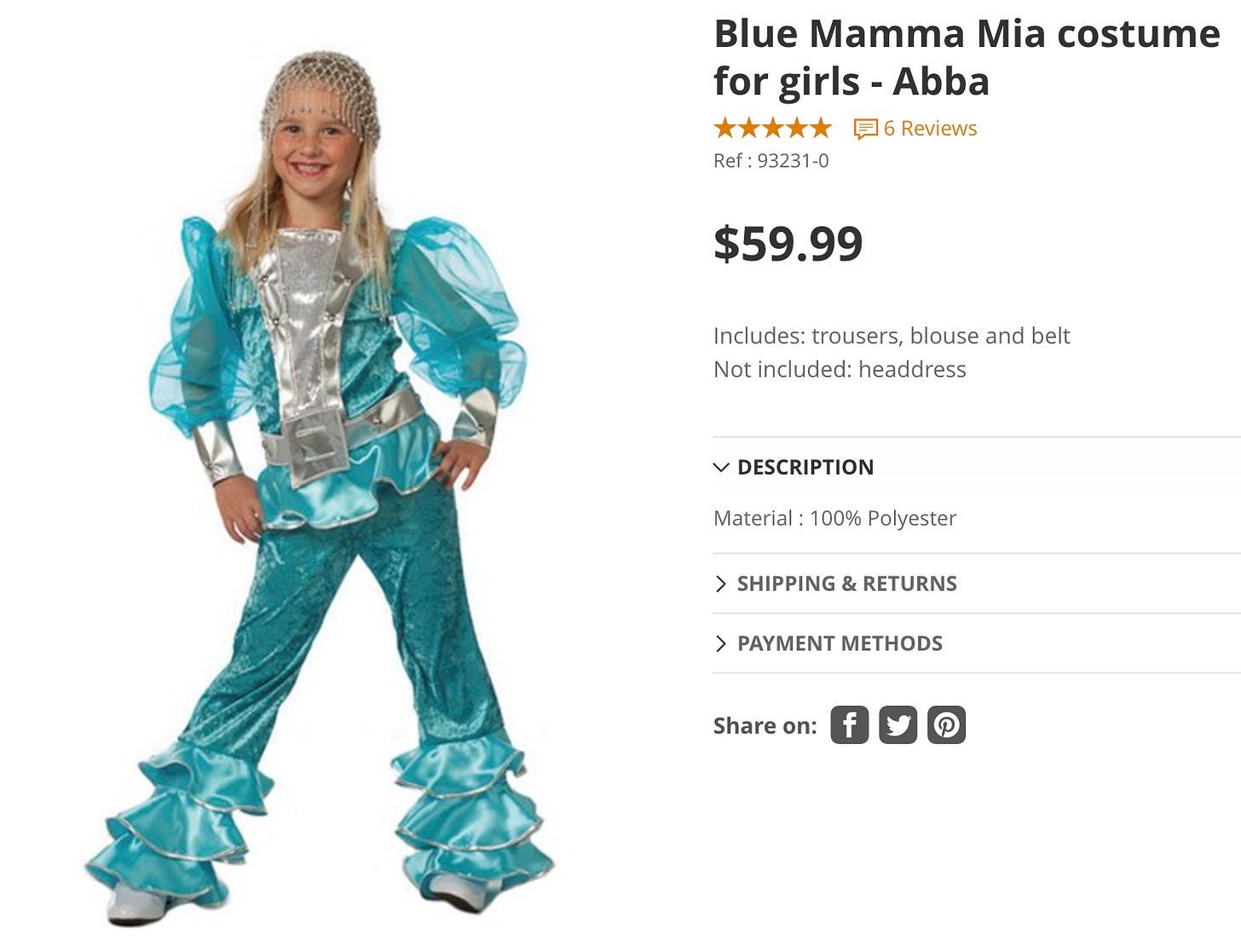
The band’s iconic look remains central to its legacy, serving as a prominent element of Mamma Mia! (both stage and screen) and inspiring children’s Halloween costumes, which can be purchased for only $60!
ABBA formally retired in 1982 after a 10-year run in which the band produced 20 Billboard hits and sold over 385 million albums. Most bands typically see a gradual decline in fandom following retirement, but not ABBA.
In the late ‘90s, Mamma Mia! took the theater world by storm, offering audiences ample ABBA music amid a breezy, largely nonsensical plot. When Mamma Mia’s New York City production ended its 14-year run, it was Broadway’s ninth-longest-running show and the first successful jukebox musical.
When estimated music sales are combined with ticket revenue from the Mamma Mia! franchise, and the hologram-driven ABBA Voyage concert experience, the ABBA Music Universe (AMU) plausibly exceeds $5.5 billion in cumulative revenue.
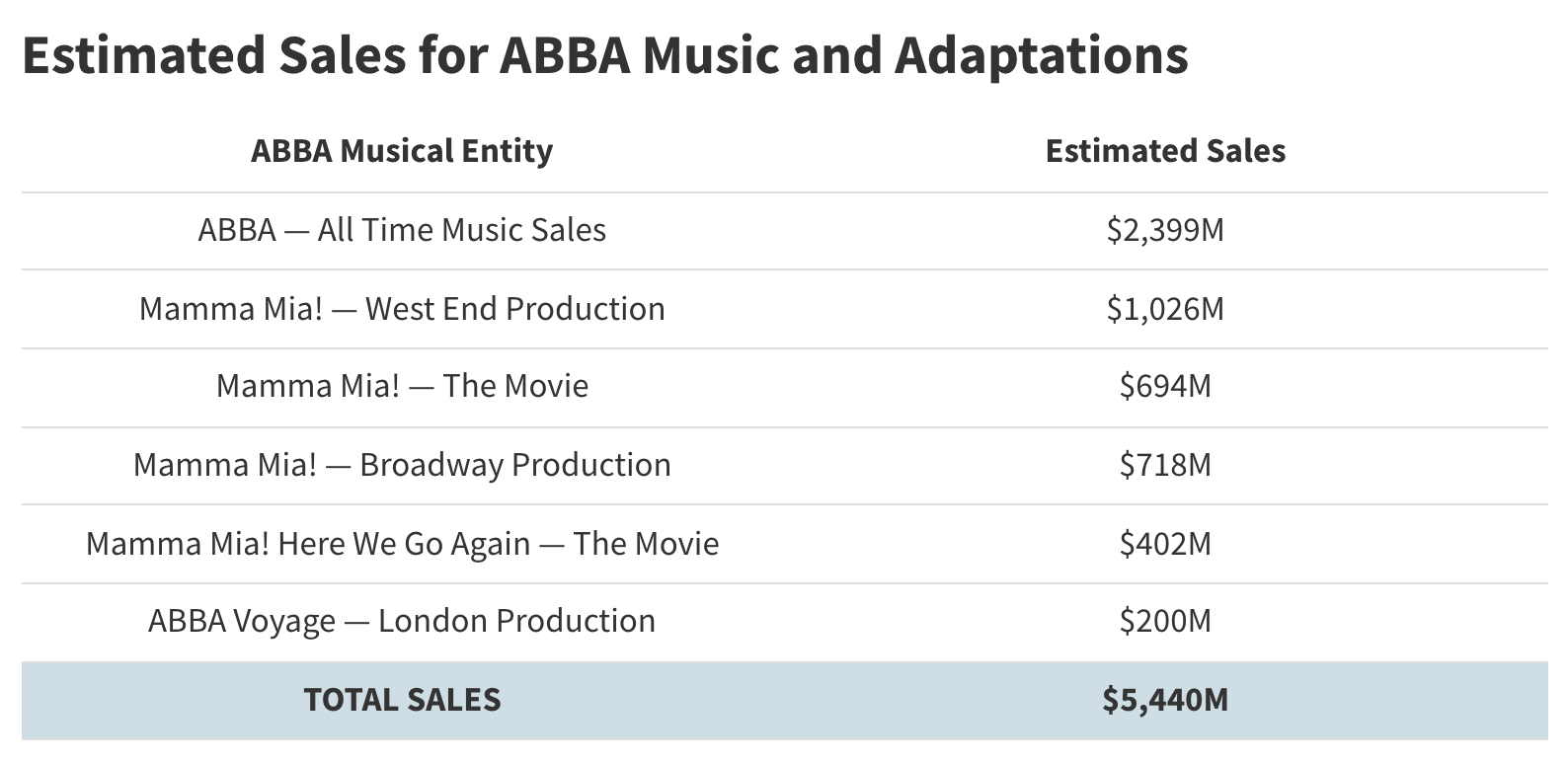
This estimation does not include ABBA’s 1970s and 1980s touring revenue, additional Mamma Mia! adaptations, dining sales at Mamma Mia! The Party, or purchases of ABBA video games. If anything, our projection is a gross underestimate.
These adaptations have propelled ABBA into a state of perpetual relevance. According to Chartmasters, ABBA ranks as the ninth-most-streamed artist among musicians who debuted before 1980, amassing more than 6.7 billion lifetime streams—a striking figure for a band that officially retired over four decades ago.
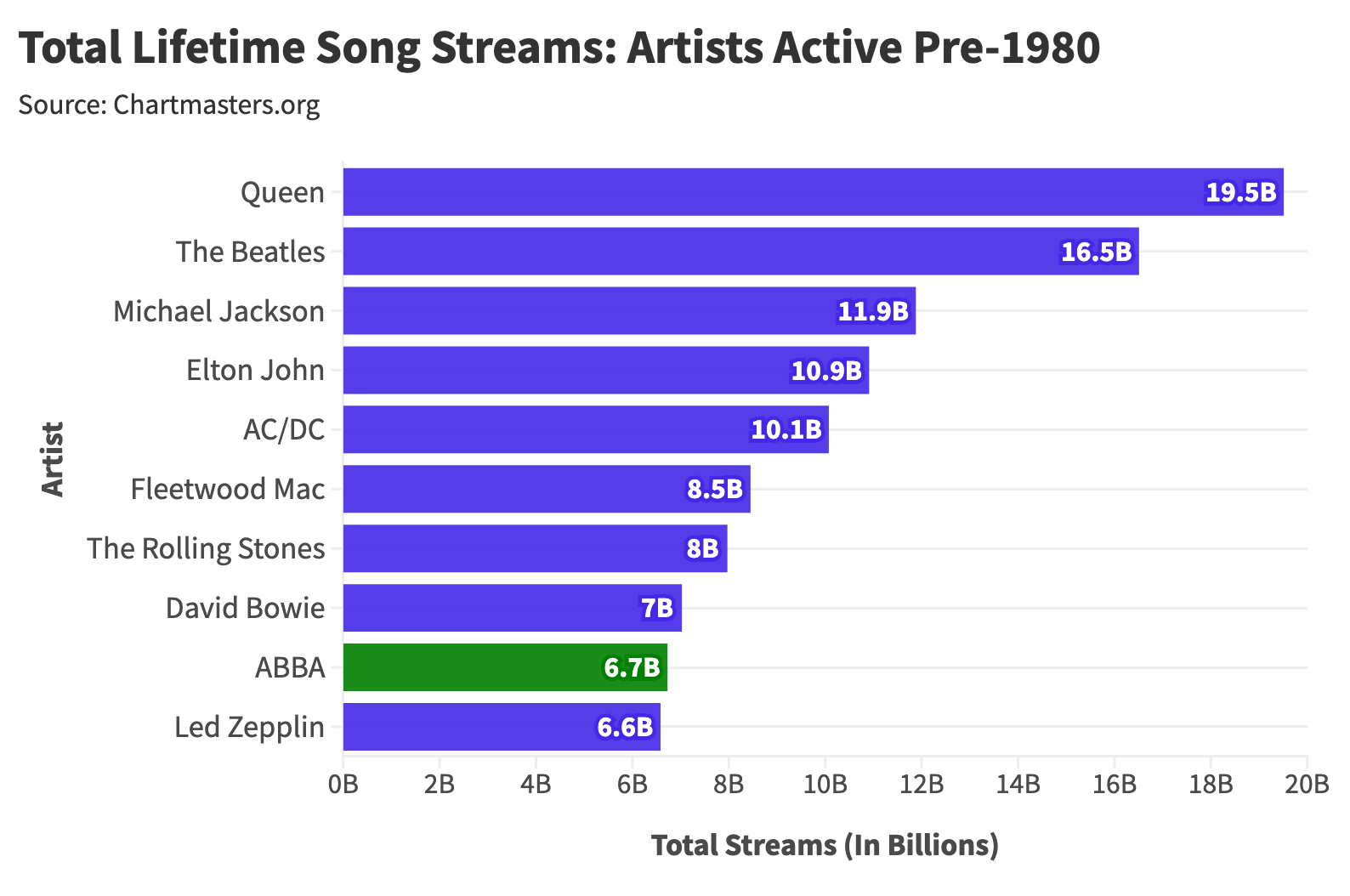
At this point, a natural question emerges: why ABBA? How did a band of unassuming Swedes, who produced music for less than a decade and disbanded 43 years ago, become the source material for a vast, self-renewing ecosystem of musical performance?
ABBA’s Unique Geographical Appeal
Twenty-one of the world’s twenty-five best-selling music acts hail from either the United States or the United Kingdom. Of the remaining four, three emerged from former British Commonwealth countries (Australia, Canada, and Ireland), while ABBA is the lone exception, hailing from Stockholm, Sweden.
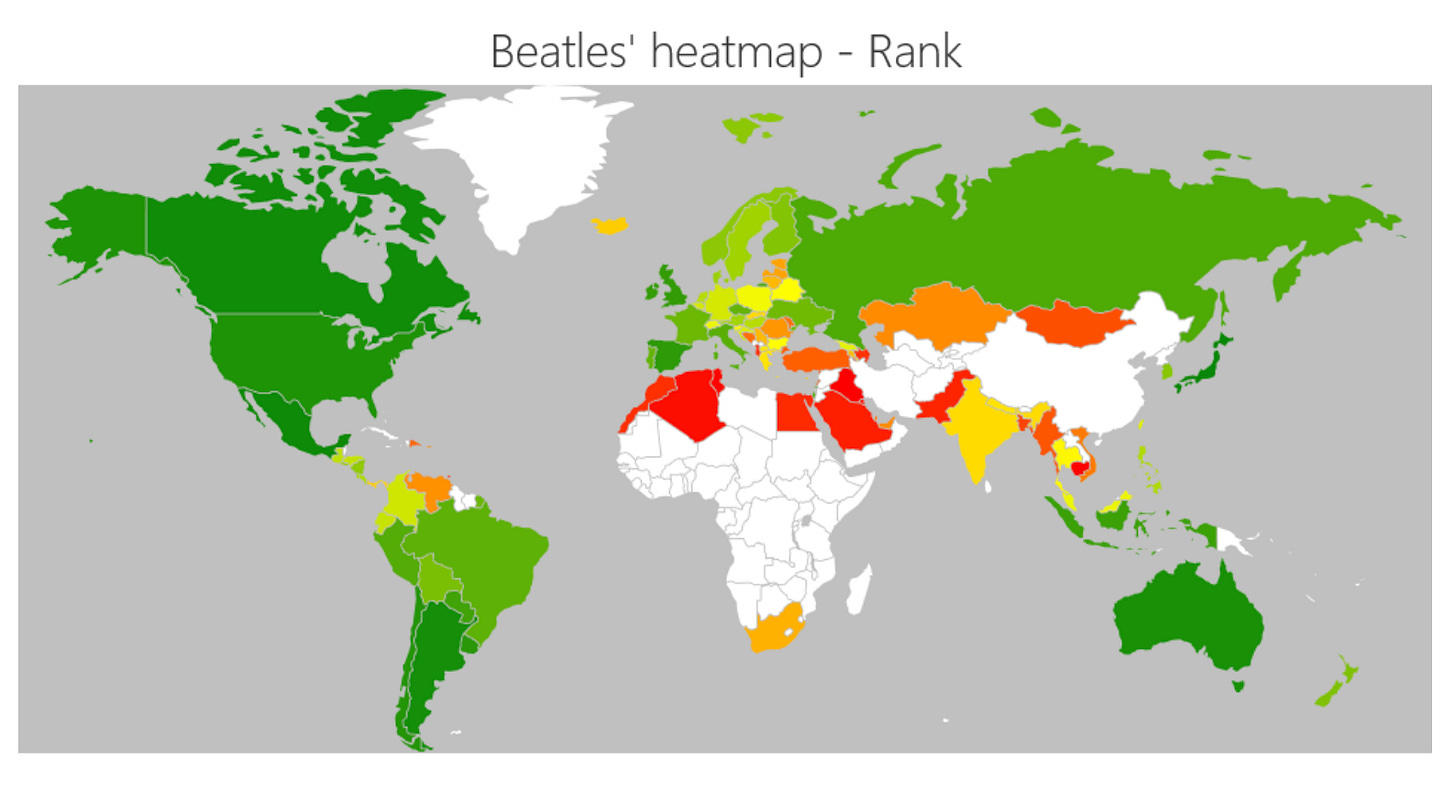
ABBA is a distinctly European phenomenon, with a core fanbase spread throughout the continent. Using YouTube streaming data, we can compare the band’s geographic footprint to that of other canonical acts. Take The Beatles as a point of comparison: their YouTube viewership is heavily weighted toward North and South America, with a meaningful but secondary presence across parts of Europe.
ABBA’s audience, by contrast, is far more Eurocentric.
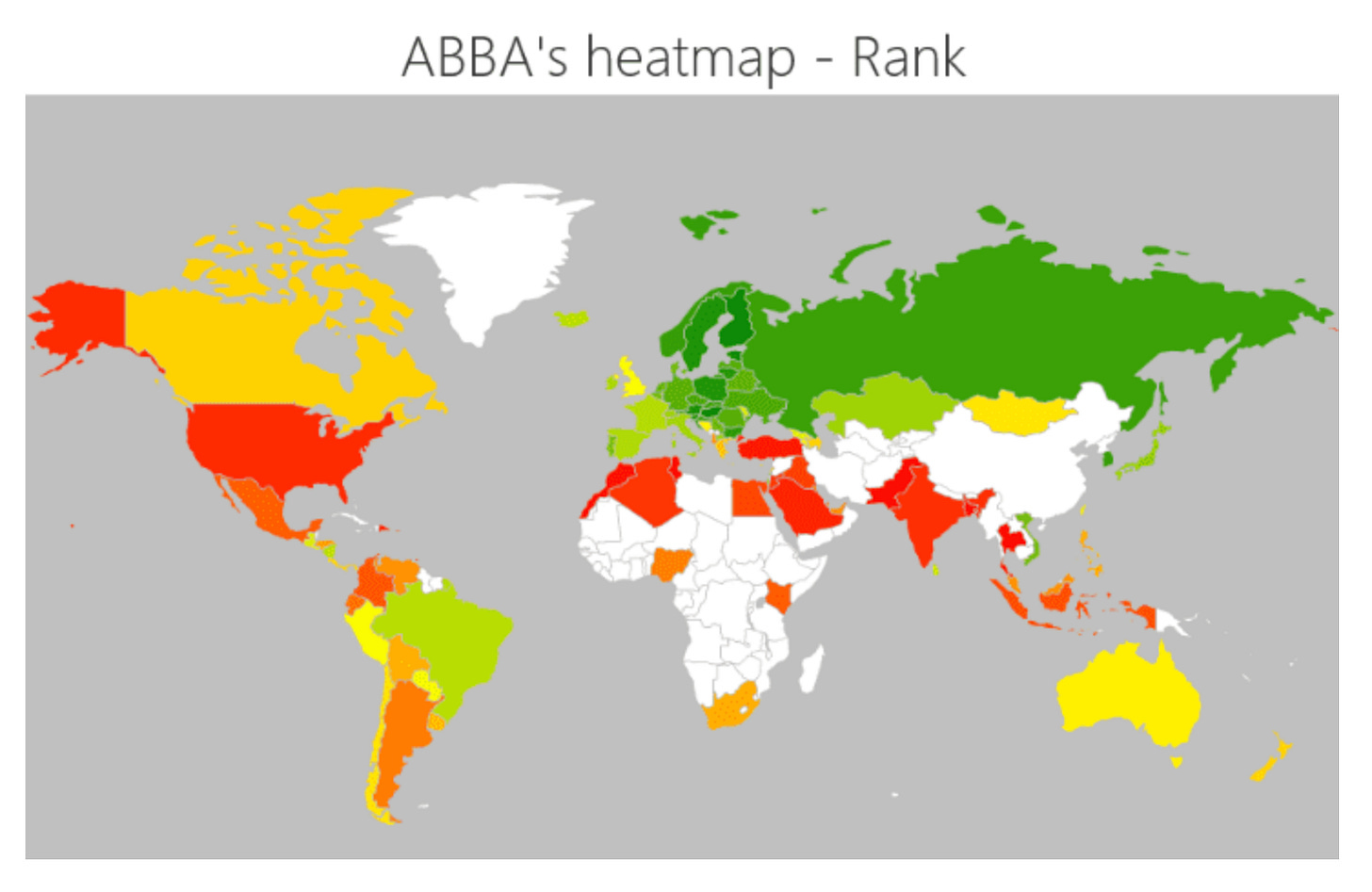
ABBA’s outsized appeal in Europe is central to the band’s commercial afterlife. Film and theater producers gravitate toward intellectual property with a built-in global fandom. In the case of Mamma Mia!, the show has been headquartered in London and New York City, two hubs of international tourism. For Hollywood and Broadway producers seeking to de-risk their investment, adapting ABBA’s music is a low-risk endeavor.
ABBA Makes People (Very) Happy
Music acts are often defined by the emotional states they evoke: Adele trades in withering despair, Eminem delivers disaffected catharsis, and Céline Dion specializes in operatic sorrow. ABBA, by contrast, occupies a different emotional register altogether: producing joyful tracks intended for dancing and delight.
This distinction is readily apparent in the data. According to Spotify’s audio-feature dataset, ABBA’s catalog scores highly on musical positivity, placing the group alongside disco-era acts like Kool & The Gang, Donna Summer, and The Spinners. These artists reliably soundtrack parties, weddings, and pretty much every other form of communal celebration. If you’ve assembled a mixed-aged group of drunk partygoers, these bands will surely make the playlist.
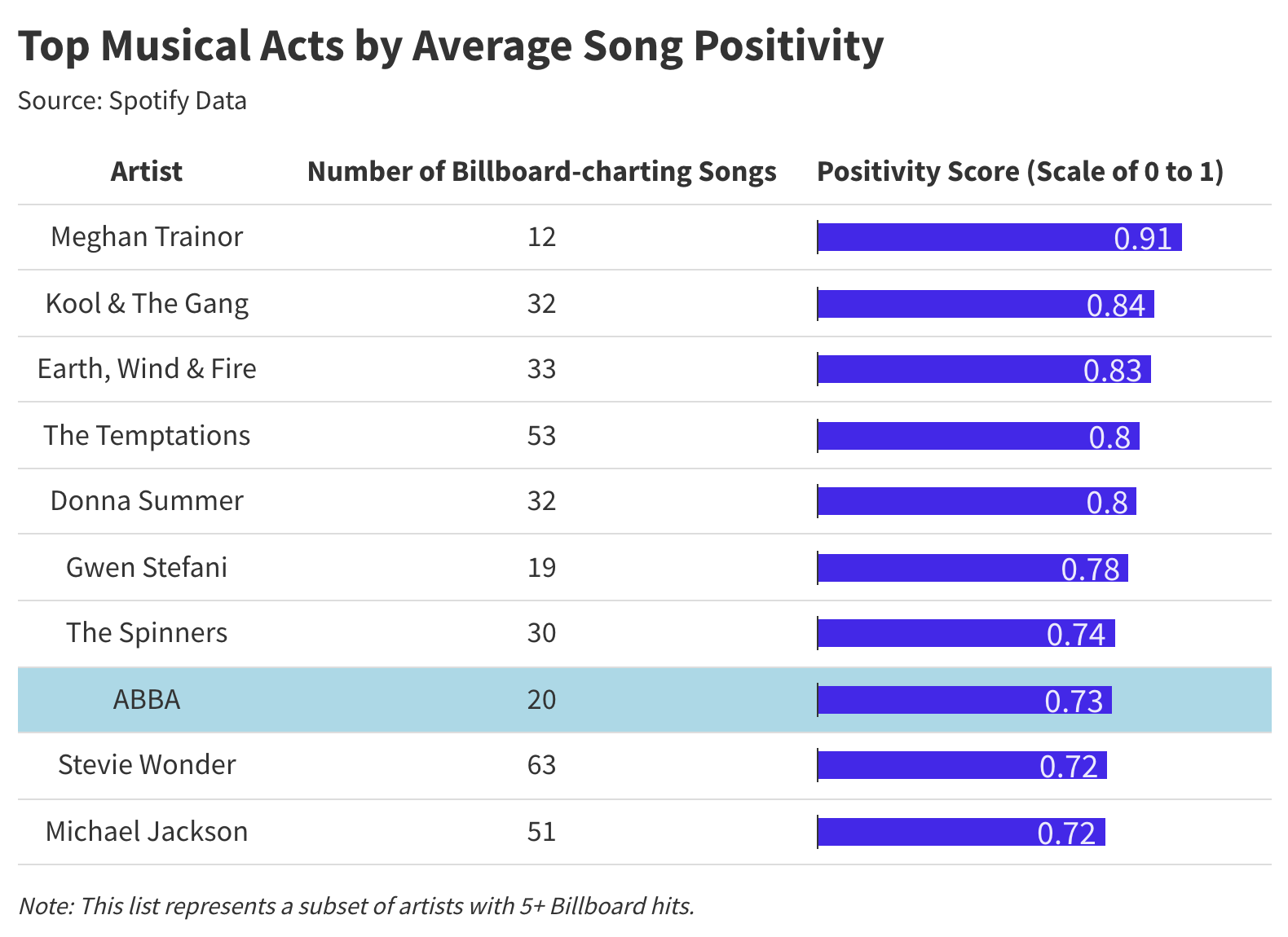
In fact, ABBA is among the most frequently featured artists on wedding playlists, appearing alongside staples like Stevie Wonder, Whitney Houston, and The Beach Boys.
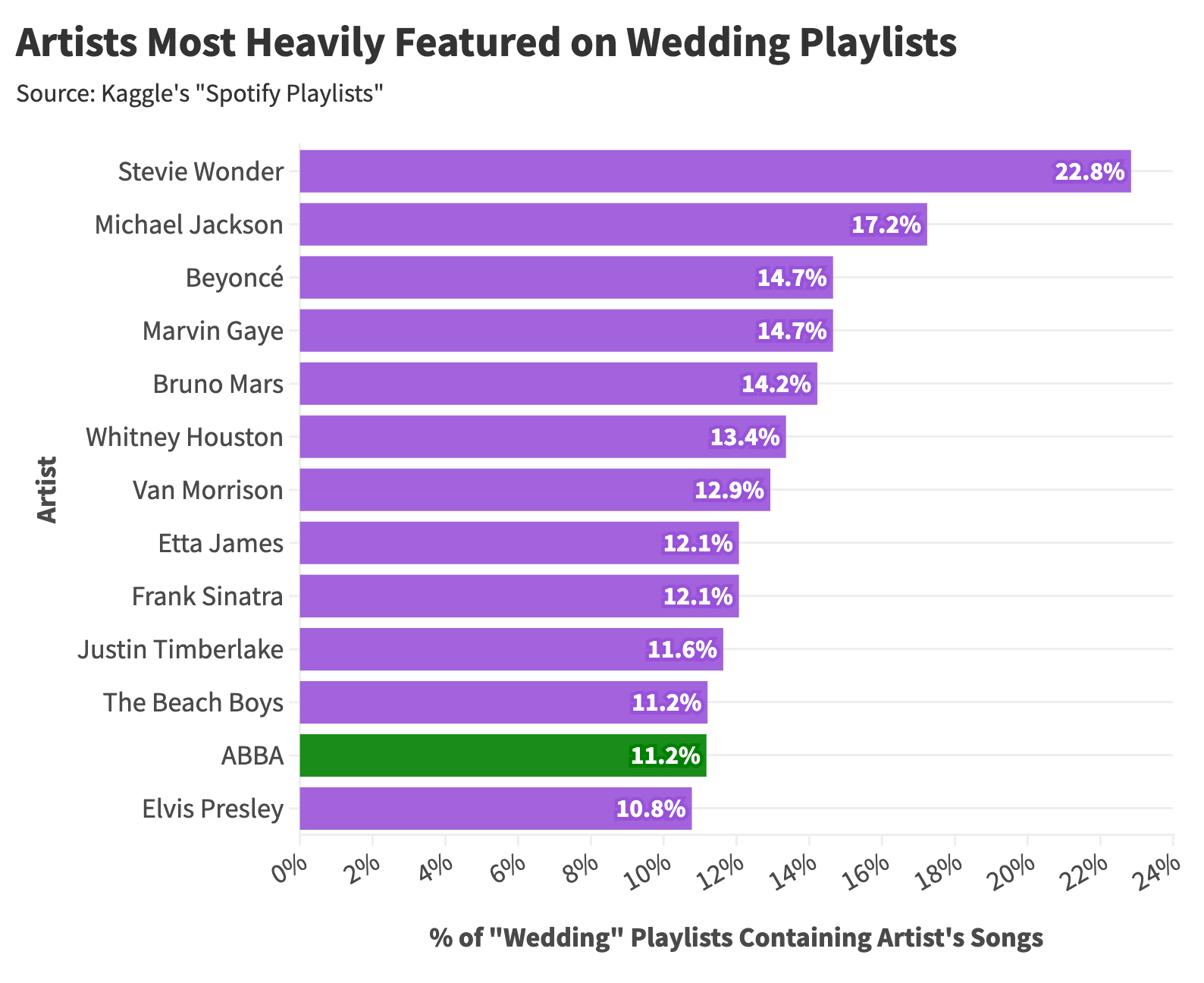
Certain songs and artists become the soundtrack to our happiest moments—Bar Mitzvahs, weddings, and impromptu dance parties alike. ABBA’s music thrives in these settings, offering simple pleasures for joyful occasions.
This past July, I visited the ABBA Museum, which—according to TripAdvisor—is the fourth-most-popular tourist attraction in Stockholm, Sweden. For frame of reference, the exhibition ranks ahead of Stockholm’s City Hall and Sweden’s Royal Palace.
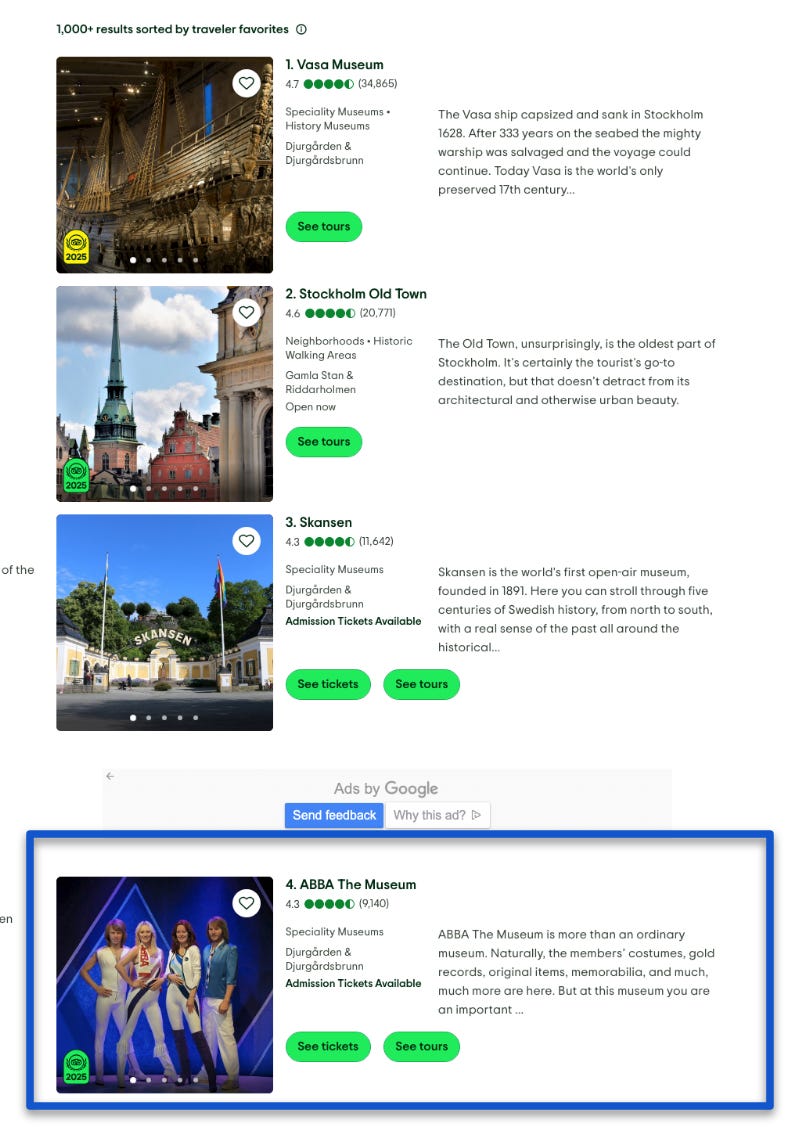
The ABBA museum is surprisingly elaborate, featuring exhibits of Smithsonian-level quality. Throughout the space, fans are repeatedly invited to sing along: you can belt “Dancing Queen” with ABBA holograms, record your own version of “Mamma Mia!” in a replica studio booth, or remix the original multitrack recordings as if you were the song’s producer.
I visited the museum partly as a bit, driven by my longstanding ABBA curiosity. What I encountered was sincere joy and a reminder that cynicism should not be my default reaction to most things. As we walked through the exhibit, I was struck by the sheer amount of giggling. Visitors were delighted to reexperience these buoyant, happy-go-lucky classics in unfamiliar ways. ABBA had once again found a way to bottle and sell its emotional affect—and judging by the plethora of giddy museumgoers, everyone seemed to be getting their money’s worth.
Enjoying the article thus far and want more data-centric pop culture content?
Final Thoughts: Nostalgia as a Service
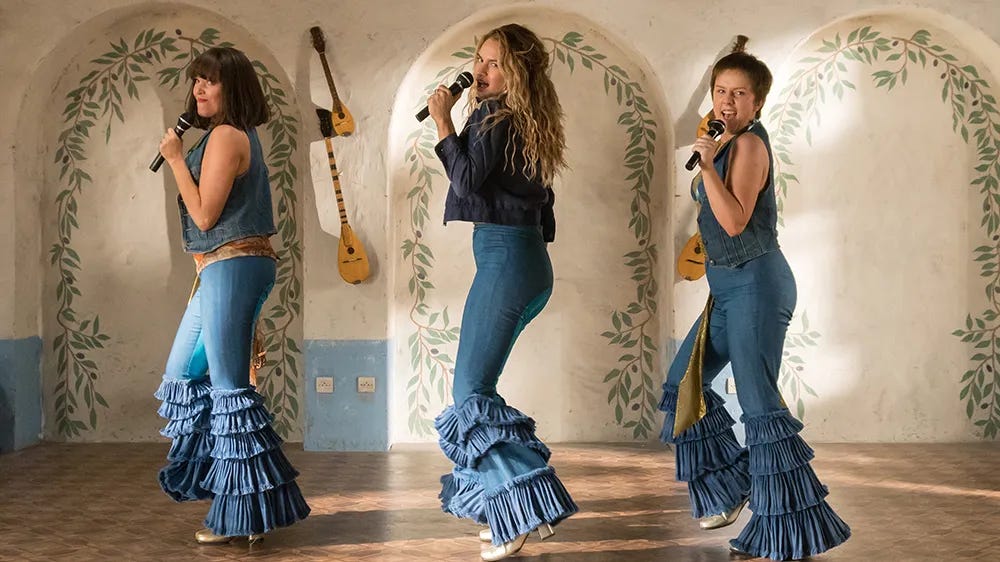
I saw a West End production of Mamma Mia! a few years back. During the curtain call, once the show’s almost-nonexistent plot had been resolved, the entire cast rushed on stage, with the leads dressed in stereotypical ABBA costumes, and the group mounted a second performance of “Mamma Mia” and “Dancing Queen.”
I found the final ten minutes of unapologetic ABBA mimicry equal parts enjoyable and ludicrous. Why did I have to sit through this loosely plotted musical if they could have just come out and performed these songs concert-style? As this thought crossed my mind, the woman beside me started to cry.
Now, I don’t know why this stranger was crying, nor will I ever know. She either:
Had other stuff going on in her life, and just happened to be crying at this show.
Was so overcome by her love of ABBA that she could not help but cry.
I prefer the thought of her crying as she wrestled with the enormity of her ABBA fandom. Perhaps she had come to hear the music of her youth, and the wistful joy of hearing these songs sent her into a state of bittersweet reflection. She paid to hear songs associated with her happiest moments, and this transaction clearly provided her with something meaningful. Or so I assume.
As I played out this invented backstory, I started thinking about the commercialization of nostalgia. If people yearn to hear their beloved ABBA hits across an ever-growing array of media formats (musicals, video games, movies, etc.), is it wrong to give the people what they want?
Cultural taste typically calcifies in our early thirties, and from then on, we like what we like. I am not a baby boomer; nostalgia is not currently a strong driver of my cultural consumption. But maybe twenty years from now, I’ll be paying to see a jukebox musical utilizing songs from The Killers, Miley Cyrus, and Bruno Mars—music I associate with my happiest formative experiences. Maybe I’ll be more than willing to fork over my hard-earned money to see Mr. Brightside: The Musical, play Bruno Mars: The Video Game, or watch a Miley Cyrus hologram. Maybe I’ll be sobbing tears of joy as a 3D rendering of Green Day sings “American Idiot,” and maybe I should just accept that this is my future.
Happiness can be hard to find. Thankfully, ABBA delivers a dependable dose of celebration—no matter the medium.
Want to promote your data tool or media publication to Stat Significant’s 24,800 readers? Email daniel@statsignificant.com
Need help with a data problem? Book a free data consultation
Connect with me on LinkedIn if you want to chat about a data project.
Like movies? Follow me on Letterboxd
I went to ABBA Voyage with my mother last Christmas, and it’s incredible to see how the band triggers so many emotions, especially happiness. She cried, but she cried saying she was happy. I was shocked by the music quality! Despite the holograms, the band and backing vocals are live. 10/10 for sure.
The never ending relevance and success of ABBA has always seemed logic-defying to me, interesting stuff. I was wondering about the graph showing the total streams of pre-'80s artists: would be interesting to see the stream-spread among different songs - how many of them have over 100 million for example, or do some artists rely on a very small cluster of tracks to carry their overall numbers.