


Intro: A Fleeting Meme Turned Petition
On November 4, 2021, Cynthia Erivo and Ariana Grande were announced as the leads in Universal’s big-screen adaptation of Wicked. On November 21, 2021—just 17 days after this announcement—one highly specific concern crystallized amongst diehard fans: keep actor-turned-late-night-talk-show-host James Corden away from Wicked. If this sounds like a fleeting meme, it was not.
Escalating online chatter eventually gave rise to a Change.org petition titled Keep James Corden Out of Wicked the Movie. What read as snark was taken quite seriously, as the petition amassed more than 109,000 signatures. I have no idea whether Corden was actually considered for a role in Wicked, and we’ll probably never know.
While I, too, have strong opinions about certain actors, I’m struck by the paradox of being a widely known—and widely disliked—movie star. Actors aspire to headline films and achieve cultural relevance. Yet that same recognizability can mutate into parasocial hostility. If James Corden’s lifelong dream was simply to achieve name recognition, he succeeded. If his goal was to be both widely known and widely liked, the results are more mixed.
The strangeness of the Corden-Wicked debacle got me thinking about the improbability of notoriety and longevity: how hard is it to reach the highest levels of acting success, let alone maintain consistent quality and public goodwill once you get there? Said differently, how difficult is it to achieve—and sustain—movie stardom?
So today, we’ll explore film stardom as a statistical anomaly, unpack the challenge of balancing celebrity and quality, and assess the precarious nature of a career in the performing arts.
How Improbable is Movie Stardom?
Among actors who secure a credited role in a feature film, what share will ever go on to headline a movie (at any point in their career)? To quantify this, we’ll analyze filmography data from Letterboxd and define a “starring role” as a performer listed first or second on a film’s call sheet.
Across all budgets and box-office outcomes, just 13 percent of credited actors will ever star in a film—whether that’s a student short, The Room, a Hallmark movie, or a Marvel franchise.
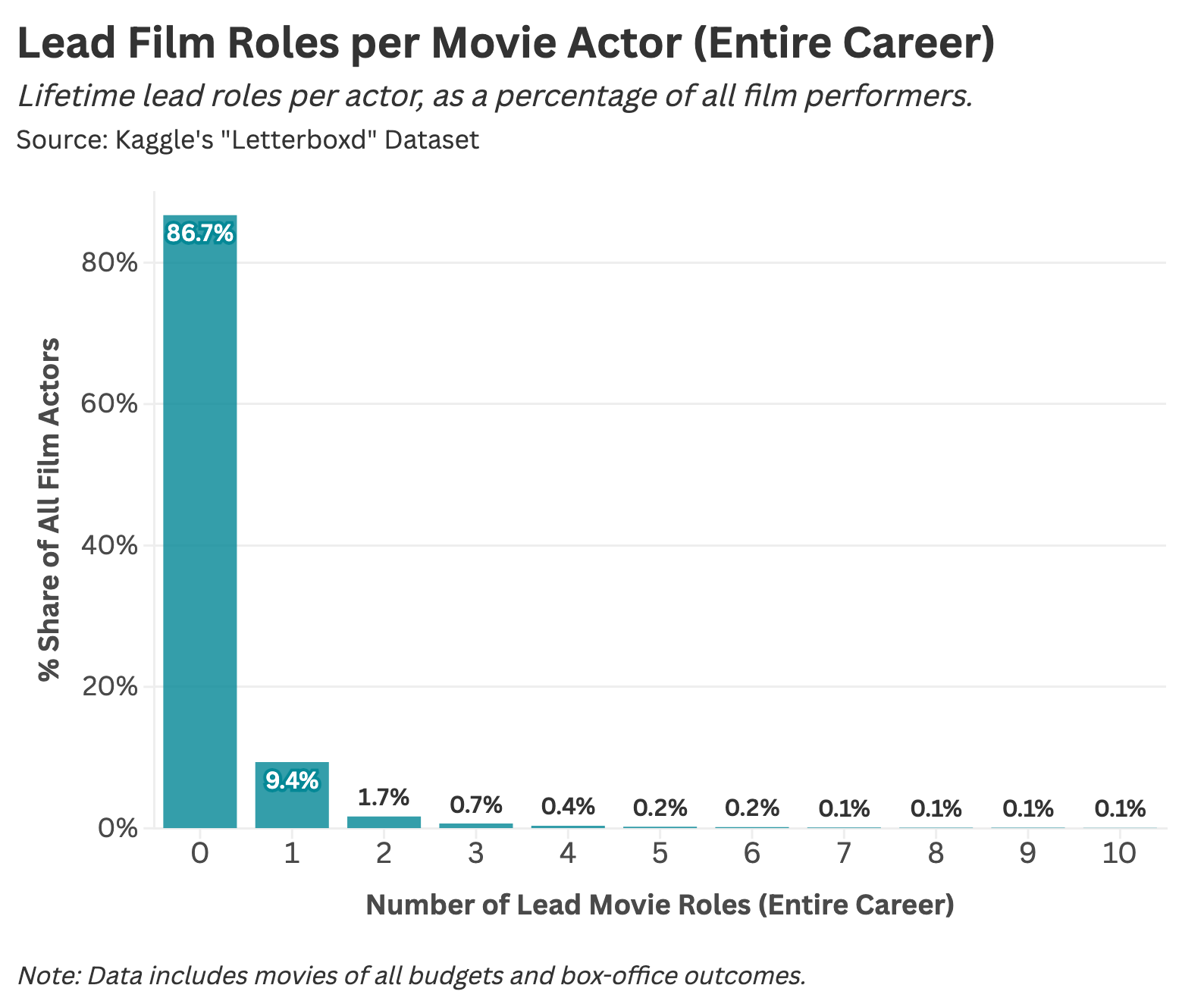
Leading a single film is relatively common among credited screen actors; leading multiple films is not. Among performers who have ever headlined a movie, more than 75% will never do so again.
Unfortunately, this framing is overly generous. Our initial statistics have excluded a large pool of working actors who will never be cast in a feature film. Put simply: What initially read as a bummer is actually a much bigger bummer! To account for this, we must broaden our dataset to include actors with a single Law & Order credit or Ozempic commercial appearance.
We’ll benchmark stardom among the working actor population by calculating the share of Screen Actors Guild (SAG-AFTRA) members who receive a starring credit in a given year. By this measure, roughly 2% of card-carrying performers headline a film in any given year.
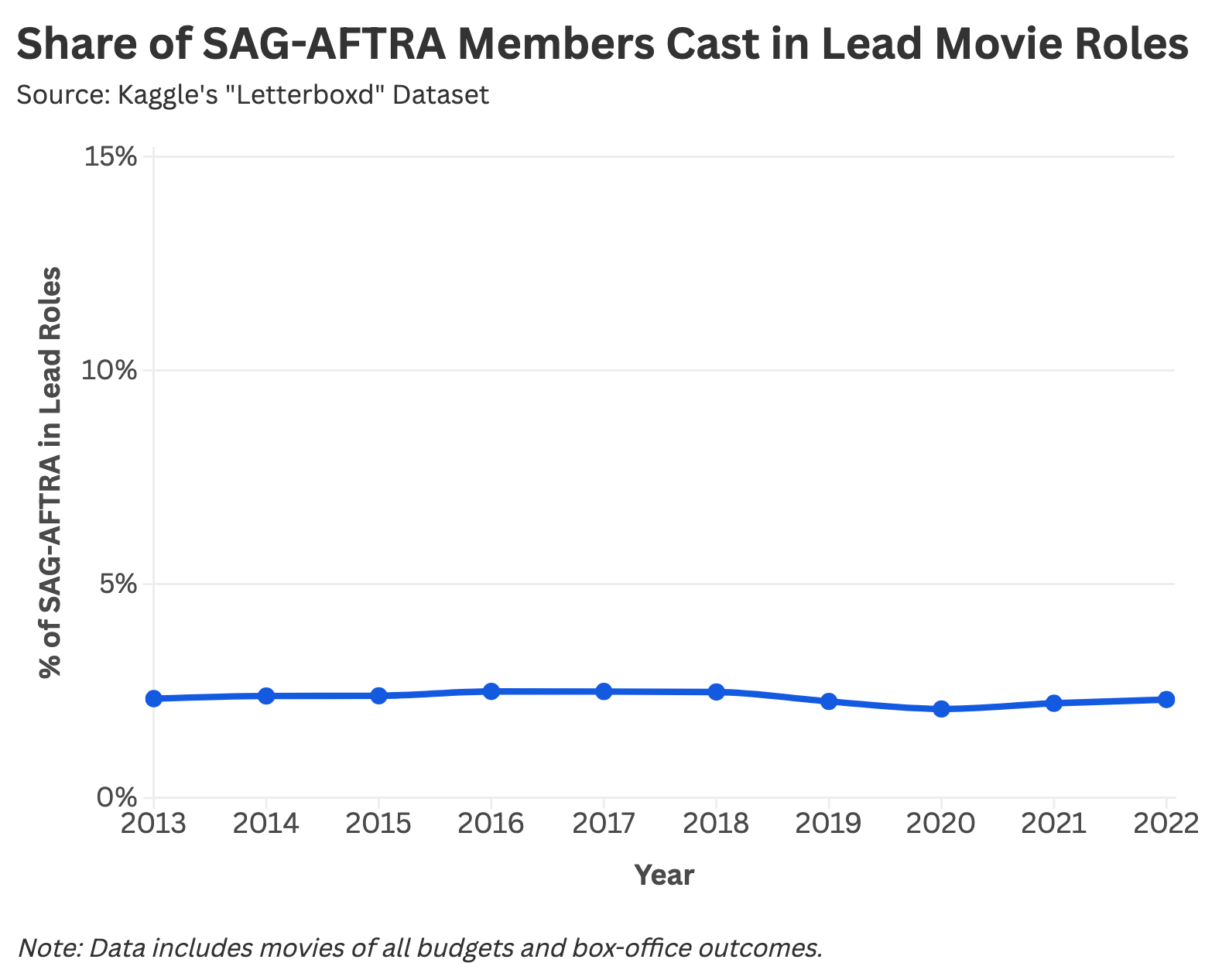
The obvious caveat is that hundreds of thousands of performers never qualify for SAG-AFTRA membership, which means we’re still undercounting. Industry estimates suggest that roughly 5 to 10% of working actors achieve union status each year. In practical terms, this implies that the share of all working actors—union and non-union—that star in a film (of any budget) likely falls between 0.02% and 0.2%: a wide, but nonetheless dispiriting, range. I concede this analysis is a Russian nesting doll of bad news.
But wait—there’s more. Securing a single starring role does not guarantee a lifetime of movie stardom. There is no assurance that your film will be widely seen, commercially successful, or critically well-regarded. Let’s say you’re fortunate enough to star in 5, 10, or 20 movies—how many of those projects will be any good?
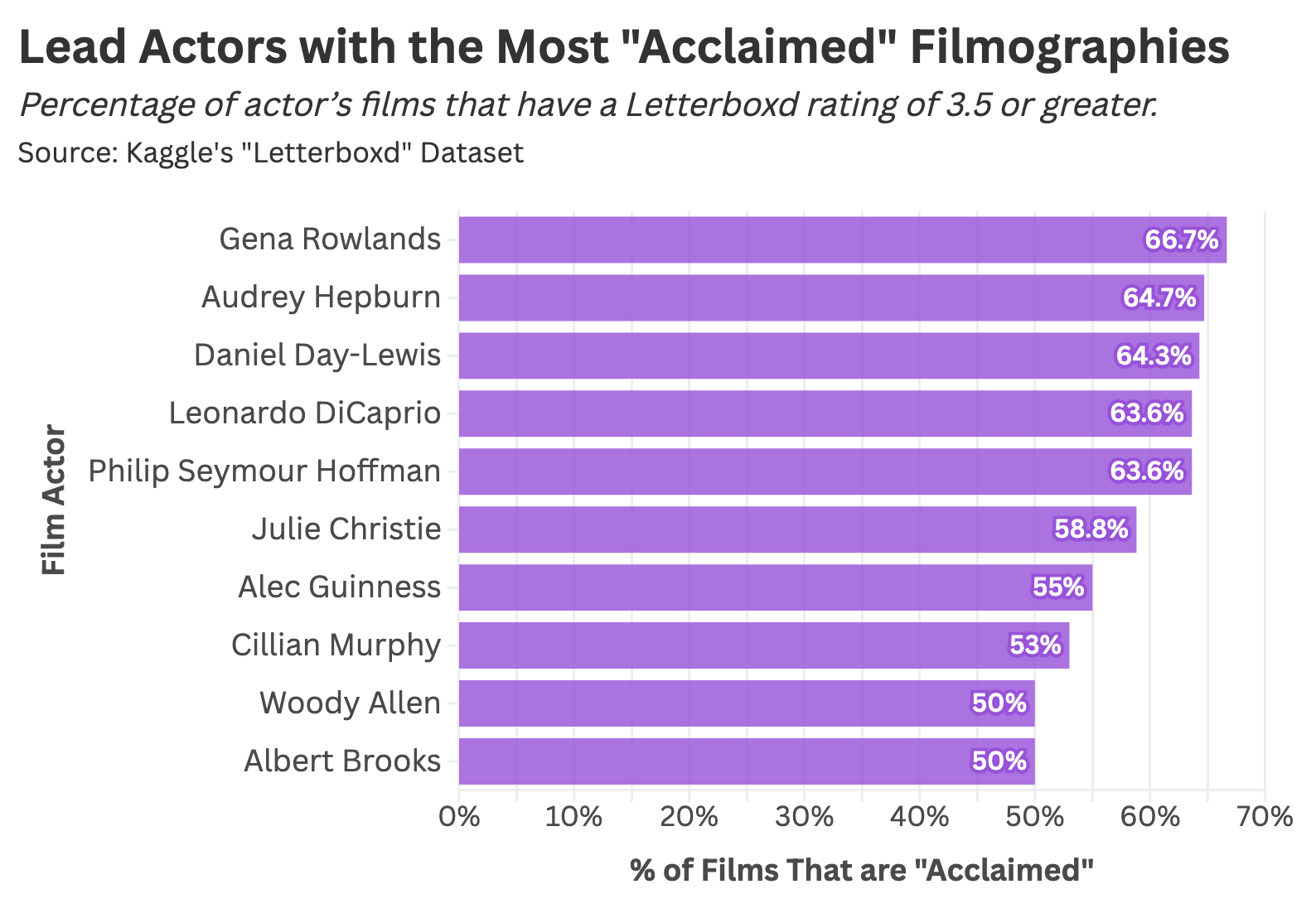
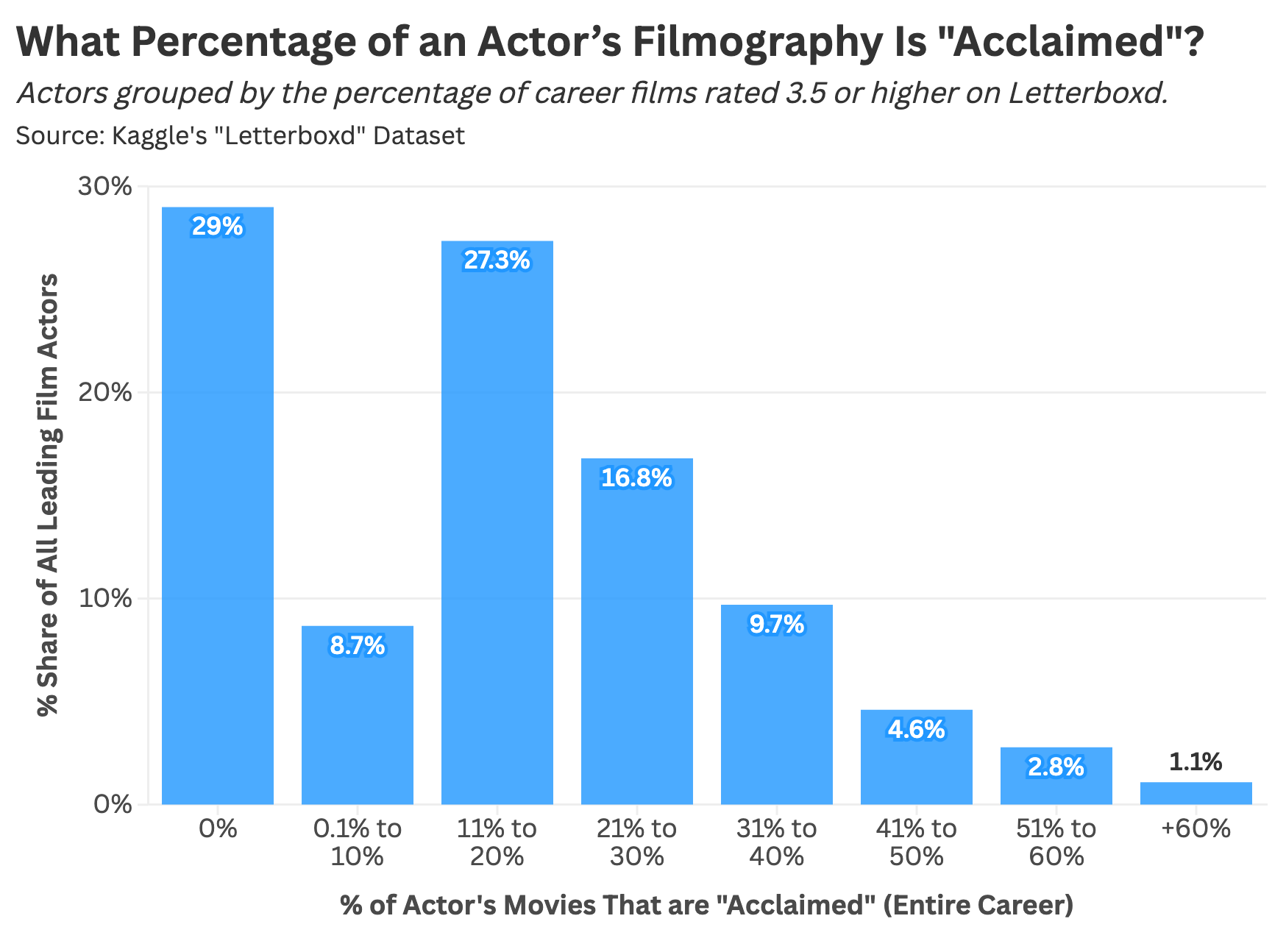
As you might expect, the numbers are not encouraging. To assess quality, we’ll calculate a performer’s career-long “hit rate,” defined as the share of their filmography with a Letterboxd score of 3.5 or higher (out of 5 stars). For example, an actor with five “acclaimed” films across ten leading roles would have a 50% hit rate.
Amongst cinema’s most elite performers—legendary stars like Leonardo DiCaprio, Daniel Day-Lewis, and Philip Seymour Hoffman—career “hit rates” tend to top out in the mid-60 percent range. Yikes.
When we examine the full distribution of career hit rates, we find nearly 30 percent of lead actors will never appear in a well-regarded film, while most stars see fewer than 20 percent of their movies earn critical acclaim.
But wait—there’s even more 🙉. If you’re feeling crummy right now, remember: you decided to read an essay on the near-impossibility of movie stardom. I will not apologize for the ever-increasing improbability of a career path that is famously a crapshoot. You were warned: it’s literally in the title!!
Okay, now on to my next dispiriting statistic: So far, our analysis has examined starring roles agnostic of budget and commercial success. What happens when we focus on performers pursuing the most traditional form of movie stardom: headlining big-budget Hollywood films intended for wide theatrical release.
To do this, we’ll impose a stricter definition of movie stardom. An actor or actress will qualify as a “star” if they have held a leading role in at least three films within a five-year window, where each film carries an inflation-adjusted production budget of $20 million or more.
When we chart a rolling count of movie stars over time, we see a distinct peak in stardom in the mid-2000s, with over 150 actors qualifying as “stars” during this period. From that point forward, the number of marquee film actors steadily declines. This downward trend persists even after adjusting for the pandemic-era slowdown in film production.
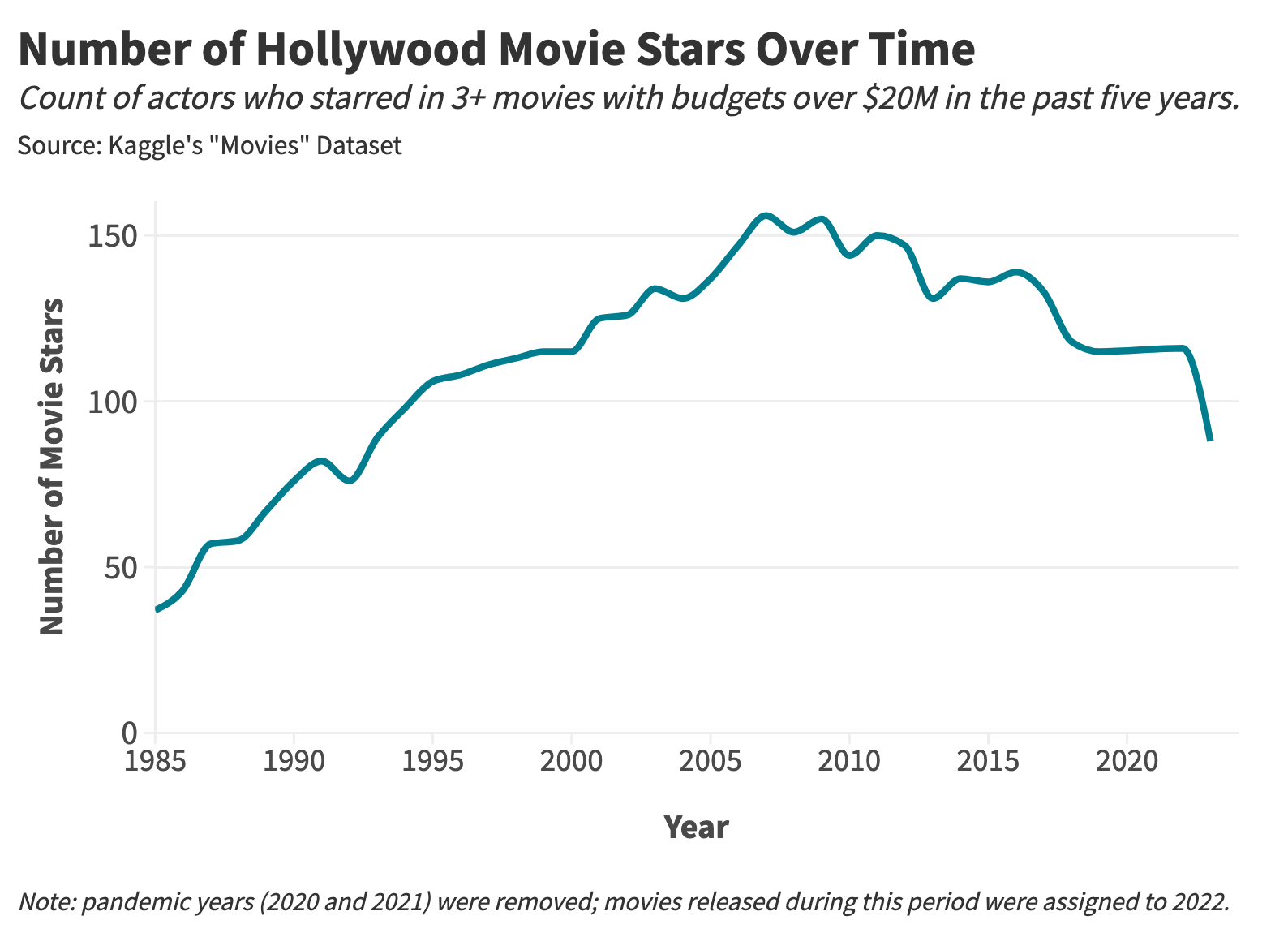
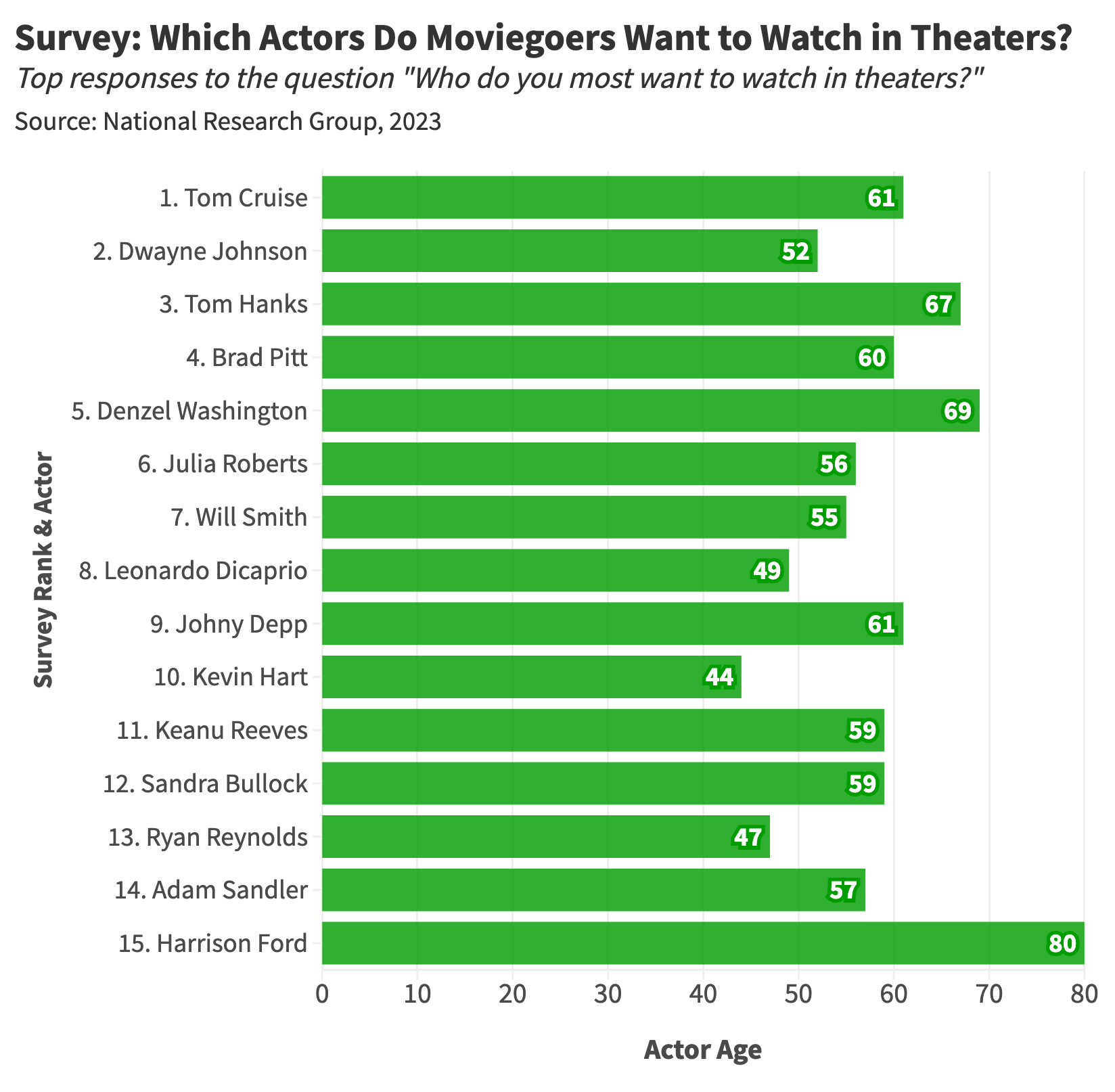
This data piqued my curiosity about the current state of film celebrity in Hollywood. Which actors sell movie tickets in an industry incapable of mythologizing new figures? The answer is: the old ones.
In late 2023, a survey conducted by the National Research Group asked consumers, “Which actor do you most want to see in theaters?” The results were remarkable: not a single actor in the top 15 was under 44. Unsurprisingly, these findings threw the entertainment industry into a (minor) existential crisis.
One day, Tom Cruise will cease to exist (or at least that’s my current belief). In that distant future, who, or what, will be headlining movies? Will we still need organic, Non-GMO human actors? Or will the movie stars of yesteryear have been replaced by AI performers and CGI monkeys—who, if nothing else, are technically not James Corden.
Enjoying the article thus far and want more data-centric pop culture content?
Final Thoughts: Never Tell Me the Odds
For two summers, I interned in the entertainment industry, the last of which was at Conan O’Brien’s talk show. I disliked nearly every aspect of these internships, and my conversations with full-time employees suggested that things would not improve after graduation. And yet, I did not care. All of this was in service of some greater goal.
When an executive assistant would tell me to change careers because they did not recommend the lifestyle or likelihood of success, I would immediately discount that advice and think, “Never tell me the odds.” This was a daily occurrence.
Sure, for the next 10 years I would be fielding phone calls, getting staplers thrown at my head, and mastering highly specific coffee orders, but it would be in service of *my dream*. And then I met someone who was actually successful in the film industry, and my entire opinion shifted.
During my sophomore year of college, I gave a campus tour to a family whose patriarch was a Hollywood screenwriter. We stayed in touch, and he became a mentor over the next few years of my short-lived entertainment career.
During my final summer in LA, I met him for coffee, and it just so happened that a few months prior, he had been nominated for an Oscar. To me, this was the ultimate achievement—the thing that would make coffee runs and stapler dodgeball worthwhile.
Being an excitable twenty-something, I asked roughly 50 variations of the same two questions: “What’s it like to be nominated for an Oscar?“ and “What’s next???” To which he downplayed the achievement and talked about the fact that he had yet to figure out his next project. I assumed that if you made it to the top of Maslow‘s hierarchy, you would pretty much stay there for the rest of your life. You would no longer need to walk because you’d simply levitate. But here was someone at the pinnacle of his field who seemed—for lack of better phrasing—kind of bummed.
A few days later, I decided to give up on my entertainment career. If I didn’t like where I was, didn’t like what the next ten years entailed, and somehow the end goal didn’t justify the heartache, then what was the point?
Intellectually speaking, I have no regrets about this decision. I’ve enjoyed my new career and have returned to entertainment on my own terms. And yet my lizard brain remains unconvinced that I made the right call. This “lizard brain” is the part of me that committed to a career in film at age eleven—the naïve, idealistic version of myself that still thinks: “Never tell me the odds!”
At the risk of being reductive, most people in the entertainment industry probably live with some version of this internal tug-of-war: between the hyper-rational self—the one that pays taxes—and an irrational dreamer that loves “da’ movies” or “da’ acclaimed limited series on HBO.”
In my case, a specific mix of experiences pushed me to confront the odds, assess my near-term future, and walk away. Others, with different temperaments and distinct experiences, make a different choice.
It’s a strange, random crapshoot, but I’m glad there are people willing to give it a shot. They will look at this data—see how hard it is to star in a movie, how difficult it is to repeat that feat, and the near impossibility of starring in more great films than bad ones—and think, “Never tell me the odds!!” Or they might just scan the list of all-time actors, see names like Daniel Day-Lewis and Philip Seymour Hoffman, and think, “Wow, it’d be cool to be like them.” And, honestly, the world is a lot better off for these people.
Enjoyed the article? Support Stat Significant with a tip!
If you like this essay, you can support Stat Significant through a tip-jar contribution. All posts remain free; this is simply a way to help sustain the publication. You can contribute with:
A Recurring Donation:
Want to promote your data tool or media publication to Stat Significant’s 24,800 readers? Email daniel@statsignificant.com
Need help with a data problem? Book a free data consultation
Connect with me on LinkedIn if you want to chat about a data project.
Like movies? Follow me on Letterboxd
Glad you decided to try to make it in da substack instead. Great read.
Great analysis! Curious what was different about the mid-2000s that led to (relatively) more stars? From memory it seemed like there were big ensemble franchises like the Fast and Furious movies, plus the Judd Apatow comedies launched a lot of new stars. Wonder how we can get back to taking chances on new faces - the industry seems to need it!