

Intro: Beguiled Physical Media Skeptic
A few weeks ago, I was out to dinner with some friends when the conversation turned to music and, eventually, physical media. It was at this point that I mentioned I had recently begun collecting vinyl, and my friend admitted that he had done the same. For a brief two minutes, I experienced the misplaced satisfaction that only a self-righteous record collector can exude. And then the unthinkable happened: my other friend earnestly confessed that he and his girlfriend had started listening to CDs. This revelation thoroughly cooked my noodle.
In the span of three seconds, I flipped from performatively open-minded vinyl advocate to beguiled physical media skeptic. CDs? Like the small discs with the unappealing casing? Like the preferred delivery vehicle for Now That’s What I Call Music 23 or Kidz Bop? My friend admitted that he and his girlfriend enjoyed the ritual of putting on a CD, and after weathering the initial shock, I agreed that this ritual sounded quite nice.
Over the past few months, I’ve noticed a steady drumbeat of media coverage centered on the resurrection of the compact disc. According to these articles, vinyl is no longer the hipster favorite, replaced by Gen Z trendsters purchasing an antiquated format whose heyday preceded their birth by two to three decades.
And while I’m game for the revival of any physical medium, be it cassettes or laserdiscs, the (alleged) commercial resurrection of CDs piqued my curiosity. Were compact discs really back? Is this format primed for a vinyl-esque resurgence?
So today, we’ll investigate claims of a CD revival, explore the buyer demographics behind this purported trend, and examine whether the music industry has adapted to news of the medium’s reemergence.
Are CDs Making a Comeback?
Every change in music distribution begets a benefit in buyer experience. Cassettes offered greater portability, the iPod allowed for individual song consumption, and Spotify enabled greater music accessibility at a fraction of the price.
When CDs first came on the scene, they offered greater storage (more songs per album), increased durability (less wear and tear), and the ability to skip between songs (rather than guessing when a track would end).
At the peak of the CD era, the format generated roughly $24B in annual (inflation-adjusted) sales and accounted for almost 100% of music industry revenue. And then Shawn Fanning launched Napster, Steve Jobs launched iTunes, and Daniel Ek launched Spotify, marking music’s transformation from physical ownership to digital distribution.
In recent years, vinyl sales have overtaken CD purchases, with listeners several generations removed from the format’s cultural apex leading its unlikely revival. By all accounts, CDs are dead.
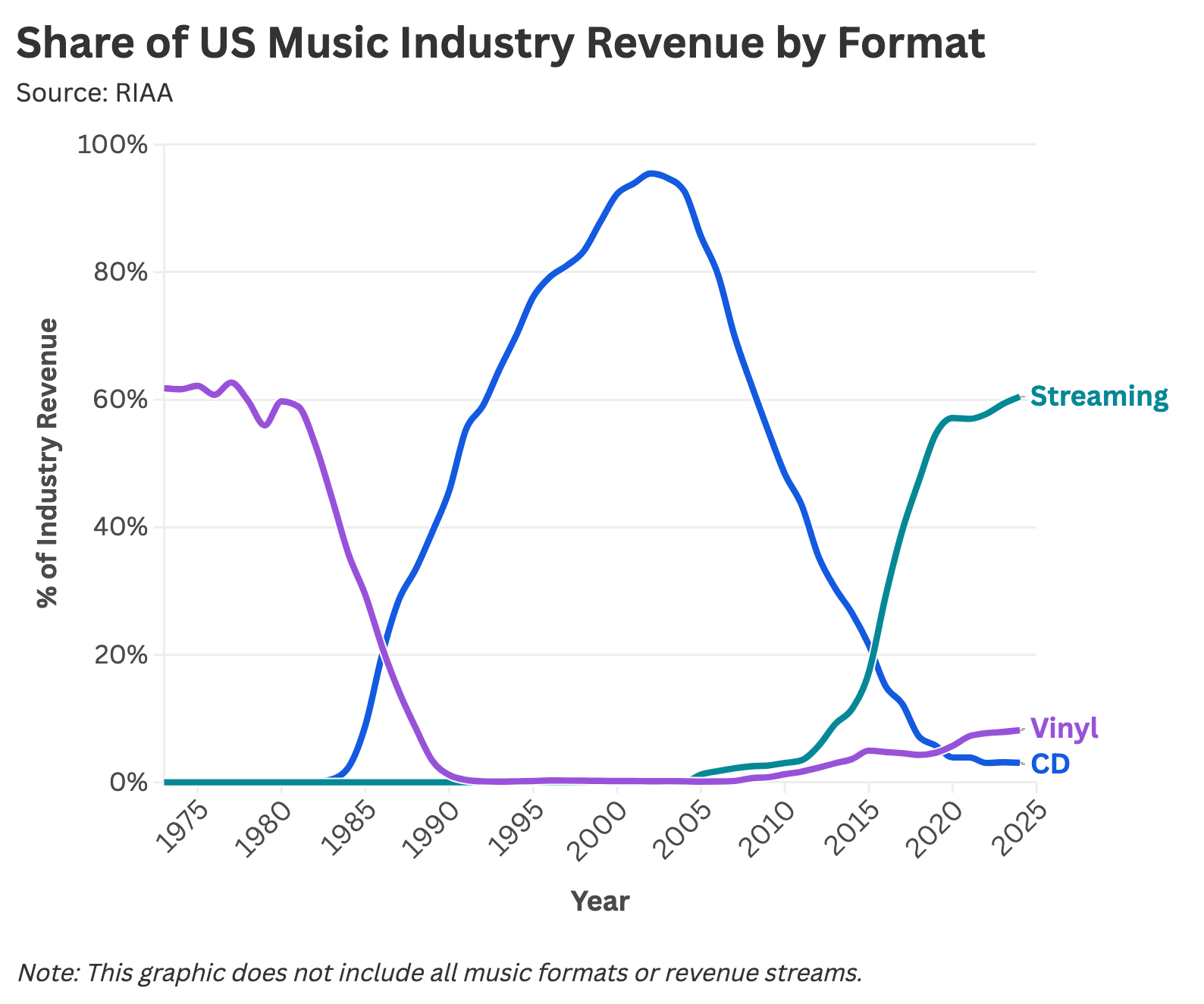
Looking at this graph, you may be wondering where we go from here. CDs do not appear to be in the midst of an epic comeback, so how will I entertain you for the next five to ten minutes? Well, not so fast! If you squint really hard and zoom in on a hyper-specific section of the data, you’ll notice the slightest of trend breaks: around 2022, CD sales stopped their rapid decline.
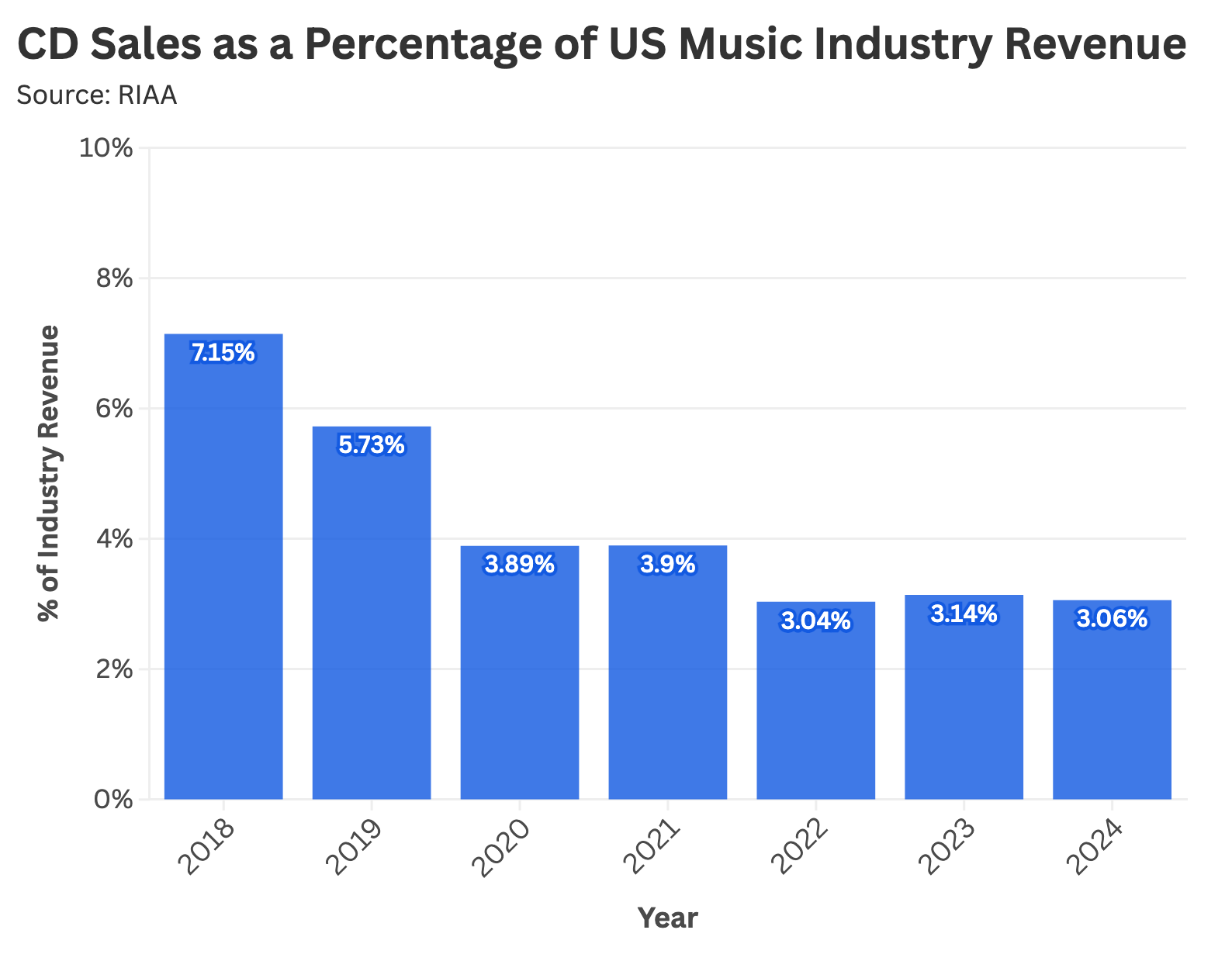
Media coverage of this nominal sales increase prophesied an imminent compact disc revival. The absence of overwhelmingly bad news is actually good news for physical media.
In fact, scattered across the interwebs are clues of an impending CD resurgence. If you had a corkboard and yarn, you could make a pretty convincing case for Big CD’s growing influence and the return of the Compact Disc Industrial Complex.

For example, Google search traffic for the term “CD Player” has begun increasing over the past 16 months, after two decades of precipitous decline.
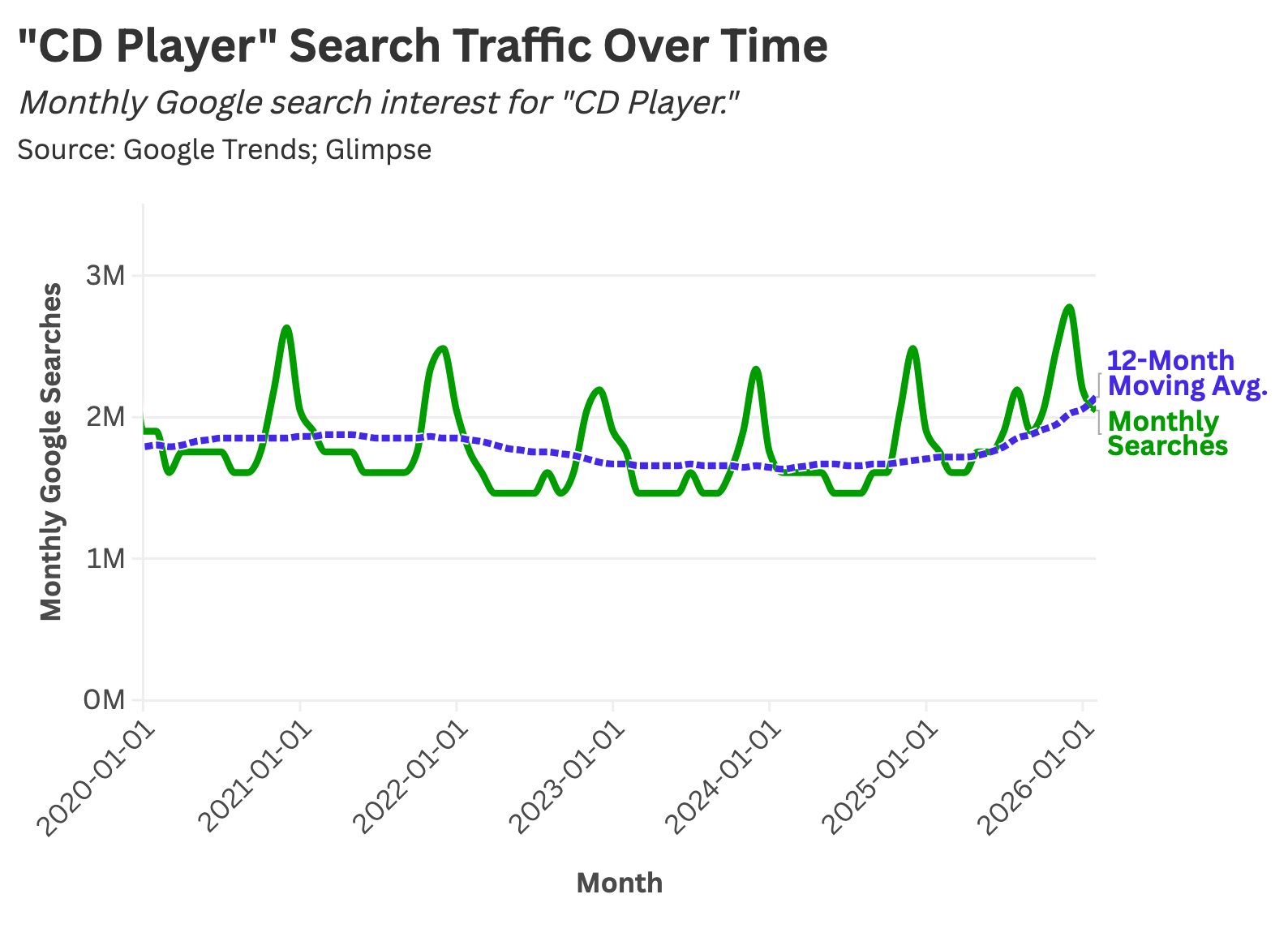
Is this a coincidence, or the first sign of a glorious resurrection?? Will this minor uptick disappear a few weeks after I publish this article?? Quite possibly.
But wait, there’s more! A recent YouGov poll found that Americans are more willing to pay for CDs than vinyl and online streaming—a datapoint that is complicated by the fact that real-life humans are more likely to pay for streaming and vinyl.
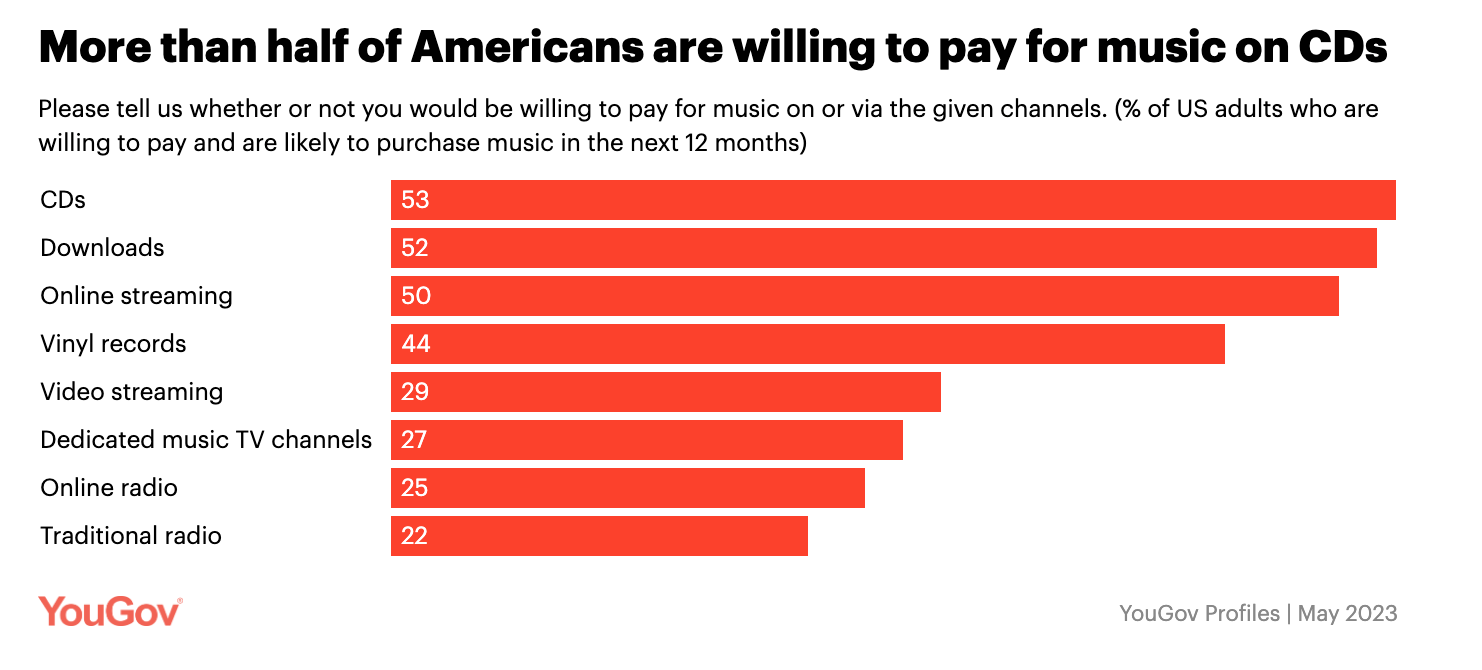
Who, exactly, are these hypothetical CD buyers?
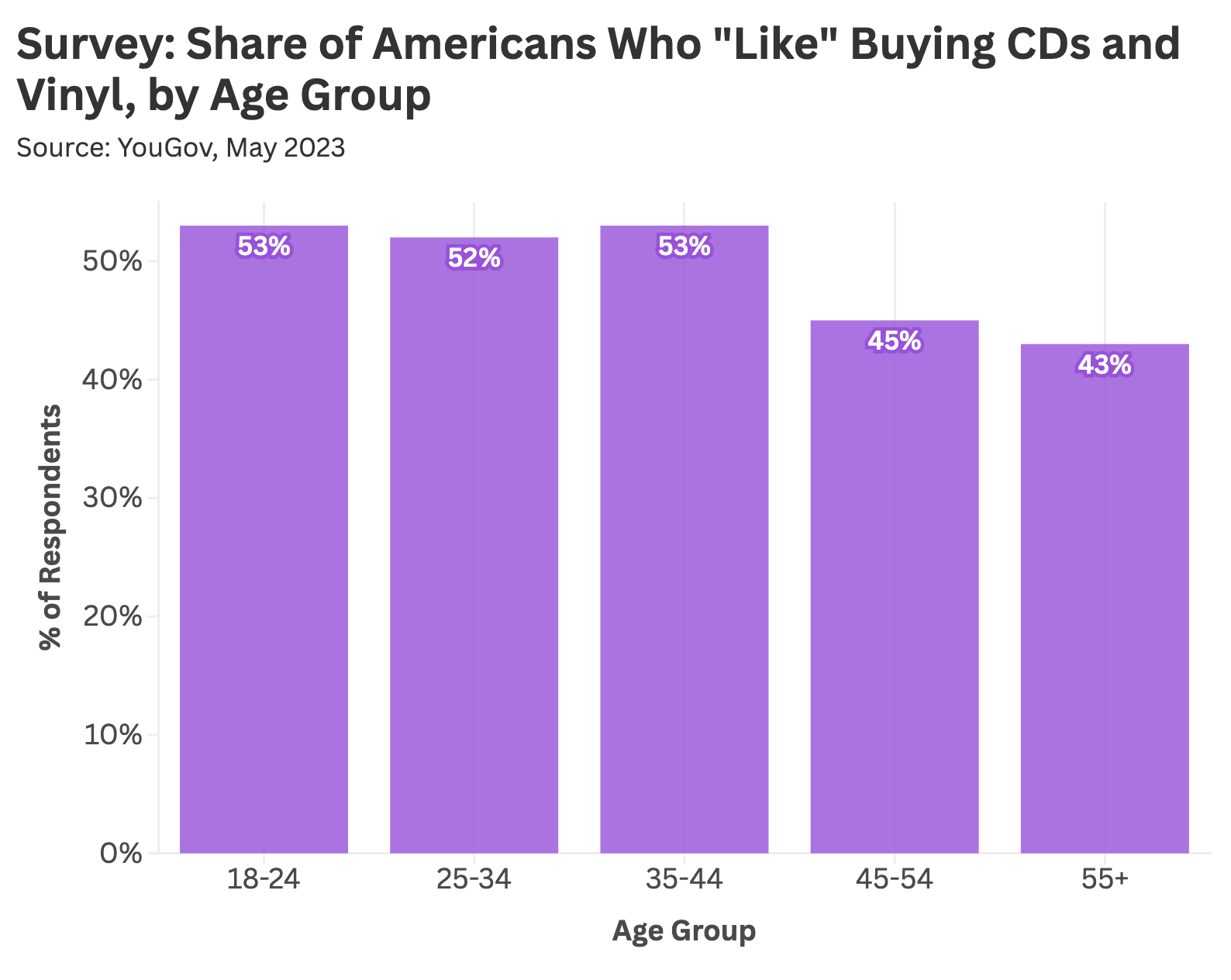
When the survey broke down preferences by generation, respondents under 45 years old were more likely to express interest in purchasing outdated formats. Said differently, those who did not live through the peak of physical media are now its most enthusiastic adopters.
Perhaps these generations do not understand what it’s like to listen to B-sides or spend $3,000 cultivating a music library that encapsulates the totality of one’s taste (versus paying $10 a month to Spotify for that same privilege).
While the consumer side of the equation shows some signs of a CD resurrection, the supply side does not. And by supply side, I mean the artists themselves. According to Discogs, vinyl remains the go-to format for physical releases, with no demonstrable reemergence for the compact disc (yet!!).
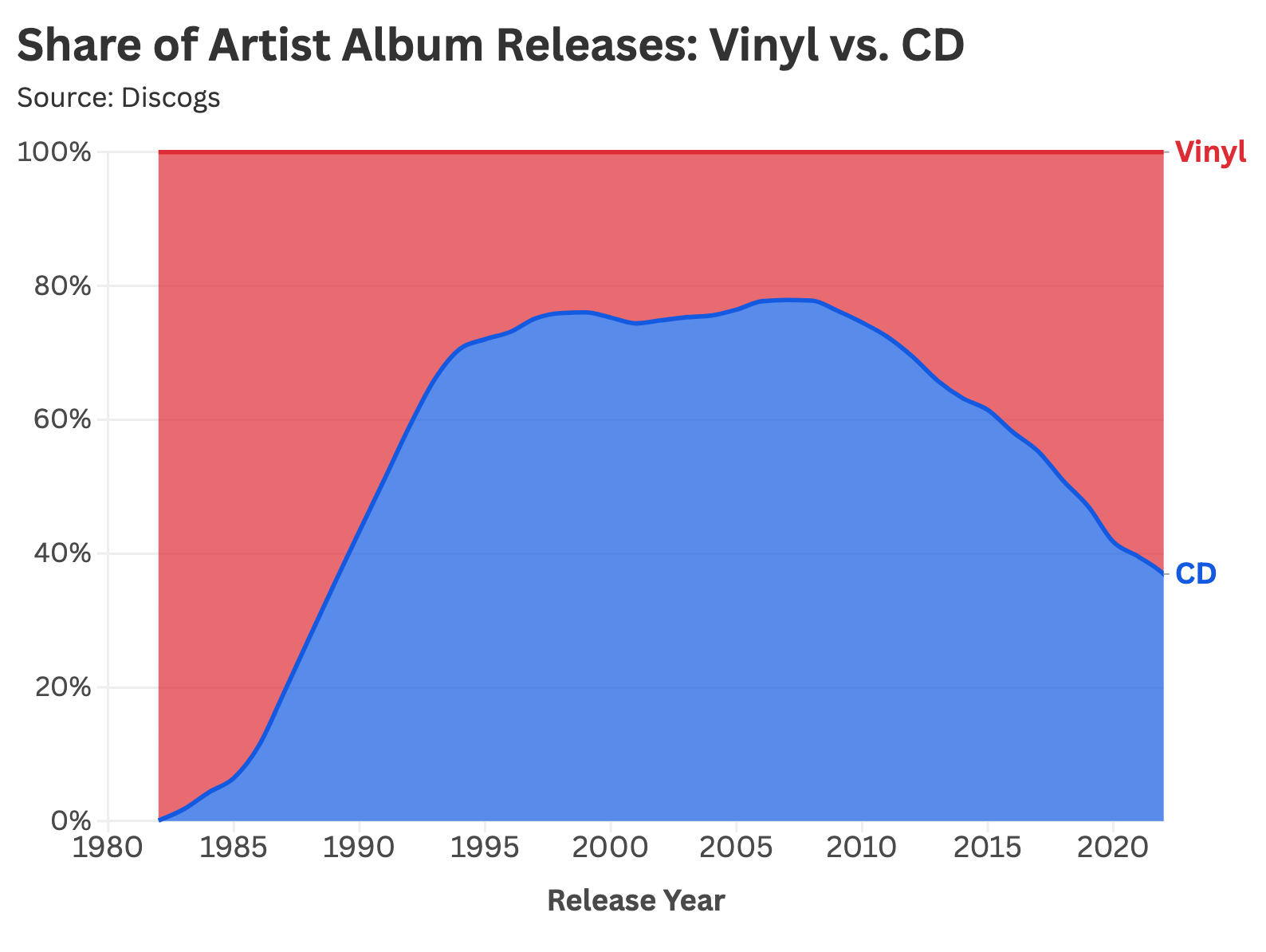
In practice, this means a music act with a modest or moderate following is more likely to release a vinyl than a CD.
So what does all this say about the future of CDs? The medium appears to be at a crossroads: primed for a slight reemergence or in the midst of a last gasp before commercial obsolescence. I genuinely have no idea how this will play out, so I will not forecast the medium’s prospects. And because I make no predictions, I will not be wrong. Five years ago, I would have prognosticated annual CD sales hitting near-zero, so consider my abstinence a relative improvement.
Enjoying the article thus far and want more data-centric pop culture content?
Final Thoughts: Everybody Loves an Underdog
There are several aspects of the 1998 rom-com You’ve Got Mail that have not aged well. Yet on a recent rewatch, what stood out most was the David-and-Goliath struggle between an evil corporate bookstore (a stand-in for Barnes & Noble) and a local bookshop on the Upper West Side.
Today, people are happy to cheer for both the local bookshop and the corporate megaseller. Against all odds, Barnes & Noble has been recast as a scrappy upstart, with media coverage celebrating the modest revival of a chain that helped drive thousands of independent bookstores out of business in the 1990s.
Like Barnes & Noble or Waterstones, CDs have inexplicably taken on the mantle of music industry underdog, an absurd role reversal when you consider the medium’s commercial dominance:
At the peak of the CD era, annual US music revenues reached $27B (inflation-adjusted)—roughly $10B higher than total sales in 2024. More than two decades later, the industry is still clawing its way back to this commercial high point.
CDs were significantly more expensive than every format that came before them. Record labels and distributors justified the higher price by pointing to increased storage capacity (more songs) and the convenience of track-skipping.
Somehow, the music industry convinced long-suffering consumers to invest in yet another medium. People had to ditch their turntables and tape decks for CD players.
After all this spending and inconvenience, CDs have inexplicably been reframed as the little engine that could. How is this possible?
The most obvious explanation is that people instinctively root against market leaders. Facebook was celebrated when it overtook MySpace, Tesla was praised as a challenger to the auto industry, and Netflix was embraced in its fight against Blockbuster. Once these companies became dominant, that support largely dissipated. The same dynamic applies to Spotify and music streaming. Anything that is not Spotify is suddenly good: I would happily root for iTunes if it ever experienced a resurgence, despite this platform being owned by the most valuable company on planet Earth. Everybody loves an underdog, even if that underdog once thrived on vanquishing other underdogs.
But the appeal of discarded trends goes beyond commercial cyclicality or class resentment. Many of these cultural revivals are the simple product of nostalgia. A bookstore or music medium becomes an avatar for an outdated way of life, and is subsequently imbued with greater meaning. When I was a kid, my friends and I played hide-and-seek at our local Barnes & Noble every week, and so for reasons entirely unrelated to books, I’ll forever root for this faceless corporation.
The same logic applies to CDs: many people’s happiest moments are tied to the compact disc (even if it was the music, not the medium, that mattered at the time). Some long for lazy afternoons digging through CD stacks at Tower Records or Sam Goody (now-defunct music stores). Others miss the ritual of putting on a CD and listening to Now That’s What I Call Music 25 in its entirety. And some are simply nostalgic for a time they never knew: when culture was tangible, and people owned the art that they consumed (instead of leasing it from the cloud).
Our disdain for commercial hegemony and longing for bygone cultural experience is a palpable mix. Whether these forces can resurrect the once-dominant-now-lowly compact disc is anyone’s guess.
Enjoyed the article? Support Stat Significant with a tip!
If you like this essay, you can support Stat Significant through a tip-jar contribution. All posts remain free; this is simply a way to help sustain the publication. You can contribute with:
A Recurring Donation:
*Note: For best results, open this link in a web browser while logged in to your Substack account.
Want to promote your data tool or media publication to Stat Significant’s 24,800 readers? Email daniel@statsignificant.com
Need help with a data problem? Book a free data consultation
Connect with me on LinkedIn if you want to chat about a data project.
Like movies? Follow me on Letterboxd
Gen Z and physical media lover here. Aside from wanting to own my music forever, I’m much more inclined to buy a cd over a vinyl because a) it’s much cheaper, and b) I can use it in more places. I can buy a cd at the thrift store for $2 or $3 and then listen to it in my car on the way home. I can also burn my own cd mixtapes, which I couldn’t do for vinyl.
CDs are better quality than streaming or vinyl. And I can get them cheaply from charity shops.