

Welcome to the Monday Roundup!
A weekly bonus edition featuring data-driven culture stories, curated datasets, and recommended reads. Note: Your regular Wednesday essay remains free for all readers.
This week: six original data stories exploring the ever-earlier arrival of Christmas music, a pumpkin spice recession, Letterboxd’s potential buyers, Barbie’s decline, the cities most celebrated in popular music, and a record-breaking CEO payday—plus notable reads and 10 public datasets. Free readers get the first two stories; paid subscribers get everything.
Trend 1: Is “The Holiday Season” Starting Earlier?
In theory, “the holidays”—as in Thanksgiving and Christmas—should amount to a handful of bank closures and vacation days. Yet these individual celebrations have slowly become a sprawling holiday season that keeps expanding across the calendar.
Each year, the holiday season begins a little earlier, as measured by our appetite for Christmas music. According to the data, the festivities now kick off immediately after Halloween. Since 2020, Christmas songs have begun appearing on the Billboard Hot 100 as early as November 1st.
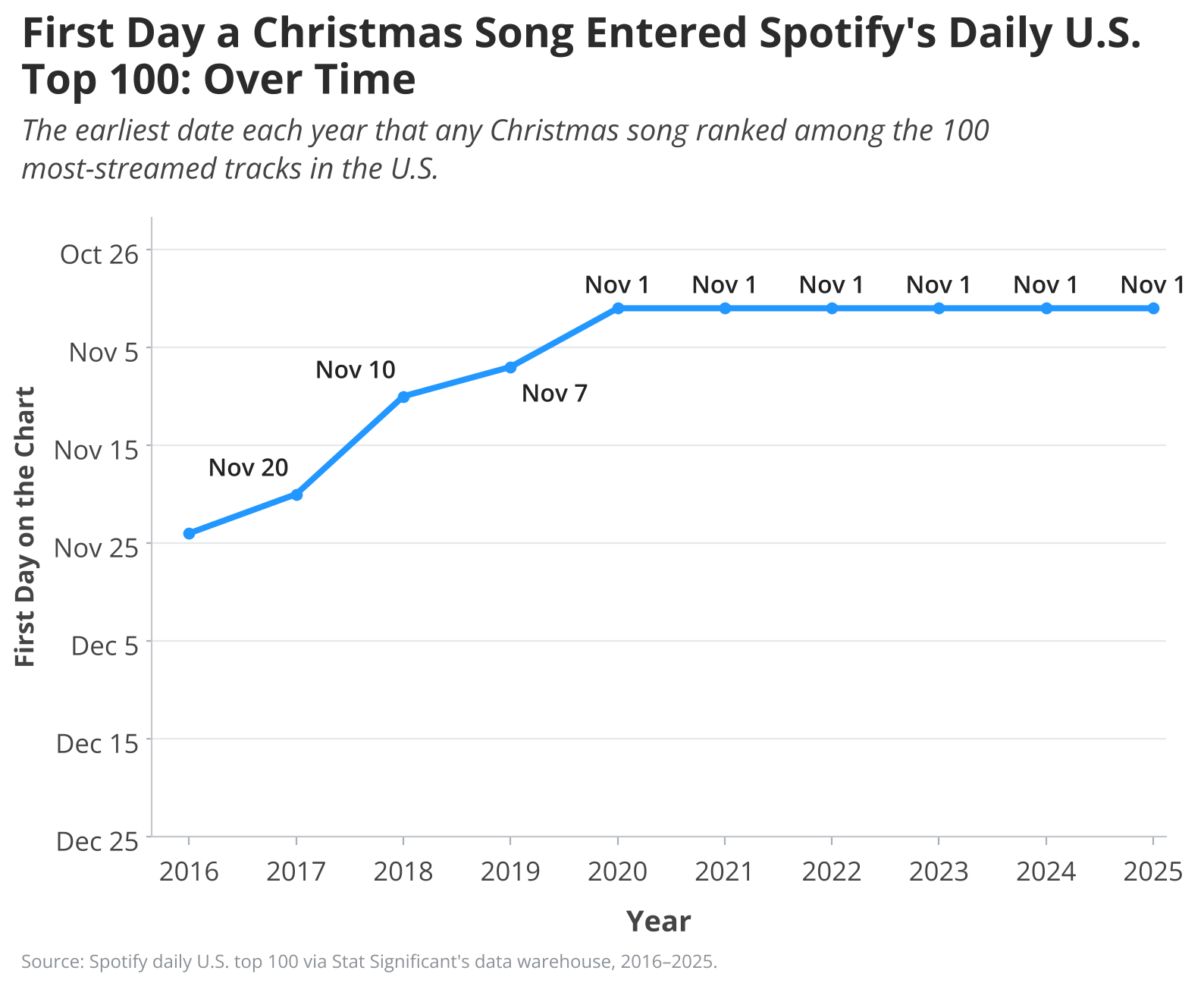
This gives us a sense of when people begin dipping their proverbial toe into the holiday season. But equally fascinating is the scale of this shift. Looking at the number of Christmas songs entering Spotify’s Top 100 each year, we see an ever-growing collection of holiday classics dominating the charts earlier and earlier.
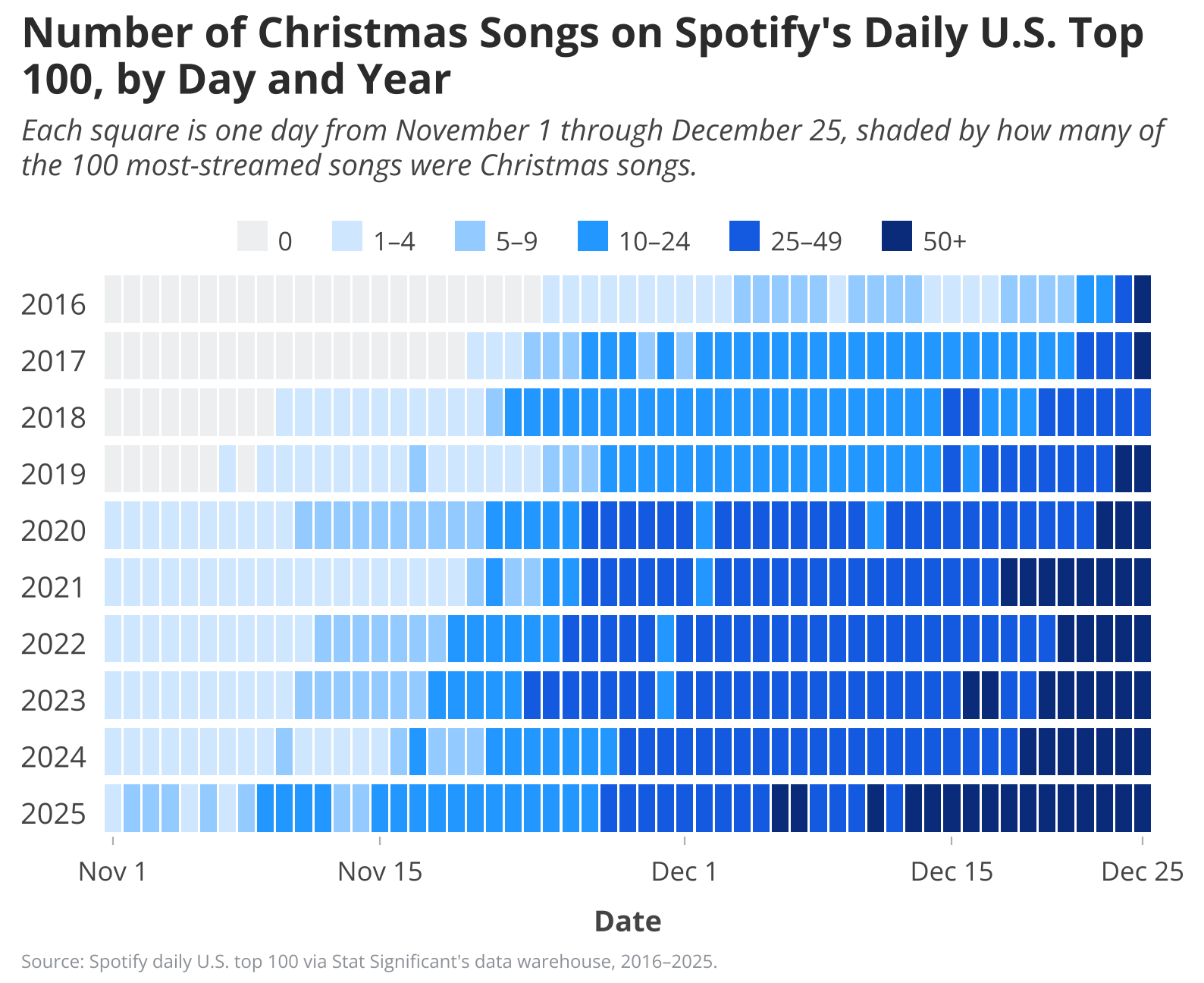
I have always viewed the holiday season’s gradual expansion across the calendar as an optimization problem. The holidays derive their magic from scarcity; after all, the entire year can’t be one giant celebration. At the same time, people seem perfectly content to exist in a perpetual state of festivity and consumption. Somewhere between these competing impulses lies an optimal balance of scarcity and celebration, and for the moment, we seem to have settled on November 1st as the starting point.
Trend 2: A Pumpkin Spice Recession
Sometimes, you turn to the media to make sense of our chaotic world—to better understand others’ suffering and what you might do to make even the smallest difference. And sometimes, you come to a newsletter, and you read about pumpkin spice lattes. This story falls squarely into the latter category.
October is upon us, which means gourds of all varieties will invade our lives, led by the ever-popular pumpkin spice. As with any seasonal consumption trend (like Christmas music), what was once quaint has now been co-opted by corporations that want to sell you more stuff.
In the case of pumpkin spice, that means this seasonal flavor is appearing on the menus of coffee chains like Starbucks earlier and earlier, now arriving in late August rather than early September.
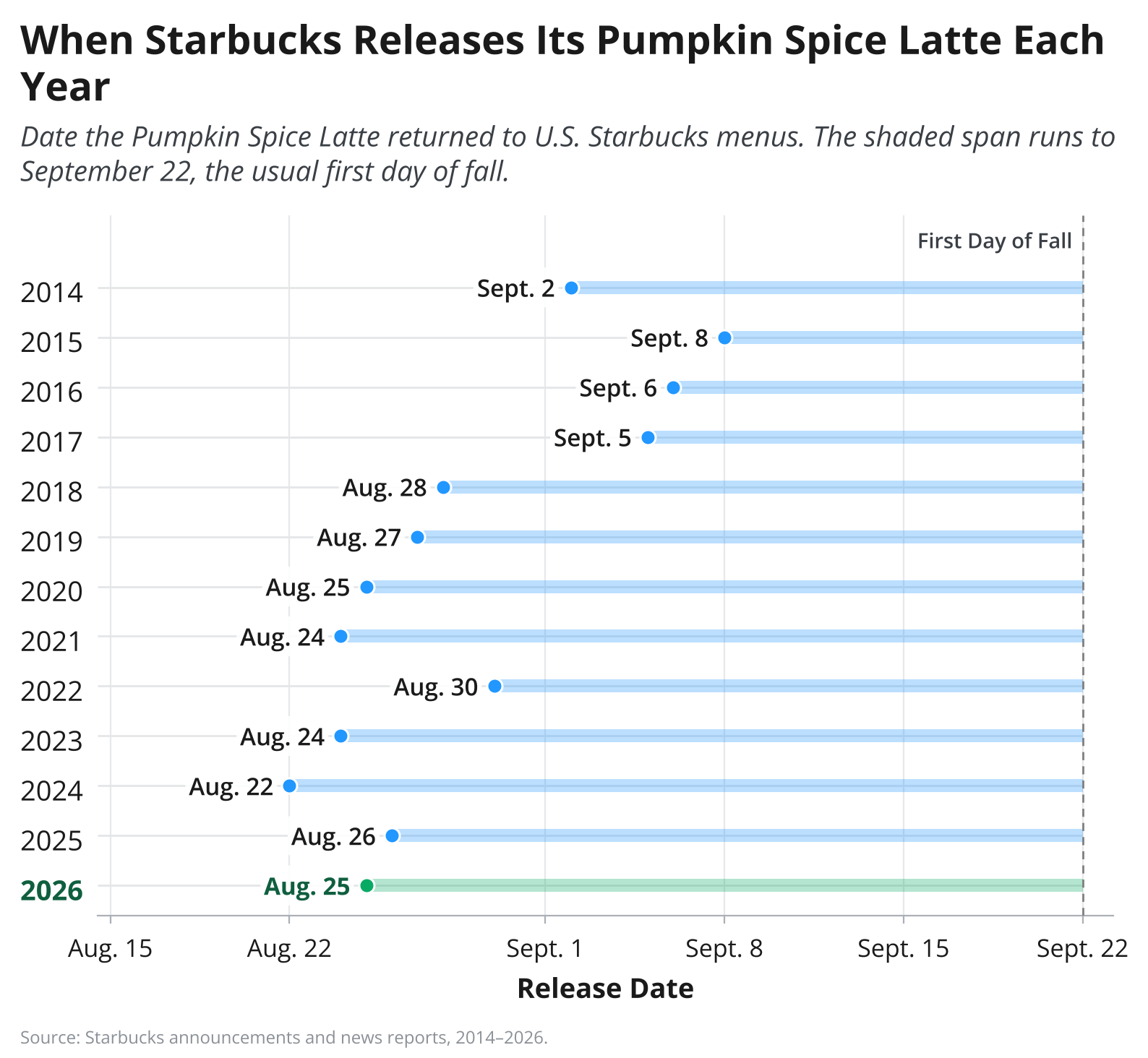
When corporations capitalize on a popular trend, the question becomes: will this organic cultural phenomenon lose its appeal when it’s no longer scarce?
At first glance, the answer appears to be yes. Google search interest in this reliably viral drink has declined since the mid-to-late 2010s. Once a popular search term in August, ahead of its seasonal launch, pumpkin spice no longer ranks as the most-searched latte that month.
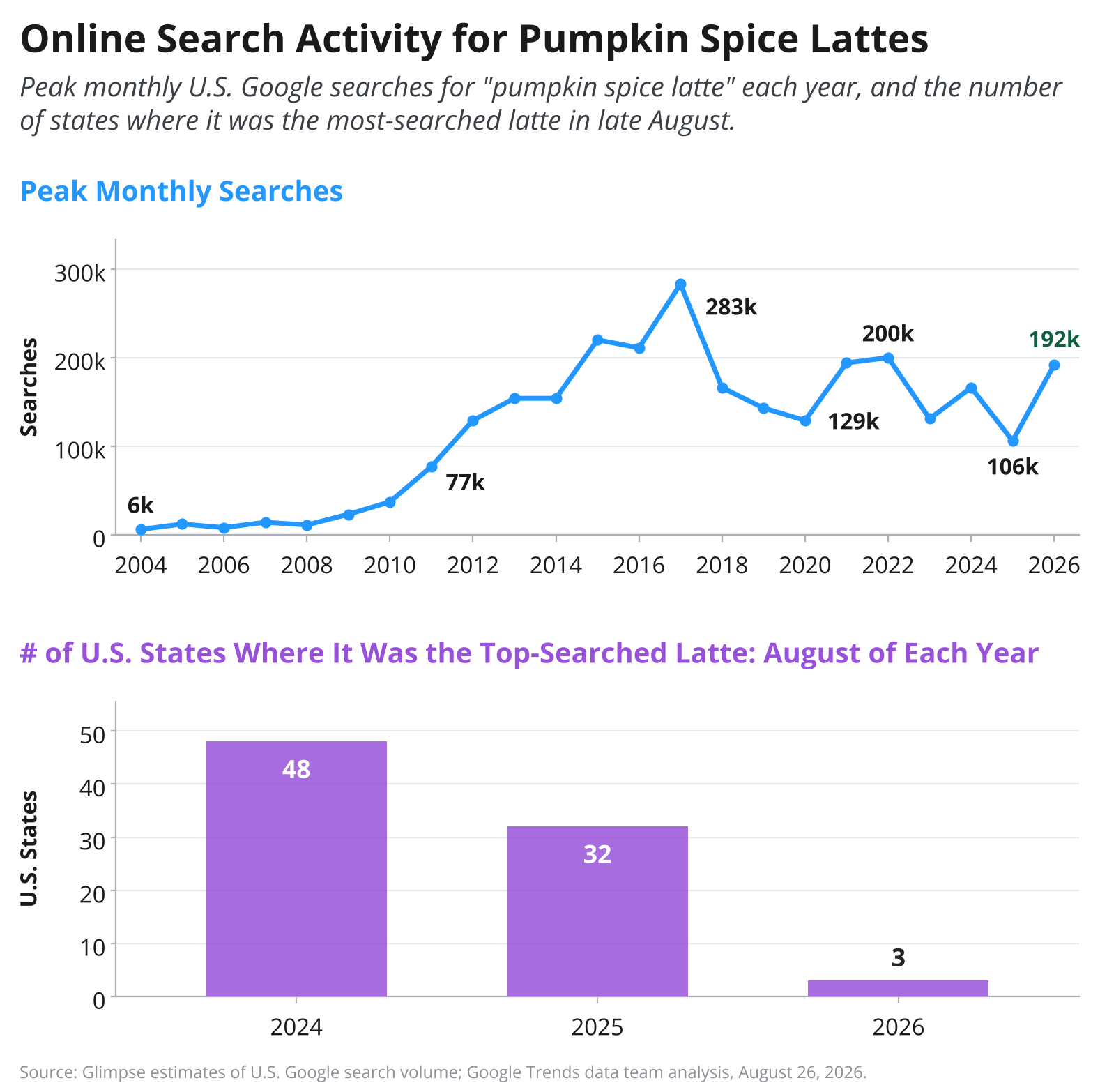
Pumpkin spice is no longer a novelty, which means it’s no longer special. Gone is the little rush of excitement that comes with buying your first pumpkin-infused beverage in September. Instead, we see the flavor appear on shelves in mid-August and think, “Oh, I guess fall’s around the corner.”
Trend 3: Who Will Acquire Letterboxd?
An investor consortium led by film financier G.G. Pritzker recently expressed interest in acquiring Letterboxd for more than $300 million, becoming the latest group of wealthy Hollywood insiders hoping to get their hands on the platform’s vast repository of reviews and its 35 million users.
At this point, reports of prospective Letterboxd buyers have started to resemble a game of Mad Libs. One week, it’s Netflix. The next, it’s The New York Times. Then A24, or some wealthy Hollywood financier you’ve never heard of. The list of potential suitors is almost endless.
So, for posterity’s sake, who are the key players in this bidding war, and, better yet, who is the odds-on favorite to acquire the cinephile social network?