

Welcome to the Monday Roundup!
The Monday Roundup is a weekly bonus edition featuring data-driven culture stories, curated datasets, and recommended reading.
Your regular Wednesday essay stays free for everyone—this is strictly additive.
Today’s edition has six new data stories. Free readers get the first two; paid subscribers get the full thing, plus datasets and recommended reading. Enjoy!
In Today’s Roundup:
Original Data Stories: Ed Sheeran’s brutal month, U.S. film onshoring, Apple TV’s post-Emmys momentum, a U.S. and UK musical decline, Paramount+’s critical disconnect, and Hollywood’s rising glass ceiling.
Recommended Reads: Notable data journalism and pop culture reads from around the web.
Unique Datasets: Ten publicly available datasets, covering everything from YouTube comments to musical instrument names.
Trend 1: Ed Sheeran’s Very Bad Month
Judd Apatow has a stand-up bit about the so-called “cancellation” of many of his former collaborators, including Russell Brand, James Franco, and Jonah Hill. According to Apatow, he himself cannot be canceled because he doesn’t leave his house often or do anything interesting. There’s an inherent paradox to this bit, since stand-up comedy is an extremely public activity. Still, the premise holds for most non-comedians, and I’m sure Ed Sheeran in particular wishes he had never left his house over the past month. Against all odds, Sheeran has managed to anger pundits across the political spectrum by dropping Macklemore from his tour following the rapper’s pro-Palestine comments at a recent performance.
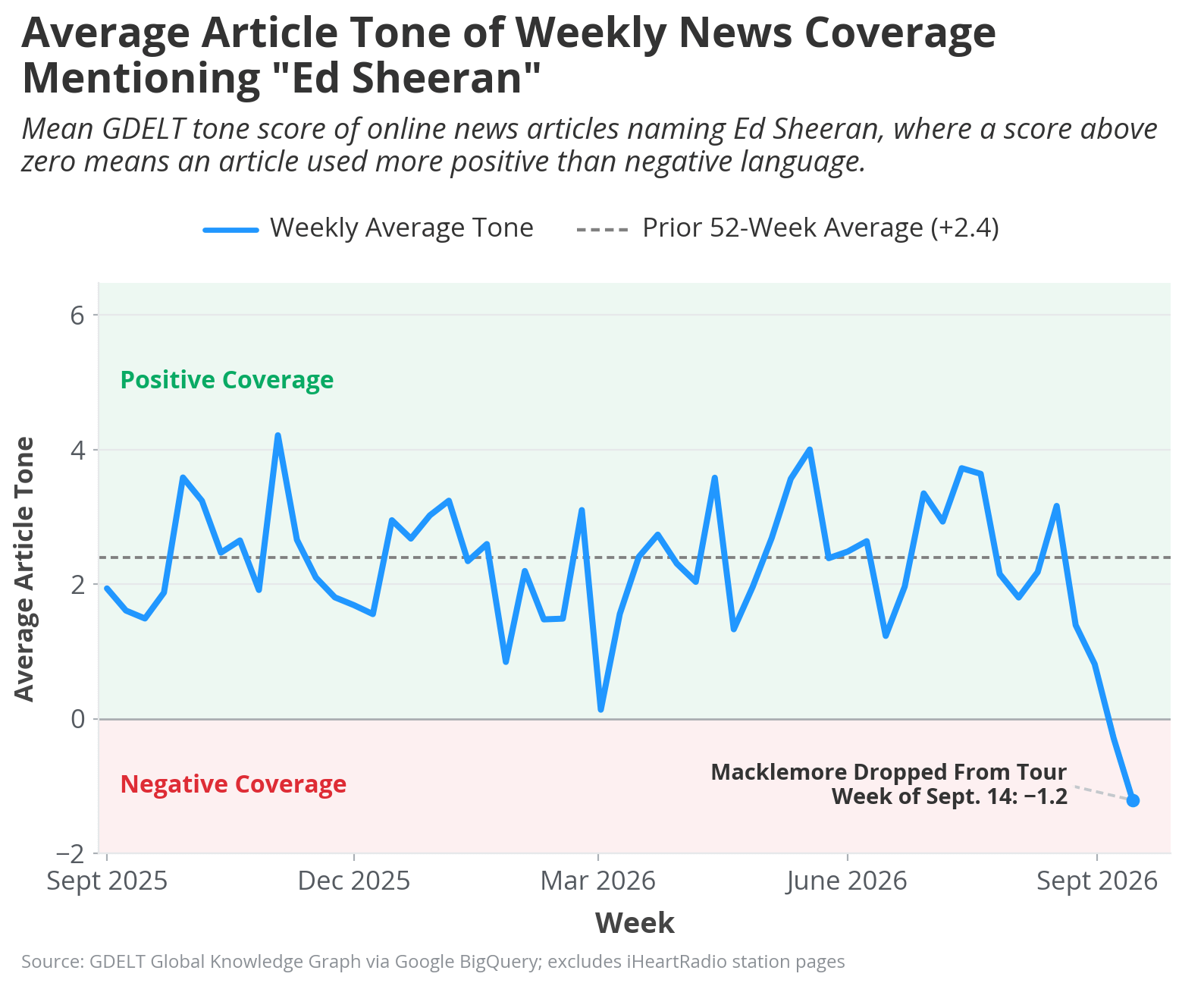
In fact, media coverage surrounding Sheeran, which typically qualifies as “standard industry stuff” or “boring,” has skewed radically negative over the last few weeks, as measured by article tonality.
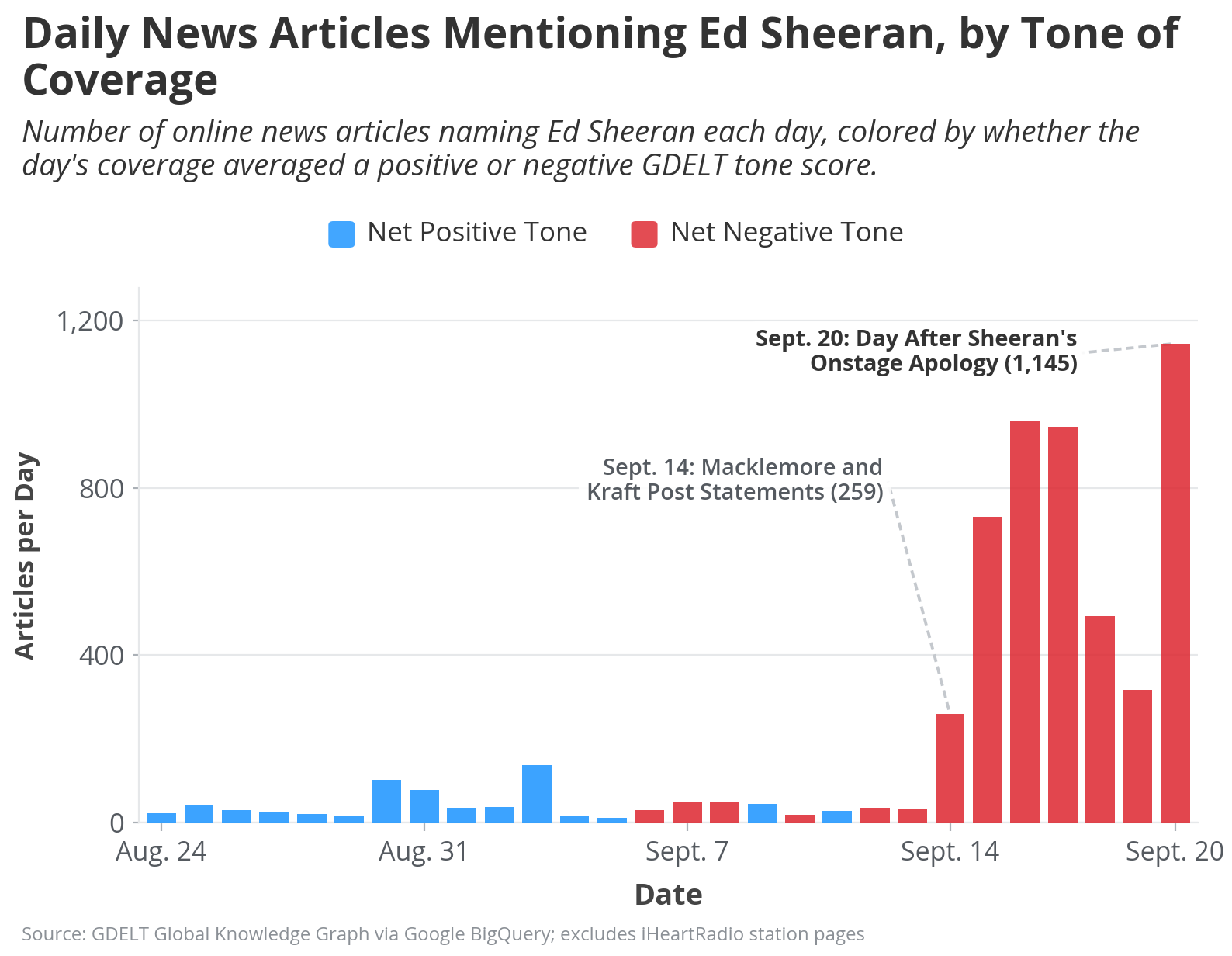
And this negative coverage continues to escalate as Sheeran and his supporters (like New England Patriots owner Robert Kraft) keep saying and doing the exact wrong thing. The sheer volume of hypercritical think pieces at the singer’s expense is almost impressive.
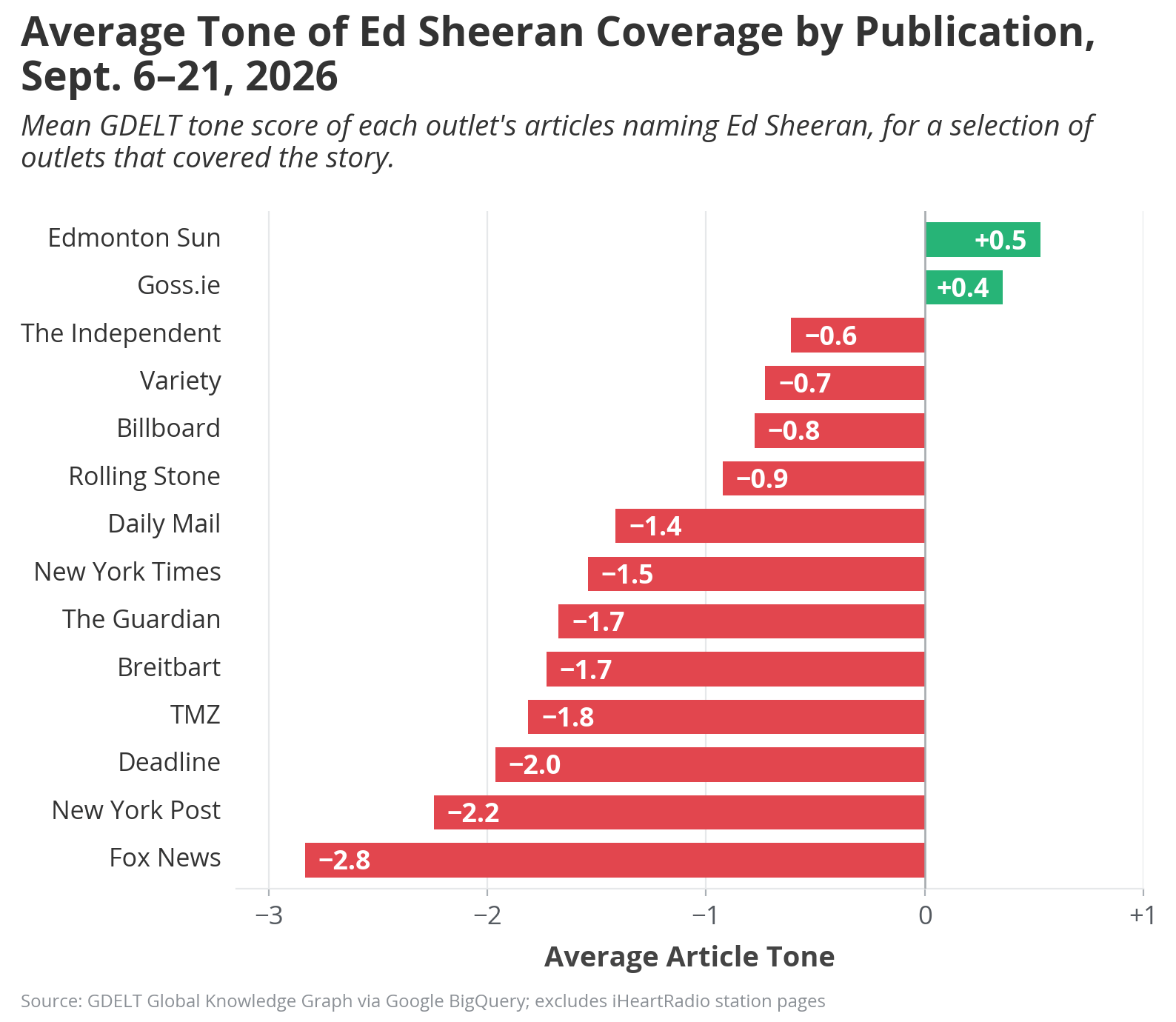
Media outlets of all ideological persuasions have joined together in this collective pile-on. In fact, the only publications to cover the singer positively are Goss.ie and the Edmonton Sun, two outlets that technically exist but play little role in international, national, regional, local, or neighborhood discourse.
Most celebrities would respond to this media onslaught by following Apatow’s advice: lay low for a few months and stay out of the public eye. Sheeran, however, has no such option, as he has nine more concert dates to close out his ongoing tour. The singer’s existence is bordering on Kafkaesque, as he is contractually obligated to leave his house and appear in public, even while serving as the focal point of an all-time media drubbing.
Trend 2: Onshoring U.S. Movies
A film production incentive bill is slated to be introduced in the U.S. House of Representatives within the next few weeks, aimed at keeping American movie shoots in America. The bill has surprising bipartisan support, even from Donald Trump, who has never been much of an ally to the film industry, despite his starring role in Home Alone 2: Lost in New York.
As of this writing, 121 active film and TV incentive programs exist worldwide, up from 86 in 2017. The U.S. is responsible for around 33% of these initiatives, all of them state- and county-level efforts.
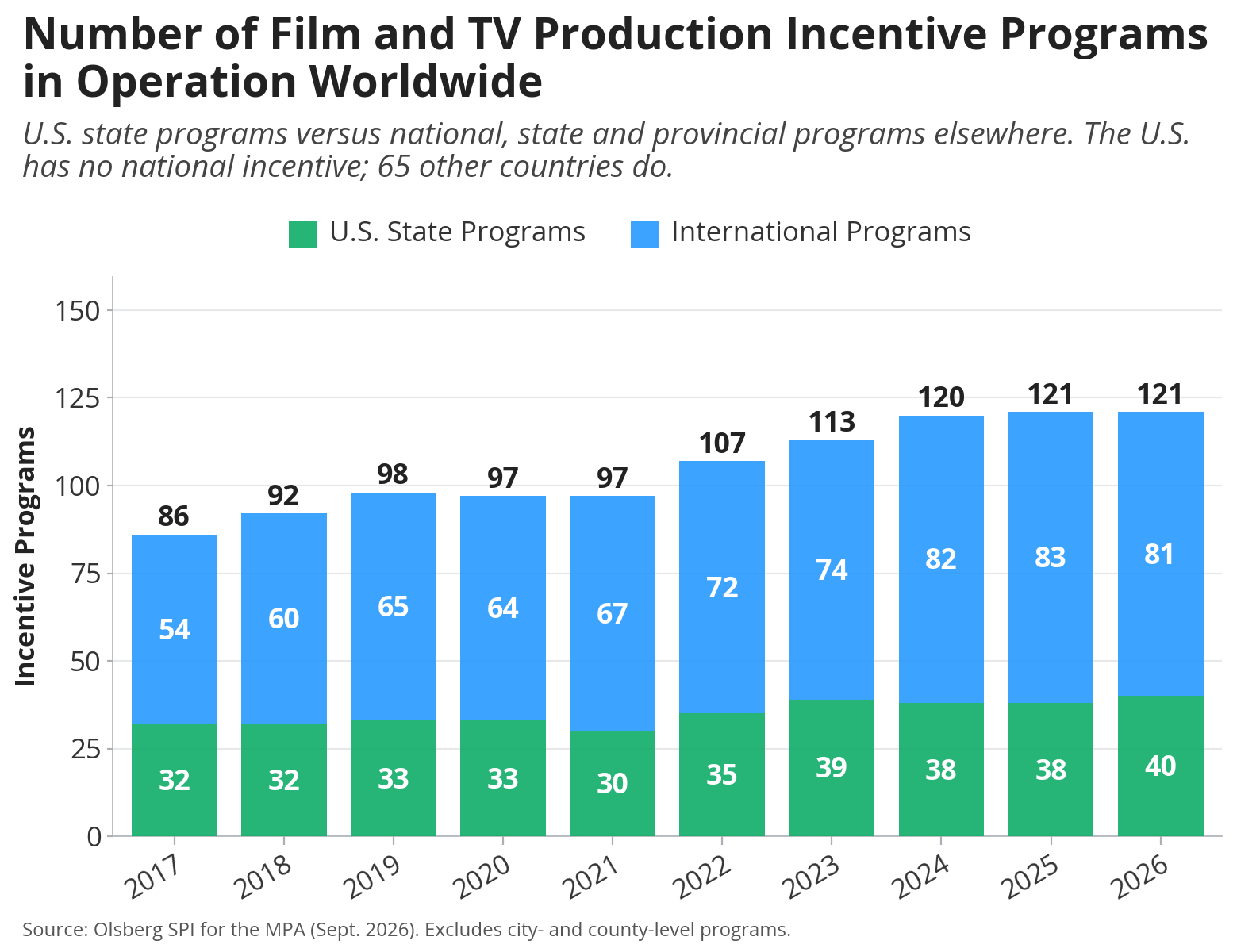
The proposed federal filmmaking tax credit would layer national subsidies on top of existing state-level benefits, meaning an established production hub like Georgia would be the primary beneficiary of this program, offering one of the most competitive cost-saving packages worldwide (based on current projections).
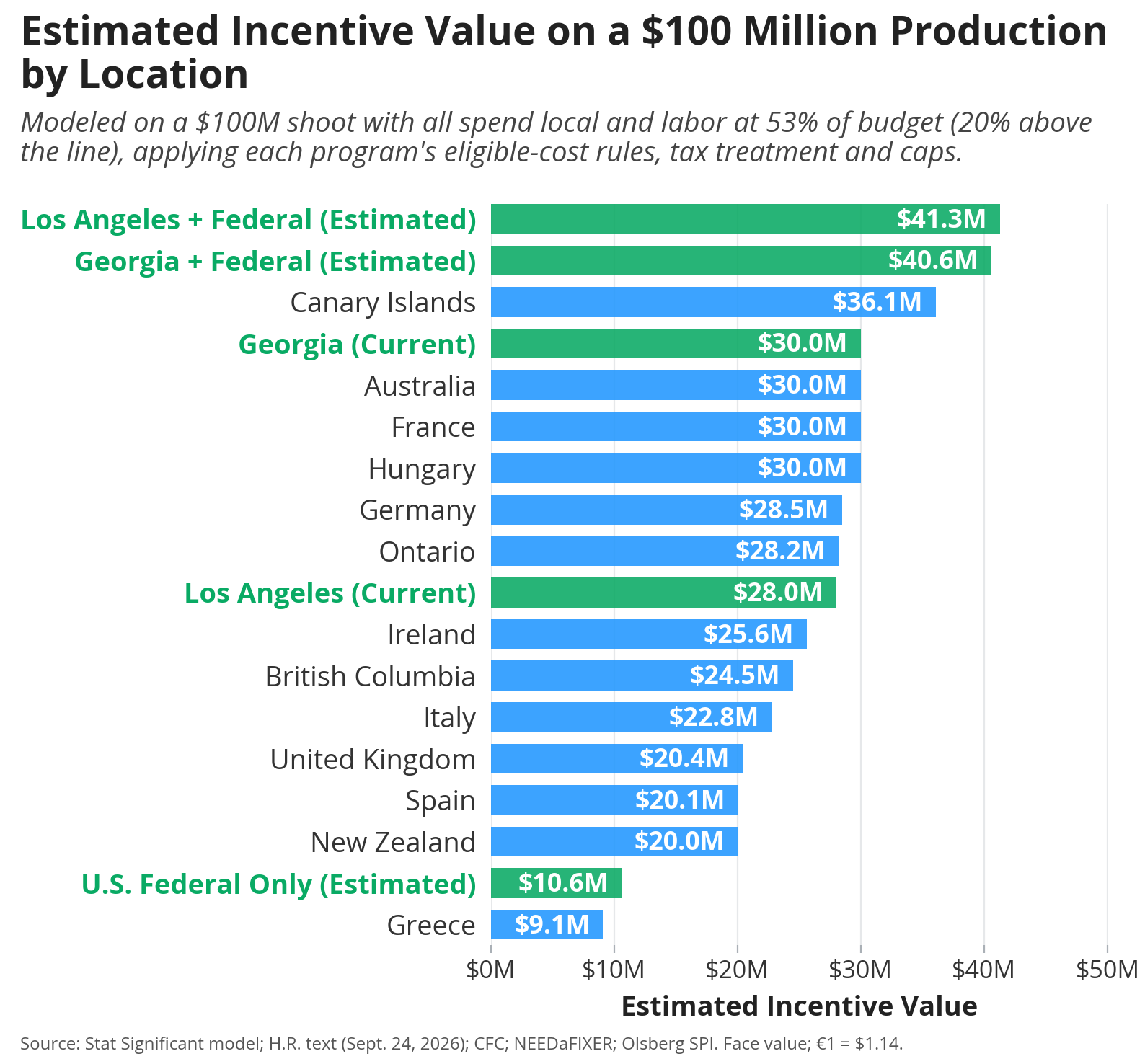
So if you were frustrated by films where Prague or Vancouver served as unconvincing stand-ins for New York, you can rest easy knowing Atlanta will soon become the de facto substitute for the Big Apple.
Trend 3: Apple TV = The New HBO?
A few weeks ago, I wrote a 2,000-word essay about Apple TV+, complete with nine graphics, that could just as easily have been a single sentence: the Silicon Valley streamer is producing great television, yet that hasn’t translated into meaningful TV market share. Since I published that piece, Apple has premiered a new season of Ted Lasso and dominated the 2026 Emmys, winning 28 primetime awards.
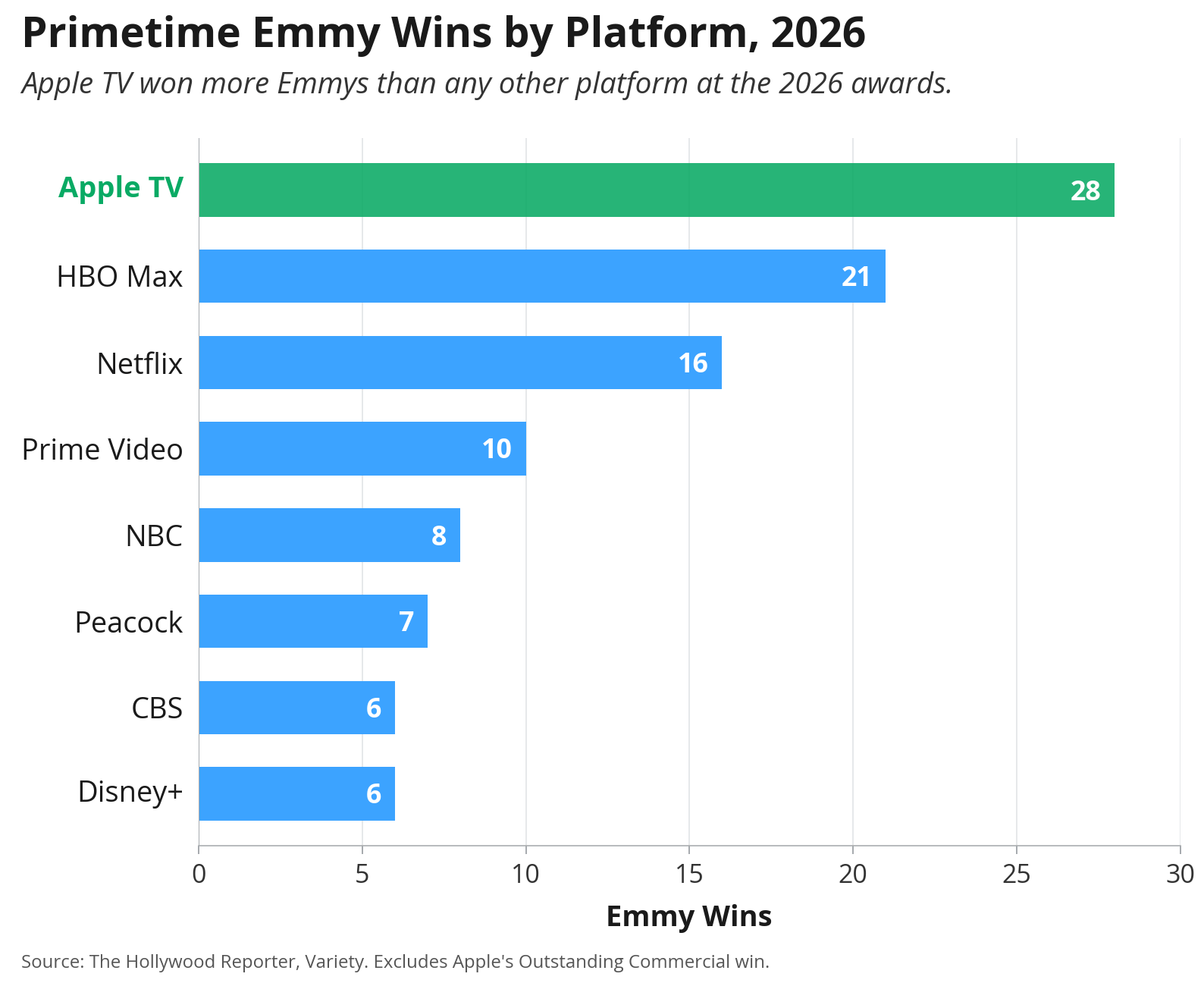
And so the question remains: have Apple’s admirable efforts translated into viewership?